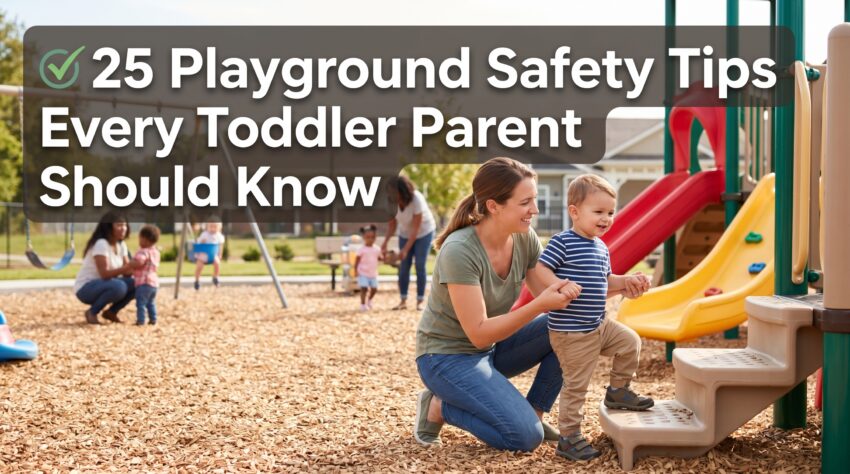
The biggest playground risks for toddlers are falls from equipment that is too tall for them, burns from hot metal and plastic surfaces in summer, and head or limb entrapment in gaps between 3.5 and 9 inches. Stay within arm’s reach the entire time, stick to the 2 to 5 section, test every surface with the back of your hand before your child touches it, and teach feet-first sliding from day one. Most serious playground injuries are preventable with the right habits before your toddler ever touches the equipment.
Your two year old climbed to the top of that platform in about eight seconds. You were right there, bag on the bench, water bottle in the cupholder, and by the time you looked up she was standing at the top of a slide designed for a seven year old, grinning at you like she had just summited Everest.
That’s how fast it happens. One moment of inattention. One section of the playground that wasn’t gated off from the big-kid area.
Playgrounds are one of the best things for toddlers. Climbing builds strength and coordination. Swinging teaches balance. Running on uneven surfaces is exactly the kind of physical challenge their developing bodies need. But toddlers move faster than they think, and they have no concept of height, speed, or what happens when their foot slips on a wet rung.
I’m not here to make you paranoid about the park. I’m here to give you 25 specific habits that keep the trip fun instead of ending it in urgent care.
1. Find the 2 to 5 Section First
Most well-maintained playgrounds separate equipment by age: the 2 to 5 section and the 5 to 12 section. The toddler section has lower platforms (usually under 4 feet), wider steps, bucket swings, and shorter slides with sides that come up higher.
Head straight there. Do not let your toddler wander to the big-kid side “just to look,” because they will climb something before you finish that thought.
Trade-off: Toddler sections are often smaller and less exciting, so around age 3 many kids start pulling toward the taller structures. Let them explore the bigger side only when you can stay within arm’s reach the entire time, and only on equipment where a fall would land on surfacing, not concrete.
Practical note: Not every playground labels its sections. If there’s no sign, look at the platform height. If the lowest platform is above your toddler’s chest, the structure was not designed for them.
2. Do a 60-Second Safety Scan Before They Play
Before you let go of their hand, take one lap around the equipment. You’re looking for four things: broken parts (cracked plastic, missing rungs, wobbly rails), sharp edges or exposed bolts, the ground surface, and objects on the ground that should not be there.
This takes less than a minute. It saves you from discovering a jagged bolt with your child’s palm.
What goes wrong the first time: You skip the scan because the playground looks fine from the parking lot. The broken rail is on the back side of the structure, where you can not see it from the bench.
3. Check the Ground Surface
The surface under the equipment matters more than almost anything else on the playground. Falls are the leading cause of playground injuries, and the surface is what determines whether a fall is a scare or a fracture.
Safe surfaces: rubber pour-in-place mats, engineered wood fiber (not regular mulch), sand that is deep enough (at least 9 inches), rubber tile, and shredded rubber mulch.
Unsafe surfaces: concrete, asphalt, packed dirt, thin grass over hard ground, and brick pavers.
If the playground surface is concrete or hard-packed dirt underneath the climbing structures, find a different playground. That is not overcautious. That is the single biggest factor in serious fall injuries.
Practical note: Wood chips compress and scatter over time. If you can see bare ground through the chips under the climbing area, the fill is too thin to absorb impact the way it is supposed to.
4. Test Every Surface Temperature With Your Hand
This one saves you a trip to the pediatrician for burns, especially June through September.
Press the back of your hand against the slide surface, the metal handrails, and any platform that sits in direct sun. Hold it there for three full seconds. If you can not keep your hand on it, your toddler can not sit on it, grip it, or walk across it.
Metal slides and dark-colored plastic can reach temperatures above 150°F in direct afternoon sun. That will burn a toddler’s legs, hands, or feet on contact.
Best times to avoid burns: Go before 10 am or after 4 pm during summer months. If you have to go midday, look for a playground with shade structures over the equipment, or stick to the shaded side.
Practical note: I learned this the hard way on a July afternoon. My daughter sat down on a black plastic slide and stood right back up crying. The slide had been in full sun for three hours. Now I test every surface she is going to touch, every single time, no exceptions. It takes ten seconds.
5. Stay Within Arm’s Reach, Not Bench Distance
“I was watching” is not the same thing as “I was close enough to catch her.” Toddlers fall without warning. They step backward off platforms. They lean too far over railings. They try to climb down something headfirst.
You need to be close enough to physically catch them or steady them before the fall happens. That means standing next to the equipment, not sitting on a bench 20 feet away.
Trade-off: This means you’re standing the whole time. You’re not reading, not scrolling, not having a long conversation with another parent while facing the other direction. It’s tiring. It’s also the single most effective thing you can do to prevent injuries.
Ages this changes: By age 4 or 5, most kids have enough coordination and judgment for you to step back a little. At 2 and 3, arm’s reach is the rule.
6. Skip the Monkey Bars and Tall Climbing Walls
Monkey bars require upper-body strength and grip endurance that most toddlers do not have. Their hands are small, their grip tires in seconds, and they will let go mid-swing from a height that can break an arm.
Tall rope-climbing walls and vertical ladders are the same story. If the equipment requires your child to support their full body weight by their hands, it is not for a toddler.
When they’re ready: Most kids develop the grip strength for monkey bars around age 5 or 6. Some strong climbers can manage at 4 with spotting. If your 3 year old insists on trying, stand directly underneath with your hands ready, and let them try the first rung only.
7. Teach Feet-First Sliding From Day One
Every time, every slide, no exceptions: sitting upright, feet facing forward. Not on their belly, not headfirst, not backward, not standing.
Headfirst sliding is how toddlers get head and neck injuries. It is also how they learn the wrong habit for the bigger, faster slides they will use later.
How to teach it: Walk them to the top of the slide, sit them down, put their hands on the sides, and say “feet first.” Do it the same way every single time. Toddlers learn by repetition, and they will test you on this one.
8. Never Go Down the Slide With Your Toddler on Your Lap
This one surprises most parents, but it is one of the most important tips on this list.
When a toddler rides down on an adult’s lap, their foot can catch on the slide’s edge or side wall while the adult’s weight and momentum keep pushing them forward. The result is a twisted or broken leg, usually a tibial fracture. This injury is common enough that pediatric emergency rooms see it regularly.
Your toddler should always slide independently. Stand at the bottom of the slide and let them come to you. If they are too scared to go alone, they are not ready for that slide yet.
9. Use Bucket Swings Only
Bucket swings (the ones with leg openings and a high back) are the only appropriate swings for toddlers. Regular flat swings do not provide enough support, and a toddler can slide off mid-swing and land on the back of their head.
How to use them safely:
- Make sure your toddler fits snugly in the bucket. If they can slide their hips through the leg openings, the swing is too big.
- Teach them to hold both chains with both hands.
- Push gently. Toddler swings do not need height. A gentle arc is all they need.
- Never let them try to climb in or out of the bucket swing by themselves. Lift them in, lift them out.
What goes wrong: The toddler leans sideways or tries to turn around in the bucket. If the fit is loose, this can tip them forward and out. Snug fit plus both hands on chains is the rule.
10. Teach the Swing Danger Zone
Moving swings are one of the most common injury sources on a playground, and usually the victim is a toddler who walked in front of or behind a swinging child.
Teach your toddler the rule before you get to the playground: “We never walk in front of the swings.” Then enforce it every visit. Walk them around the back side of the swing set, not through the swing area, every time you cross the playground.
Realistic expectation: A two year old will not remember this rule on their own. You have to physically redirect them every time for months. By 3 or 3.5, most kids start to remember, but you still need to watch for it.
11. Watch for Head and Limb Entrapment Gaps
This is the one most parents never think about. Gaps in guardrails, between slats, or between a platform and a slide opening can trap a toddler’s head or limbs.
The danger range is any opening between 3.5 inches and 9 inches. A toddler’s body can fit through, but their head can get stuck. Below 3.5 inches, nothing fits through. Above 9 inches, the head passes through too.
Before your toddler climbs anything, look at the gaps between railings, the space between the platform and the slide entrance, and any V-shaped openings where two parts of the structure meet. If you can fit your fist through a gap but not your head, that gap is in the danger zone.
12. Check for Loose Bolts, Sharp Edges, and Rust
Run your hand along the railings, check the bolts on stairs and platforms, and look for rust where metal parts connect.
Specifically look for:
- Bolts that protrude more than two threads past the nut (they catch skin and clothing)
- S-hooks on swings that are not fully closed (fingers get caught)
- Rust where chains meet metal (weakened, and rust cuts are nasty)
- Cracked or splintered wood on older structures
- Plastic that has cracked from sun exposure with sharp edges exposed
If the equipment is in bad shape, leave. Report it to your city’s parks department. It takes two minutes to find the number.
13. Remove Helmets, Scarves, and Drawstrings Before Play
Bike helmets, scarves, hooded sweatshirt drawstrings, and any dangling cord or strap can get caught on playground equipment and create a strangulation hazard.
Take the helmet off before they get near the equipment. If they rode their bike to the playground, the helmet comes off in the transition. Tuck hoodie strings inside or tie them short. Skip scarves entirely.
This is not negotiable. Strangulation injuries from playground entanglement are rare, but when they happen they are catastrophic.
14. Put Them in Closed-Toe Shoes With Grip
Flip flops slip off on climbing rungs. Crocs without the strap up can slide. Bare feet get burned on hot surfaces and cut on debris. Smooth-soled shoes slip on wet metal.
Put them in sneakers or closed-toe sandals with a rubber sole and a secure fit. Shoes with tread that grips metal rungs are ideal.
The real reason this matters: A toddler’s foot slipping one rung while climbing is often how falls start. Good shoes do not prevent all falls, but they reduce the ones caused by poor grip.
15. Scan for Broken Glass, Animal Waste, and Sharp Objects
Before your toddler hits the ground running, look at the ground. Specifically check:
- Under the slide exit (glass collects here because it is sheltered)
- In the sandbox (cat and dog waste, buried sharp objects)
- Around benches (dropped food, cigarette butts)
- In tall grass bordering the play area (sticks, rocks)
Toddlers will pick up everything they find and put it in their mouth. That is not a maybe. That is a certainty. A two second scan of the ground saves you from fishing glass out of their hand.
Pick a Safety Tip in 30 Seconds
| Tip # | What It Covers | Biggest Risk It Prevents | When to Check |
|---|---|---|---|
| 1 | Age-appropriate section | Falls from equipment too tall or complex | Start of every visit |
| 2 | 60-second safety scan | Broken equipment injuries | Start of every visit |
| 3 | Ground surface | Serious fall injuries | Start of every visit |
| 4 | Surface temperature | Burns | Summer visits, sunny days |
| 5 | Arm’s reach supervision | All fall and entrapment injuries | Entire visit |
| 6 | Skip monkey bars | Arm fractures from falls | When child points at big-kid equipment |
| 7 | Feet-first sliding | Head and neck injuries | Every slide use |
| 8 | No lap sliding | Tibial fractures, twisted legs | Every slide use |
| 9 | Bucket swings only | Falls from flat swings | Every swing use |
| 10 | Swing danger zone | Struck by moving swing | Entire visit |
| 11 | Entrapment gaps | Head and limb entrapment | Start of every visit |
| 12 | Loose bolts and rust | Cuts, falls from failed equipment | Start of every visit |
| 13 | No helmets, scarves, drawstrings | Strangulation | Before entering play area |
| 14 | Closed-toe grip shoes | Foot slips causing falls | Before leaving home |
| 15 | Ground scan for debris | Cuts, choking on picked-up objects | Start of every visit |
| 16 | One at a time on stairs | Pushed off stairs or platforms | Entire visit |
| 17 | Wet and icy equipment | Slip-and-fall injuries | Rainy, dewy, or winter visits |
| 18 | Water and sunscreen | Dehydration, sunburn | Every outdoor visit |
| 19 | Fenced playgrounds | Toddler running into road or parking lot | When choosing a playground |
| 20 | Off-peak hours | Collisions with older kids | When planning the trip |
| 21 | Watch older kids | Knocked down, collisions | Entire visit |
| 22 | Social rules | Pushing and shoving injuries | Entire visit |
| 23 | ER warning signs | Missed serious injuries | After any fall or impact |
| 24 | Indoor playground differences | Germ spread, overcrowding injuries | Indoor visits |
| 25 | Post-playground routine | Tick bites, sunburn follow-up, hygiene | End of every visit |
16. Teach One-at-a-Time on Stairs and Platforms
Toddlers on playground stairs are a pileup waiting to happen. One child stops, the one behind bumps them, and somebody’s going over the side or tumbling back down.
Teach your child to wait at the bottom until the stairs are clear, hold the railing with one hand, and climb one step at a time. Same rule for platforms: one child at the top at a time, especially near slide entrances.
Trade-off: You will spend a lot of the visit saying “wait your turn.” It is repetitive, and other parents may not enforce the same rule. That’s fine. Your child learning to wait and hold the rail is what keeps them safe, regardless of what the kid behind them is doing.
17. Watch for Wet, Icy, or Dewy Equipment
Morning dew on metal climbing rungs is invisible and slippery. Rain-soaked wooden platforms are the same. Ice on any equipment is an obvious no, but morning frost on a cold slide is less obvious and just as dangerous.
If the equipment is wet, your toddler’s hands will slip on every grab and their shoes will slide on every step. They are still learning balance and coordination as it is. Adding a slippery surface to that equation is asking for a fall.
When to go anyway: If you arrive and the equipment is wet, wait 20 to 30 minutes for the sun to dry it off, or bring a small towel and wipe down the slide and handrails yourself. That actually works, and other parents will thank you for it.
18. Bring Water and Use Sunscreen, Even on Cloudy Days
Toddlers overheat faster than adults because their bodies are less efficient at regulating temperature. Active play in the sun accelerates this.
What to bring every time:
- A water bottle with a straw or sippy lid (they will drink more if it is easy)
- Broad-spectrum SPF 30 or higher sunscreen, applied 15 minutes before play
- A hat with a brim, if your child will keep one on (many will not, and that is where sunscreen on the ears and neck matters most)
- Light-colored, breathable clothing
Reapply sunscreen every 2 hours, or sooner if they are sweating heavily. And yes, you need sunscreen on cloudy days. Up to 80% of UV rays penetrate clouds.
Signs of overheating: Red face, excessive sweating that suddenly stops, irritability, fatigue, refusal to drink. Move to shade immediately, offer water, and cool them down with a damp cloth. If they seem confused or vomit, that is a heat emergency and you need medical help.
Practical note: Bring a shade canopy or pop-up tent if your park has no shade trees. The $20 beach tent from Walmart folds into a disc and fits in the car. It gives you a place to cool down and a spot for water breaks. Worth more than every other piece of park gear combined.
19. Choose Fenced Playgrounds Near Roads
If the playground is next to a parking lot or a street, look for a fence. Toddlers bolt. They see a dog across the street. They spot another kid in the parking lot. They decide to chase a bird. They do not check for cars.
A fenced playground buys you the two seconds you need to close the distance. Without a fence, you are relying on your reaction time versus a toddler who has been storing energy all morning.
If you cannot find a fenced option: Position yourself between your toddler and the road. Do not let them play on the side of the structure closest to traffic.
20. Visit During Off-Peak Hours When You Can
A crowded playground is a harder playground to supervise. More kids means more movement, more pushing, more collisions, and more chances for your toddler to get knocked down by a bigger kid running past.
Best times for toddler visits: Weekday mornings before 10 am, or late afternoon on weekdays (around 4 pm, before the after-school rush hits). Weekends mid-morning can also be calm depending on your area.
Trade-off: You do not always get to pick your timing. A crowded playground is still better than no playground. Just tighten your supervision, stay within arm’s reach, and steer them toward the less crowded equipment.
21. Watch Older Kids Around Your Toddler
A six year old jumping off the top of a slide has no idea your two year old is standing at the bottom. An eight year old pumping hard on a swing does not see the toddler walking through the swing zone. Older kids are not being mean. They are just bigger, faster, and completely absorbed in their own play.
You are your toddler’s spotter. When bigger kids are nearby, position yourself where you can physically redirect your toddler away from fast-moving play. And if an older kid is about to jump off something near your child, speak up. A calm “heads up, little one down here” works every time.
22. Teach Gentle Social Rules, Even at Two
Toddlers push. They grab. They do not understand personal space or waiting. This is normal development, not bad behavior. But a push near the top of a platform or at the top of a slide is a safety issue, not just a manners issue.
Rules to repeat on every visit:
- We wait for our turn on the slide and stairs.
- We do not push anyone, ever.
- We ask for a turn. We do not grab toys or equipment from someone’s hands.
Two year olds will not remember these rules on their own for a long time. You are going to repeat them hundreds of times. That’s the job.
23. Know When to Go to the ER
Falls and bumps happen. Most playground injuries are minor scrapes and bruises that need a bandage and a hug. But some need medical attention fast, and recognizing the difference matters.
Go to the ER or call your pediatrician immediately if your toddler:
- Loses consciousness, even briefly
- Vomits after a fall or head bump
- Seems confused, unusually sleepy, or has trouble walking
- Refuses to move an arm or leg, or cries when you touch a specific spot
- Has a visible deformity in an arm, wrist, or leg
- Has a deep cut that won’t stop bleeding with pressure
- Complains of severe or worsening head pain
For minor scrapes: Clean with water, apply an antibiotic ointment if you have it, and bandage. Watch for swelling or changes in the hours after. A bump that was fine at the park can swell later.
What most parents get wrong: They wait too long on head injuries. A child who bumps their head and seems fine but then vomits 45 minutes later needs to be seen. When in doubt, call your pediatrician’s nurse line.
24. Handle Indoor Playgrounds Differently
Indoor play spaces (the ones at malls, fast food restaurants, and dedicated indoor play centers) have their own set of risks that outdoor playgrounds do not.
What to watch for:
- Overcrowding: When too many kids are packed into the tube slides and climbing tunnels, pushing and pileups happen inside spaces where you can not reach your child.
- Age mixing: Many indoor playgrounds do not separate ages, so your toddler shares tunnels with school-age kids who are much bigger and rougher.
- Steep slides inside tubes: These can be faster and more enclosed than anything your toddler has tried outdoors.
- Hygiene: Shared indoor equipment sees hundreds of runny noses a week. Bring hand sanitizer and wash hands immediately after.
Go during off-peak hours (weekday mornings are usually empty), and walk through the structure yourself before letting your toddler in. If you can not reach any section within about 10 seconds, that section is too deep for a toddler visit.
25. Build a Post-Playground Routine
The playground trip is not over when you leave the playground.
After every visit:
- Check for ticks, especially behind ears, along the hairline, in armpits, and behind knees. This is essential if the playground borders grass or wooded areas.
- Wash hands with soap and water, not just sanitizer.
- Check for any injuries you might have missed during play. Toddlers do not always cry when they get hurt, especially small cuts or splinters.
- Check shoes for debris. Glass, thorns, and small rocks get wedged in treads.
- Offer water if they have not had enough during play.
In summer: Check for sunburn that evening. Sunburn shows up hours after exposure, and you may not notice redness underneath sweaty hair and playground dirt until bath time.
Common Mistakes Toddler Parents Make at the Playground
Assuming all playgrounds are safe. Public playground equipment is maintained on different schedules by different municipalities. Some parks have not been inspected in years. Always do your own 60-second scan.
Spotting from behind. When your toddler is climbing, stand in front of them or to the side where you can see their face and hands. Standing behind them means you can not see when their grip is failing until they are already falling backward.
Catching them in the air. If your toddler falls, your instinct is to grab their arm. Grabbing a toddler’s arm mid-fall can dislocate their elbow (nursemaid’s elbow). Instead, try to cushion the fall by blocking their path or catching their torso.
Letting them climb up slides. When your toddler walks up the slide surface, they are invisible to the child about to come down. This causes direct collisions, and the child coming down has gravity and speed. Slides are one-way. Always.
Treating the playground like a break. Playground time with a toddler is not downtime for the parent. It is active supervision time. The break comes later. If you are too tired to stand by the equipment and stay alert, it is better to do a shorter visit than a distracted one.
Forgetting about other people’s dogs. Off-leash dogs at parks can knock a toddler over or scare them off equipment. Position yourself between your child and any off-leash dogs, and do not hesitate to ask the owner to leash their dog near the play area.
Read Next
If your toddler is a climber (and most of them are), you will want to know which climbing toys are worth the money and which ones end up in the garage by February. best climbing toys for toddlers
For rainy days when the playground is not an option, here are screen-free activities that actually hold a toddler’s attention for more than four minutes. best screen free toddler activities indoors
Frequently Asked Questions
What age can toddlers start using playgrounds?
Most toddlers can start using playground equipment designed for the 2 to 5 age group around 18 months to 2 years, depending on their walking stability and confidence. Before that, stick to ground-level play like sandboxes and open grass areas. Always stay within arm’s reach regardless of age.
Is it safe to let my 2 year old go down slides alone?
Yes, as long as the slide is in the 2 to 5 section and you are standing at the bottom. Teach them to sit upright with feet forward. Do not ride down with them on your lap, as this creates a risk of leg fractures if their foot catches on the side.
How do I know if a playground is safe for toddlers?
Do a 60-second walk around the equipment. Check the ground surface (rubber or deep wood chips, not concrete), look for broken parts, test metal surfaces for heat, and look for gaps between 3.5 and 9 inches where a child’s head could get trapped. If the equipment is clearly designed for older kids (tall platforms, large gaps between rungs), it is not safe for a toddler.
Should my toddler wear sunscreen at the playground?
Yes. Apply broad-spectrum SPF 30 or higher 15 minutes before going outside, and reapply every 2 hours. Toddlers’ skin burns faster than adults’ skin, and up to 80% of UV rays pass through clouds. Cover ears, the back of the neck, and the tops of feet if they are in sandals.
How closely should I supervise my toddler at the playground?
Within arm’s reach at all times for children under 3. This means standing next to the equipment, not sitting on a bench. You need to be able to physically catch or steady your child before a fall, not react after it. After age 4 or 5, most children can handle slightly less close supervision on equipment they are familiar with.
What should I do if my toddler got bumped on the head at the playground?
Monitor them closely for the next 24 hours. Warning signs that need immediate medical attention include vomiting, unusual drowsiness, confusion, trouble walking, or a worsening headache. A small bump that stays small and doesn’t change your child’s behavior is usually fine, but call your pediatrician’s nurse line if anything seems off.