My daughter’s 7th birthday, 11:20 in the morning. Fourteen kids hit my sister’s pool at the same second and the noise level went somewhere between a water park and a fire drill.
I had a laminated schedule. I had a bin of games sorted by category. Nobody cared. Two kids were already crying about goggles, one wouldn’t come off the steps, and a 5 year old I’d never met was standing at the deep end edge in a puddle jumper looking very ready to jump.
Here’s what I learned that day and at every party since: kids do not need 17 activities. They need water, roughly four short games spaced out so the energy doesn’t crash, one grown up whose only job is watching the water, and food that survives 90 degree heat.
So this list of pool party ideas for kids is written the way I wish someone had written it for me. Every idea below has the ages it really works for, a real time estimate, a mess level, a supply list with a cheap or free swap, and the thing that goes wrong the first time you try it. Some of these I’d run again tomorrow. A couple only work if you set one rule out loud before you start, and I’ll tell you which rule.
How To Pick Pool Party Ideas For Kids By Age And Swim Level
Age tells you almost nothing at a pool. I’ve watched a 5 year old with two years of lessons out swim a 9 year old who only gets in the water on vacation. So before you plan a single game, text the parents one question with the RSVP:
“How’s your kid in the water? Independent swimmer, needs a life jacket, or shallow end only?”
Nobody does this and it is the most useful 30 seconds of party prep there is. Once you have the answers, sort your guests into three buckets and pick games from the table below.
Shallow end and steps kids (roughly 2 to 5, plus any non swimmer). They need an adult within arm’s reach at all times, and they need dry land options, because they will be done with the water before anyone else. Beach ball bowling, sponge relays, the photobooth.
In the water but not confident (roughly 5 to 8). Coast Guard approved life jacket, games with a fixed finish point they can touch, nothing that requires going under. Simon Says, floating letter hunt, half width kickboard races.
Independent swimmers (roughly 8 to 12). These are the kids who get bored fastest and need competition. Relays, timed obstacle course, deep end treasure hunt.
Pool Party Games At A Glance
| Activity | Best ages | Swim level needed | Mess / soak level | Time (prep + play) | Supervision |
| 1. Kickboard Sprint Races | 6 to 12 | Independent | Wet only | 5 + 15 min | Eyes on water, constant |
| 2. Simon Says Splash Edition | 4 to 9 | Any, steps included | Wet only | 0 + 10 min | You’re running it |
| 3. Freeze and Float Dance | 5 to 10 | Shallow, feet down | Wet only | 5 + 15 min | Constant |
| 4. Beach Ball Bowling | 3 to 8 | None, dry game | Low | 10 + 15 min | Check every few min |
| 5. Pool Float Invitation | Adult prep | N/A | Low | 30 min total | Adult marker use |
| 6. Poolside Birthday Relay | 7 to 12 | Independent | Wet only | 10 + 15 min | Constant, judge at wall |
| 7. Poolside Treasure Hunt | 5 to 12, split by depth | Mixed, zoned | Wet only | 10 + 20 min | Constant |
| 8. Beach Ball Garland | 6+ can help | N/A | Low | 40 min total | Adult on ladder |
| 9. Sponge Relay Races | 4 to 10 | None, on grass | Soaked, muddy patch | 10 + 10 min | Check every few min |
| 10. Popsicle Break | All ages | None | Sticky, stains | 5 + 15 min | Constant with under 4s |
| 11. Jello Pool Dessert | 5+ can help | N/A | Blue dye, stains | 20 min + 3 hr chill | Adult does hot water |
| 12. Sun Protection Station | All ages | N/A | Greasy hands | 10 min setup | Ongoing reminders |
| 13. Water Balloon Volleyball | 7 to 12 | Shallow or lawn | Soaked, latex litter | 30 + 15 min | Constant |
| 14. Floating Letter Hunt | 4 to 8 | Shallow | Wet only | 5 + 15 min | Constant |
| 15. Splash Zone Obstacle Course | 7 to 12 | Independent, strong | Wet only | 20 + 25 min | Constant, one adult per station |
| 16. Pool Party Photobooth | All ages | None | Low | 20 min setup | Check every few min |
| 17. Pool Noodle Popsicle Garland | 4+ can help | N/A | Foam bits everywhere | 30 min total | Adult cuts foam |
Save this for later: screenshot or pin the table above. You will want it at 8am on party morning when your house is full of relatives and you cannot remember which games needed the grass instead of the deck.
Water Safety Rules I Don’t Bend
Skip this section and the rest of the article is worthless, so I’m putting it before the fun.
According to the CDC, drowning is the leading cause of death for children ages 1 to 4. The part that gets parents is that it is silent. There is no splashing and no shouting, which means it can happen 15 feet from a dozen adults at a loud, happy party. That is exactly the setting where it tends to happen, because everyone assumes someone else is watching.
Here is what I do, every time:
- One designated water watcher, 15 to 20 minute shifts, no phone. Standing at the water’s edge, not sitting at the food table. Hand off something physical when the shift changes (a whistle, a lanyard, the printable Water Watcher card the Red Cross and Safe Kids publish) so nobody assumes they’ve been relieved when they haven’t.
- One adult per four to five kids in the water. For any child under 5 or any non swimmer, it’s one adult within arm’s reach of that specific child. Touch supervision, not eyesight.
- More than 10 kids means hire a lifeguard. A certified teen from your local community pool usually runs about 20 to 30 dollars an hour and it is the best money in the entire party budget. You cannot host and guard at the same time. I’ve tried.
- Head count out loud every 15 minutes. One whistle blast, everyone touches a wall, count aloud, count again. Takes 20 seconds and it also gives you a natural break between games.
- Puddle jumpers and armbands are toys, not safety devices. Only US Coast Guard approved life jackets count. Inflatables slip off, they deflate, and they hold kids in an upright position that works against the horizontal body position swimming actually needs. If a child needs flotation, they need a proper jacket and an adult nearby.
- No breath holding contests and no underwater distance races. Repeated breath holding underwater can cause a blackout with no warning, and it happens to strong swimmers, not weak ones. Shut it down the second you hear “bet you can’t hold it longer than me.”
- Clear every toy out of the pool when swim time ends. Floating dive rings and beach balls are exactly what pulls an unsupervised toddler back to the edge after the party has moved on to cake.
- The gate. At a normal pool day the self latching gate does its job. At a party it gets propped open for four hours while kids run to the bathroom. Assign one person to the gate and door, or put a bell on it.
- Know the address you’d give a 911 dispatcher. If you’re hosting at your sister’s or a friend’s house, you may not actually know it. Write it on a sticky note by the phone. Keep a reaching pole and ring buoy on the deck, not in the shed.
- Thunder means out. The National Weather Service rule is out of the water at the first rumble and stay out for 30 minutes after the last one. No, not “one more lap.”
Practical note: the “wait 30 minutes after eating” thing is a myth. What actually matters is that nobody gets in the water with gum, a lollipop, or hard candy in their mouth, and that little kids aren’t drinking pool water by the mouthful. Also watch for shivering and blue lips even in 95 degree heat. Kids get cold long before they’ll admit it, and a cold kid is the one who stops swimming well.
A Two Hour Pool Party Timeline That Holds Up
The single biggest fix I ever made to my hosting was giving up on the idea that kids will play a game the moment they arrive. They will not. They will get in the water. Let them.
| Clock | What’s happening |
| 0:00 to 0:20 | Arrivals, sunscreen check at the gate, free swim. You are just counting heads. |
| 0:20 to 0:40 | Two water games back to back (kickboard races, then treasure hunt). |
| 0:40 to 0:55 | Everyone out. Towels first, then popsicles, water bottles, sunscreen reapply. |
| 0:55 to 1:20 | Water balloon volleyball or the obstacle course. This is peak energy. |
| 1:20 to 1:40 | Cake or dessert in the shade, photobooth open, dry land games running. |
| 1:40 to 1:55 | Last free swim. Announce a five minute warning or you’ll never get them out. |
| 1:55 to 2:00 | Toys out of the pool, wet suits into a laundry basket, bags by the gate. |
Notice where the popsicle break sits. Roughly 40 minutes in is when the first meltdown normally lands, so the break gets there first.
Pool Party Ideas For Kids
All 17 below, in the order I’d actually run them. Each one tells you the ages it works for, what it costs, how wet or messy it gets, and what went wrong when I tried it.
1. Kickboard Sprint Races

Best for: Ages 6 to 12 who can swim a full pool width unassisted
Time: 5 minutes to set up, 15 minutes of racing
Soak level: Wet, no mess
Supervision: Eyes on the water the entire time, this is deep water effort
You need: Three or four foam kickboards.
Budget swap: Pool noodles held under the chest work nearly as well, and the pool owner probably already has two boards in the shed. Check before you buy.
Line kids up at one end, one board each, legs only. It sounds too simple to hold their attention and then the competitive instinct kicks in and they’re suddenly capable of five sprints in a row.
- Sort kids into pairs by ability, not by age. Race two at a time, not eight.
- Give each racer a lane by having an adult stand at the finish wall as their marker.
- Set the distance: full width for strong swimmers, halfway for everyone else.
- Go on “three, two, one,” and cheer loudly for last place too.
Tip: Almost every kid kicks with bent knees and goes nowhere. Ten seconds of “kick from your hips, keep your legs long” makes them visibly faster, and they will be extremely pleased with themselves about it.
What goes wrong the first time: I used pool noodles as lane dividers like every guide says to. They drifted out of position during the first heat and then two kids collided at the wall. Adults as human lane markers work better. The other problem is that the two fastest kids win every single heat and the rest check out by round three, so handicap it: strongest swimmers start a body length back.
Won’t work for: Anxious swimmers, or any kid who has not swum a full width without stopping. Give them the half distance or a lap on a noodle and skip the timing.
2. Poolside Simon Says Splash Edition

Best for: Ages 4 to 9, and it’s the best mixed age game on this list
Time: Zero prep, 10 minutes
Soak level: Wet, no mess
Supervision: You’re running it, so you’re already watching
You need: Your voice.
Budget swap: It’s free.
The reason this one earns its place has nothing to do with fun. It’s crowd control. When a party is spiraling and you need every kid looking at you and out of the deep end, “Simon says everyone touch the shallow wall” gets it done in eight seconds without you being the bad guy.
- Stand where every kid can see you, shallow end, and get loud.
- Alternate dry commands (touch your nose, wave to a parent) with wet ones (blow bubbles, dolphin dive).
- Anyone who moves without “Simon says” does a silly forfeit, one lap riding a noodle, and rejoins immediately.
- When they’re focused, use the last command to move them where you need them for the next game.
Tip: Never eliminate anyone. A 6 year old sitting “out” on the steps while everyone else plays is the fastest route to tears at a pool party. Forfeits keep them in.
What goes wrong the first time: They can’t hear you. Splashing plus 12 excited kids is louder than you expect and you’ll be hoarse by the third game. Call commands from a step or a chair, and consider a cheap whistle to reset attention before each one.
Won’t work for: Never call a command that involves holding a breath or staying under. And for the kid who hates water in their face (there’s usually one, and it’s a real sensory thing, not fussiness), give them dry commands only. Announce that “some commands are dry ones” so it doesn’t look like special treatment.
3. Freeze-and-Float Dance

Best for: Ages 5 to 10, shallow end only
Time: 5 minutes to set up, 15 minutes of playing
Soak level: Wet, no mess
Supervision: Constant, kids fall off floats on purpose
You need: A speaker and a summer playlist, plus floats or noodles.
Budget swap: No floats needed at all. Dancing in chest deep water with feet on the bottom is funnier and safer.
Music on, kids dance. Music stops, everybody freezes. The wobble is the whole point.
- Set the speaker on a table well back from the edge, never on the wet deck, and never with an extension cord crossing a walkway.
- Shallow end only, feet able to touch.
- Play 20 to 30 second bursts, then cut it. Short rounds, fast rounds.
- Anyone who moves after the freeze gets a silly title, not an elimination.
Practical note: One kid per float. Two kids on one big inflatable mat sounds better than it is, and what you get is a knee to somebody’s face. Also make “no standing on floats” a rule out loud before the music starts, because standing plus a stopped beat means a backward fall.
What goes wrong the first time: Kids drift into the deep end mid song without noticing. Rope off or mark the line and restate it every couple of rounds.
Won’t work for: Non swimmers, unless they play from the steps in a life jacket with an adult right there.
4. DIY Beach Ball Bowling Game
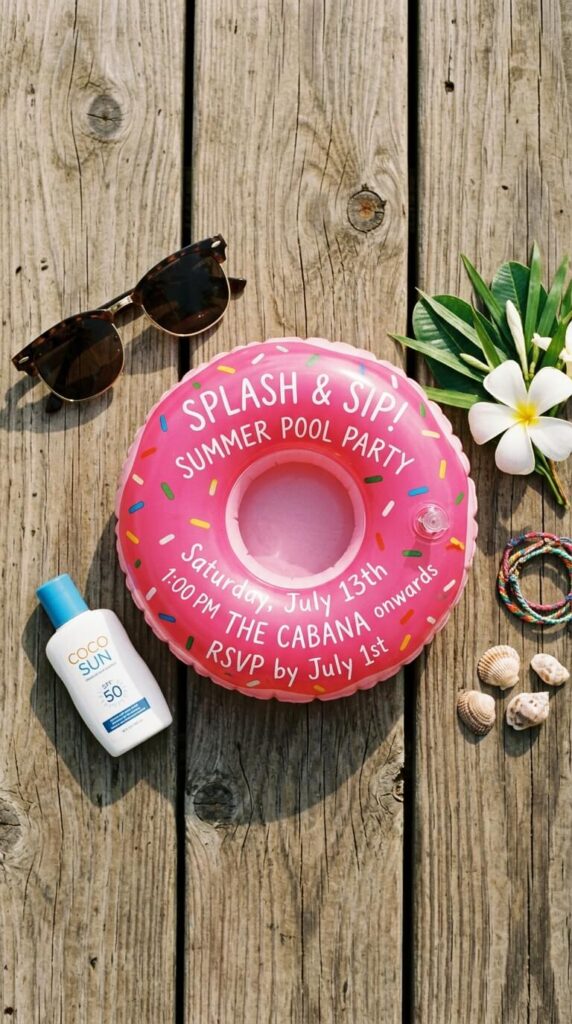
Best for: Ages 3 to 8, and it’s the single best option for the kid who won’t get in the water
Time: 10 minutes to set up, 15 minutes of play
Soak level: Dry, no mess
Supervision: Check in every few minutes
You need: Six to ten empty plastic bottles and a beach ball.
Budget swap: This is already nearly free. Dollar Tree beach balls run about 1.25 each, or use the deflated one from last summer. Empty 16 ounce water bottles from your recycling are the pins.
- Fill each bottle with about one inch of water. No more. I filled them halfway the first time and nothing fell over, which is a deflating moment for a 4 year old.
- Set the pins on grass or a flat patio, not the wet deck.
- Chalk a throwing line about eight feet back, closer for the little ones.
- Dunk the beach ball in the pool before each roll. A wet ball is heavier and rolls straight. A dry one catches the smallest breeze and curves off into the flowerbed.
Tip: Trace the pin positions with sidewalk chalk. Then a 4 year old can reset the lane correctly by themselves, which matters because nobody, and I mean nobody, volunteers to be the pin setter twice.
Safety: Plastic bottles only. No glass anywhere within sight of a pool deck, ever, because a barefoot crowd plus broken glass near water is an afternoon ending injury.
What goes wrong the first time: Everyone loses interest after four rolls if there’s no structure. Give it a scoreboard on a chalkboard or paper plate and suddenly they’ll play for 20 minutes.
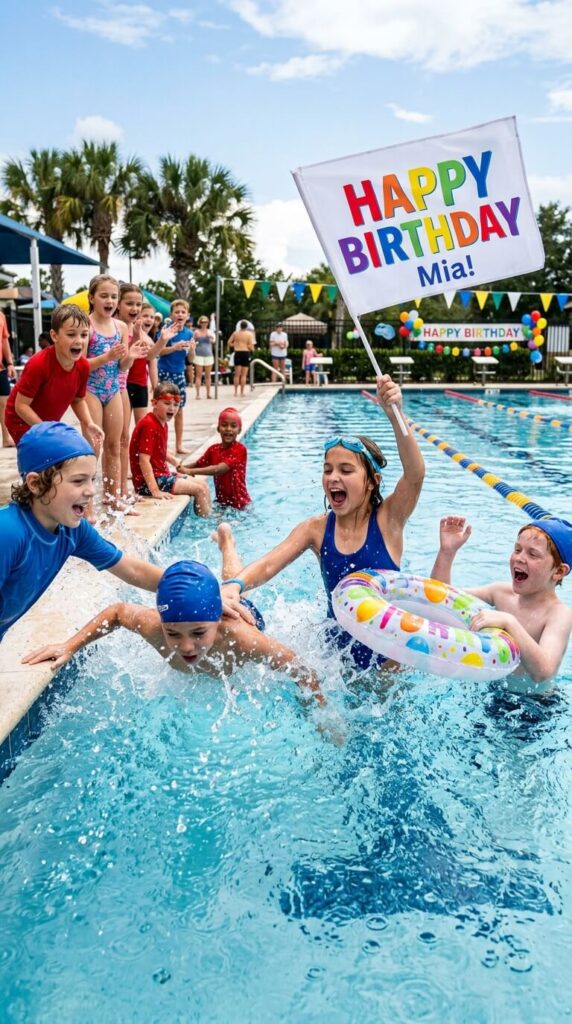
5. Pool Party Float Invitation
Best for: Adult prep, though a 7 year old can write names
Time: About 30 minutes for a batch of ten
Mess level: Low, but the marker stains everything it touches
Supervision: Adult handles the markers and mailing
You need: Mini inflatable drink floats (flamingo, donut, palm tree) and an oil based paint marker.
Budget swap: A 1.25 pack of foam pool shape stickers on cardstock looks great for a fraction of the cost, or hand deliver a deflated beach ball with the details written on it.
- Leave the float deflated and lay it flat.
- Write the details with a Sharpie oil based paint marker, not a regular Sharpie. Regular permanent marker smears right off vinyl and you’ll find that out after you’ve done six of them.
- Let it cure for 10 minutes before you touch it.
- Slip it into a padded 6×9 envelope with a plain paper card that repeats the date, time, address, and RSVP.
Practical note: Send the paper card too. Half the parents will admire the float and never notice the writing on it, and then you spend the week before your party answering “wait, what time?” texts. The float is the delight. The card is the information.
Safety: Deflated vinyl and small mini floats are a choking and suffocation risk for babies and toddlers. Address the envelope to the parent, not the child, and if you know the family has an infant, mention it when you text them.
What goes wrong the first time: Don’t mail it inflated. It gets crushed, and some post offices treat an odd shaped parcel as a different rate entirely.
6. Poolside Birthday Relay
Best for: Ages 7 to 12, confident swimmers
Time: 10 minutes to organize, 15 minutes to run
Soak level: Wet, no mess
Supervision: Constant, plus one adult at the far wall as judge
You need: Two floats and a waterproof sign or flag.
Budget swap: Write “Happy Birthday” on a plastic placemat with a Sharpie. Poster board turns to pulp in about 30 seconds, which I learned the loud way.
Run this as the last water game before dessert. The energy peak lands right where you want it, and it keeps the spotlight on the birthday kid without anybody having to make a speech.
- Split into two even teams. Odd number? The birthday kid swims twice and will consider this a gift.
- Team one pushes the float across, touches the far wall, brings it back, tags the next swimmer.
- Put an adult at the far wall to judge the touch, because they will argue about it.
- Give the birthday child the anchor leg so they finish to actual cheering.
Tip: Pushing a float is slower and clumsier than swimming, which is what makes it funny and also what levels the field between a strong 11 year old and a decent 8 year old.
What goes wrong the first time: Teams stacked by friendship instead of ability, so one side wins by half a pool and the other side is done. Count swimmers off yourself, one two one two, and blame the numbers.
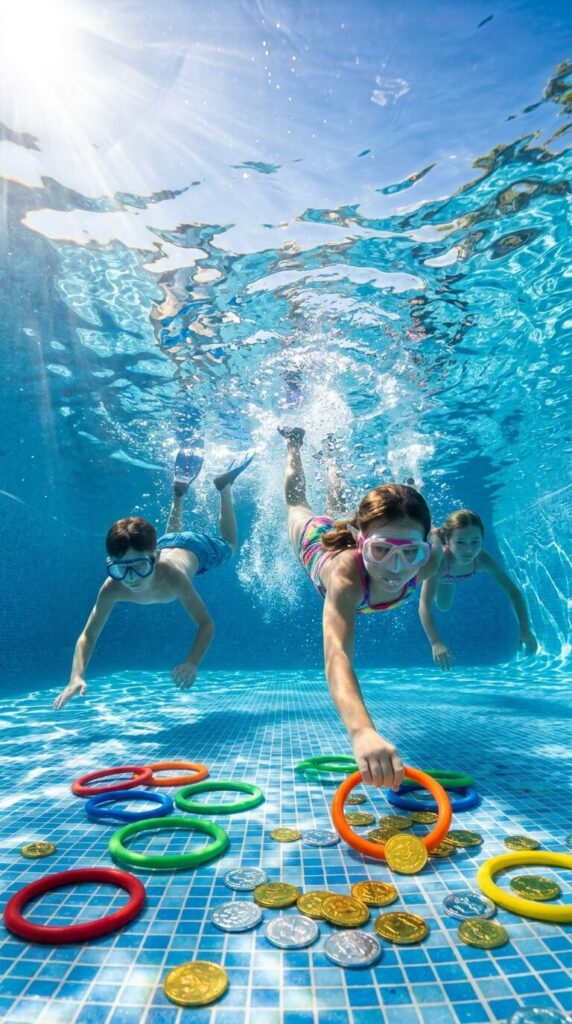
7. Poolside Treasure Hunt
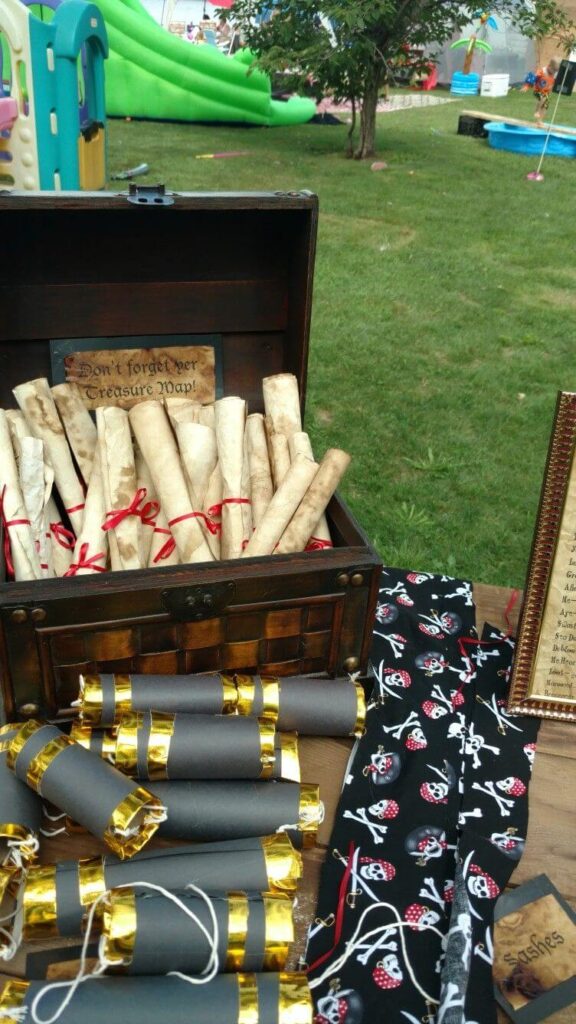
Best for: Ages 5 to 12, zoned by depth
Time: 10 minutes to set up, 20 minutes and they’ll want three rounds
Soak level: Wet, no mess
Supervision: Constant, and one adult watching the deep zone specifically
You need: Weighted dive rings, sticks, or gems, plus a bucket per kid.
Budget swap: Metal spoons and a handful of quarters from the kitchen sink drawer. They sink, they flash in the sunlight, and they’re free. Count them before and after. Dollar stores carry dive gems in summer, and a multipack online runs around 12 dollars.
- Split the pool into a shallow zone and a deep zone and assign kids by ability. Say it out loud so it’s a rule, not a suggestion.
- Scatter the treasure. Keep the good stuff shallow so the little kids get wins.
- Give each kid their own bucket on the deck with their name on it.
- Cap it: three items per dive, then surface. This is the fix for everything.
Practical note: Dark blue and dark green dive toys are effectively invisible against a blue pool liner, especially past four feet. Buy orange, yellow, and hot pink. I lost two blue rings for an entire summer before I figured this out and found them in September.
What goes wrong the first time: The strongest swimmer hoovers up 80 percent of it in the first 45 seconds while a 6 year old is still adjusting their goggles. The three item cap fixes it, or assign each kid one color to collect.
Safety: No headfirst diving. Not for retrieving toys, not for anything, unless you have a properly deep diving well, and never in an above ground pool. Also count your treasure at the end and get all of it out. Toys left on the pool floor are what draws an unsupervised kid back to the water two hours later.
8. DIY Beach Ball Party Garland

Best for: Ages 6 and up can help thread, adult does the height work
Time: about 40 minutes, mostly inflating
Mess level: Low
Supervision: Adult on the ladder, no kids on ladders
You need: Eight to ten small beach balls, clear fishing line, and outdoor rope.
Budget swap: Cut circles from a cereal box, color them in beach ball stripes, and string those. Or buy the balls at Dollar Tree and pump them with a five dollar hand balloon pump instead of your lungs.
- Inflate each ball to about 90 percent, not rock hard. Left in direct sun, a fully inflated ball expands and splits at the seam by mid afternoon.
- Tie a short loop of fishing line around the valve stem of each ball.
- Thread the loops onto your rope, spacing them roughly a hand’s width apart.
- Hang it along a fence, a railing, or above the dessert table.
Tip: Don’t use zip ties around the ball itself. They squeeze the vinyl, deform it, and pop it in the heat. The valve stem is the only place to attach anything.
What goes wrong the first time: I hung mine over the water. It dropped a ball into the pool every 20 minutes all afternoon and two of them ended up jammed in the skimmer. Hang it away from the water line.
Won’t work for: Windy days. A garland of light plastic balls acts like a sail and will take a cheap fence panel with it. Tie both ends down properly.
9. Sponge Relay Races
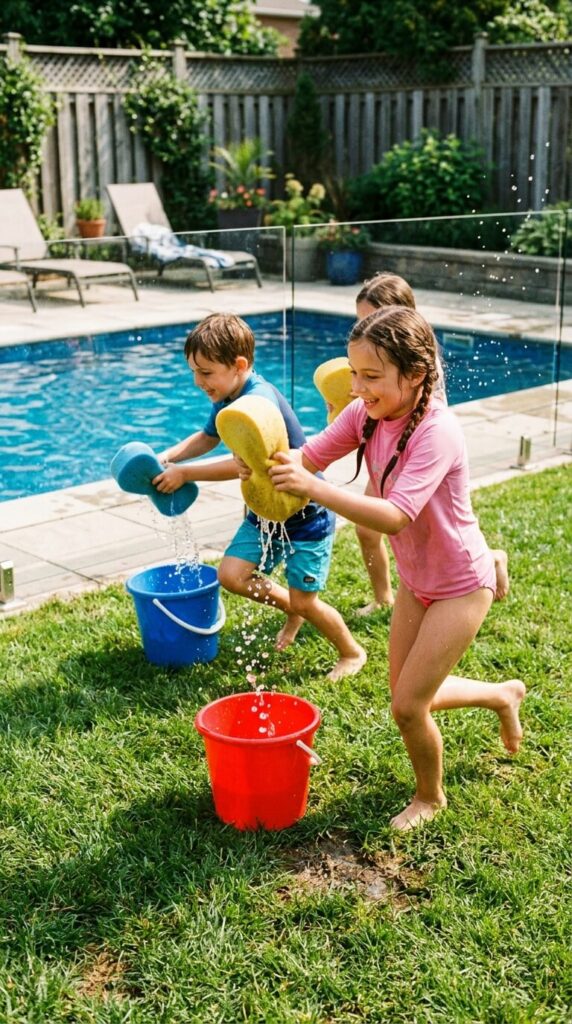
Best for: Ages 4 to 10, including kids who won’t get in the pool
Time: 10 minutes to set up, 10 minutes of play, dump the buckets on the lawn to clean up
Soak level: Completely soaked, plus a swampy patch of grass for a day
Supervision: Check in every few minutes
You need: Four buckets and two big sponges.
Budget swap: Oversized car wash sponges are two or three for about 1.25 at the dollar store, or cut an old bath towel in half. A towel holds even more water, which the kids love and your lawn does not.
Run this on grass, not the pool deck. I know most guides say to use the deck. Sprinting kids on wet concrete is how you get a scraped chin and a party that ends at urgent care, and I watched it happen at a party that was not even mine. Grass costs you nothing and removes the whole risk.
- Two full buckets at the start line, two empty ones about 20 feet away on the grass.
- First kid soaks the sponge, runs, squeezes it into the empty bucket, runs back, tags the next.
- Use clear buckets or mark a fill line with tape so the winner is obvious.
- First team to the line wins. Then let them dump the leftover water on each other, because they’re going to anyway.
Tip: Put the finish buckets on a flat spot. On a slope, one team’s bucket tips at the halfway mark and the entire moral order of the game collapses.
What goes wrong the first time: Kids carry the sponge above their heads and lose most of the water on the run. Show them once: hold it low and cupped in both hands. They’ll get competitive about technique.
10. Poolside Popsicle Break Challenge
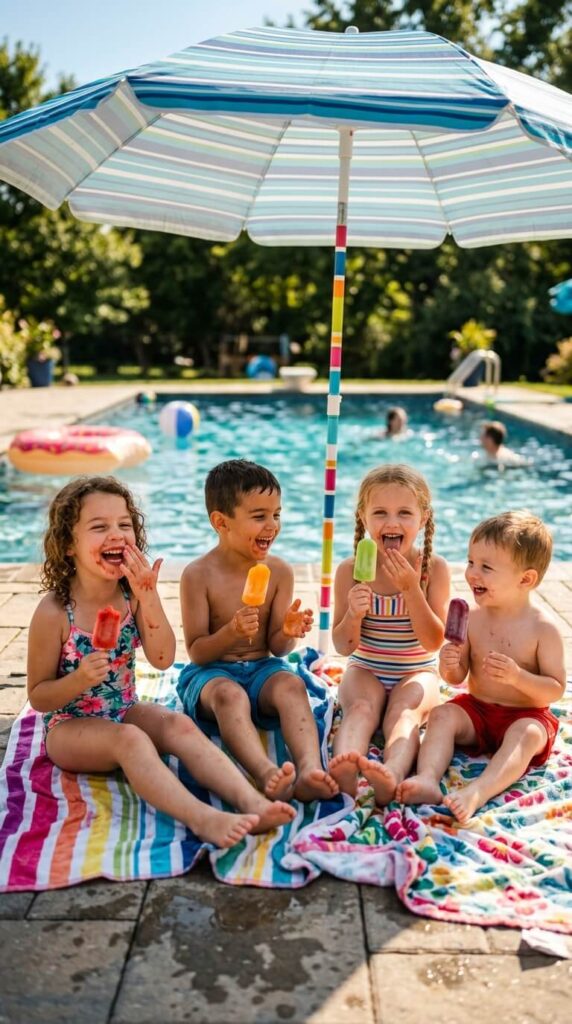
Best for: All ages, and it’s the scheduling anchor of your whole party
Time: 5 minutes to hand out, 15 minutes of actual rest
Mess level: Sticky, and the dye stains white towels
Supervision: Constant with under 4s, sticks and cold treats need watching
You need: Two popsicles per kid and a stick bucket.
Budget swap: Freeze juice in an ice cube tray with toothpicks, or a batch of frozen grapes, which are a real hit and cost almost nothing.
The trick is you never say the word break. You announce a challenge, they come running, and they end up sitting still for 15 minutes.
- Call everyone out. Hand each kid a towel first, then the popsicle. In that order.
- Set up one eating zone on the grass, not on the patio furniture.
- Award silly titles: funniest drip face, most dramatic brain freeze, cleanest hands.
- Water bottles go out at the same time, and this is your sunscreen reapply moment too.
Practical note: Never make it a speed contest. “Fastest eater” is how you get a choking scare and a kid crying from brain freeze. Silliest face gets the same laugh with none of the risk.
Safety and allergens: No running with a stick in the mouth, and that rule needs saying out loud because a fall with a popsicle stick between the teeth is a real emergency room visit. For under 4s, push the pop out of a squeeze tube or cut it into a bowl and skip the stick. Keep the boxes on the table so parents can read labels themselves. Creamsicles and fudge bars contain dairy, some fruit bars are made on shared equipment, and it is not your job to guess.
What goes wrong the first time: Wasps. Within 20 minutes of a sticky snack there is a wasp situation at the trash can. Put a lidded bin at the far end of the yard, and set out a bucket with an inch of water for used sticks.
11. Jello Pool Party Dessert

Best for: Ages 5 and up can help assemble, adults do the hot water
Time: 20 minutes of hands on work, about 3 hours to chill. Make it the night before.
Mess level: The blue dye stains towels, grout, and white swimsuits
Supervision: Boiling water is an adult only step, no exceptions
You need: Berry Blue Jell-O, clear 3 ounce cups, Teddy Grahams, and Life Savers Gummies rings.
Budget swap: Store brand blue gelatin is half the price and looks identical, and a gummy peach ring works as the float.
- Adult mixes the gelatin with boiling water. Kids stay back from the counter for this part.
- Pour into 3 ounce cups. Not 9 ounce ones. They look impressive and no kid finishes one.
- Chill about 90 minutes, until it’s set enough to hold something on the surface.
- Add the gummy ring, then rest a Teddy Graham inside the ring so the bear sits in the float rather than in the jello.
- Back in the fridge until serving, then hand them out from a cooler.
Practical note: The cracker goes soggy roughly 15 minutes after it touches the gelatin, and then the bear sinks and looks like a small tragedy. Assemble the bears within half an hour of serving, and put them on the ring rather than in the jello.
Safety and allergens: Gelatin is made from pork or beef collagen, which rules it out for a lot of families, so have a fruit cup or frozen grapes ready as an alternative and don’t make anyone ask. Teddy Grahams contain wheat and soy. Whole gummy rings are a choking risk for under 4s, so cut them or leave them off those cups.
What goes wrong the first time: Blue jello in direct sun is blue soup in about 20 minutes, and that dye does not come out of a white towel easily. Serve six cups at a time straight from a cooler and keep the rest inside.
12. Sun Protection Station
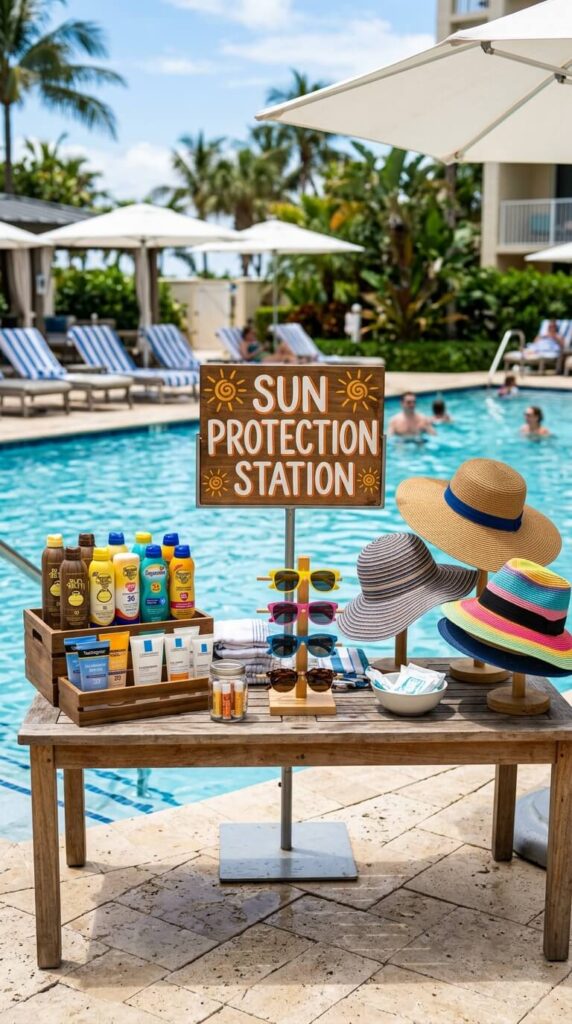
Best for: All ages, and it’s the single most useful non game on this list
Time: 10 minutes to set up
Mess level: Greasy hands and sandy sunglasses
Supervision: Ongoing, this needs announcements not just a table
You need: Broad spectrum SPF 30 or higher, water resistant, plus spare hats and sunglasses.
Budget swap: Shade is free. An old bedsheet clipped along a fence line or a tarp over two chairs does more for a pale 4 year old than any reapplication schedule.
Set the table right by the gate so it’s the first thing kids walk past, not tucked behind the food.
- Put out one lotion, one mineral stick for faces (Blue Lizard and Thinkbaby both make one), and a spray for backs and legs.
- Add a basket of spare sunglasses, two spare wide brim hats, and a couple of UPF 50 rash guards in common sizes.
- Announce a sunscreen check at arrival, at the popsicle break, and once more before the last swim.
- Keep a dry towel stack here too, because the kid who needs sunscreen is always dripping.
Practical note: Don’t apply sunscreen to somebody else’s kid without asking. Plenty of children have eczema or react to chemical filters, and plenty of parents have a specific product they use. Ask at drop off, or hand the bottle to the kid and supervise. It takes five seconds and it avoids an awkward conversation later.
Safety: Spray sunscreen makes a wooden or tile deck slick as ice, so spray on the grass. It should never go directly on a face either. Spray it into your hands and rub it on. The AAP advises keeping babies under 6 months out of direct sun and using clothing and shade rather than sunscreen. Reapply every two hours, and right after swimming or towel drying, regardless of what the bottle claims.
What goes wrong the first time: The burns nobody plans for are the tops of the feet, the backs of the ears, the back of the neck, and the part in the hair. Those are the four spots I check now.
13. Water Balloon Volleyball
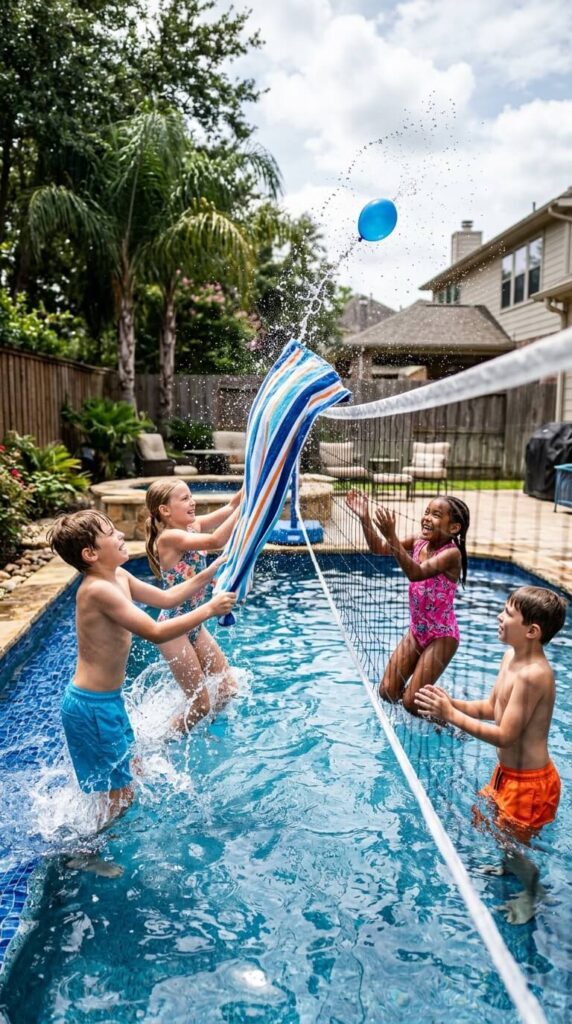
Best for: Ages 7 to 12, since it takes two kids coordinating one towel
Time: 30 minutes of filling, 15 minutes of play, 10 minutes of cleanup
Soak level: Completely soaked, plus latex fragments across the yard
Supervision: Constant, and one rule enforced from the start
You need: 60 water balloons, a rope, and one beach towel per pair.
Budget swap: Reusable silicone water balloons, the magnetic sealing kind, refill in a few seconds by dunking them and cost nothing after the first purchase. Bunch O Balloons fills about 40 at once if you’re going the disposable route. Filling 60 balloons by hand takes 45 minutes and you will resent every single one.
- Tie a rope between two chairs at chest height, in the shallow end or on the lawn.
- Fill balloons to about baseball size. Grapefruit sized ones burst on the towel and never clear the net.
- Pairs hold the towel corners, place a balloon in the center, pull taut, and launch.
- The receiving pair tries to catch it in their towel. Rotate pairs every few points.
Safety, and this one is not optional: Broken latex balloon pieces are a serious choking hazard. The CPSC has long flagged latex balloons as one of the leading choking risks for young children, and it’s the burst fragments that do it, not the inflated balloon. Sweep the yard with a bucket before anybody walks barefoot and before a toddler is back outside. If any guest has a latex allergy, use silicone reusables or skip this game entirely.
Practical note: One child will throw a balloon at somebody’s face within the first two minutes. Say the rule before you hand out a single balloon: launch with the towel, aim across the net, never at heads. Then it’s a rule everyone heard, not a telling off.
What goes wrong the first time: The towel launch sends balloons straight up rather than forward. Kids figure it out after four or five tries, so let them fail a bit instead of coaching every throw.
14. Floating Letter Hunt

Best for: Ages 4 to 8, and it works beautifully for pre readers with a picture card
Time: 5 minutes to set up, 15 minutes of play
Soak level: Wet, no mess
Supervision: Constant
You need: Foam bath letters.
Budget swap: Write letters on ping pong balls with a permanent marker. They float high, they’re easy for small hands, and there’s probably a tube of them in your garage already. Cutting letters from a pool noodle also works, adult with a serrated knife only.
- Pick a target word: the birthday kid’s name, or SPLASH, or SUNSHINE.
- Scatter those letters plus a dozen decoys across the shallow end.
- Little kids get a laminated picture card of the word to match against.
- Call the letters they need one at a time, or let them race to build the whole word as a team against a 90 second clock.
Tip: Run this right after the obstacle course. It’s a calm down game disguised as a hunt, and it buys you 15 minutes of low intensity water time before dessert.
Safety: Foam letters and ping pong balls are choking hazards for under 3s. If a toddler is at the party, this game happens while they’re occupied elsewhere, and everything gets collected the moment it’s over.
Won’t work for: Competitive 10 to 12 year olds will call it a baby game if you pitch it as letter matching. Pitch it as a timed team challenge and they’re in.
What goes wrong the first time: Foam bath letters mildew if you bag them wet. Mine came out of storage the next June with black spots and went in the bin. Dry them flat overnight.
15. Splash Zone Obstacle Course
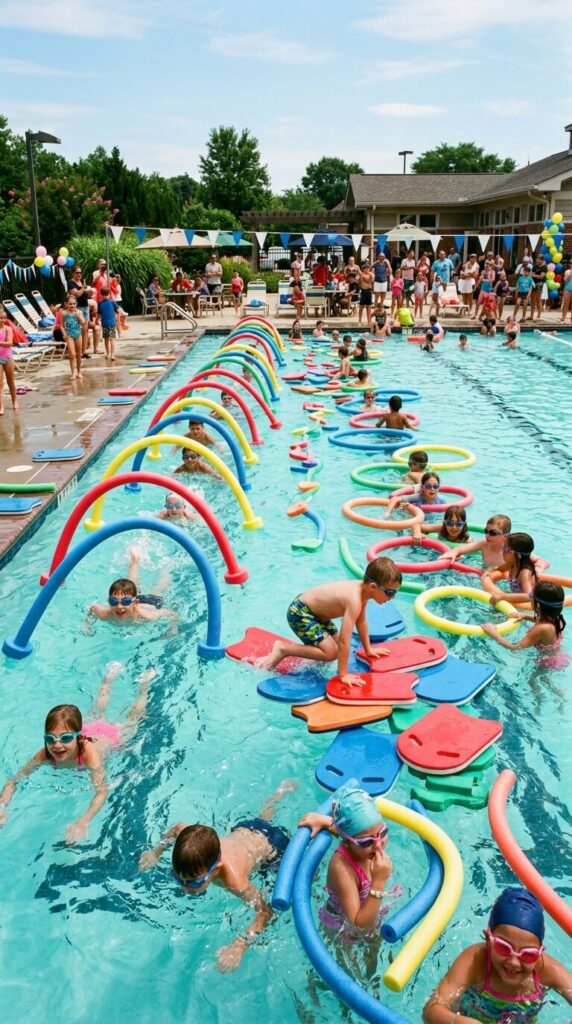
Best for: Ages 7 to 12, strong swimmers only
Time: 20 minutes to build, 25 minutes to run, 10 minutes to clear
Soak level: Wet, no mess
Supervision: Constant, ideally one adult per station
You need: Pool noodles, floating rings, kickboards, and a stopwatch.
Budget swap: Everything here is already in the pool toy bin. Use your phone’s stopwatch. For non swimmers, build the identical course on the lawn with the sprinkler on.
- Anchor stations to fixed points: the ladder, the steps, the corners, the wall. Anything floating loose will drift.
- Build three or four stations, no more. Noodle arch to duck around, rings to swim through at the surface, kickboards marking a zigzag.
- One kid at a time, timed, everyone cheering.
- Give every kid two runs.
Practical note: Do not build anything a child has to swim under. No submerged tunnels, no going beneath a float or a mat. A kid who panics under a float cannot find the surface, and it takes seconds. Rings stay at the surface, and every station is something they go through or around, never under.
Tip: Don’t announce times publicly. Announce improvements. Time run one quietly, then tell each kid how much faster their second run was. Everybody improves on the second run, so everybody gets a win, and the slowest kid doesn’t quit halfway through the afternoon.
What goes wrong the first time: The layout reshuffles after literally every run. Accept it. Assign one adult or one enthusiastic big kid as the course resetter, and treat the design as a rough suggestion.
Won’t work for: Tired kids, and they will not admit they’re tired. Two runs each, then it’s over, even if they’re begging. This is the game where fatigue and deep water meet.
16. Pool Party Photobooth

Best for: All ages, and it’s the winner for kids who are done swimming but not ready to leave
Time: 20 minutes to set up
Mess level: low
Supervision: Check in every few minutes, but keep it in view of the pool
You need: A backdrop and a basket of props.
Budget swap: A 1.25 blue plastic tablecloth from Dollar Tree taped to a fence is a genuinely good backdrop, or use a bedsheet. Props: the pool toys and sunglasses you already own.
- Tape or clip the backdrop on all four sides. One loose corner and the wind turns it into a flag.
- Fill a basket with plastic and foam props only: oversized sunglasses, a snorkel mask, an inflatable flamingo, leis.
- Scatter a few beach balls at the base for color.
- Set your phone on a tripod on the grass, well back from the edge, in a dry hands only zone.
Practical note: Cardboard props on sticks are pulp within 10 minutes of wet hands. I’ve thrown away two sets. Plastic, foam, and inflatables only at a pool.
Practical note, the one people forget: Ask parents at drop off whether photos of their child can be shared. Plenty of families keep their kids off social media, and finding that out after you’ve posted the group shot is a bad conversation.
What goes wrong the first time: The booth ends up around the side of the house where you can’t see the pool from it, which splits your supervision. Put it in the same sightline as the water.
17. Pool Noodle Popsicle Garland

Best for: Ages 4 and up can help, adult does all the cutting
Time: About 30 minutes
Mess level: Foam crumbs everywhere, and marker on fingers
Supervision: Adult cuts the foam, kids assemble
You need: Three pool noodles, jumbo craft sticks, and twine.
Budget swap: Noodles are about 1.25 each at the dollar store, and the offcuts from last summer’s noodle projects work perfectly. Cardboard popsicle shapes colored with markers cost nothing at all.
- Adult cuts the noodles into six inch sections with a serrated bread knife. Scissors chew the foam and leave a ragged edge, a bread knife cuts it clean in one pass.
- Push a jumbo craft stick into the bottom of each section. The friction holds it.
- Kids draw a bite mark on the top with a marker, on a covered table.
- Thread the sections onto twine through the foam or tie around each stick, then hang above the dessert table.
Tip: Do not use a hot glue gun on pool noodles. The heat melts polyethylene foam and you get a shrunken crater instead of a join. If the stick feels loose, use tacky craft glue.
What goes wrong the first time: Foam holds water like a sponge, so one rain shower and your garland stays soggy for days and starts smelling like a wet dog. Bring it in overnight.
Won’t work for: Kids under 4 with the marker step, unless you like Sharpie on a patio table. Ask me how I know.
Common Mistakes To Avoid At A Kids’ Pool Party
These are the ones I’ve personally made, not the generic list.
- Starting with a game. Kids arriving at a pool have exactly one goal. Fight it and you lose 20 minutes and your voice. Let them swim first, then they’ll play along.
- Inviting the whole class. Eight to ten kids is the ceiling for a home pool. At 14 you cannot count heads reliably, and counting heads is the job.
- Assuming the guest list tells you the swim list. Ask every parent about swim ability in the RSVP text. It changes which games you plan and how many adults you need in the water.
- Hosting from noon to 3. That’s peak UV, peak burn risk, peak afternoon thunderstorm season, and it collides with lunch. A 10 to 12 or a 3:30 to 5:30 party is kinder to everyone.
- Cake outdoors at 2pm. Buttercream slumps, candles won’t stay lit in the breeze, and wet hands plus paper plates is a losing combination. Serve dessert in the shade, or skip the cake ceremony and do ice cream sandwiches and the jello cups instead.
- No plan for the kid who won’t get in. There is always one, and they are not being difficult. Have the bowling, the sponge relay, and the photobooth ready to go so they have somewhere to belong.
- No dry zone. Without one, wet kids walk through your house and you lose a hallway and a couch. Put a laundry basket for wet suits at the door, one named towel per kid on a chair, and a bin for goggles.
- Paper anything in the goody bags. Coloring books, stickers, paper crowns. All of it comes apart in a wet hand within a minute. Cheap goggles, a bouncy ball, and a dive gem hold up.
Practical note: the strangest, most useful thing I’ve ever done at a pool party is put a cheap kitchen timer in my pocket set to 15 minutes. Every time it goes off, I call a head count and swap the water watcher. It makes the most important task automatic instead of something you remember when the noise level changes.
If you’d rather run the whole thing away from a pool, or you’re rained out, the same games translate to a backyard and a hose. These water games work without a pool and most of them use the same supplies as the list above.
FAQs
What is the ideal duration for a kids’ pool party?
Two to three hours, and two is plenty for kids under 7. Swimming wears kids out faster than parents expect, and the sunburn risk climbs the longer you’re out. Two hours gives you free swim, three or four games, a food break, and dessert without hitting the wall where everyone gets cold and cranky at once.
How many adults should be present for supervision?
At least one adult per four to five children in the water, with one adult designated purely as the water watcher on a 15 to 20 minute rotation with no phone. Any child under 5 or any non swimmer needs an adult within arm’s reach of them specifically. For more than 10 kids, hire a certified lifeguard, often a teen from your local pool for about 20 to 30 dollars an hour.
Is a pool party safe for a 3 year old?
Yes, with a Coast Guard approved life jacket and one adult whose only job is staying within arm’s reach of that child, in the water, the whole time. Drowning is the leading cause of death for kids ages 1 to 4 according to the CDC, and it happens silently, so a 3 year old needs touch supervision rather than an adult watching from a chair. Plan for them to be done with the water after 30 minutes and have a dry activity and a shady spot ready.
What are the best foods to serve at a pool party?
Keep it light, cold, and one handed. Watermelon slices, grapes, finger sandwiches, pretzels, and the blue jello cups all work. Skip anything that needs a fork or melts fast. Put out far more water than you think you need, because kids do not feel thirsty when they’re wet, and nobody gets in the water with gum, hard candy, or a lollipop in their mouth.
Do I need to provide towels for all the guests?
Ask guests to bring their own on the invitation, then keep five or six clean spares anyway. Towels get dropped in puddles, forgotten in cars, and claimed by the wrong kid. A named towel on a chair for each guest, marked with painter’s tape and a Sharpie, saves you the pile of unclaimed damp towels at the end.
How do I get sunscreen and blue jello stains out of towels and swimsuits?
Rinse in cold water immediately, before anything dries or goes in a hot wash. Sunscreen marks are oil, so work a little dish soap into the spot before washing. For blue dye, soak in cold water with an oxygen based stain remover and keep it away from heat, because a hot dryer sets the dye permanently. The orange or rust colored marks that show up on white swimsuits are usually sunscreen reacting with minerals in pool water, and a rinse right after swimming prevents most of it.
Read Next
If your kid is the one who wants a winner, a medal, and a scoreboard for everything, the relay and obstacle formats here scale up nicely. These Olympic style games for kids give you a full event structure you can run poolside with the same pool noodles.
And if the obstacle course was the hit of the party, which it usually is with the 8 to 12 crowd, this guide to building obstacle courses for kids covers dry land versions for the weeks when the pool isn’t an option.
Conclusion
You don’t need 17 activities. You need four games, one popsicle break, and one adult who isn’t holding a phone. If you only take three things from this: ask every parent about swim ability before you plan anything, set a 15 minute timer in your pocket for head counts, and let the kids swim for the first 20 minutes before you try to organize a single thing.
One seasonal note, since we’re at the tail end of the 2026 summer as this update goes out. Late August through September is the cheapest week of the year to stock up. Dive toys, noodles, kickboards, and beach balls all hit clearance the moment the back to school displays go up, and a full bin of pool games for next June costs about the same as one party’s worth bought in a panic on the morning of. Print the timeline, put your phone in a drawer, and go be the person watching the water. The kids will handle the fun part.