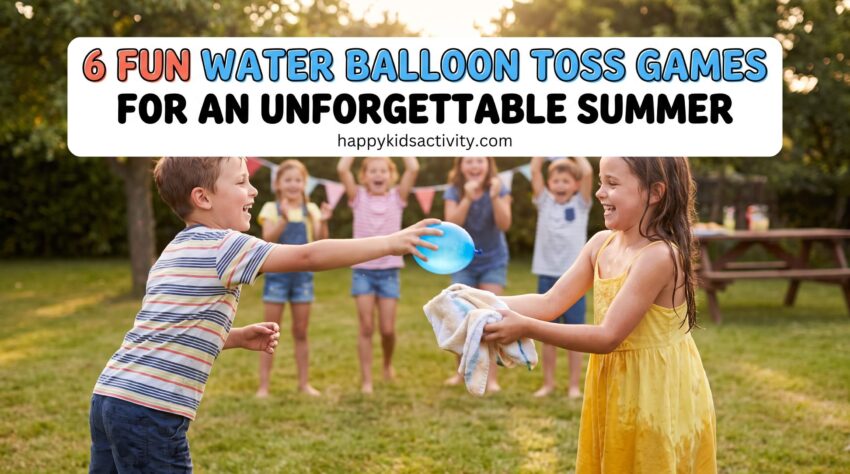
It was almost 4pm on a Saturday in July. Six kids in my backyard, one popsicle left in the box, and somebody had already said the word “bored” twice.
I found a half-used bag of balloons in the garage junk drawer, dragged the hose over, and filled maybe forty of them while the kids hovered and asked if they could start yet. Water balloon toss games saved that afternoon. They have saved a lot of afternoons since.
Here is the part nobody tells you: filling took me twenty-five minutes and the first game lasted eight. That ratio is the whole trick to pulling this off well, and it shapes almost every tip below.
Quick answer: The six water balloon toss games worth your time are the classic step-back toss, the team towel toss, musical balloons, target splash practice, a relay toss, and the spoon balance toss. Most work best for kids 5 to 12, need nothing but balloons and a flat patch of grass, and run 10 to 15 minutes each. Plan on 8 to 10 filled balloons per child, fill them within an hour of playing, and expect prep to take longer than the games themselves.
Seasonal note:If you are reading this in late summer or early fall, do not shelve it. In most of the US it stays hot enough for water games well into September, and these work at a Labor Day cookout or a first-week-of-school playdate exactly the way they work in July.
Why Water Balloon Games Are Perfect for Summer
A splash resets an overheated, cranky kid faster than a snack does. That is the real reason these games work, and it is why I reach for them at the exact point in the afternoon when everyone starts arguing about nothing.
They also solve the mixed-age problem. Most of these games run in pairs or teams, so a 5 year old and a 10 year old can play the same game at different difficulty levels without anyone announcing that it is unfair.
There is a quieter benefit I did not expect. A partner game gives a shy kid a job, which is much easier than being told to go play with everyone. I have watched a kid who spent twenty minutes standing by the fence end up mid-circle, soaked, yelling instructions at somebody’s cousin.
Two honest trade-offs before you commit. First, you will burn through supplies faster than you think, and you will spend real time at the hose. Second, every popped balloon leaves latex on your lawn that you have to pick up, all of it, every time.
Practical note: For a lot of sensory-sensitive kids, the pop is the problem, not the water. If your kid startles at balloons, skip musical balloons and start with target practice, where the popping happens twenty feet away and they are the one causing it.
Water Balloon Toss Games at a Glance
Mess level here is a 1 to 5 splash scale. A 1 means wet hands and a few grass splashes. A 5 means everyone changes clothes and you are sweeping latex out of the lawn for ten minutes.
| Game | Best ages | Kids needed | Mess (1 to 5) | Time (prep + play + cleanup) | Supervision | Balloons used |
| Classic step-back toss | 4+, sweet spot 6 to 11 | 2 or more pairs | 2 | 2 + 15 + 5 min | Check in every few minutes | Low, 2 to 3 per pair |
| Team towel toss | 7+ | 2 per towel | 3 | 5 + 15 + 10 min | Hands-on at first | Medium |
| Musical balloons | 5+ | 6 or more | 3 | 5 + 10 + 5 min | Hands-on, you are the DJ | 1 per round, 10 to 15 rounds |
| Target splash practice | 3+, best mixed-age game | 1 or more | 4 | 10 + 20 + 10 min | Line of sight, enforce the lane | High, 10+ per kid |
| Water balloon relay toss | 6+ | 6 or more | 4 | 5 + 15 + 10 min | Hands-on, you are the ref | Highest |
| Spoon balance toss | 6+ | 2 or more | 1 | 5 + 10 + 2 min | Check in | Low, 2 to 3 per kid |
Pin this table now and you can skip re-reading the whole thing next time somebody announces they are bored. Save this for later.
What You Need Before Getting Started
None of these games need special gear. Most of what you need is already in your kitchen or costs a couple of dollars.
Core Supplies
- Water balloons, 8 to 10 per kid, filled about two-thirds full. A bag of 100 runs about $1.25 at Dollar Tree.
- A hose with a spigot you can reach, plus a balloon filling nozzle if you want to save your fingers. Mine cost about $4.
- Two tubs or buckets. One for filled balloons, one for the popped pieces you collect as you go.
- Flat grass, roughly 30 feet of it for the bigger games.
- Old towels in a laundry basket by the back door, and a change of clothes for anyone under 6.
Game-Specific Extras
- Two or three beach towels for the towel toss. Not the nice ones.
- A portable speaker or a phone for musical balloons.
- Sidewalk chalk, hula hoops, or plastic buckets for target practice. Crayola chalk survives wet concrete; the cheap chunky sticks turn to paste after two splashes.
- Large serving spoons or metal ladles for the spoon balance toss.
Budget Swaps for Everything Above
| What you would buy | Where I get it | Free or cheaper swap |
| Water balloons | Dollar Tree, or Bunch O Balloons for speed | Kitchen sponges cut into strips and tied in the middle with a hair elastic. Reusable, no litter, and they work for every game except the ones that need a pop. |
| Balloon filling nozzle | Amazon or the hardware store, about $4 | Stretch the balloon over the kitchen tap, or push the neck of a plastic water bottle into it and squeeze. |
| Buckets and tubs | Dollar store dish tubs, $1.25 | Laundry basket lined with a trash bag, an empty cat litter tub, a beach pail, or a cooler you already own. |
| Beach towels | Whatever is already in the linen closet | An old twin flat sheet. It is lighter than a towel and snaps better, which makes the towel toss noticeably more fun. |
| Speaker | Any bluetooth speaker | Phone propped in an empty mug for volume, or just sing and stop singing. A whistle works too. |
| Targets | Hula hoops, $1.25 each | Laundry baskets, a cardboard box, painter’s tape shapes on the driveway, or a kiddie pool as one giant target. |
| Spoons | Dollar store slotted spoons and ladles | Your soup ladle, a spatula, or a small plastic cup taped to a paint stir stick. |
| Prizes | A $1 box of freezer pops | Winner picks the next game. Works better than you would expect. |
Gather everything before the first kid arrives. Once the games start, walking away to hunt for chalk is how you lose the group. If you want to skip latex entirely this year, [INTERNAL LINK: how to make reusable sponge balls] takes about ten minutes with a pack of kitchen sponges and works for four of the six games below.
Best Water Balloon Toss Games
1. The Classic Step-Back Toss

This is the one everybody pictures, and it is still the best opener because it takes ten seconds to explain.
Ages: 4 and up with tweaks. Sweet spot is 6 to 11.
Time: 2 minutes to explain, 10 to 15 minutes of play, 5 minutes of cleanup.
Mess level: 2 out of 5. Wet clothes and splash marks, nothing more.
Supervision: Set it up, then check in every few minutes.
How to Play
- Pair kids by size and arm strength, not by friendship. A 6 year old paired with a 10 year old gets a balloon fired at her chest on the first throw and takes it personally.
- Line the pairs up facing each other, about three feet apart. Close enough that it feels silly.
- Give each pair one balloon, filled two-thirds. Underhand tosses only.
- After every clean catch, both partners take one step back. Call the steps out loud so nobody creeps forward.
- A pair is out when the balloon pops or hits the ground. Last pair standing wins.
Tip: Teach the catch before you start. Hands out, palms up, and pull the balloon in toward your chest as you catch it, the way you would catch a raw egg. Stiff arms pop balloons. Ten seconds of coaching doubles how long the game lasts.
Why It Works So Well
The difficulty curve builds itself. The first few tosses are easy enough that the youngest kid in the yard succeeds immediately, and by fifteen feet the 10 year olds are the ones sweating it.
What goes wrong the first time: somebody switches to overhand once the gap gets past about twelve feet, and the balloon detonates on contact. Call underhand-only at the start and mean it. The other thing that surprises new parents is that half the kids want to lose, because getting soaked is the actual prize. Fine. Run it as “how far can we get” with no winner and it lasts longer.
Skip it for: kids under 4, who will squeeze the balloon on purpose within seconds, and pairs with a big skill gap.
Adapt it down: Sit on the grass and roll the balloon back and forth instead of tossing, or stay at three feet and just count catches. Sponge balls for toddlers.
Adapt it up: One hand only, non-dominant hand only, or add a full spin before every catch.
2. Team Towel Toss
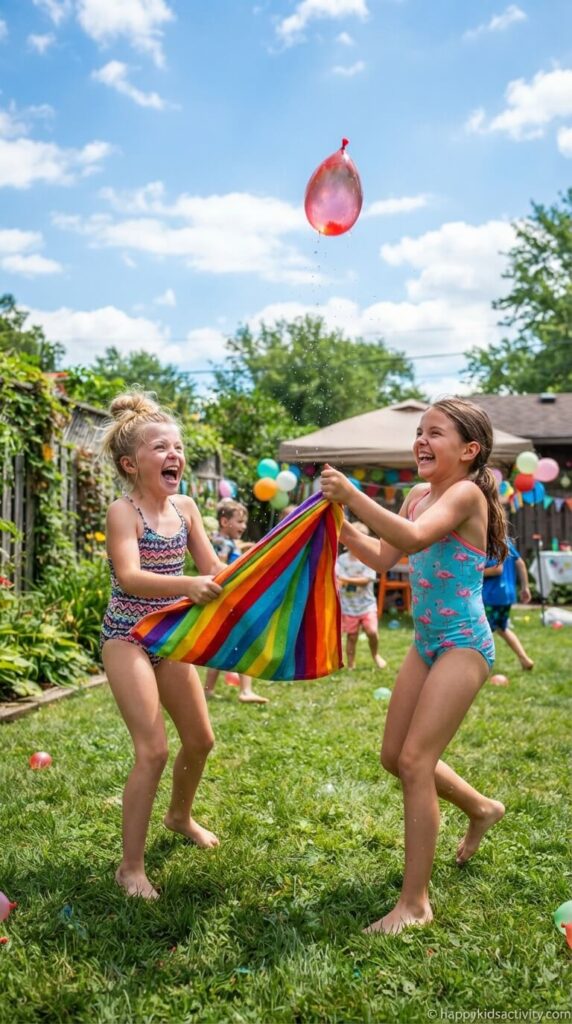
This is the one that makes adults laugh harder than the kids, and it is the game my two ask for by name.
Ages: 7 and up, realistically. It needs two kids who can count to three together.
Time: 5 minutes to set up, 10 to 15 minutes of play, 10 minutes of cleanup because you now own several soaked towels.
Mess level: 3 out of 5.
Supervision: Hands-on for the first few launches, then you can step back.
How to Play
- Give each pair an old beach towel. They will be soaked and grass-stained by the end.
- Each kid holds two corners, towel pulled tight and flat at hip height.
- Set one balloon in the middle of the towel.
- Count to three out loud together, then both snap the towel upward at the same moment.
- Chase the balloon, get the towel underneath it, catch it before it lands.
- One point per catch. Three drops and you rotate out.
Tip: The count matters more than strength. If one kid pulls harder or higher, the balloon fires sideways instead of up, which is how ours ended up on the garage roof.
Coordination and Skill Building
Both kids have to move as one unit, so this game builds actual communication rather than just reflexes. It is also the loudest ten minutes of any party I have hosted.
First-try failures, in order of likelihood: the launch goes sideways into a fence, one kid drops the towel and grabs at the balloon with her hands out of instinct, and somebody aims for maximum height and loses the balloon over the neighbor’s fence. Aim for a low arc, roughly as high as the house gutters at most.
Skip it for: pairs under 6 or 7, and kids who cannot stand losing at something that is mostly luck.
Adapt it down: An adult holds one end. Or lay the towel flat on the ground and lift it in a gentle pop with no snap.
Adapt it up: Two towels. One pair launches, the other pair catches. Or upgrade to a twin flat sheet with four kids on the corners.
Practical note: A flat bedsheet beats a beach towel. It is lighter, it snaps harder, and four kids on the corners of a twin sheet can launch a balloon twenty feet straight up. Use a sheet you have already retired.
3. Musical Balloons

Hot potato with consequences. Best game on this list for a big group where you want everyone playing at once.
Ages: 5 and up, and it needs at least six kids.
Time: 5 minutes to set up the speaker and circle, 10 minutes of play, 5 minutes of cleanup.
Mess level: 3 out of 5. One soaked kid at a time, plus latex pieces scattered inside the circle.
Supervision: Hands-on the whole time. You are the DJ and the referee.
How to Play
- Circle the kids up on grass, about an arm’s length apart.
- Start the music. The balloon gets passed hand to hand around the circle. No throwing.
- Stop the music at a random moment. Whoever is holding the balloon is it.
- That kid picks their fate: pop the balloon over their own head, or hand it to the group for a soaking.
- Grab a fresh balloon and go again.
Tip: Do not eliminate anyone. Keep a tally of who has been soaked and let the first kid to three claim the wettest-player title. In a game this random, elimination means your youngest is out in the first thirty seconds and attached to your leg for the rest of the party.
Keeping the Energy High
Random stops keep everyone leaning and watching, which is the whole appeal. If you are running this at a bigger gathering, it fits neatly into a lineup of family reunion games that keep every age group busy at the same time.
The thing that derails this game is grip. A wet balloon is slippery and it hits the grass constantly, then five kids argue about whether that counted. Settle it before the music starts: if you drop it, you are it. Arguing over.
Skip it for: Kids under 4, groups of three, and any kid who genuinely hates loud pops. Give that kid the job of stopping the music instead. It is the best job in the game and it puts them in charge of the noise rather than at the mercy of it.
Adapt it down: Pass a soaked sponge instead of a balloon. Same game, no bang. Adapt it up: Two balloons going in opposite directions, or a rule that passes have to happen behind your back.
4. Target Splash Practice
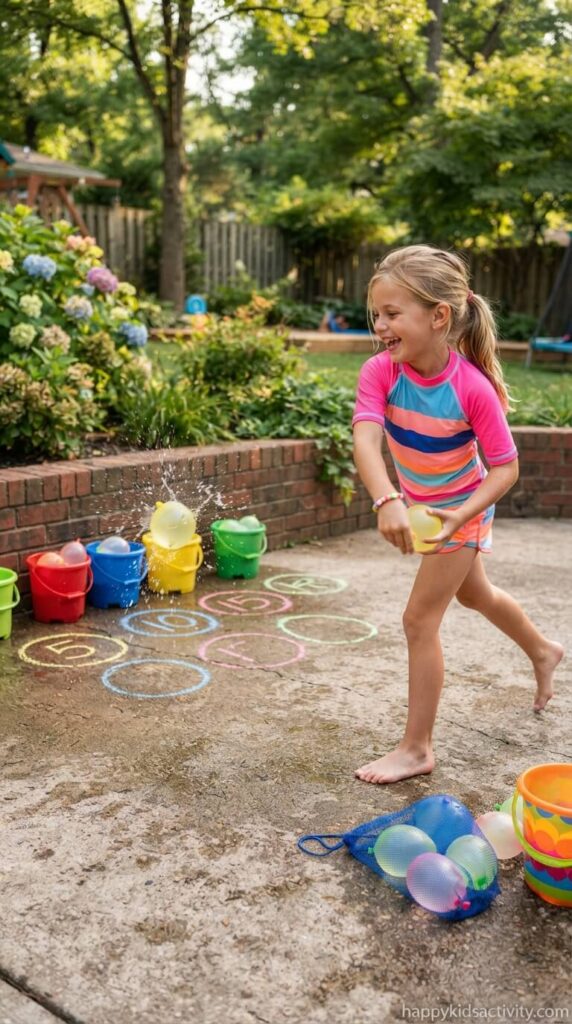
If you have a kid who cannot catch, or a wide age spread, start here. This is the most inclusive game on the list.
Ages: 3 and up. The best mixed-age option here.
Time: 10 minutes to draw targets, 15 to 20 minutes of play, 10 minutes of cleanup. This game generates the most latex on the ground.
Mess level: 4 out of 5.
Supervision: Line of sight the whole time, and you enforce the throwing lane.
How to Play
- Draw four or five chalk circles at different distances, or set out hula hoops, buckets, and laundry baskets.
- Write point values inside: 5 for the close ones, 10 for the middle, 25 for the far or small ones. Let a kid do the writing.
- Mark one throwing line. Everyone throws from behind it, one kid at a time, all in the same direction. No exceptions to this one.
- Five balloons per turn. Add up the points.
- Reset the targets between rounds, because buckets get knocked flying.
Tip: Fill your bucket targets a third of the way with water so they stay put. Empty buckets skitter across the lawn and somebody will chase one straight into the throwing lane.
Adapting for Different Ages
A 4 year old lobbing balloons into a kiddie pool from three feet away is having the exact same amount of fun as the 11 year old going for the 25 point ring, which is rare and worth using.
Safety note that is not optional: this is the only game where balloons get thrown hard. One direction, one thrower at a time, and never at another kid. A balloon that does not burst on impact is a water-filled ball, and it hurts.
Adapt it down: A kiddie pool or laundry basket as one giant target, three feet away, counting hits instead of points.
Adapt it up: Timed rounds, non-dominant hand, or a moving target with an adult walking a hula hoop back and forth.
5. Water Balloon Relay Toss
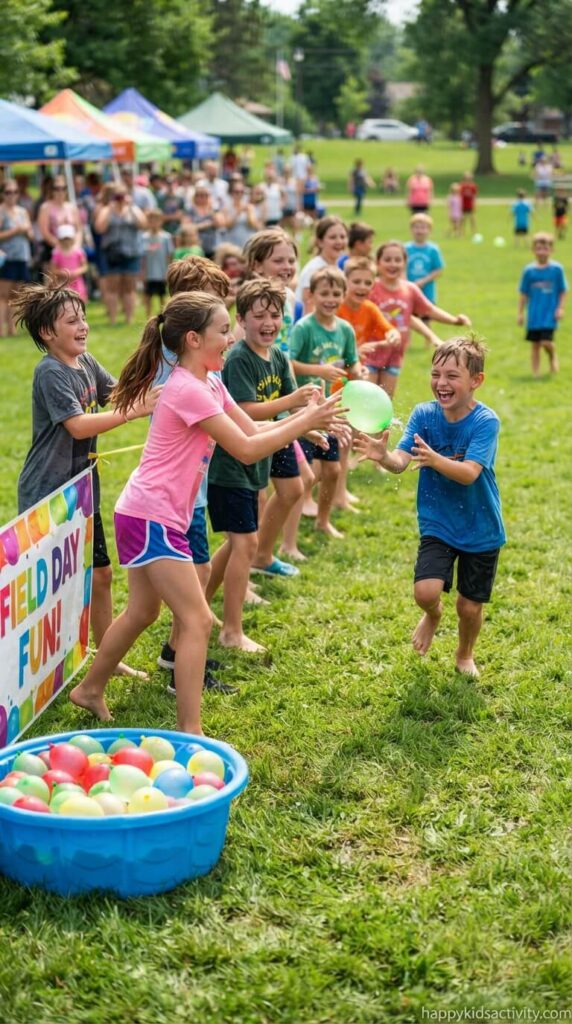
The loud one. Save it for last, because it eats your entire balloon supply and soaks everybody.
Ages: 6 and up, ideally eight or more kids. Time: 5 minutes to set up, 10 to 15 minutes of play, 10 minutes of cleanup. Mess level: 4 out of 5, with the fastest balloon burn rate on the list. Supervision: Hands-on. You are the starter, the timer, and the referee.
How to Play
- Split into two teams, single file, about four feet between kids. Closer than that and they just hand it over; much farther and the balloon never survives the trip.
- Full bucket at the front of each line, empty bucket at the end.
- On “go,” the first kid grabs a balloon and tosses it to the next in line. Tosses, not handoffs.
- It travels down the line to the last kid, who sets it in the empty bucket. One point.
- Put two minutes on the clock. Most balloons in the bucket wins.
Tip: Put your youngest or least coordinated kid at the very end of the line, right next to the bucket. Shortest toss, most important job, guaranteed win.
Building Team Spirit
Two teams going at once creates real urgency, and it is the format that works best for camps, school field days, and parties big enough to split.
One change from how you probably learned it. The traditional rule is that a popped balloon sends the whole team back to the start. That is fine with a line of 10 year olds at camp, and it falls apart with a mixed-age group, because one kid becomes the reason everybody lost and it is a long walk back to the front of the line. Timed scoring keeps every kid moving and nobody carrying the blame.
Skip it for: Groups under six, and kids who take a public loss hard.
Adapt it down: Handoffs instead of tosses, with a two-foot gap. Adapt it up: Over-under passing down the line, or backward tosses over the head.
Practical note: This is the game where your balloon supply vanishes. Two teams of six will go through fifty balloons in about eight minutes, so run it last unless you enjoy standing at the hose while twelve kids watch you.
6. The Spoon Balance Toss

The egg-and-spoon race, wet. This is the one I use to bring the temperature down when everyone is overheated and yelling.
Ages: 6 and up. It needs a bit of fine motor control.
Time: 5 minutes to set up, 10 minutes of play, 2 minutes of cleanup. Driest game here by far.
Mess level: 1 out of 5.
Supervision: Check in occasionally. Low risk all around.
How to Play
- Fill a handful of balloons small, roughly plum-sized. Standard balloons will not sit in a spoon.
- Give each kid a big serving spoon. Wooden spoons are too shallow. A metal soup ladle or a slotted serving spoon holds a small balloon far better, and Dollar Tree has both.
- Walk from the start line to a finish line about twenty feet away, one hand on the handle only.
- At the line, partners face each other and tip the balloon from one spoon to the other. No hands.
- A clean transfer is a point. Drop it and you go back for a new balloon.
Tip: Run this one right after the relay. It pulls the energy down on purpose, and it buys you five quiet minutes to refill the bucket.
Why Kids Love It
Balancing something that might burst takes total concentration, and you can watch kids narrow in on it. It is the only game here that makes a loud group go quiet.
What kills it on the first try is balloon size. Too big for the spoon and the game is over in sixty seconds. Fill small, smaller than feels right. Also know that a real spoon-to-spoon toss is harder than it sounds; most kids under 8 need the “tip it over from two inches away” version rather than an actual toss.
Skip it for: Kids under 5, and kids who lose patience with precision tasks. If your kid is a spoon-thrower, this is not the one.
Adapt it down: Carry the balloon on a small plastic plate or a frisbee with both hands and skip the toss entirely. Adapt it up: Full relay format, or lay a pool noodle across the path to step over halfway.
Tips for Running a Smooth Water Balloon Game Session
Fill to two-thirds, and judge it by squish rather than size. A good balloon wobbles like a beanbag. A drum-tight one bursts while you are still tying it.
Fill within an hour of playing. Filled balloons left in the sun expand and start popping on their own, and a bucket of them sounds like popcorn going off. Keep them in the shade, or in an empty cooler with the lid cracked.
Do the math before you start. Eight to ten balloons per kid, minimum. Hand-filling and tying takes me 20 to 30 seconds each, so sixty balloons is close to half an hour. Recruit a second adult, or draft the oldest kid.
Bunch O Balloons are the fast option and the expensive one. The box claims 100 in a minute. In my yard it is more like forty usable balloons per bunch after a few burst on the stem, and every single one leaves a small rubber band in the grass to find later.
Run the hose for 20 to 30 seconds before you fill anything. Water that has been sitting in a hose in the sun comes out hot enough to hurt a kid’s hands.
Set the filling station away from the play zone. Wherever the hose lives becomes mud.
Grass only. Not the patio, not the pool deck, not the driveway for the running games. Wet concrete plus sprinting kids equals scraped knees and one crying kid.
Order your games on purpose: dry-ish first (spoon balance, target practice), soakers last (relay, musical balloons). Once kids are drenched, nobody will stand still for a precision game.
Pick up the latex while it is still wet. Wet fragments are shiny and easy to spot. Dry ones curl up, blend into the grass, and reappear in the mower or the dog’s mouth for weeks. I hand out a bucket and make it a race with a freezer pop on the line, and the yard is clear in five minutes.
Safety Considerations to Keep in Mind
These games are low risk, but the hazards that do exist are real, and one of them is serious.
Balloon pieces are a choking hazard. The warning printed on every bag is federally required, and it says children under 8 can choke or suffocate on uninflated or broken balloons. Latex is soft enough to mold to a small airway, which is what makes it more dangerous than a hard object of the same size. Broken pieces get discarded immediately, not at the end of the party.
Under 3s do not get loose balloons at all, filled or empty. Give a toddler a job instead: carrying the bucket, dropping balloons into a kiddie pool with you sitting right there, or squeezing a tub of them in the shade under direct supervision.
Practical note: count roughly how many balloons you filled, so you know how many pieces you are looking for at the end. It sounds fussy until you have watched a dog trot off with a piece of latex in its mouth. Dogs and local wildlife will eat these.
Ask about latex allergies before a party. Latex allergy is common enough that it belongs in the invite along with food allergies. If a guest has one, switch that kid to sponge balls or reusable silicone balloons and keep them out of the popping games.
Water only inside the balloons. No water beads, no flour, no small toys, nothing frozen. Water beads are dangerous if a child swallows them because they expand, and a frozen balloon is a rock.
No balloon launchers or three-person slingshots for kids. A balloon out of one of those travels fast enough to injure an eye, and it is the one piece of water balloon gear I keep out of the yard entirely.
Never at the head or face, in any game. Popping a balloon over your own head is fine, over somebody else’s is not, and glasses come off first either way.
Watch the noise. Keep the speaker at a moderate volume for musical balloons, because the combination of a sudden silence and a bang startles young kids, and give any noise-sensitive kid a role outside the circle.
Adults do the sharp and high-pressure parts: cutting sponges into strips, opening packaging, and running a hose nozzle at full pressure.
Heat is the sneaky one. Cold water on the outside does not mean a hydrated kid. Water bottles in the shade, sunscreen reapplied after towels, and a walk of the yard first for sticks, rocks, bees in the clover, and anything the dog left behind. Bare feet grip wet grass better than wet sandals, which is why we play barefoot, but only after that sweep.
Common Mistakes Parents Make With Water Balloon Toss Games
Filling the night before. They go soft, they weep water, and a good number of them are on the garage floor by morning. Fill within the hour.
Filling them too full, which is the single most common reason a game ends in four minutes.
Not filling enough of them. Forty balloons for eight kids is one game, not an afternoon.
Filling during the party. If you are at the spigot while twelve kids wait, you have lost control of the afternoon. Prep in bins ahead of time, or put another adult on refill duty.
Starting with the soaker games. Once everyone is drenched, the calm games are unplayable.
Running elimination rules with a wide age spread. Your 4 year old goes out first every single time, and then you have a 4 year old on your leg.
Playing on concrete because the grass is uneven. Take the uneven grass.
Skipping the shard sweep because the kids are hungry. It takes five minutes now and thirty minutes across the next three weeks if you skip it.
Pairing kids by who is friends with whom. Pair by size and throwing strength, then let them be friends about it afterward.
Forgetting that wet kids have to get home. A plastic grocery bag for wet clothes in each family’s car solves a problem you would otherwise discover at pickup.
Frequently Asked Questions
Are water balloon games safe for a 3 year old?
With changes, yes. Skip the tossing and popping games and let a toddler drop balloons into a kiddie pool from two feet away, or squeeze a tub of them in the shade. The hard rule is that balloons and balloon pieces are a choking hazard for children under 8, so a 3 year old needs an adult within arm’s reach and every broken piece cleared right away.
How many water balloons do I need for 10 kids?
Plan on 80 to 100 balloons for about an hour of play, which works out to 8 to 10 per child. Fast games like the relay toss and target practice go through them in minutes, while the step-back toss and spoon balance toss use a small fraction of that.
How do I fill water balloons fast without a hose attachment?
Stretch the balloon over your kitchen tap, or push the neck of a plastic water bottle into the balloon and squeeze. Both work and both are slower than a $4 hose nozzle. Bunch O Balloons style bunches are the fastest option, the most expensive per balloon, and the messiest to clean up because of the rubber bands.
Can you play these games without a big yard?
Four of the six work in a driveway or a small patch of grass: the step-back toss, spoon balance toss, musical balloons, and target practice. The relay and towel toss need roughly 30 feet of clear ground. A park with a grassy strip works, though check the rules first, because some parks ban balloons outright. small space and apartment-friendly summer water activities.
How do I clean up broken water balloon pieces from the grass?
Collect them while they are still wet, when they are shiny and easy to spot. A bucket plus a five minute scavenger hunt with a popsicle prize clears most of it, and a leaf rake gets the rest. Do not mow until you have swept, or you will shred the pieces into confetti you will never find.
Are reusable or biodegradable water balloons worth it?
The reusable silicone kind (two magnetic halves that seal themselves) are worth it if you do this often, because you refill a dozen at once by dunking them in a bucket and there is nothing to pick up afterward. The trade-off is that they hold less water and never pop, and some kids feel cheated by that. Latex balloons labeled biodegradable still take a long time to break down and are still a choking hazard, so they do not change your cleanup job at all.
Read Next
If your kids get hooked and want more than tossing, our full roundup of water balloon games for kids covers the stomp, dodge, and piñata versions, which is where to go next once these six get familiar.
And for the days when you cannot face filling a hundred balloons,backyard water games with no balloons, using sponges and a sprinkler gets you the same soaked, happy kids with about four minutes of setup.
Conclusion
Start with two games, not six. Pick the classic step-back toss and target splash practice, fill sixty balloons while the kids are still inside, and keep the other four in your back pocket for when the energy dips. Set an empty bucket by the back door before anyone comes out. That is the difference between a great afternoon and finding latex in your lawn in October.