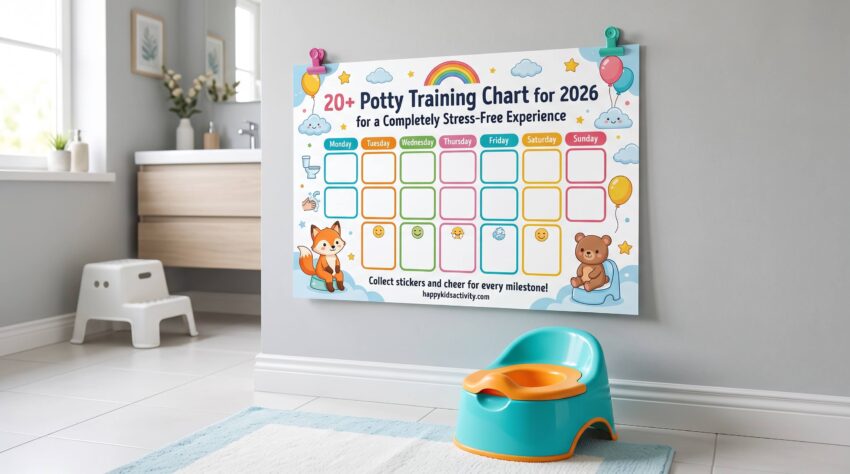
It was 4:52 on a Tuesday. Chicken in the oven, my 2 year old standing in the kitchen in one wet sock, looking at the floor like it had personally betrayed her. Third accident that day.
I had a brand new potty, a stack of tiny underwear with foxes on it, and no plan at all.
What actually moved the needle was not the potty. It was a piece of printer paper taped to the bathroom wall and a sheet of foil star stickers she was not allowed to touch unless she earned one.
That is the whole idea. A toddler cannot picture progress. They can absolutely see a chart filling up, and they want to be the one who fills it.
Below you get 24 chart themes, the age each one actually suits, what it costs to put together (including free versions), and the parts nobody mentions. Like how your kid will figure out how to game the sticker system within about 48 hours.
What is a Potty Training Chart?
A potty training chart is a grid or a path on paper where your child marks every potty win. Sticker, stamp, checkmark, crayon scribble, it does not matter. What matters is that they put it there themselves.
Most charts come in one of two shapes, and the shape matters more than the cartoon on it:
- Grid charts run days down one side and times across the top (morning, after lunch, before bath, bedtime). Good for spotting patterns, good for handing off to a babysitter or grandparent.
- Path or build-up charts move one character from start to finish, or stack one thing higher (a rocket to the moon, scoops on an ice cream cone). Better for kids under 3, because there is one obvious direction and one obvious ending.
Toddlers do not understand “you are making progress.” They understand “there are six stars and I put every single one there.” The chart takes a skill that happens invisibly inside their body and puts it on the wall at their height.
Practical note: Keep it to 5 to 10 boxes. I started with a printable 28 box monthly grid and my daughter looked at it, added two stickers, and never asked about it again. Twenty-eight empty squares reads as failure to a 2 year old. Five squares reads as almost done.
What are Benefits of Using a Potty Training Chart?
The chart is not magic. It works because it fixes three specific problems: toddlers cannot see their own progress, they live entirely in the present, and they will do almost anything for a job that feels like theirs.
1. Motivation and Encouragement
Toddlers run on immediate proof. A sticker they place with their own thumb is proof, and the chart on the wall is a running record of it. Mine used to drag her grandmother into the bathroom to point at it.
Trade-off: Once they connect sticker to potty, some kids start producing three drops on demand, every ten minutes, all afternoon. Reward the trip, cap it at one sticker per genuine visit, and do not act impressed by attempt number nine.
2. Consistency
A chart on the wall means everyone in the house is running the same play. Grandparents, a sitter, an older sibling who likes being in charge, they can all see when the last potty break happened without asking you.
Trade-off: Consistency cuts both ways. If the chart lives at home and daycare does nothing, your kid gets two sets of rules. Send a mini version (a business card sized strip with 5 boxes) in their bag so the win still gets marked.
3. Positive Reinforcement
Pairing a slightly scary thing with a small good thing makes the scary thing less scary. That is most of what this chart is doing. The flush is loud, the seat is cold, the whole setup is weird, and a sticker sits on the other side of it.
Trade-off: Rewards you hand out for free stop meaning anything. If your kid gets a sticker for walking into the bathroom, the sticker is now wallpaper. Keep the bar low but real.
4. Goal Setting
A chart is a first taste of “do the thing a few times, get the bigger thing.” Fill a row, earn a trip to the park. That is real skill building, not just bribery.
Trade-off: This is where age matters most. Under 3, the payoff has to land the same day, ideally within the hour. A “10 stickers and then Saturday we go to the zoo” plan is meaningless to a 2 year old and works fine for a 4 year old.
Is Your Child Actually Ready? Check This First
A chart cannot create readiness. If the body is not there yet, all the chart does is give you one more thing to nag about, and nagging is how you get a kid who clamps their legs shut at the sight of the bathroom door.
Most kids land somewhere between 18 months and 3 and a half years for daytime training, and readiness signs beat the calendar every time. Look for a few of these:
- Stays dry for about two hours at a stretch, or wakes up from a nap dry
- Tells you after they have gone, then eventually before
- Can pull elastic pants down and back up (mostly)
- Poops around the same time each day, or hides to do it
- Follows a two-step instruction like “grab your bear and come here”
- Complains about a wet or dirty diaper
- Is curious about the toilet, the flush, or what you are doing in there
Two or three of those and a chart will land. None of them and you are early. Wait two or three weeks and try again, nothing is lost.
Adapting for younger kids (18 months to 2 and a half): Big stickers only, 5 boxes max, one sticker for sitting down at all. Peel the backing yourself and park the sticker on the back of your hand so they can grab it. Skip week-long goals entirely.
Adapting for older kids (3 and a half and up): Skip the cartoons, they will find them babyish and tell you so. Use tally marks, a points column, or a checklist they fill in with their own pen. Let them design it. A 4 year old who drew their own chart will defend it.
Realistic time: 10 minutes to print and hang a chart, 15 to 20 minutes if you are drawing one from scratch with your kid helping, and about 10 seconds per sticker moment after that. Cleanup is basically nothing for the chart itself. The training around it is the messy part, and that runs in weeks, not days.
When to call the pediatrician instead of printing a chart: If your child is holding poop for days, crying or straining, leaking small amounts, or was trained and suddenly is not (especially with fever, tummy pain, or complaints about burning), that is a call, not a motivation problem. Constipation and urinary tract infections both look exactly like stubbornness from the outside.
What You Need to Make One (and the Free Version)
You can spend forty dollars on this or nothing at all. Nothing at all works about as well.
| What you need | What I use | Free or cheap swap |
| Chart | Printed potty training chart on cardstock | Sharpie and a sheet of printer paper, or the flattened inside of a cereal box |
| Stickers | Dollar Tree sticker sheets, or Mrs. Grossman’s if you want ones that peel easily | Produce stickers off bananas and apples (free, and toddlers love them), crayon scribble in the box, or a rubber stamp |
| Protection | Laminating pouch | Slide it into a clear plastic page protector or a gallon zip bag, or run clear packing tape over the front |
| Reusable marks | Expo dry-erase marker on the laminated version | Crayola washable marker plus a damp cloth |
| Mounting | Command strips or blue painter’s tape | Fridge plus a magnet, or the back of the bathroom door |
| Reward stash | Shoebox with a few dollar store bits | Privilege rewards: extra story, choosing dinner, flashlight in the blanket fort |
Mess level: 1 out of 5 for making the chart, unless you hand a toddler a marker unsupervised, in which case you now have a mural. Cover the table, use washable markers only, and skip glitter glue entirely. Glitter in bathroom grout is forever.
Supervision: Making it together needs you at the table the whole time (markers, scissors, small stickers). Using it needs a glance every few minutes, not hovering.
Adults only: cutting with scissors, the laminator (it gets hot, and the cord is at grab height), and hanging it. No thumbtacks or pushpins at toddler eye level, ever. Tape or Command strips.
20 Potty Training Chart Themes
Pick based on your kid, not on which one looks nicest on your wall. Whether you draw it yourself or buy a ready made potty training chart, the theme’s only job is to make them want to walk into the bathroom. There is a scannable table right after these if you would rather compare at a glance.
1. Dinosaur Potty Adventure
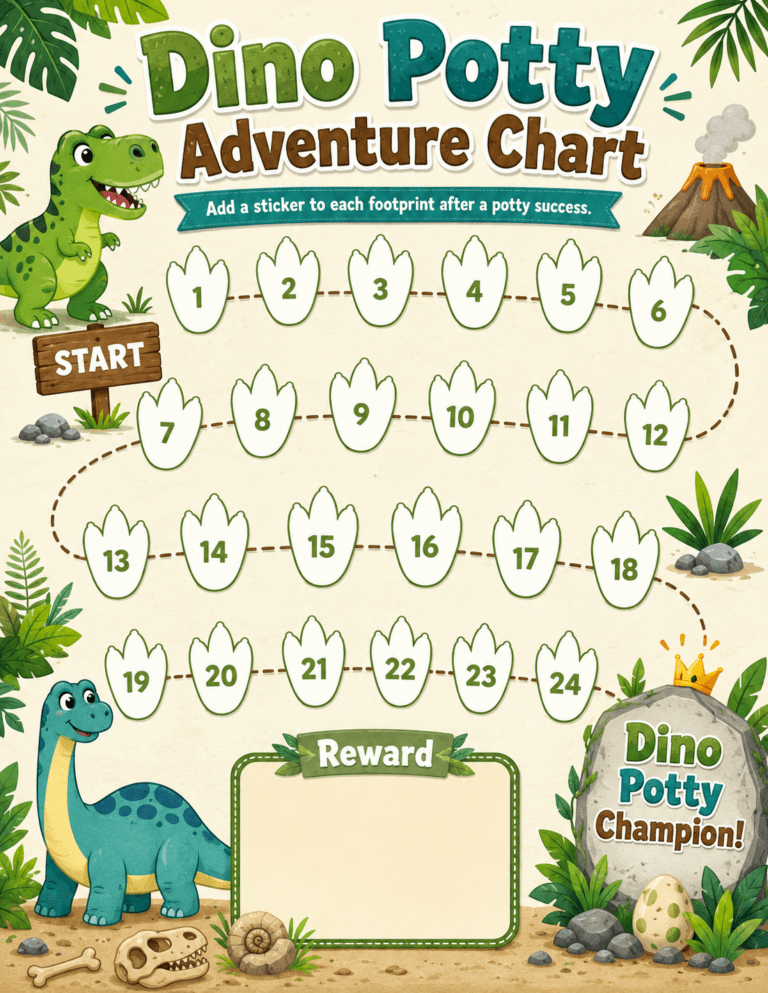
Footprints wind across a jungle path and each success moves your kid one stomp closer to the end. Dino egg stickers and footprint stickers both work, and the walk to the bathroom becomes a stomp, which gets a reluctant toddler moving without an argument.
Best for: Ages 2 and a half to 4, the kid who can already name six dinosaurs.
Heads up: Dollar store dino stickers are often tiny and slick, which small fingers hate. Also drop the roaring at bedtime unless you enjoy a wired kid at 8pm.
2. Star Sticker Chart
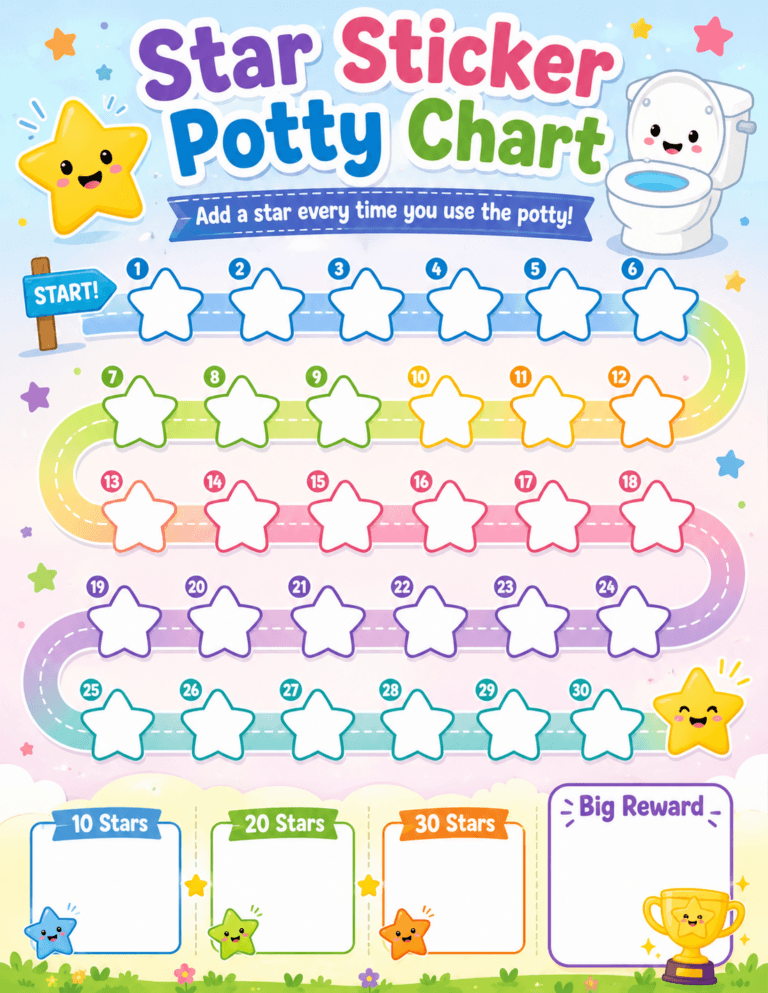
The one I keep coming back to. A grid, gold foil stars, done. Five stars gets something small today, and everybody understands what a star means without any explaining.
Best for: Ages 2 to 5, any kid, any stage. The safest first choice.
Heads up: Foil stars are thin and stick to fingertips instead of paper. Peel it and park it on the back of your hand for them to grab, or buy puffy stars instead.
3. Garden Growth Chart

Starts as bare dirt and grows: seed, sprout, then a flower. The pacing is calm and the message is nice, that things grow a bit at a time.
Best for: Ages 3 to 5, kids who like plants, animals, quiet things.
Heads up: Slow progress is the whole design, so a 2 year old will lose interest before anything blooms. Pair it with a same-day treat or skip it until 3.
4. Rainbow Progress Chart
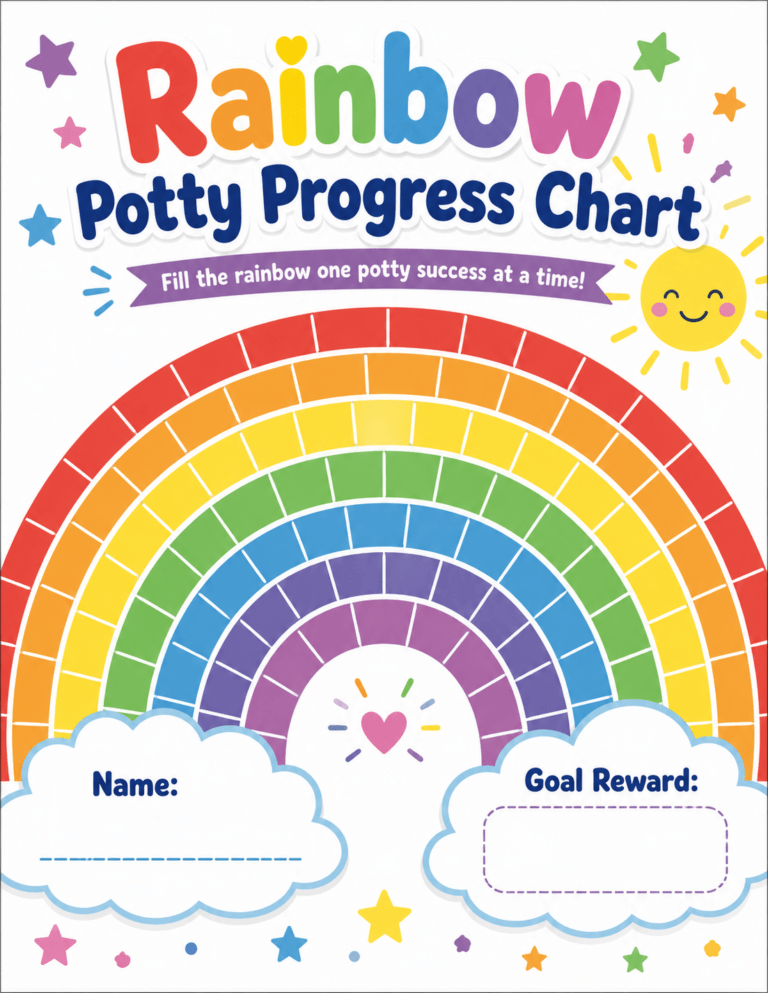
One arc of the rainbow gets colored in per win, so the chart gets brighter as the week goes. Handing over a Crayola washable marker instead of a sticker also helps kids who cannot peel yet.
Best for: Ages 2 and a half to 5, kids who would rather color than stick.
Heads up: Leave the markers within reach and you will come back to a fully colored rainbow and zero potty trips. Markers stay with you.
5. Classic Reward Chart
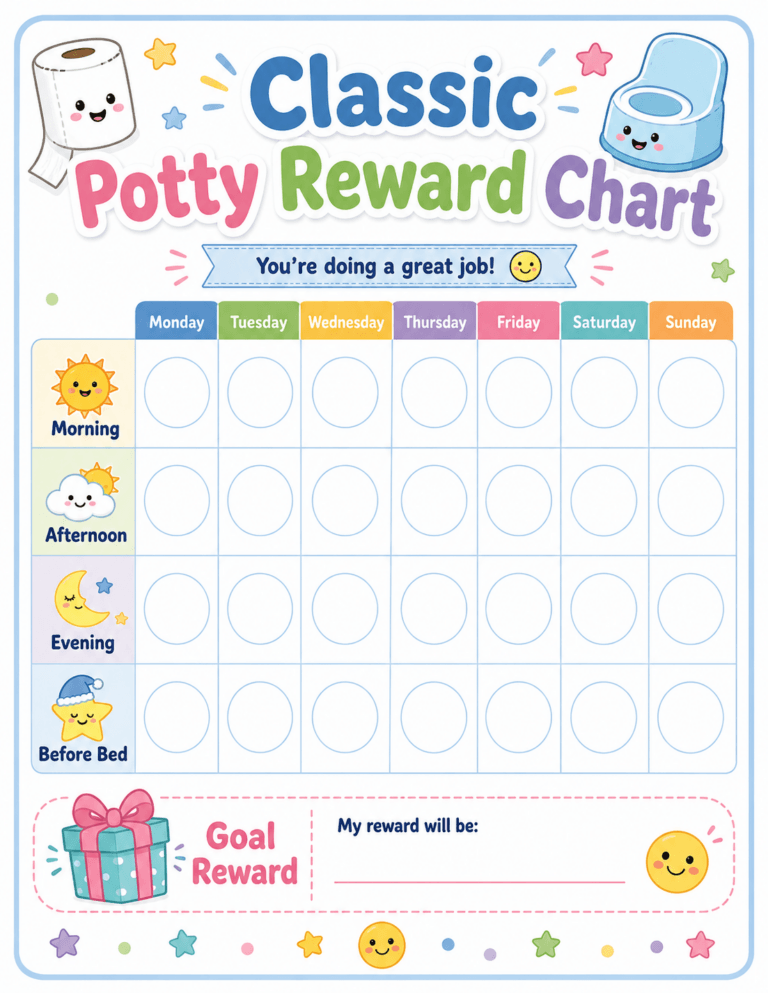
Plain grid: days down the side, morning, afternoon, evening, bedtime across the top. No characters. This is the one to use if a sitter or grandparent needs to read your chart in three seconds.
Best for: Ages 2 to 5, routine-loving kids, and any house with multiple caregivers.
Heads up: Seven days by four slots is 28 boxes, which is demoralizing. Fold the future rows back or cover them with painter’s tape and reveal two days at a time.
6. Pirate Treasure Map Chart
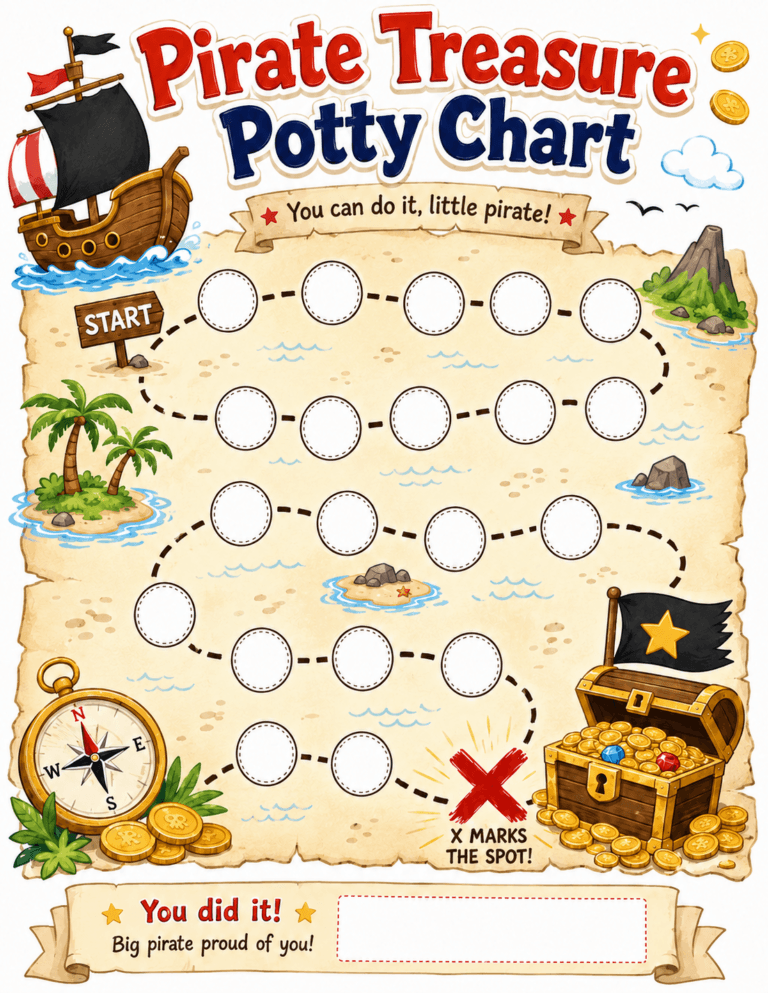
A dashed line crosses islands toward a big X. Each sticker sails the ship one stop further. The story pulls kids along, which is why it holds up over a full week better than most.
Best for: Ages 3 to 5, kids who like a plot.
Heads up: The treasure has to actually exist. Decide what is in the chest before you hang the chart, because “we will see” at the X is how you lose all credibility for the next chart too.
7. Princess Potty Reward Chart
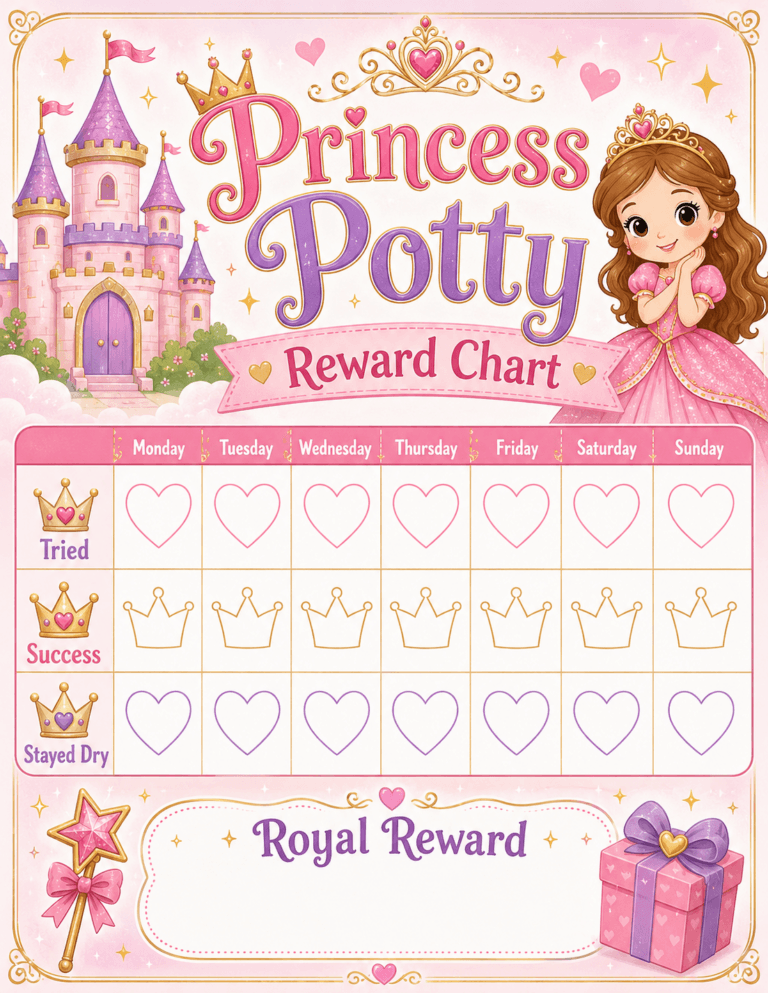
Jewels get added to a paper crown, or towers to a castle, one per potty win. It leans on pretend play, which is exactly the age this lands.
Best for: Ages 2 and a half to 4 and a half, kids deep in dress-up.
Heads up: Skip the stick-on plastic gems for anyone under 3. They are choking sized and they end up in noses, ask me how I know. Flat printed jewel stickers only.
8. Superhero Potty Mission

Badges, lightning bolts, shields. Each win earns another badge and the language does the work: “potty mission complete.”
Best for: Ages 3 to 5, high energy kids who are already running everywhere.
Heads up: Mission framing lands badly on a kid who is scared of the toilet. A frightened kid does not want a challenge, they want you sitting on the floor next to them. Read the room before going big.
9. Space Rocket Chart
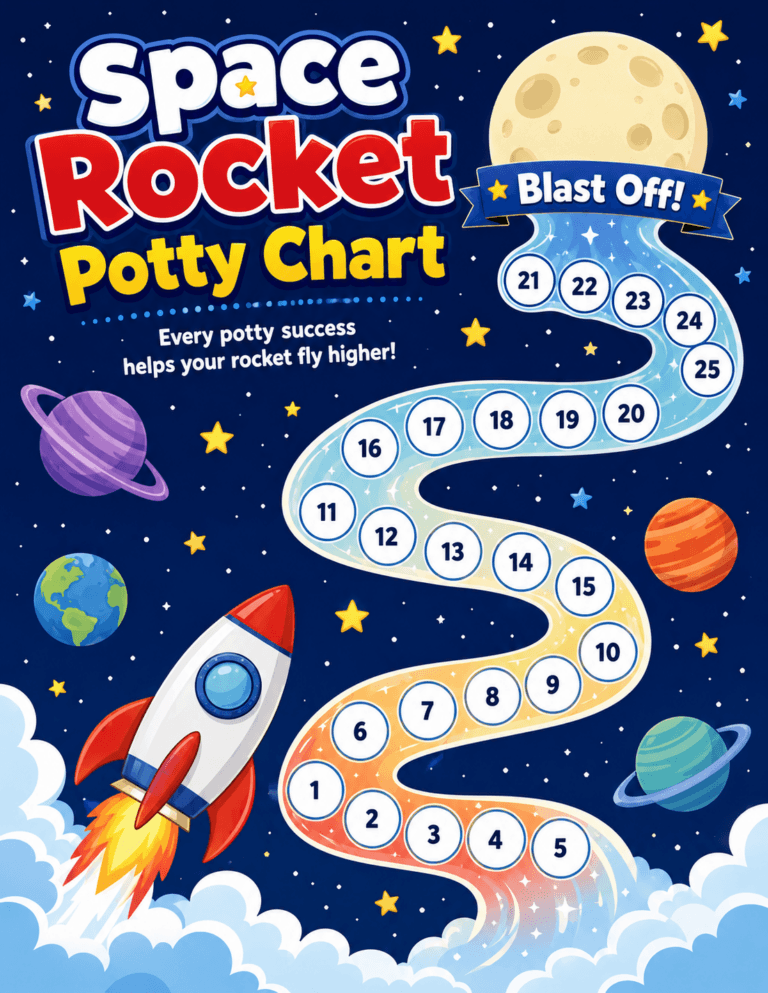
Stickers move the rocket up toward the moon, and the countdown gives you something to say at every trip. Very clear finish line.
Best for: Ages 3 to 5, space obsessed kids.
Heads up: Blast off ends the chart, and that ending can flatten motivation overnight. Have the next chart printed before you launch.
10. Unicorn Magic Chart
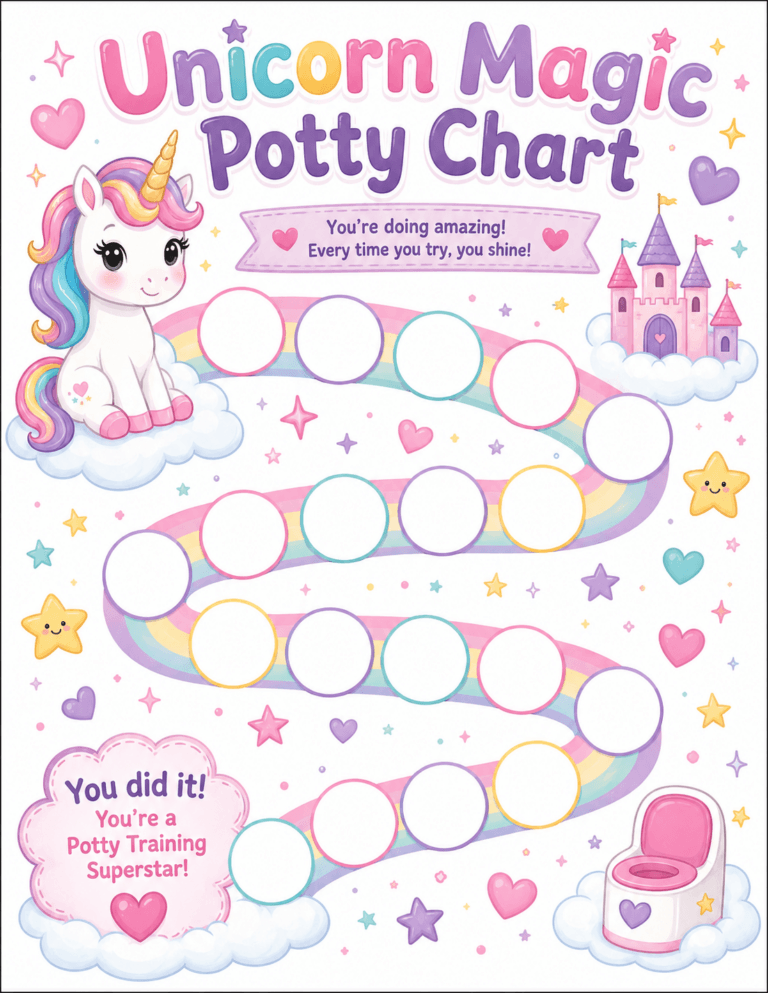
Clouds, rainbows, sparkles, and every sticker is “a bit more magic.” Soft and non-threatening, which is why it works on anxious kids.
Best for: Ages 2 and a half to 4 and a half, kids who need the whole thing to feel gentle.
Heads up: Glitter stickers shed. Glitter plus a bathroom floor plus wet feet equals glitter in your grout until spring. Matte stickers if you care about your floor.
11. Farmyard Potty Chart

A barn or pasture fills up with cows, pigs, ducks, and sheep, and your kid picks which animal goes on next. That small choice is the real motivator, not the barn.
Best for: Ages 2 to 4, kids who already do animal sounds.
Heads up: Choosing takes four minutes when you are late. Offer three animals, not the whole sheet.
12. Ocean Adventure Chart

Blue water, coral, turtles and dolphins added one at a time. Calmer visually than the truck and superhero charts, which matters if bright busy artwork winds your kid up.
Best for: Ages 2 and a half to 5, sensory-sensitive kids.
Heads up: Do not hang this one in the splash zone or near the shower. Steam curls paper and lifts tape within about a week. Laminate it or move it to the door.
13. Animal Safari Chart
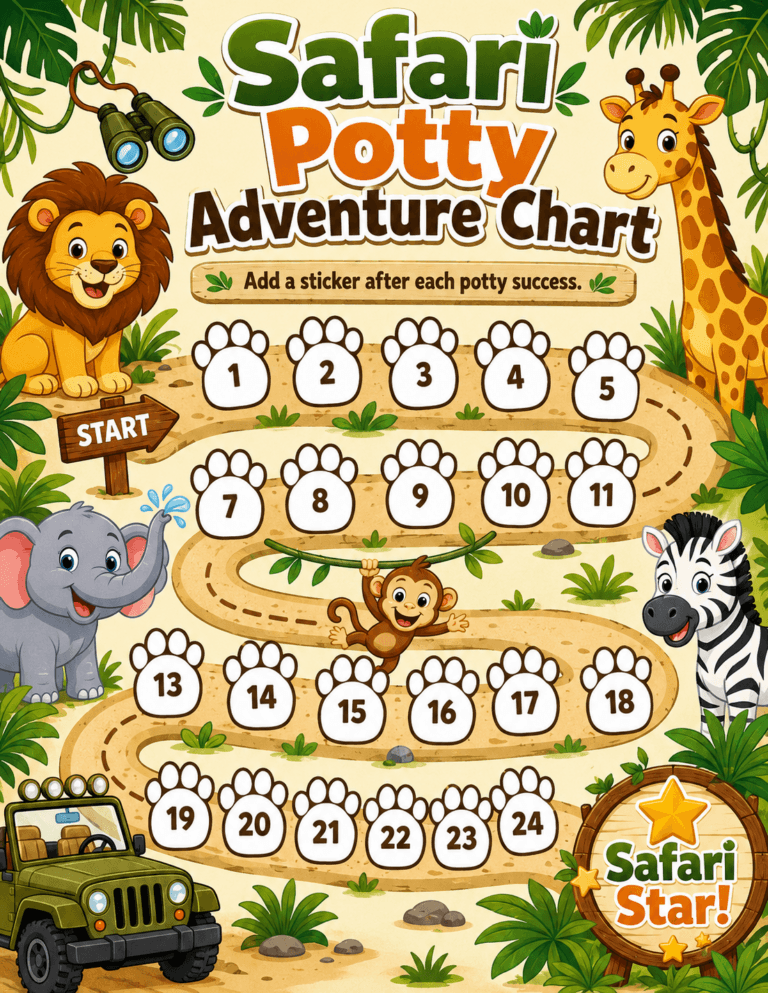
Lions, elephants, giraffes, zebras, monkeys, moving deeper into the safari with each success. The walk to the bathroom turns into a sound game, which is a useful trick for a kid who stalls at the door.
Best for: Ages 2 to 4 and a half, animal lovers, stallers.
Heads up: If the sound routine becomes part of the ritual, it becomes part of the ritual at 2am too. Fine if you can live with that, less fine if you cannot.
14. Train Track Chart

A railway winds across the page and each win adds one train car until there is a long train by the end of the week. The final stop can be the Big Kid Station, which is a phrase toddlers repeat for months.
Best for: Ages 2 to 4, the train obsessed.
Heads up: If a car goes missing or the order gets broken, expect a full meltdown over the sequence. Laminate it and draw the cars with a dry-erase marker instead of using stickers.
15. Construction Truck Chart
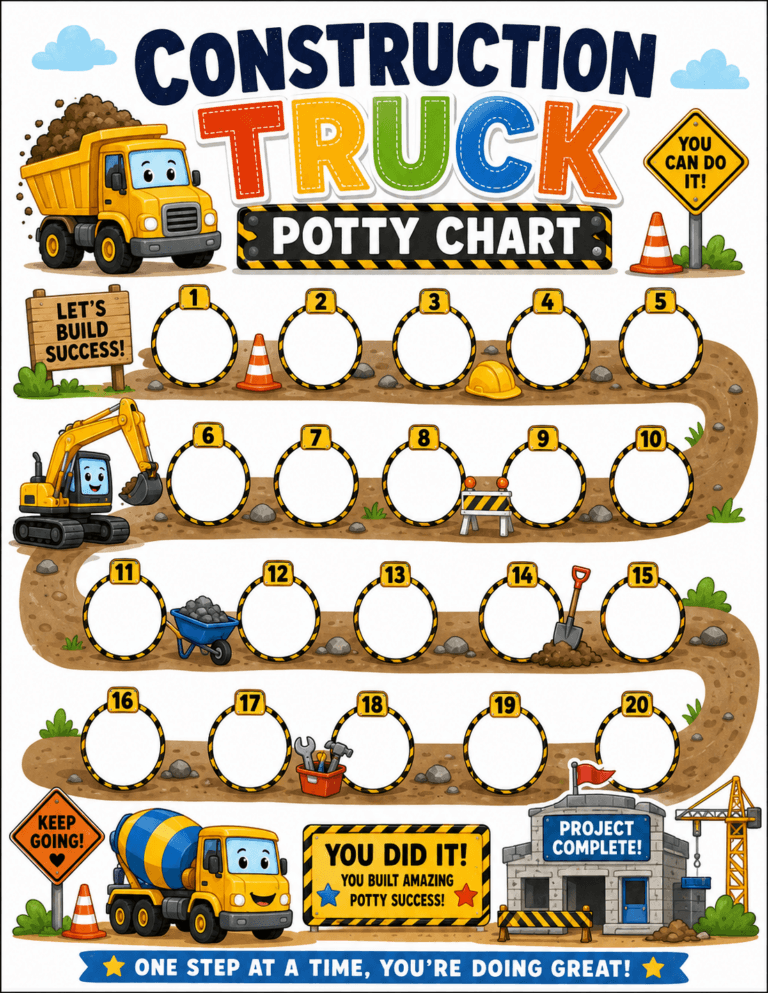
The site gets built load by load: dirt, beams, bricks, with excavators and dump trucks as stickers. Kids who narrate their own play love the running project.
Best for: Ages 2 and a half to 4 and a half, busy hands, truck kids.
Heads up: The “get back to work” framing slides into pressure fast. Keep it playful, and never use it as leverage when they are refusing.
16. Race Track Potty Chart
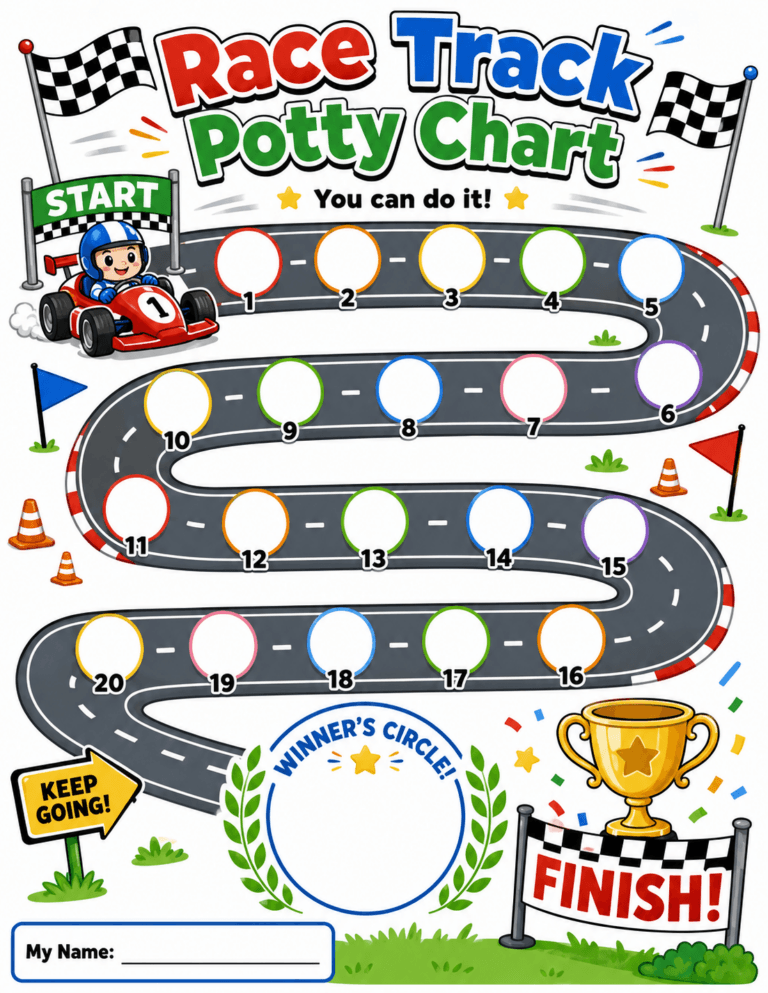
A car moves along a winding track toward the finish line. The forward momentum is what does the work, and it is the most competitive of the bunch.
Best for: Ages 3 to 5, kids who already race everything.
Heads up: Do not turn this into a sibling race. Potty training is the last thing that should be a competition between two kids. Separate charts, separate walls, separate rewards.
17. Bug and Butterfly Chart
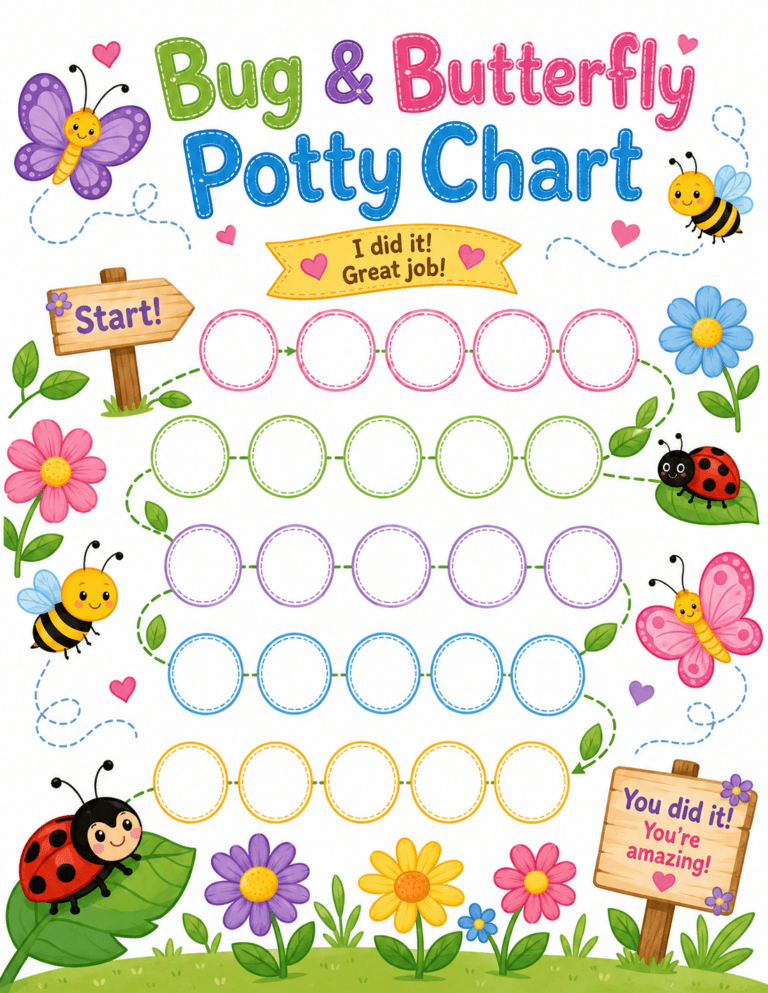
Ladybugs, beetles, butterflies added across a garden scene. Busier than the plain garden chart but still gentle, which makes it a good middle option.
Best for: Ages 3 to 5, outdoor kids.
Heads up: Plenty of toddlers are creeped out by bugs. Show them the sheet first and let them veto it.
18. Teddy Bear Reward Chart
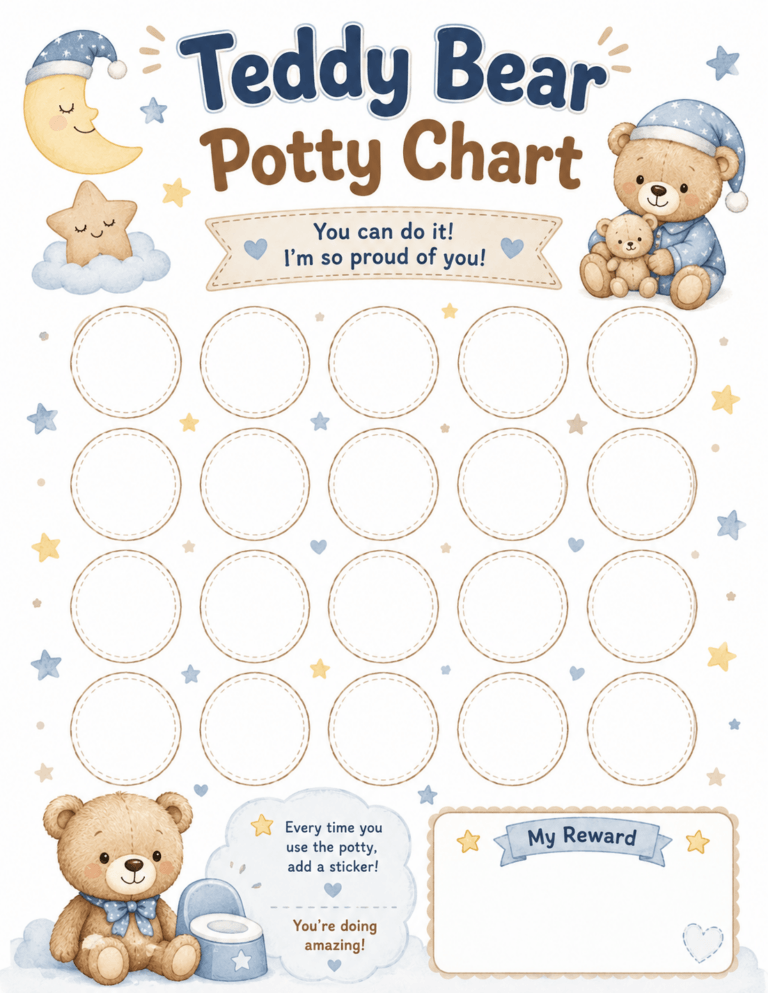
Soft bears at a picnic, one added per win. This is the chart for the kid who is nervous about the whole business, because nothing about it feels like a challenge.
Best for: Ages 18 months to 3, anxious or hesitant kids.
Heads up: A 4 year old will find it babyish and say so out loud. Keep it for the little ones.
19. Ice Cream Scoop Chart

An empty cone at the bottom, and every win stacks one more scoop on top. Building upward is the easiest kind of progress for a toddler to read, and a ten scoop tower gets a laugh every time.
Best for: Ages 2 to 4 and a half.
Heads up: They will ask for real ice cream. Decide your answer before you hang it, and do not promise a scoop per scoop unless you mean it.
20. Potty Champion Trophy Chart
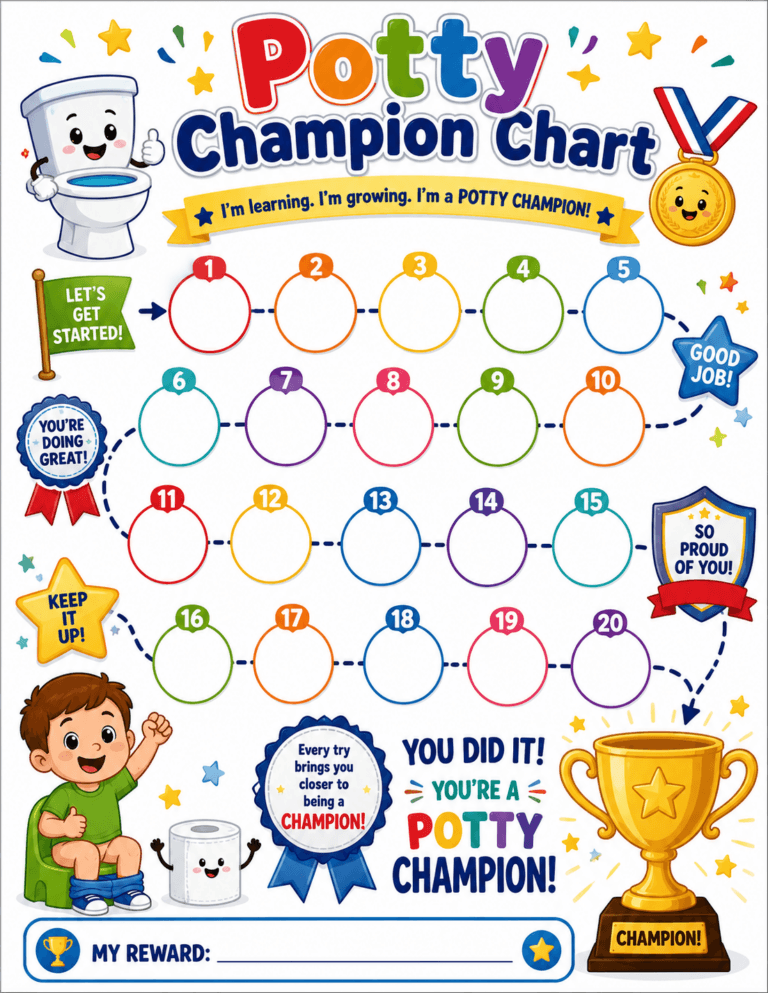
Checkmarks, ribbons, medals, and a trophy at the end. No storyline, just recognition, which is what older kids actually want.
Best for: Ages 4 and up, or any kid in the last stretch before they are fully trained.
Heads up: This one only works when they are mostly there already. A trophy chart during a week of three accidents a day reads as a scoreboard of failures.
4 Bonus Charts for Kids Who Do Not Care About Stickers
Some kids shrug at stickers. Mine did at first, and it took me an embarrassing amount of time to work out that peeling was the problem, not motivation. These four use a different currency.
21. Paper Chain Countdown
Loop ten paper links into a chain and hang it by the potty. Each win, they rip one off. The tearing is the reward, which is perfect for kids who like taking things apart.
Best for: Ages 2 and a half to 5. Costs nothing, five minutes with a stapler (you staple, not them).
22. Marble or Pom-Pom Jar
Drop one marble in a jar per win. The clink plus the rising line is satisfying in a way stickers are not.
Best for: Ages 3 and up only.
Safety, not optional: Marbles and pom-poms are choking hazards. The jar stays on a high shelf, you hand over one marble, and you skip this idea entirely if there is a baby or crawling sibling in the house.
23. Stamp a Square Chart
A self-inking stamper and a plain grid. No peeling, no fine motor frustration, and the thunk of the stamp is half the appeal. Melissa & Doug make chunky ones, dollar store ones work fine too.
Best for: Ages 2 to 5, especially kids who cannot manage sticker backing yet.
Heads up: Washable ink only, and expect a stamped forearm, wall, or dog. Check the pad says washable before it comes anywhere near a bathroom wall.
24. Tally and Trade Chart
No cartoons at all. Your kid makes a tally mark per win with their own pen, and a set number trades for something specific: park trip, chosen dinner, twenty minutes of a show.
Best for: Ages 4 and up, kids who feel patronized by unicorns and trophies. Also the best option for a late trainer who is embarrassed about it, because it looks like a grown-up list, not a baby chart.
Compare All 24 Charts by Age, Setup, and Mess
Scan this, pick one, move on. You have other things to do today.
| Chart | Best age | Style | Best for the kid who | Setup | Fades fast? |
| Dinosaur Adventure | 2.5 to 4 | Path | Knows every dinosaur name | Print, 10 min | No |
| Star Sticker | 2 to 5 | Grid | Just needs something simple | Print or draw, 5 min | No |
| Garden Growth | 3 to 5 | Build up | Likes calm, quiet things | Print, 10 min | Yes, slow payoff |
| Rainbow Progress | 2.5 to 5 | Build up | Would rather color than stick | Draw, 10 min | No |
| Classic Reward | 2 to 5 | Grid | Runs on routine | Draw, 5 min | No |
| Pirate Treasure Map | 3 to 5 | Path | Wants a story | Print, 10 min | No |
| Princess Reward | 2.5 to 4.5 | Build up | Lives in dress-up | Print, 10 min | No |
| Superhero Mission | 3 to 5 | Grid | Never stops moving | Print, 10 min | No |
| Space Rocket | 3 to 5 | Path | Is into planets | Print, 10 min | Yes, ends at launch |
| Unicorn Magic | 2.5 to 4.5 | Build up | Needs it all to feel gentle | Print, 10 min | No |
| Farmyard | 2 to 4 | Build up | Does animal sounds | Print, 10 min | No |
| Ocean Adventure | 2.5 to 5 | Build up | Gets overstimulated easily | Print, 10 min | No |
| Animal Safari | 2 to 4.5 | Path | Stalls at the bathroom door | Print, 10 min | No |
| Train Track | 2 to 4 | Path | Lines up every train | Laminate, 20 min | No |
| Construction Truck | 2.5 to 4.5 | Build up | Narrates their own play | Print, 10 min | No |
| Race Track | 3 to 5 | Path | Races everything | Print, 10 min | No |
| Bug and Butterfly | 3 to 5 | Build up | Digs in the yard | Print, 10 min | No |
| Teddy Bear | 18 mo to 3 | Grid | Is nervous about all of it | Print, 10 min | No |
| Ice Cream Scoop | 2 to 4.5 | Build up | Needs progress they can see | Draw, 10 min | No |
| Champion Trophy | 4 and up | Grid | Is almost fully trained | Print, 10 min | No |
| Paper Chain | 2.5 to 5 | Countdown | Loves ripping things | DIY, 5 min | No |
| Marble Jar | 3 and up | Build up | Likes sound and weight | DIY, 5 min | No |
| Stamp a Square | 2 to 5 | Grid | Cannot peel stickers yet | Draw, 5 min | No |
| Tally and Trade | 4 and up | Grid | Thinks charts are for babies | Draw, 5 min | No |
Every chart on this list is low mess (a 1 out of 5) unless you add glitter, paint, or an unsupervised marker. Assume most charts hold a toddler’s attention for roughly two to three weeks before you need to swap the theme or raise the goal. The “fades fast” column flags the two designs where the structure itself works against you.
Save this one for later. You will want it again when the novelty dies in week three and you need a new theme at 7am.
How to Use a Potty Training Chart
Six steps, and none of them take longer than a minute. The chart supports what your kid is already learning, it does not push them faster.
Step 1: Choose a Chart TogetherShow two or three options, not twenty, and let them pick. That one small decision flips the whole thing from your project to theirs, and it buys you real cooperation later when they are tired of it.
Ask straight out: “Do you want the dinosaurs or the trains?” A toddler who chose the trains will remind you about the chart.
Step 2: Write Their Name on ItBig letters across the top, their name, in their favorite color if they have one. Then hang it where they can actually reach it.
Here is the thing almost everyone gets wrong: we hang it at our eye level. Aim for the top edge of the chart at about your kid’s forehead height, which will feel absurdly low to you. Next to the potty is best, back of the bathroom door second best.
Tip: Painter’s tape or Command strips, not regular tape. Bathroom steam lifts standard tape off the wall within a week and the chart ends up behind the toilet.
Step 3: Decide the RewardPick it before day one, and say it out loud so there is no negotiating later. Small is fine. Free is fine. What matters is that it is specific: “five stars and we go to the park” beats “five stars and you get a treat.”
For kids under 3, the payoff has to happen the same day. Over 3, you can stretch it to a few days.
Step 4: Add a Sticker After Each SuccessRight then, in the bathroom, hands still wet from washing. Not later, not at bedtime. Toddlers connect the reward to whatever they did in the last minute or two, and that is the whole mechanism.
Practical note: Keep the sticker sheet out of reach and out of sight. Mine found the sheet on the counter and stickered the entire chart in about ninety seconds. You cannot un-give stickers, and that chart was finished. Medicine cabinet, top of the fridge, your back pocket, anywhere but the bathroom shelf.
Step 5: Celebrate EffortPraise the trying, not just the result. “You told me you needed to go, that is the hard part” does more than “good job.”
Keep it real though. Toddlers can tell the difference between you being pleased and you performing. A high five and a normal voice is plenty. Some kids find clapping and cheering overwhelming and will refuse the potty to avoid the fuss.
Step 6: Keep the Routine CalmSame times every day: after waking, twenty minutes after meals, before nap, before bed. Predictable beats frequent.
If they are crying, arching their back, or flat refusing to sit, stop. Clean up without commentary, put the chart aside, come back tomorrow. Pushing through a refusal is how a two week project becomes a two month standoff.
Tip: If your kid is climbing onto the toilet with a step stool, check that the stool does not slide on tile. Once they can climb, they will try it alone. Related reading if you are in that everything-is-a-ladder phase: best toys for climbing toddlers.
Simple Reward Ideas for Potty Training Charts
Small and immediate beats big and delayed, every time. If you start with a toy per success you will be buying toys for a month and your kid will still hold out for a better one.
Free, and often the most effective:
- One extra bedtime story, their pick
- Fifteen minutes of one-on-one play with you, phone in another room
- They choose dinner, or breakfast tomorrow
- They pick the movie or the next episode
- A trip to the park or the splash pad
- A phone call to grandma to report the news themselves
- A produce sticker off a banana, stuck to the back of their hand where everyone can see it
- Ten minutes of flashlight time under a blanket
Under five dollars:
- A new sticker sheet, puffy or scratch-and-sniff
- A coloring page or a cheap activity book
- One item from a shoebox of dollar store bits, kept up high
- Bath drops or a new bath toy for an extra-long bath
- A fresh pot of playdough
About food rewards. They work fast, which is why so many of us reach for them, and they are the hardest thing to phase out. If you use them, skip hard candy, whole nuts, marshmallows, popcorn, and anything small and round for kids under 4, all of which are choking hazards. Check labels for peanut and tree nut if there are allergies in your house or at daycare, and check what your daycare allows before you send anything in.
The reward your kid remembers is usually you. Undivided attention for ten minutes outranks anything plastic.
Tips for Making Potty Training Charts Work Better
- Start with a win they cannot fail. Day one, a sticker for sitting on the potty with clothes on is fine. Confidence first, accuracy later.
- Raise the bar slowly. Sitting, then telling you, then getting there in time. Move up when they are winning, not on a schedule.
- Cap the stickers. One per real trip. Otherwise you get a kid sitting down eleven times an hour producing four drops each time, purely for inventory.
- Never take a sticker away. Accidents are part of learning, not a debt. Removing a sticker is the fastest way to get flat refusal, and I have watched it happen.
- Laminate or use a page protector. Toddlers peel stickers back off. A dry-erase version also lets you wipe and reuse it for the next kid.
- Send a mini chart to daycare. A card sized strip with five boxes keeps the wins consistent across both places.
- Take a strip on the road. Cut off two days of the chart, tape it inside the hotel bathroom door, keep going.
- Brief the grandparents. One rule: stickers come from potty trips, not from being cute. Free stickers from grandma end the chart’s power in an afternoon.
- Expect the two to three week wall. When interest dies, swap the theme or change the currency (stickers to stamps, stamps to tally marks). It is boredom, not regression.
- Keep the chart with the potty. A chart in the bedroom and a potty in the bathroom breaks the link for a 2 year old.
Safety and Supervision Notes You Should Not Skip
A chart is low risk. The stuff around it is not, and a couple of these caught me off guard.
Small parts. Stickers, foam gems, googly eyes, pom-poms, marbles, and tiny reward toys are all choking and nose-stuffing hazards for kids under 3. The old rule of thumb still holds: if it fits through a toilet paper tube, it is too small for a child who still puts things in their mouth. Stickers on a sheet also get chewed, and a wad of wet sticker paper is a real choking risk for a toddler left alone with it.
Younger siblings. If there is a baby crawling around, everything above applies double, because the reward box on the floor is now a snack bar. Marble jars are out entirely until the youngest is past mouthing everything.
Adults only: scissors, the laminator (hot plate, hot output, cord dangling at grab height), and hanging the chart. Never iron a laminating pouch with a kid nearby. No thumbtacks or pushpins at a toddler’s eye level.
The bathroom itself. Once your kid goes in alone to add a sticker, that room needs a second look: cleaners and medications up high or locked, nothing electrical on the counter, a step stool that does not slide, and a toilet lid they cannot slam on their own fingers. Hand washing every time, with a stool at the sink so they can reach.
Markers and glitter. Washable only (Crayola washable and Expo are both fine on a laminated chart). Keep glitter glue out of it, and keep every marker away from faces and eyes.
Practical note: Skip the “you sit here until something happens” approach that some chart routines drift into. Long forced sitting is how kids start holding it in, and withholding causes constipation, which causes painful poops, which causes more withholding. Two or three minutes is plenty. If your child is straining, in pain, leaking, going days without a poop, or was trained and suddenly is not, call your pediatrician rather than adding stickers. Constipation and urinary tract infections both look like defiance from the outside.
Common Mistakes to Avoid
These are the ones I made, plus the ones I hear about most from other parents at pickup.
- Hanging it at adult eye level. If they cannot see it and touch it without help, it is decoration. Forehead height, theirs.
- Printing a 28 box monthly grid. Endless equals hopeless to a toddler. Five to ten boxes.
- Leaving the sticker sheet reachable. One unsupervised minute and the chart is fully stickered and finished.
- Rewarding the sitting instead of the going, then wondering why they now sit on the potty forty times a day.
- A prize at the end of the week for a 2 year old. They cannot hold a goal that long. Same day, or it does not register.
- Taking stickers away after an accident. Fastest route to potty refusal I know of.
- Talking about the chart constantly. Mention it at potty times. The rest of the day, let it be.
- One shared chart for two kids. Somebody is losing a race they did not enter, and it will not go well for either of them.
- Swapping themes every three days because today did not go well. Give a chart two weeks before you call it.
- Starting the week you also start preschool, move house, or bring home a baby. Big changes plus potty training equals regression. Pick a boring week.
- Regular tape in a steamy bathroom. It will be on the floor by Thursday.
- Buying the chart before checking readiness. The chart is the last step, not the first.
When the Chart Stops Working
It will, and usually around week three. Here is how to tell which problem you have.
They stopped caring. Boredom, not backsliding. Change the currency rather than the cartoon: stickers to stamps, stamps to tally marks, or move to the marble jar. New theme, same routine.
They are gaming it. Constant sitting for stickers means the reward is attached to the wrong action. Switch to one sticker per actual pee, and add a bonus for a poop, which is the harder skill.
They refuse the chart entirely. Usually the chart has picked up pressure it was never meant to carry. Take it down for a week. Keep the potty routine, drop the tracking, then let them choose a new one.
They were trained and now they are not. Look for a life change first (new baby, new room, new daycare, a house guest) and rule out constipation or a urinary tract infection with your pediatrician. Then restart gently at an easier level. Do not restart at the level they were at when it fell apart.
FAQs
Is a potty training chart safe for a 3 year old?
Yes, with two caveats. Keep stickers, gems, and small reward toys away from any child who still mouths things or has a crawling sibling, and make sure the bathroom itself is toddler safe if they will be going in alone to add a sticker.
How do I get sticker residue off the wall or the chart?
On painted walls, warm soapy water and the edge of an old credit card, working slowly, and test a hidden patch first because some paint lifts. On a fridge or tile, a dab of cooking oil on a cloth breaks the glue down. Easier answer: laminate the chart or slide it into a page protector from day one and the residue never happens.
What if my toddler licks or eats the stickers?
A swallowed paper sticker is usually harmless, but chewed sticker paper and small foil stars are a genuine choking risk, and toddlers push them up their noses too. Supervise, use bigger stickers, and switch to a stamp or a crayon mark if your kid mouths everything.
How long does a potty training chart take to work?
Buy-in often happens the first day, which is misleading. Daytime training usually runs in weeks, not days, and the chart’s novelty typically fades after two or three weeks even when training is going well. Plan to swap the theme or raise the goal at that point instead of assuming it failed.
Do potty training charts work for poop too?
They can, but pooping on the toilet is a separate skill that often lags weeks behind peeing, and holding it in is common. Give poop its own row and a bigger reward, never pressure or long forced sitting, and talk to your pediatrician if there is pain or several days between poops.
Should I use the chart for nighttime potty training?
Celebrate dry mornings if you want, but never penalize wet ones. Staying dry overnight depends on bladder growth and hormones your child cannot control by trying harder, and bedwetting is still considered normal well into the early school years. If it worries you, raise it with your pediatrician rather than raising the stakes on the chart.
Conclusion
The chart is a small tool doing one job: making an invisible skill visible to someone who cannot yet imagine tomorrow. It is not what teaches your child to use the toilet. Their body does that, on its own schedule, and the chart just keeps everyone cheerful while it happens.
One timing note for 2026: if your child starts preschool in the fall and the program expects them to be out of diapers, give yourself six to eight weeks of runway, not the last week of August. Training against a deadline is miserable for everybody.
Tonight, do this. Grab a sheet of paper, draw five big boxes, write their name across the top, and tape it to the wall at their forehead height next to the potty. Put the stickers on top of the fridge. Then tomorrow morning, after they wake up, walk in there together and see what happens.