
The best water balloon games for kids give every player a job instead of just a target, which is why Water Balloon Piñata, Fill the Bucket, and Towel Volleyball outlast a free-for-all fight by a mile. Pick a calm, hands-managed game (Drip Drip Splash, Wet Hot Potato) for toddlers, save Dodgeball and Baseball for kids seven and up, and buy at least 15 to 20 balloons per child so you’re not refilling every ten minutes.
It’s the last week of summer break, the kids have already rewatched everything, and someone just yelled “I’m BORED” for the fourth time before 10 a.m. You’ve got a bag of balloons in the freezer aisle receipt pile and a hose that works. What you don’t have is a plan, and a plan is the only thing standing between you and a two-minute water fight that ends with someone crying because they got hit in the face.
I’ve run every game on this list more times than I can count, usually with a mix of ages I didn’t get to choose (my kids’ friends show up in clumps of 4-year-olds and 11-year-olds, and everyone wants to play the same game at the same time). What follows is what actually works, what I got wrong the first few summers, and what I’d tell a friend at pickup if she asked “will my kid actually enjoy this?”
Quick Comparison: Which Game Fits Your Crowd
Practical note: If you only read one section, read this one. I’ve watched too many afternoons go sideways because someone picked Dodgeball for a group with a 3-year-old in it.
| Game | Best Ages | Time (prep + play) | Mess Level | Supervision |
| Classic Toss | 5+ | 5 min + 15 min | Low | Check in |
| Water Balloon Piñata | 3+ (with adult help) | 20 min + 20 min | Medium | Hands-on |
| Drip, Drip, Splash | 2-6 | 2 min + 15 min | Low | Hands-on |
| Towel Volleyball | 8+ | 10 min + 20 min | Medium | Check in |
| Fill the Bucket | 5+ | 10 min + 10 min | Medium-high | Hands-on |
| Dodgeball | 7+ | 5 min + 20 min | High | Hands-on |
| Spoon Race | 4-9 | 5 min + 10 min | Low | Check in |
| Backyard Bullseye | 5+ | 10 min + 20 min | Low | Check in |
| Water Balloon Baseball | 6+ | 5 min + 20 min | Medium | Hands-on |
| Wet Hot Potato | 3-8 | 2 min + 15 min | Low | Hands-on |
| Over-Under Relay | 6+ | 5 min + 15 min | Medium | Check in |
11 Engaging Water Balloon Games for Kids
1. The Classic Water Balloon Toss
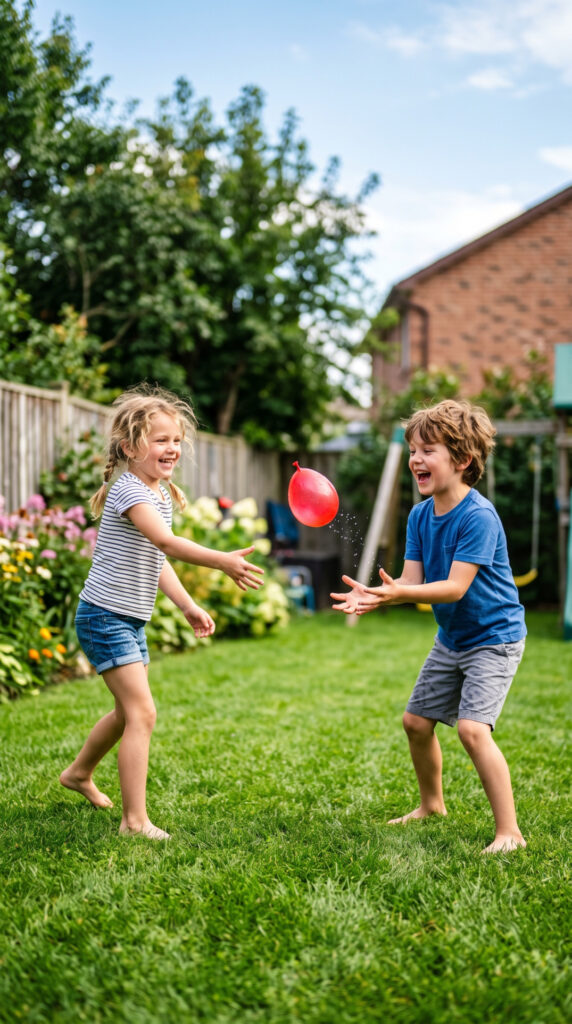
Ages: 5 and up works best. For kids under 5, skip the “step back” rule entirely and just let them toss back and forth from a fixed, close distance so the win is the catch itself, not the distance. For tweens, add a “no two-hand catches” rule to make it harder.
Time: 5 minutes to explain, 10 to 20 minutes to play depending on group size.
Two kids, one water balloon, and a rule that they take a step back after every catch. Nose to nose at the start, giggling. By round six or seven, they’re leaning across a real gap and one wobbly throw ends it in a splash.
Supplies and what they actually cost
- Water balloons, 3 to 4 per pair. A rapid-fill pack runs about $10 for 100 at most drugstores or Amazon. Free alternative: sandwich-size ziplock bags filled halfway with water and squeezed to push the air out work in a pinch, though they don’t pop as satisfyingly.
- A wide, flat grassy stretch. Free.
Mess and supervision: Low mess, mostly just wet grass. This one runs itself once you’ve set the rule; check in every few rounds to enforce the “start close” rule.
Steps
- Pair kids up, standing about two feet apart.
- Hand one balloon to one child per pair.
- On your signal, they toss it gently to their partner.
- Caught without popping? Both step back.
- Repeat. Dropped or popped balloon means that pair is out.
- Last intact pair wins.
Tip: Enforce the close starting distance no matter how much the older kids protest. Starting too wide ends the game in five seconds flat.
Common mistakes: Playing on concrete or a driveway. Every dropped balloon shatters instantly there, so nobody gets the lucky recovery bounce that makes this game fun on grass.
The trade-off: This is the easiest game on the list to set up and the first one to bore an 11-year-old who wants a real challenge. Great opener, weak closer.
2. Build-Your-Own Water Balloon Piñata
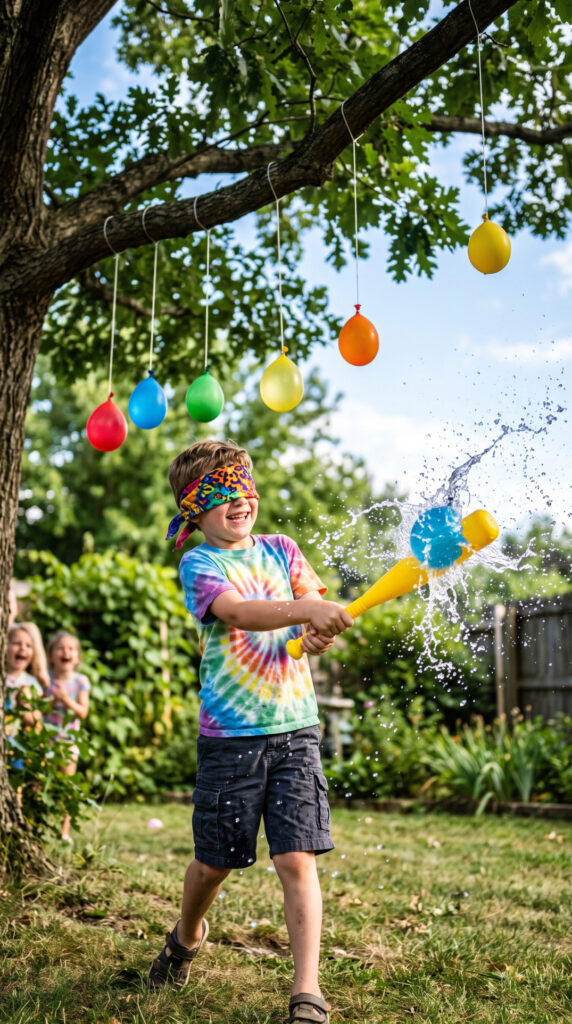
Ages: 4 and up for swinging, 3 and up if an adult holds the bat hand for the first few tries. Skip the blindfold under age 6.
Time: This is the one real project on the list. Budget 20 minutes to fill and hang balloons before anyone arrives, then 20 to 30 minutes of play.
This borrows the mechanics of a birthday piñata but soaks everyone instead of rewarding one lucky final swing. A coin or small waterproof prize hides inside 8 to 10 of the balloons, so every pop is part lottery, part cold surprise.
Supplies and what they actually cost
- Water balloons, 30 to 40. About $10.
- Twine or heavy kitchen string, about $3 a roll. Free swap: old shoelaces or leftover ribbon from gift wrapping.
- A low, sturdy tree branch or a clothesline strung between two porch posts.
- A plastic bat or pool noodle, $1 to $5. Free swap: a pool noodle you already own works better than a bat anyway because it can’t accidentally hurt anyone.
- A bandana for a blindfold, $1, or use one you already have.
- Optional prizes: waterproof coins, rubber duckies from the dollar store, or quarters. Total damage stays under $20.
Mess and supervision: Medium mess directly under the tree. This needs full hands-on supervision the entire time, especially the swinging part.
Steps
- Fill 30 to 40 balloons. Drop a coin or small prize into 8 to 10 before tying them off.
- Tie each balloon to a 12-inch length of string.
- Loop the strings over the branch about six feet up, spacing balloons a hand’s width apart so they swing freely.
- Line kids up eight feet back. Youngest swings first.
- Blindfold the swinger (skip for toddlers), spin once, and point them at the target.
- Three swings per turn. Whatever falls out of a popped balloon, they keep.
- Rotate until every balloon is gone.
Practical note: Hang the balloons at chest-to-shoulder height for your shortest player, not the tallest. I hung mine too high the first summer and got zero pops and one very frustrated 6-year-old in tears.
Tip: Color-code the strings, red for prize balloons, blue for plain water. The strategizing over which one to aim for genuinely doubles the suspense.
Common mistakes: Bunching the balloons too close together so the strings tangle and the whole rig drops at once. Space them out. Also, never use a real metal bat, a wild swing near a waiting kid needs to do zero damage.
The trade-off: Highest payoff on this list, but also the most prep. If you’re setting this up solo with a toddler underfoot, budget extra time or fill the balloons the night before and store them in a cooler.
3. Drip, Drip, Splash

Ages: 2 to 6 is the sweet spot. Older kids find it too tame.
Time: 2 minutes to explain, plays in quick 3 to 5 minute rounds, so it stretches to fill however long you need.
A wet twist on Duck, Duck, Goose. One kid walks the outside of a circle, tapping heads and saying “drip,” then picks someone, yells “splash,” and pops the balloon over their head.
Supplies: One balloon per round, cost is basically nothing. A sewing pin (adult use only).
Mess and supervision: Low mess, hands-on the whole time since you’re managing turn order with a group of young kids.
Steps
- Kids sit cross-legged in a circle facing inward.
- Give the “picker” a water balloon.
- They walk the outside, tapping heads, saying “drip.”
- When ready, they pick someone, yell “splash,” and press the balloon to pop it over that child’s head.
- That child chases the picker around the circle, trying to tag them before they sit in the open spot.
Tip: Have an adult pre-poke a tiny pinhole in the top of the balloon with a sewing needle before handing it over. It actually drips as the picker walks, and it pops more easily when pressed.
Common mistakes: Letting kids slam the balloon down hard on a peer’s head instead of pressing it. Also check that the running path is clear of slick, muddy patches before you start.
The trade-off: Great for mixed-age groups with little ones in the mix, but it moves slowly for kids over 7 who’ll want more action.
4. Towel Water Balloon Volleyball

Ages: 8 and up. The timing this requires is genuinely hard for younger kids and leads to a lot of frustration, not fun.
Time: 10 minutes to rig a net, 15 to 25 minutes to play.
Pairs hold a beach towel by the corners, load a balloon into the center, and launch it over a rope to the other team, who has to catch it in their own towel.
Supplies and what they actually cost
- Two large beach towels, free from your linen closet.
- A rope or a length of clothesline tied between two lawn chairs, free to $5.
- A bucket of water balloons.
Mess and supervision: Medium mess when the balloon inevitably bursts mid-air. Check in periodically, kids mostly self-regulate once they understand the timing.
Steps
- Divide into teams of two, each pair gets a towel.
- Teammates stand side-by-side, each holding two corners.
- Place a balloon in the center of the serving team’s towel.
- Servers dip the towel slightly, then pull it taut and upward to launch over the rope.
- Receiving team maneuvers under the balloon and catches it softly.
- Continue volleying until the balloon bursts.
Tip: Under-fill the balloons slightly. A balloon that isn’t stretched to capacity survives several rough catches in terrycloth, so your rallies actually last more than one hit.
Common mistakes: Trying this with kids under 8. I tried it with my niece’s 6-year-old friend group and it turned into everyone just standing there holding towels, no real coordination yet.
The trade-off: This is the best teamwork-builder on the list, but it’s a poor fit for a wide age range since the younger half will check out fast.
5. Fill the Bucket

Ages: 5 and up. Great for kids who love pure destruction.
Time: 10 minutes to set up buckets and balloons, rounds run exactly one minute each.
Kids race to pop as many balloons into a bucket as possible before the timer runs out.
Supplies and what they actually cost
- Two to four plastic buckets, about $5, or reuse buckets you already have for beach trips or cleaning.
- 20 balloons per bucket.
- A stopwatch or your phone timer.
Mess and supervision: Medium-high mess right around the buckets. Needs hands-on supervision since kids run while carrying wet balloons.
Steps
- Set empty buckets in a row, spaced a few feet apart.
- Mark a starting line ten feet away.
- Give each player or team an equal pile of balloons.
- Set a timer for one minute.
- On “go,” players run one balloon at a time and pop it over their bucket.
- When the timer beeps, whoever’s bucket holds the most water wins.
Tip: Drop a large car-washing sponge into the bottom of each bucket first. It stops the water from splashing back out every time another balloon pops inside.
Common mistakes: Letting kids carry an armful of balloons at once. They drop and waste half of them on the grass before reaching the bucket. One at a time, no exceptions.
The trade-off: Loud, fast, and over quickly, which is exactly what you want for a restless group, but it burns through your balloon supply faster than almost anything else here.
6. Water Balloon Dodgeball: What Parents Expect vs. Reality

Ages: 7 and up only. Younger kids get overwhelmed and the pace is too fast for them to track.
Time: 5 minutes to set boundaries, 15 to 20 minutes of actual play.
Most parents picture a tidy game with a clean center line and gentle underhand lobs. What actually happens is closer to a controlled free-for-all, and that’s fine as long as you set hard boundaries first.
Supplies and what they actually cost
- Large plastic laundry baskets, cardboard boxes, or trash cans as bases, free from around the house.
- Dozens of balloons, $10 to $20 depending on group size.
Mess and supervision: High mess, this is the wettest game on the list. Needs full hands-on supervision, an adult should be watching the whole time, not just checking in.
Steps
- Set up barricades on opposite sides of the yard as safe bases.
- Split into two equal teams, assign a base each.
- Give each team an equal number of balloons.
- Announce the two rules below before anyone touches a balloon.
- Yell “go.”
- The driest team when the balloons run out wins.
Practical note: Set these two rules before you hand over a single balloon. One, throws stay below the shoulders, no exceptions, ever. Two, barricades stay put, which gives nervous kids a guaranteed safe spot to hide behind.
Common mistakes: Skipping the rules briefing. The line dissolves in under a minute, someone throws point-blank at a face, and you’re now the parent breaking up a fight instead of watching one unfold safely.
The trade-off: Highest energy payoff, but it’s also the game most likely to end in tears if a sensitive or younger kid gets caught in the crossfire. Not a fit for sensory-sensitive kids who dislike sudden, unpredictable contact.
7. Spoon Balloon Race

Ages: 4 to 9. It’s the best option for kids who need to move but can’t handle full-contact games.
Time: 5 minutes to set up, 10 to 15 minutes to play through a few rounds.
A wet version of the egg-and-spoon race. Kids balance a small water balloon on a spoon and walk to the finish line without dropping it.
Supplies and what they actually cost
- Heavy-duty plastic serving spoons or wooden mixing spoons, about $2, or use what’s already in your kitchen drawer.
- Small, under-filled balloons so they actually fit on the spoon.
Mess and supervision: Low mess. Check in periodically, kids manage this mostly on their own.
Steps
- Line kids up side-by-side at the start.
- Hand each a spoon with a small balloon balanced on it.
- Say “go.” Walking only, no running.
- Dropped balloon (popped or not) means walking all the way back to start.
- First to cross the finish line with the balloon still on the spoon wins.
Tip: For older kids finding it too easy, add a zigzag path with garden hoses laid on the grass, or step-overs using lawn chairs.
Common mistakes: Using a fully inflated balloon. It rolls off the spoon the second a kid takes a breath. Keep them no bigger than a standard egg.
The trade-off: Slow and calm compared to everything else here, which makes it a great palate cleanser between high-energy games, but impatient kids will want to sprint and will lose immediately.
8. Backyard Bullseye

Ages: 5 and up, works well solo too, unlike most games on this list.
Time: 10 minutes to set up the target, 15 to 20 minutes to play through everyone’s turns.
A stationary target game. Draw concentric circles on cardboard, hang it on a fence, assign point values.
Supplies and what they actually cost
- A large piece of scrap cardboard, free (an old moving box works).
- Thick permanent markers or paint.
- String to hang the board.
- Water balloons.
Mess and supervision: Low mess, contained to one area of the yard. Check in periodically, mostly self-managing once the rules are set.
Steps
- Draw a bullseye, center worth 50 points, middle ring 25, outer ring 10.
- Tie it securely to a fence or sturdy tree trunk.
- Mark a throwing line ten feet back.
- Give each child five balloons.
- Throw in sequence, tally scores by where balloons burst.
- Highest score wins.
Tip: If you’ve got a wooden privacy fence you don’t mind getting wet, skip the cardboard and draw the target directly onto the fence with sidewalk chalk. It washes off instantly with the hose afterward.
Common mistakes: Hanging the target near a window or a neighbor’s flowerbed. Wild throws will miss, and you want those landing on grass or solid wood, not glass.
The trade-off: This is the one game where a kid who isn’t fast or strong can genuinely win on accuracy alone, which matters more than it sounds for a kid who usually loses the running games.
9. Water Balloon Baseball

Ages: 6 and up.
Time: 5 minutes to set up, 15 to 20 minutes to get through a full lineup.
An underhand-pitched balloon meets a lightweight plastic bat. Contact means a splash.
Supplies and what they actually cost
- A thick plastic whiffle-style bat, about $5.
- A bucket of tightly filled balloons.
Mess and supervision: Medium mess from the splash zone. Hands-on supervision, especially around the pitcher and on-deck area.
Steps
- Mark a home plate area on the grass.
- An adult or older kid pitches underhand from 10 to 15 feet away.
- Pitch the balloon gently toward the batter.
- Batter swings.
- Three pitches per turn, then rotate.
Tip: For older kids, keep score like real baseball based on how far the spray travels. For little ones, skip the rules entirely and let them swing until the bucket’s empty.
Common mistakes: Using a heavy metal or wooden bat, which is a real safety risk if it slips out of a wet, sweaty hand. Also clear the “on-deck” area, waiting kids get blasted by backspray otherwise.
The trade-off: High satisfaction, low patience required, but you’ll go through balloons fast since misses still count as a pitch used.
10. Wet Hot Potato

Ages: 3 to 8.
Time: 2 minutes to explain, rounds run 2 to 4 minutes each.
A musical passing game. Kids pass a balloon around a circle while music plays. When it stops, whoever’s holding it gets wet.
Supplies: A Bluetooth speaker and phone, likely already owned. One balloon per round.
Mess and supervision: Low mess, hands-on the whole time since you’re controlling the music.
Steps
- Kids sit close together in a circle.
- Hand one balloon to a child.
- Play upbeat music.
- Kids pass the balloon quickly around the circle.
- Pause the music without looking.
- Whoever’s holding it pops it over their own head and is “out.”
- Last dry kid wins.
Tip: Poke a tiny pinhole in the balloon right before the round starts with a sewing needle. It leaks slowly onto everyone’s hands as it circles, which naturally caps how long a round can drag on.
Common mistakes: Stopping the music too rarely, which kills the pace. Stop it often and unpredictably. Watch for kids holding the balloon “hostage” on purpose to get splashed, encourage fast passing instead.
The trade-off: Fully adult-paced, which is great for keeping toddlers calm, but older kids who want more action will find it repetitive after a few rounds.
11. Over-Under Relay

Ages: 6 and up, needs some coordination.
Time: 5 minutes to explain, 10 to 15 minutes to run a few heats.
A line relay. The first kid passes a balloon overhead to the next, who passes it between their legs to the third, alternating down the line.
Supplies and what they actually cost
- Water balloons, plan for several breakages, about $5 worth.
- A whistle to start (optional, use your voice if you don’t have one).
Mess and supervision: Medium mess. Check in periodically, teams mostly manage themselves.
Steps
- Divide into two equal teams, single file, facing the back of the person ahead.
- Hand a balloon to the first person on each team.
- On “go,” pass overhead to the second person.
- Second person passes between their own legs to the third.
- Continue alternating down the line.
- Dropped or popped balloon means grabbing a new one and restarting from the front.
- First team to move three balloons end to end wins.
Tip: For a longer version, have the last person in line run the balloon to a bucket ten feet away, sit on it to pop it, then run back to the front before the next one starts.
Common mistakes: Running this on concrete or asphalt. Every dropped balloon shatters instantly, which makes it nearly impossible for a team to keep momentum. Grass only.
The trade-off: This one genuinely rewards careful hands over speed, which is a nice reset for a team of kids who’ve been sprinting through everything else, but it takes real patience to explain to a group under 6.
How to Pick the Right Game for Your Crowd
A few quick filters save you from a flop.
Match the complexity to your youngest player, not your oldest. Toddlers want Drip, Drip, Splash and Wet Hot Potato, where nothing is flying toward a face and adults control the pace. Save Dodgeball and Baseball for age 7 and up.
Read the room’s energy before you pick. If kids arrive already wound up, start with a target game or a relay that gives them focus. Save the chaotic games for the end of the afternoon when you actually want them tired out before snacks.
Stock more balloons than you think you’ll need. Six energetic kids will burn through 100 balloons faster than seems possible. A rapid-fill tool like Bunch O Balloons genuinely saves your fingers if you’re filling more than 50 by hand.
Common Mistakes First-Timers Make
- Filling balloons the morning of a big group event. Tying 100 balloons by hand takes longer than you think, especially solo. Fill the night before and store them in a cooler with ice, or split the job with another adult.
- Not designating one “no throwing” zone. Somewhere for a kid to catch their breath without getting ambushed matters more than it sounds like, especially for sensory-sensitive kids.
- Skipping the rules briefing for competitive games. Announce boundaries before balloons are in hand, not after the first bad throw.
- Forgetting a towel and dry clothes station. Kids will want to keep playing wet. Have a spot with towels so the day doesn’t end early over someone being cold.
- Assuming latex balloons are fine near a known latex allergy. Some kids have latex sensitivities. If you’re not sure, ask the parent ahead of time, and consider ordering latex-free balloons if it’s a mixed group of unfamiliar kids.
FAQs
Is water balloon dodgeball safe for a 3-year-old?
No, skip it for that age. The pace and unpredictable throws are made for kids 7 and up. Stick with Drip, Drip, Splash or Wet Hot Potato instead, where an adult controls the whole pace.
How many water balloons do I need for a group of kids?
Plan for at least 15 to 20 per child for a full afternoon of structured games. A group of six kids will go through 100 to 150 balloons easily, so a rapid-fill hose attachment saves real time over hand-tying each one.
What do I do with all the popped balloon pieces afterward?
Hand each kid a small bucket and turn cleanup into a scavenger hunt for scraps. This matters beyond tidiness: broken latex is a real choking hazard for small children and pets who might find a piece later in the grass.
Can I do any of these games without a hose or sink nearby?
Yes. Fill balloons ahead of time using a large cooler of water and a funnel, or fill them at home and transport them in a cooler to a park.
Are these games okay for a kid with a latex allergy?
Only with latex-free balloons, which are sold at most party supply stores and online. Regular latex balloons can trigger a reaction on contact for a sensitized child, so check before a mixed group plays.
What’s the single best game if I only have ten minutes before kids get picked up?
Wet Hot Potato or Drip, Drip, Splash. Both need under two minutes to explain and can run in quick rounds until parents start arriving.
Read Next
If this lineup was useful, sprinkler and backyard water play ideas for toddlers covers the no-balloon-needed version for younger siblings who aren’t ready for any of the throwing games yet. And if you’re planning an actual party around the piñata, budget-friendly backyard birthday party checklist walks through the rest of the setup.
The rubber scraps wash off the grass, the towels dry, but a genuinely good structured game is the difference between “that was fun” and a kid asking to do it again next weekend. Start with one game from this list, see what your specific group gravitates toward, and build the rest of the afternoon around that.
Conclusion
Water balloons often get a bad rap among parents because, when left completely to their own devices, kids will inevitably turn them into a ruthless, thirty-second backyard brawl that ends in tears. However, if you step in and give them a structured game instead, that exact same bag of balloons becomes an entire afternoon of laughing, critical strategy, and cool relief from the sweltering heat.
Start by choosing one quick, easy-to-explain game from this list. See what mechanics your specific crowd of kids gravitates toward, and then build the rest of the day around that style of play. The muddy mess washes right off with a hose, but the joyful “remember that summer” memories will stick around for years to come.