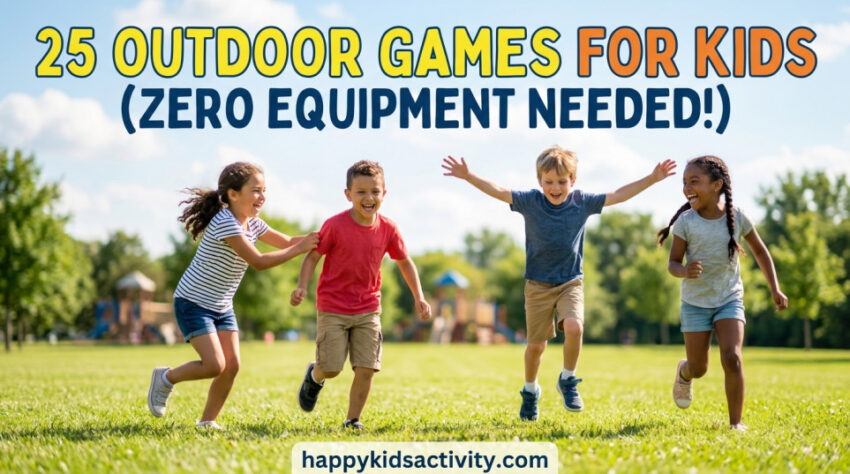
Isn’t it amazing how kids can turn the simplest, most mundane spaces into sprawling playgrounds of endless possibilities? With the sun shining brightly and a gentle breeze whispering through the trees, outdoor play quickly becomes a cherished and vital part of childhood. The true beauty of these moments lies in their absolute simplicity. There is no need for fancy gadgets, expensive gear, or high-tech toys. All that is required is the boundless imagination and contagious laughter of children at play.
However, parents often face a common dilemma: what do you do when you want the kids to play outside, but you do not have any sports equipment or toys on hand? Fear not. There are countless games children can play outdoors that require absolutely nothing more than a bit of open space and a healthy dose of creativity. Stepping away from structured play and screen time allows children to develop crucial physical, cognitive, and social skills in a completely natural environment.
From timeless, energy-burning classics to inventive new ideas that challenge the mind, this comprehensive guide has got you covered. Get ready to dive into the wonderful world of outdoor fun without the fuss of carrying around heavy equipment. Let us explore these highly engaging games that are guaranteed to keep kids entertained, active, and laughing for hours on end.
25 Outdoor Games for Kids
1. Classic Tag
Tag is a foundational game as old as time, beloved by generations for its straightforward rules and high-energy pace. The premise is simple: one person is designated as “it” and has the sole task of chasing and tagging the other players. Once a player is tagged, they take on the role of “it,” and the chase begins anew. The true beauty of tag lies not just in its simplicity, but in the endless variations you can seamlessly introduce. You can establish specific rules, such as prohibiting running outside a designated boundary, or choose to play in a more challenging terrain like a dense forest or a playground filled with natural obstacles. These small tweaks make the game continuously exciting. Tag heavily encourages cardiovascular physical activity, helping children develop their running, dodging, and pacing skills. It is arguably the greatest way for kids to burn off excess energy while practicing agility and quick reflexes.
2. Freeze Tag
In this highly popular twist on the classic chase game, the mechanics of being caught change entirely. When someone is tagged by the person who is “it,” they must immediately freeze in place, unable to move their feet. They can only be unfrozen and rejoin the run if another active player manages to successfully crawl under their legs without being tagged themselves. This dynamic adds a crucial extra layer of excitement, risk assessment, and teamwork to the game. You can also experiment with different freezing positions to increase the difficulty, such as requiring players to hold a specific, awkward pose or balance on one leg until they are unfrozen. This variation keeps the game unpredictable and actively tests the players’ physical balance and endurance. Freeze Tag requires strategic thinking, as kids need to remain acutely aware of their surroundings, working cooperatively to unfreeze their friends without getting caught.
3. Shadow Tag
Shadow Tag is a highly creative and observant variation of the traditional game. Instead of physically tagging bodies with their hands, players aim to step on each other’s shadows. Naturally, this game is absolutely perfect for sunny days when shadows are long and distinct. It effectively sharpens a child’s spatial awareness and physical agility, as they must watch both the ground and their opponents simultaneously. To increase the overall difficulty, you can set strict rules stating that players can only move within certain sunlight boundaries or must keep one hand positioned on their own shadow at all times. These unique variations will keep kids literally and figuratively on their toes. Shadow Tag teaches children to be highly mindful of their shifting environment and enhances their ability to predict the physical movements of others based on the sun’s angle.
4. Traditional Hide and Seek
Hide and Seek remains a staple of childhood outdoor play. One person covers their eyes and counts to a predetermined number while everyone else scrambles to find the perfect hiding spot. Once the count is up, the seeker must explore the area to find all the hidden players. Typically, the last person found becomes the next seeker. To make the traditional format more interesting, you can create elaborate themed hide-and-seek games. For example, you might pretend the seeker is a roaming monster and the hiders are villagers taking cover in a medieval setting. This encourages deep imaginative play and ensures that each round feels like a brand-new adventure. Hide and Seek is fundamentally a game that fosters creativity, patience, and problem-solving. It helps kids develop excellent spatial awareness and the ability to strategize, as they evaluate the best hiding spots and calculate the seeker’s likely path.
5. Sardines
Sardines offers a wonderfully fun, reversed twist on traditional hide and seek. In this version, only one person hides while everyone else closes their eyes and counts. Once the counting finishes, the group splits up to search for the hidden player. The catch is that when a seeker finds the hider, instead of announcing it and ending the game, they must quietly squeeze into the exact same hiding spot with them. This continues as more and more seekers find the spot, packing in tightly like sardines in a tin, until only one seeker is left wandering around. Playing Sardines in a large, varied landscape like a sprawling park adds an excellent layer of challenge. The thrill of squeezing into small spaces without making a sound makes this variation particularly exciting. It promotes close cooperation and usually ends in fits of suppressed giggles, building strong camaraderie among the players.
6. Flashlight Hide and Seek
Best played at dusk or in the early evening when the sun has gone down, this thrilling version utilizes flashlights to change the dynamic of the hunt. The seeker relies solely on the beam of the flashlight to spot hidden players in the dark, adding a highly exciting element of suspense and stealth to the traditional game. For an added strategic twist, you can introduce rules where seekers are only allowed to turn on their flashlight intermittently for a few seconds at a time, or mandate that hiders must silently move to a completely new hiding spot every few minutes. This keeps the environment dynamic and challenging for everyone involved. Flashlight Hide and Seek adds an adventurous, slightly spooky dimension to the traditional game. The limited nighttime visibility and the absolute need to stay quiet heighten the suspense, making it an unforgettable activity.
7. Three-Legged Race
The three-legged race is a fantastic cooperative physical challenge. You pair up the kids and use a soft cloth or bandana to tie one leg of each pair together (the right leg of one child to the left leg of the other). They must then race together toward a designated finish line, an act that requires immense coordination, communication, and teamwork to avoid tumbling over. To make the event more interesting, you can create a relay race format where large teams must switch partners at each stage of the race. Alternatively, you can add gentle obstacles that they must navigate around while tied together. This variation heavily emphasizes verbal communication and physical collaboration. The three-legged race is a famously fun game that directly tests balance and cooperation, teaching kids how to synchronize their movements and work as a unified unit.
8. Spoon and Potato Race
This game requires only items you can easily grab from the kitchen. Instead of a messy egg, use a standard potato. Each player must balance the potato on a regular spoon and race from the starting point to the finish line without letting the potato fall. If they drop it, the strict rule is that they must pick it up, return to the starting line, and begin all over again. You can add different balancing items like small rubber balls or even small water balloons for variety. Introducing complex movement challenges, such as requiring players to walk completely backward or navigate a winding zigzag path, makes the race much more challenging and entertaining. The Spoon and Potato Race is phenomenal for developing fine motor skills, steady hands, and deep concentration, proving that simple household items make the best game props.
9. Pretend Play
Never underestimate the power of open-ended pretend play. Encourage the kids to create their own elaborate worlds using absolutely nothing but their boundless imagination and the natural environment around them. They can become brave pirates searching for hidden treasure beneath the oak tree, daring astronauts exploring the craters of an alien planet, or anything else their minds can conjure. To facilitate and guide this pretend play, you can suggest initial themes or specific scenarios, like a bustling day at the veterinary clinic where kids pretend to care for different invisible animals, or a magical kingdom where they must protect a castle from imaginary dragons. Pretend play is absolutely crucial for robust cognitive and social development. It allows kids to explore different social roles, develop a deep sense of empathy, and practice conflict resolution in a safe space.
10. Simon Says
In this classic auditory processing game, one player takes on the authoritative role of “Simon” and issues various physical instructions to the group. If the leader prefaces the command with the phrase, “Simon says touch your toes,” all players must immediately follow the action. However, if the leader gives an instruction without saying “Simon says” first, any players who instinctively follow the command are eliminated from the round. Adding fun, highly active, and silly instructions, like “Simon says dance like a frantic chicken” or “Simon says pretend to swim,” makes the game incredibly entertaining. Rotating the role of Simon ensures everyone gets a chance to practice leadership. Simon Says helps children rapidly develop their critical listening skills and physical self-control, teaching them to pause and process information before reacting.
11. Charades
Charades is the ultimate test of non-verbal communication. Without using any spoken words or sound effects, kids must physically act out a specific word, phrase, movie, or animal while the rest of the group tries to guess what it is. This game is exceptional for encouraging spontaneous creativity and quick, out-of-the-box thinking. You can prepare mental categories or create simple charades cards beforehand with different overarching themes, such as jungle animals, popular cartoon characters, or everyday household activities, to keep the gameplay fresh and exciting. Acting out these prompts helps kids develop vital non-verbal communication skills, teaching them how to convey complex ideas using only their facial expressions and body language. Charades effectively fosters teamwork as the guessers work together to piece the visual clues together.
12. Duck, Duck, Goose
Ideal for younger children but fun for all ages, Duck, Duck, Goose starts with everyone sitting in a wide circle. One person is chosen to walk around the outside of the circle, gently tapping the heads of the seated players while saying, “duck, duck, duck.” Eventually, they choose a player by tapping their head and yelling “goose!” The chosen goose must immediately leap up and chase the tapper around the perimeter of the circle, attempting to tag them before the tapper can successfully sit down in the goose’s empty spot. You can add fun variations like changing the vocabulary used (for example, “apple, apple, orange”) or requiring the chosen goose to perform a silly task like hopping on one foot during the chase. Duck, Duck, Goose is a lively, fast-paced game that promotes physical agility, quick reaction times, and spatial awareness.
13. Red Rover
Red Rover is a classic playground game of strength and strategy. Two teams stand in parallel lines facing each other across a stretch of grass, tightly holding hands to form a human chain. One team initiates the round by collectively calling out a player from the opposing side, chanting, “Red Rover, Red Rover, send [Name] right over!” The called player must then sprint across the gap and attempt to forcefully break through the linked hands of two players on the opposing team. If they successfully break the chain, they get to choose one of those two players to take back to their own team. If they fail to break through, they must join the opposing team’s line. Allowing teams to quietly strategize on whom to call or which specific weak point in the line to target adds a great element of tactical planning to this high-energy game.
14. Capture the Flag
Capture the Flag is an epic, large-scale game perfect for big yards or parks. You divide the kids into two equal teams, assigning each team a specific territory and a “flag” (which requires no special equipment—a t-shirt, a stick, or a bright leaf works perfectly). Teams are tasked with aggressively protecting their own flag while simultaneously sending scouts across enemy lines to capture the opposing team’s flag and bring it safely back to their home base. You can easily introduce marked “safe zones” and designated “guardians” to make the game much more strategic. Safe zones provide temporary immunity for invaders, while guardians can patrol the border to tag and imprison opponents. Capture the Flag is widely considered one of the best games for teaching complex strategic thinking, long-term planning, and unified teamwork.
15. Sharks and Minnows
Sharks and Minnows is a high-octane running game that requires a wide, open rectangular space. One child is chosen to be the “shark” and stands in the middle of the field, while all the other players act as the “minnows” lined up on one end. On the shark’s command, the minnows must attempt to run across the entire playing area to the opposite safe zone without being tagged by the shark. Any minnows who are tagged instantly transform into sharks for the next round, making crossing the field increasingly difficult as the predator numbers swell. The game continues until only one minnow remains. Adding variations like designating “super minnows” who have the power to free tagged players by touching them adds great complexity. This fast-paced game is unmatched for building cardiovascular endurance, rapid agility, and directional changes.
16. Cops and Robbers
This is an incredibly popular, thematic variation of tag that incorporates role-playing elements. The group is divided, with the “cops” tasked with chasing down the fleeing “robbers.” When a cop successfully tags a robber, the robber is escorted to “jail” (a clearly designated area, like a specific tree or a park bench). The twist is that imprisoned robbers can only be freed if a free robber manages to sneak past the cops and tag them inside the jail. To elevate the game, you can set up multiple jail locations across the yard and introduce physical “keys” (like a specific colored stone or a fallen branch) that the robbers must find and deliver to the jail to execute a breakout. Cops and Robbers perfectly combines the cardiovascular exertion of tag with elements of stealth, rescue strategy, and team collaboration.
17. Imaginary Tightrope Walk
This game requires immense focus and absolutely zero equipment. Simply find a line on the ground—such as a crack in the pavement, a shadow cast by a fence, or a line drawn in the dirt—and instruct the kids to pretend it is a high-altitude tightrope. They must carefully walk heel-to-toe across the entire length of the line without letting their feet step off. For an added layer of difficulty, you can challenge them to try walking the tightrope completely backward, or even with their eyes closed while a partner guides them verbally. Creating different, complex paths using various natural lines, such as curved edges or sharp zigzagged boundaries, adds great variety. The Imaginary Tightrope Walk is an incredibly effective, quiet game for developing core physical balance, deliberate movement control, and deep mental concentration.
18. Hopscotch
Hopscotch is a globally recognized street game that has stood the test of time. While it traditionally uses chalk to draw the grid on the pavement, you can easily trace a grid in the dirt with a stick if you are at a park or beach. Kids find a small natural object, like a smooth stone or a piece of wood, to act as their marker. They throw the object into the numbered squares sequentially, then hop through the entire grid on one foot, making sure to completely skip the square containing their marker. To challenge older kids further, you can design highly complex hopscotch patterns, such as winding spirals or multi-level, scattered grids. Introducing different physical hopping styles, like requiring double hops in certain squares, keeps the activity fresh. Hopscotch excels at promoting single-leg balance, hand-eye coordination, and basic counting skills.
19. Obstacle Course
You do not need plastic cones or fabric tunnels to create a thrilling obstacle course; nature provides everything you need. Set up an extensive course using the natural elements available in your yard or local park. Instruct the kids to navigate the route by jumping over specific exposed roots, crawling under low-hanging tree branches, and weaving in a figure-eight pattern around a series of large rocks. To keep things continuously exciting, change the specific layout and the required physical actions regularly. You can also introduce a stopwatch (or just count out loud) to turn the course into a friendly, timed competition, challenging the kids to beat their own personal best records. Natural obstacle courses are excellent for building full-body physical fitness, spatial awareness, and real-time problem-solving skills as kids figure out the fastest way to navigate terrain.
20. 20 Questions
When kids need a break from running, 20 Questions is the perfect resting game. One player silently thinks of a specific object, person, or animal. The rest of the group is allowed to ask up to 20 questions to deduce what the secret subject is. The critical rule is that the thinker can only answer the questions with a simple “yes” or “no.” The ultimate goal is to logically narrow down the possibilities and guess the object using the fewest questions possible. To make the game more educational or tailored to the group’s age, you can restrict the subjects to specific themes, such as famous historical figures, geographic landmarks, or types of wildlife. 20 Questions is a phenomenal mental exercise that actively develops critical thinking, categorical deduction, and precise communication skills.
21. I Spy
I Spy is the quintessential observational game that can be played anywhere, whether sitting under a tree or walking down a trail. One player visually selects an object within the immediate line of sight and announces, “I spy with my little eye something that is [color or shape].” The other players then take turns looking around the environment and guessing what the specific object might be until someone eventually gets it right. For younger children, you can add more descriptive, obvious clues to make guessing easier. For older kids, you can limit the clues to highly obscure details to make the hunt much more challenging. I Spy is a fantastic, calm game for developing sharp observational skills, visual scanning abilities, and the patience required to systematically evaluate an environment.
22. Categories
Categories is a fast-paced word association game that tests memory and vocabulary. Players sit together in a tight circle, and one person acts as the leader, choosing a broad category (for example, farm animals, types of fruit, or modes of transportation). Going clockwise around the circle, each player must quickly name something that perfectly fits into that chosen category without repeating any answers that have already been said. If a player hesitates for too long, repeats a word, or names something outside the category, they are eliminated for that round. To heighten the stakes, you can introduce a strict rhythmic clapping beat that players must keep time with when delivering their answer. Categories is a highly educational game that encourages rapid cognitive recall, quick thinking under pressure, and vocabulary expansion.
23. Human Knot
The Human Knot is a physical puzzle that requires zero running but immense cooperation. Players stand shoulder-to-shoulder in a tight circle. Everyone reaches across the center of the circle and grabs the hands of two different people (ensuring they do not hold hands with the person directly next to them). Once everyone is thoroughly tangled, the group must work together to physically untangle themselves and form a perfect, unbroken circle once again—all without ever letting go of each other’s hands. This requires stepping over arms, ducking under linked hands, and constant verbal direction. For an added layer of extreme complexity, you can time the untangling process or ask the group to perform the task in total silence. The Human Knot is an unparalleled game for fostering clear communication, group problem-solving, and patient teamwork.
24. Group Jump Rope
While traditional jump rope requires equipment, you can easily play a highly imaginative version of Group Jump Rope without one. Two players stand apart and pretend to rhythmically swing a massive, heavy invisible rope. The other players must stand in the middle and jump exactly in unison with the imaginary swings. The challenge lies entirely in the group’s ability to sync their timing based solely on the visual cues of the “swingers.” It requires intense coordination and a unified group effort to maintain the rhythm. You can create different, complex jumping patterns, or instruct the swingers to speed up and slow down the imaginary rope to test the jumpers’ reaction times. This inventive variation is a brilliant way to build collective coordination, rhythm awareness, and cooperative focus without needing a single piece of gear.
25. Pass the Water
If you have access to a water fountain and a few basic cups, Pass the Water is a brilliant cooling game for hot summer days. The kids line up facing forward in a single-file line. The person at the very front is given a cup entirely full of water. Without turning their body around to look, they must carefully reach over their own head and pour the water backward into the empty cup held by the person standing directly behind them. This blind pouring continues down the entire line. The ultimate goal is to see how much water successfully makes it to the very last cup without being spilled on the grass (or the players). This hilarious game meticulously tests spatial awareness, precise physical coordination, and fine motor control.
Frequently Asked Questions (FAQs)
How do outdoor games benefit a child’s development?
Outdoor games without equipment heavily encourage creativity, as children are forced to use their imaginations rather than relying on toys to dictate the play. Physically, these games promote cardiovascular health, gross motor skills, agility, and balance. Socially, group games teach essential life skills such as conflict resolution, negotiation, teamwork, and how to follow complex rules.
What should I do if my kids say they are bored without their toys?
It is completely normal for children who are used to highly structured or screen-based play to initially resist no-equipment games. The key is to participate with them at first. Introduce a game like Freeze Tag or Sardines and play alongside them to build excitement. Once they understand the rules and get caught up in the fun, their natural competitive and imaginative instincts will take over.
Are these games suitable for mixed age groups?
Absolutely. Many of these games can be easily modified to accommodate different ages playing together. For example, in games like Hide and Seek or Tag, older children can be given specific handicaps (like having to hop on one foot or count to a higher number) to level the playing field for younger siblings.
How can I ensure safety while playing these high-energy games?
While equipment-free games are generally very safe, it is important to establish clear physical boundaries before the game begins to prevent kids from wandering into streets or unsafe areas. Additionally, always quickly inspect the playing area for hazardous natural objects like deep holes, sharp branches, or slippery mud patches, and remind children of basic safety rules, such as looking where they are running.
Conclusion
Outdoor games are a truly timeless, universally accessible way to keep children active, deeply engaged, and thoroughly entertained without ever needing to spend money on expensive sports gear or electronic equipment. From the heart-pounding physical exertion of classic games like tag and capture the flag to the quiet, cerebral challenges of imaginary tightrope walking and 20 questions, there is an activity perfectly suited for every child, every location, and every mood.
These games do far more than just provide a way to pass the time; they are vital tools that promote physical fitness, encourage healthy social interaction, teach the value of teamwork, and ignite the boundless power of a child’s creativity. So, the next time the kids are restless and looking for something to do outside, remember this comprehensive list. With just a bit of open space, a willingness to play, and a lot of imagination, endless fun awaits just outside your front door. Let us embrace the pure joy of simple outdoor play and help our children create active, joyful memories that will last a lifetime.