
Classic clapping games like Patty Cake, Miss Mary Mack, and Concentration 64 are the easiest zero-prep activity you can hand a child: no supplies, no setup, no cleanup. Most games work best from age 5 upward, though Patty Cake and Pease Porridge Hot start younger at around age 3. Each game takes 5 to 15 minutes to learn and can run as long as kids want, since the goal is not to finish but to go faster.
It was a rainy Saturday afternoon, the kind where screen time had already been used up by 11am and everyone was starting to look at each other funny. My daughter grabbed her cousin’s hands, started chanting “Miss Mary Mack, Mack, Mack,” and within four minutes they were both laughing so hard at their own mistakes that they forgot they were bored.
I had not taught her that game. She learned it at school, the same way I did twenty-something years ago, in a lunch line. It passed from kid to kid the way it always has: no instructions, no YouTube tutorial, just one child showing another.
That is the thing about clapping games. They require nothing. No supplies, no Wi-Fi, no battery life, no setup, no cleanup. They work in the back of a car, in a waiting room, at a birthday party that has run out of steam, or on that rainy Saturday when you have already said no to the tablet twice.
This guide gives you the lyrics, the step-by-step moves, and the honest age and patience notes for ten games worth learning. Including the ones I have watched fall apart spectacularly the first time and look effortless by the third.
The Hidden Developmental Benefits of Hand Clapping Games
Kids playing clapping games are not thinking about coordination or memory. They are thinking about whether they can go faster than last time. But the physical and cognitive work those games do is real, and worth knowing about, especially if you are looking for an activity with actual developmental payoff.
Fostering Bilateral Coordination and Midline Crossing
The brain is divided into two hemispheres that need to communicate efficiently for tasks like reading, writing, and tying shoes. Clapping games regularly require kids to cross the midline, that imaginary vertical line dividing the left and right sides of the body. When your child reaches their right hand across to meet their partner’s right hand, they are forcing both hemispheres to work together. That is the same neurological foundation that underlies reading across a page. It is not coincidence that occupational therapists often use midline-crossing activities with kids who struggle with fine motor coordination.
Practical note: If your child keeps avoiding the cross-clap and substituting a straight clap instead, that is worth noticing. It is a common substitution kids make when the crossing feels uncomfortable, and something to mention to their pediatrician if it persists.
Building Auditory Memory and Rhythmic Sequencing
Memorising the lyrics to a clapping game is not passive. The brain has to recall the exact sequence of words, map each word to a specific physical motion, and execute both at the same time, while keeping a steady beat. That layering of speech, motor planning, and timing is essentially the same process reading fluency relies on.
You will notice kids who struggle with this at first tend to drop the physical actions and just recite the words. That is completely normal. The automation comes with repetition.
Enhancing Proprioception and Spatial Awareness
Propriception is your body’s ability to sense where it is in space without looking. During a fast-paced clapping game, a child is constantly calculating where their partner’s hands are, adjusting force so they do not slap too hard, and maintaining rhythm simultaneously. That rapid feedback loop is real physical self-regulation work.
Practical note for sensory-sensitive kids: The force calibration piece is worth a quick conversation before you start. Some kids genuinely cannot judge how hard they are clapping, and the game stops being fun after the third accidental slap. Start slow, agree on “gentle hands” as a rule, and take this one at your own pace.
Encouraging Cooperative Play and Social Bonding
Unlike most games, clapping games have no winner. If one partner speeds up too much or loses the sequence, the game falls apart for both of them equally. That forces something different from competitive play: eye contact, reading your partner’s rhythm, slowing down when they need you to. Kids who find competitive games stressful often take to clapping games much more easily, because the goal is shared rather than opposed.
How to Teach Clapping Games to Beginners
Introducing a complex clapping sequence to a beginner can end in frustration if you rush it. I’ve done it both ways. Here is the version that actually works.
Master the Foundational Claps
Before any lyrics come in, make sure your child knows these four basic moves by name. Most clapping games use some combination of them:
- The Self-Clap: Clapping your own hands together.
- The Straight Clap: Clapping both of your hands flat against both of your partner’s hands simultaneously.
- The Cross Clap: Clapping your right hand against your partner’s right hand (or left to left).
- The Lap Pat: Patting your own thighs.
Spend five minutes just doing those four moves in a slow, even rhythm with no words at all. It sounds tedious but it cuts learning time in half.
Separate the Lyrics from the Motions
Do not ask a child to learn the words and the physical movements at the same time. It overloads working memory and they end up doing neither well.
First, chant the lyrics together until the child has them memorised. Then practice the hand motions in complete silence. Only when both elements feel solid on their own should you attempt to combine them. This takes an extra five minutes but saves twenty minutes of frustration.
Leverage Visual Learning Formats
Text instructions are hard to translate into physical movements. If either of you is getting confused by the written steps, search for the specific game name on YouTube Shorts. You want a slow-motion demonstration, not a performance. A 30-second looping clip of the exact hand placements is worth more than any written description, including this one.
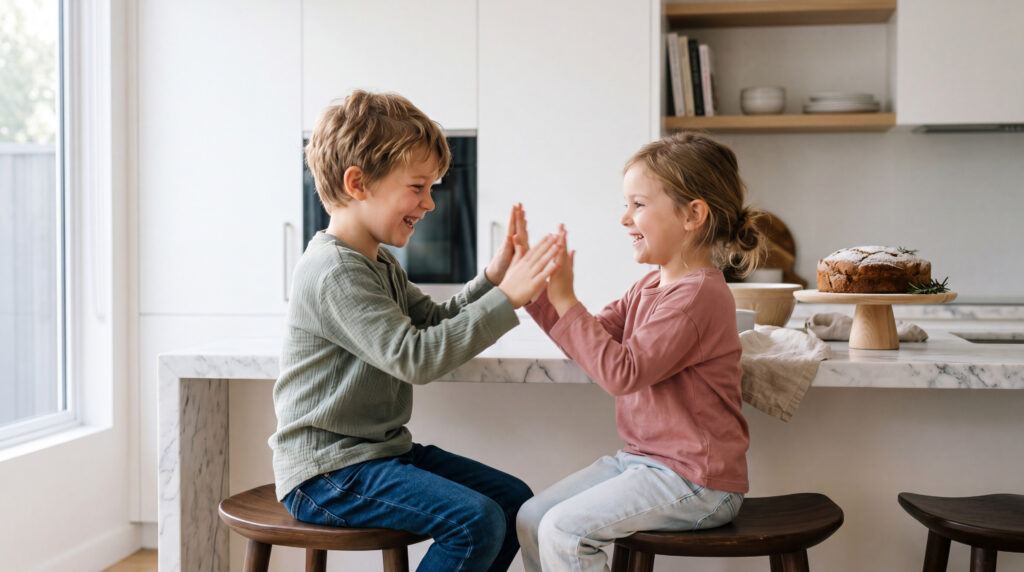
10 Classic Clapping Games to Teach Your Kids
Below are ten games in rough order of difficulty, with full lyrics and physical instructions, plus honest notes on age range, timing, and what to expect the first time.
1. Patty Cake
This is the foundational clapping game, typically the very first one introduced to toddlers and preschoolers. It introduces the basic concept of cooperative rhythm.
The Lyrics
Patty cake, patty cake, baker’s man,
Bake me a cake as fast as you can.
Roll it, and pat it, and mark it with a “B”,
And put it in the oven for baby and me!
How to Play
-
“Patty cake, patty cake”: Clap your own hands, then clap both hands against your partner’s hands. Repeat.
-
“Baker’s man”: Clap your own hands, then clap both hands against your partner’s hands.
-
“Bake me a cake…”: Continue the alternating self-clap, partner-clap rhythm.
-
“Roll it”: Roll your hands around each other in a circular motion.
-
“Pat it”: Pat your own thighs.
-
“Mark it with a B”: Use your index finger to draw the letter “B” in the air.
-
“Put it in the oven…”: Push both hands forward as if sliding a pan into an oven.
2. Miss Mary Mack
A true classic characterized by its repetitive, rhyming structure and slightly faster tempo.
The Lyrics
Miss Mary Mack, Mack, Mack,
All dressed in black, black, black,
With silver buttons, buttons, buttons,
All down her back, back, back.
She asked her mother, mother, mother,
For fifty cents, cents, cents,
To see the elephants, elephants, elephants,
Jump over the fence, fence, fence.
They jumped so high, high, high,
They reached the sky, sky, sky,
And didn’t come back, back, back,
Till the Fourth of July, ly, ly!
How to Play
The physical rhythm for this game operates on a three-beat cycle that repeats throughout the entire song.
-
Beat 1 (e.g., “Miss”): Cross your arms over your chest.
-
Beat 2 (e.g., “Mary”): Pat your own thighs.
-
Beat 3 (e.g., “Mack”): Clap both of your hands against your partner’s hands.
On the repeated words at the end of each line (e.g., “Mack, Mack, Mack”), simply keep your hands clapped against your partner’s hands and bounce them to the rhythm three times.
3. A Sailor Went to Sea, Sea, Sea
This game focuses heavily on repetition and builds cognitive endurance, as the actions compound as the song progresses.
The Lyrics
A sailor went to sea, sea, sea,
To see what he could see, see, see.
But all that he could see, see, see,
Was the bottom of the deep blue sea, sea, sea!
How to Play
The basic motion is a standard self-clap, followed by a straight clap with your partner.
-
“A sailor went to…”: Alternate clapping your own hands and your partner’s hands.
-
“Sea, sea, sea”: On these three words, bring your right hand up to your forehead in a saluting motion three times.
-
Continue the basic clapping rhythm for the next lines, repeating the three salutes whenever the word “see” or “sea” is spoken three times in a row.
4. Lemonade, Crunchy Ice
This game serves as an interactive icebreaker and ends with a physical freezing challenge, making it incredibly popular in large groups.
The Lyrics
Lemonade, crunchy ice,
Sip it once, sip it twice.
Lemonade, crunchy ice,
Sip it once, sip it twice.
Turn around, touch the ground,
Kick your boyfriend out of town!
Freeze!
How to Play
-
“Lemonade, crunchy ice”: Clap own hands, clap right hands together, clap own hands, clap left hands together.
-
“Sip it once, sip it twice”: Mimic holding a glass and taking two dramatic sips.
-
“Turn around”: Both partners physically spin around in a full circle.
-
“Touch the ground”: Both partners crouch down and touch the floor.
-
“Kick your boyfriend out of town”: Perform a playful, gentle kick in the air.
-
“Freeze!”: Both players must freeze entirely like statues. The first person to move, laugh, or break character loses the round.
5. Down Down Baby
A rhythmic, almost percussive game that uses full-body movements rather than just hand claps.
The Lyrics
Down, down, baby, down by the roller coaster,
Sweet, sweet, baby, I’ll never let you go.
Shimmy, shimmy, cocoa pop, shimmy, shimmy, pow!
Shimmy, shimmy, cocoa pop, shimmy, shimmy, pow!
Grandma, Grandma, sick in bed.
Called the doctor and the doctor said:
Let’s get the rhythm of the head, ding-dong! (Rock head side to side)
Let’s get the rhythm of the hands, clap-clap! (Clap hands)
Let’s get the rhythm of the feet, stomp-stomp! (Stomp feet)
Let’s get the rhythm of the hot dog, oh! (Swivel hips)
Put ’em all together and what do you get?
Ding-dong, clap-clap, stomp-stomp, oh!
How to Play
-
“Down, down, baby…”: Alternate self-claps and partner-claps.
-
“Roller coaster”: Make a large, swooping roller coaster motion with your hand in the air.
-
“Shimmy, shimmy…”: Shake your shoulders back and forth.
-
“Pow!”: Clap your hands together loudly.
-
“Grandma, Grandma…”: Return to the basic alternating clap.
-
For the final section, you must physically perform the actions mentioned in the lyrics (moving the head, clapping, stomping, and swiveling hips).
6. Stella Ella Ola
This is a group elimination game, typically played with three or more children sitting in a circle.
The Lyrics
Stella Ella Ola, clap, clap, clap,
Singing es-chico, chico, chico, chico, chak.
Es-chico, chico, baloney, baloney,
Cheese and macaroni!
Fire, fire, fire, fire!
1, 2, 3, 4, 5!
How to Play
-
All players sit in a circle, holding their hands out to the sides. Place your right hand over your neighbor’s left hand, and your left hand under your other neighbor’s right hand.
-
As the song begins, one person uses their right hand to cross over and tap the right hand of the person to their left.
-
That person then passes the tap to the next person, sending a continuous wave of taps around the circle to the rhythm of the song.
-
When the song reaches the countdown (“1, 2, 3, 4, 5”), the tapping continues.
-
The person who is slated to be tapped on the number “5” must pull their hand away before being struck. If their hand is tapped on “5”, they are out. If they pull away in time and the tapper hits their own hand, the tapper is out.
7. Double Double This This
This game tests cognitive flexibility by forcing the brain to associate a spoken word with the orientation of the hands.
The Lyrics
Double, double, this, this,
Double, double, that, that,
Double this, double that,
Double, double, this, that!
How to Play
-
“Double, double”: Bump the fronts of your closed fists against the fronts of your partner’s closed fists twice.
-
“This, this”: Clap the palms of your hands against the palms of your partner’s hands twice.
-
“That, that”: Clap the backs of your hands against the backs of your partner’s hands twice.
-
“Double this”: Fist bump once, palm clap once.
-
“Double that”: Fist bump once, back-of-hand clap once.
-
“Double, double, this, that”: Two fist bumps, one palm clap, one back-of-hand clap.
As players master the sequence, the goal is to recite and perform it as rapidly as humanly possible without making an error.
8. Say Say Oh Playmate
A charming, traditional game that focuses on friendship and utilizes an interlocking finger motion.
The Lyrics
Say, say, oh playmate,
Come out and play with me.
And bring your dollies three,
Climb up my apple tree.
Slide down my rain barrel,
Into my cellar door,
And we’ll be jolly friends,
Forever more, more, more!
How to Play
-
Instead of traditional flat-palm clapping, partners interlock their fingers and push their hands back and forth in a gentle, seesaw rhythm.
-
Maintain this pushing and pulling motion throughout the first six lines of the song.
-
“And we’ll be jolly friends”: Unlink fingers and clap your own hands, then your partner’s hands.
-
“Forever more, more, more”: On the final three words, place your hands flat against your partner’s hands and gently push back and forth three times to the beat.
9. Concentration 64
Unlike the other games on this list, Concentration is a competitive thinking game that tests vocabulary and rhythm simultaneously.
The Lyrics
Concentration (clap, clap, clap)
Sixty-four (clap, clap, clap)
No repeats (clap, clap, clap)
Or hesitations (clap, clap, clap)
I’ll go first (clap, clap, clap)
You go second (clap, clap, clap)
Category is: (clap, clap, clap)
[Insert Category, e.g., Colors] (clap, clap, clap)
How to Play
-
The rhythm is maintained by patting your thighs twice, then clapping your hands twice. This beat must never stop.
-
The players recite the opening chant to the rhythm.
-
The first player declares a category (e.g., Animals, Colors, Cereal Brands).
-
On the next beat, the first player must name an item in that category (e.g., “Blue”).
-
On the following beat, the second player must name a different item (e.g., “Red”).
-
The game continues back and forth. A player loses if they break the physical clapping rhythm, repeat a word that has already been said, or hesitate too long when it is their turn to speak.
10. Pease Porridge Hot
A traditional nursery rhyme translated into a tactile game that helps young children differentiate between cross claps and straight claps.
The Lyrics
Pease porridge hot,
Pease porridge cold,
Pease porridge in the pot,
Nine days old.
Some like it hot,
Some like it cold,
Some like it in the pot,
Nine days old.
How to Play
-
“Pease”: Clap your own hands together.
-
“Porridge”: Clap both hands against your partner’s hands.
-
“Hot”: Clap your own hands together.
-
“Pease”: Pat your thighs.
-
“Porridge”: Clap your own hands together.
-
“Cold”: Clap both hands against your partner’s hands.
-
“Pease porridge in the pot”: Alternate clapping own hands and clapping right-to-right, left-to-left with your partner.
-
“Nine days old”: Pat thighs, clap own hands, clap partner’s hands.
Preserving the Memories: Recording and Sharing
In today’s digital landscape, parents and educators often want to preserve these fleeting childhood milestones. Recording your children playing these clapping games is a wonderful way to capture their developmental progress and the pure joy of cooperative play.
When capturing these memories, you can easily stitch clips together using accessible video editing software like CapCut or utilize more advanced platforms like DaVinci Resolve to correct audio and perfect the final cut. If you plan to share these videos on public platforms, or if you are creating modern, minimalist lyric printables to share on platforms like Pinterest, it is highly recommended to ensure the subjects are modestly dressed and the content is strictly respectful and family-friendly, maintaining a clean and positive digital footprint for your children. Designing clean, luxury-aesthetic lyric sheets can also act as a beautiful physical keepsake for a child’s memory box.
FAQs
At what age can children start learning hand-clapping games?
Children can begin learning the fundamentals of clapping games around the age of three. At this stage, focus strictly on basic rhythms, like the simple “Patty Cake” motions, without expecting perfection. By the age of five or six, their bilateral coordination and working memory have developed enough to handle more complex games like “Miss Mary Mack” or “A Sailor Went to Sea.”
What if my child struggles with rhythm or coordination?
Patience is absolutely essential. If a child is struggling, significantly slow down the tempo. Remove the lyrics entirely and simply practice crossing the midline by giving high-fives with opposite hands. You can also practice to the beat of a metronome or a slow, familiar song to help them internalize a steady rhythm before reintroducing the complexity of the spoken chants.
Are these games beneficial for children with learning differences?
Yes, highly beneficial. Occupational therapists frequently utilize modified clapping games for children with dyspraxia, ADHD, and sensory processing disorders. The crossing of the midline and the heavy work of clapping hands provides deep proprioceptive input, which can be incredibly grounding and regulating for an overwhelmed nervous system.
How can I remember the lyrics if I haven’t played since childhood?
It is very common for adults to remember the physical motions but forget the exact verses. Utilize the lyrics provided in this guide to refresh your memory. Writing the lyrics out on a whiteboard or creating a visually appealing cheat sheet can help you practice before teaching the routine to a child.
Conclusion
Classic clapping games represent the very best of unstructured childhood play. They demand no financial investment, they can be played anywhere from a living room rug to a school playground, and they naturally foster communication, laughter, and physical coordination. By taking the time to teach your children the lyrics and rhythms of games like “Down Down Baby” and “Concentration 64,” you are passing down a rich cultural tradition while actively supporting their neurological and social development. Embrace the nostalgia, practice the complex hand motions, and enjoy the screen-free connection these games provide.