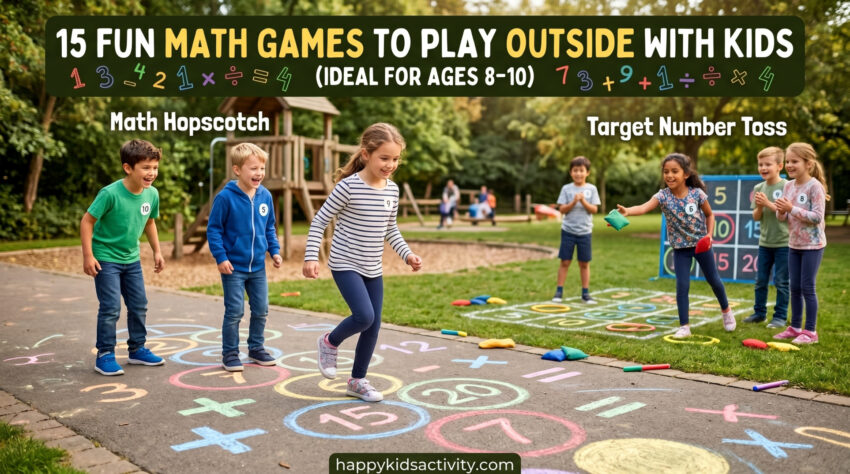
The best math games to play outside with kids ages 8-10 take one skill they are already working on at school and attach it to something physical: sprinting, jumping, throwing, or measuring. Chalk relay races, a hopscotch times table, a driveway number line, and a target toss scoring game each take under 15 minutes to set up, cost almost nothing, and hold attention for about 15 to 30 minutes. Keep the math slightly easier than their worksheet level, because a kid who is out of breath cannot do their hardest math.
It was 4:20 on a Tuesday in the first week of September, and my 9 year old was under the kitchen table.
Not sitting at it. Under it. On top of the table was a worksheet with 32 multiplication problems, and he had made it to number four before deciding the floor was a better option.
I did not argue. I grabbed a box of chalk, opened the front door, and told him I needed help with something in the driveway. Twenty minutes later he had said about 40 multiplication facts out loud while jumping between chalk squares, and he had no clue he had done any math.
That is the whole trick with math games to play outside with kids. You are not making math more fun. You are hiding the repetition inside something their body wants to do anyway.
One thing I want to be honest about, because you will see it repeated everywhere: this is not because some kids are “kinesthetic learners”. The research on matching lessons to a child’s supposed learning style has not held up well. What does hold up is much more boring and much more useful. Kids get better at math facts by recalling them over and over, spread out over time, in a low-pressure setting. A relay race is just retrieval practice with running in it.
Outside also removes the two things that turn homework into a fight: the worksheet (a visible, countable pile of work) and your face six inches from theirs while they think.
Seasonal note: We are in early September, so school has just started and most kids are being re-tested on facts they half forgot over summer. That makes right now the highest-value window for these games. Two of the games on this list (water balloon math and anything involving a hose) are really May through September activities in most of the US, so save those for spring if you are reading this in the cold. Also keep in mind that by late October you have a much shorter light window after school, so a 4:30pm start becomes a 4:00pm start.
What You Actually Need (and what you already have)
Fourteen of the fifteen games run on things you own or can buy for under five dollars. Here is the honest kit list, with a free version of everything.
The five things worth actually buying
- Sidewalk chalk. Crayola Sidewalk Chalk (the fat 48-count tub) runs about five dollars at Walmart or Target and lasts a whole season. Dollar Tree chalk is a dollar and change but the sticks are thinner and snap within about ten minutes of pressing hard on concrete. Free swap: a spray bottle of water on hot pavement draws dark lines that vanish in ten minutes, or blue painter’s tape on a patio or garage floor.
- Index cards and one chunky marker. A pack of 100 cards is about a dollar. Use a Sharpie or a fat Crayola marker, never a pen or pencil. Free swap: cut a cereal box into rectangles. They are stiffer than index cards and do not blow away as easily.
- Beanbags, three to five of them. Dollar Tree usually has them in the toy aisle. Free swap: rolled socks. Genuinely better than beanbags for bucket targets, because socks do not bounce back out.
- A 25 foot retractable tape measure. A Stanley PowerLock is around twelve to fifteen dollars and will outlive your kids. The dollar store ones bend at about eight feet and are more frustrating than useful. Free swap: a ball of string plus a 12 inch ruler.
- Play money. A Learning Resources or Melissa & Doug set is around eight to twelve dollars. Free swap: print play money, or raid the coin jar (only if you have no toddler in the house, see the safety section), or hand your kid last week’s grocery receipt and a highlighter.
Already in your house, no shopping required
Buckets, plastic bowls, laundry baskets, jump ropes, a garden hose, patio chairs, pool noodles, a clipboard (or a cereal box and a binder clip), grid paper (free to print), a kitchen scale, a measuring cup, an empty pasta jar, an egg carton, and two regular dice.
Practical note: put the whole kit in one plastic tote by the back door. The single biggest reason these games do not happen is that finding the chalk takes eleven minutes and by then the moment has passed. My tote lives on a shelf in the garage and it is the only reason we still do this in week six of the school year.
Safety rules that actually matter outside
This is not disclaimer padding. Four of these games have a real hazard the original version of this list did not mention, and one of them (water balloons) involves the material that safety regulators single out most often for kids.
The toddler sibling rule comes first. Almost every one of these games puts small objects on the ground in a yard: pebbles, bottlecaps, coins, marker lids, beanbag beads, and burst balloon pieces. If there is a child under three in your yard, on the swing set, or likely to wander out, sweep the ground before you start and after you finish. The home test is the toilet paper tube: if an object fits through a toilet paper tube, a toddler can choke on it. A dime, a penny, a pebble, and a bottlecap all fit through.
Balloons are the one genuine danger on this list. Uninflated balloons and burst balloon pieces are a documented choking and suffocation hazard for young children, which is why US federal law requires latex balloon packaging to carry a warning about children under eight. A wet piece of latex moulds to the airway and is very hard to clear. If you play game 10, you pick up every fragment before anyone goes inside, and you keep toddlers and dogs out of the yard entirely. Skip latex completely if anyone in your family has a latex allergy.
No throwing rocks, ever. The original version of a couple of these games suggests small stones as throwing objects. Do not. Rolled socks, beanbags, or a tennis ball do the same job without teaching a kid that throwing rocks is a sanctioned activity, and without the eye injury risk.
Watch the end of the driveway. Four games (the chalk grid, hopscotch, the number line, and relay races) happen on a driveway. A kid who is concentrating hard on where the multiple of 7 is will not hear a car reversing. Set up at the garage end, not the street end, and put something physical (a bin, a bike, a cone) between the game and the road.
Check the pavement temperature with your hand. A dark driveway in direct sun runs far hotter than the air, and drawing chalk means bare knees and palms on that surface. Press the back of your hand flat on it for five seconds. If you cannot hold it there, your kid cannot kneel on it. Move to shade, or do it before 11am or after 5pm.
Heat and water. Relay races and the obstacle course are the two highest-exertion games here. Kids ages 6-17 are supposed to get 60 minutes of moderate to vigorous activity a day per CDC and WHO guidance, and these games count toward it, but that also means a real water bottle outside with you, not a promise to drink later. Shoes, not sandals or bare feet, for anything involving running.
Adult-only jobs. Cutting anything (sponges, a cardboard box, lumber for DIY yard dice) is yours, not theirs. Filling water balloons at the tap is yours. Flipping rocks and logs for the bug survey is done with a stick, from the far side, never with bare hands, because that is where spiders, centipedes, and wasps live. Check for ticks after any game in long grass.
Allergens. If you use real snacks as merchandise in the money market game and a friend comes over, ask about allergies first and keep wrappers so you can read the label. It is a five second question that avoids a very bad afternoon.
Pick A Game In 30 Seconds
Prep time is adult time, before your kid is involved. Play time is how long it actually held attention in my house, not how long it theoretically could.
| Game | Real ages | Prep | Play | Mess | Where you need to be | What it drills |
| 1. Math Relay Races | 7-11 | 10 min | 15-20 min | None | Right there, you check answers | Fact fluency, speed |
| 2. Sidewalk Chalk Math Grid | 7-10 | 15-20 min | 15 min | Low, chalk dust | At the edge, calling prompts | Multiples, primes, coordinates |
| 3. Fraction Scavenger Hunt | 8-11 | 5 min | 25-40 min | Low, dirty hands | On the walk with them | Fractions, equivalence |
| 4. Target Toss Math | 6-11 | 5-10 min | 20 min | None | Right there, scoring | Addition, multiplication, order of ops |
| 5. Geometry Scavenger Hunt | 8-11 | 10 min | 25-30 min | None | Check in every few minutes | Shape vocabulary, angles, perimeter |
| 6. Skip Counting Hopscotch | 6-10 | 10 min | 15 min | Low, chalk dust | Nearby, counting along | Times tables, decimals |
| 7. Math Obstacle Course | 7-11 | 15-20 min | 20 min plus repeats | Low | Arm’s reach at anything they climb | Mixed facts under load |
| 8. Measurement Challenge | 7-11 | 5 min | 25 min | None | Check in, help hold the tape | Units, perimeter, area, conversion |
| 9. Estimation Station | 8-11 | 15 min | 20-25 min | Medium if water | Hands-on the whole time | Number sense, sampling |
| 10. Water Balloon Math | 6-11, no toddlers nearby | 20-25 min | 10-15 min | High, wet and littered | Hands-on, adult-led cleanup | Fast mental math |
| 11. Money Math Market | 7-11 | 15-20 min | 25-30 min | None | You are the customer or shopkeeper | Decimals, change, budgeting |
| 12. Backyard Graphing | 8-11 | 10 min | 20 min plus 15 min graphing | Low | Check in outside, sit down for the graph | Tally, bar graphs, data |
| 13. Number Line Races | 8-11 | 10-15 min | 15 min | Low, chalk dust | At the line, calling prompts | Addition, subtraction, negatives |
| 14. Outdoor Math Pictionary | 8-11, needs 2 players | 5 min | 20 min | Low | Playing with them | Math vocabulary |
| 15. Giant Yard Dice Probability | 8-11 | 10 min | 25 min | None | Nearby, help record | Probability, tally, data |
Match it to their grade, not their age. In most US curricula, a third grader is working on multiplication and division facts to 10 by 10 and seeing fractions as numbers for the first time, so games 1, 4, 6, and 12 hit hardest. A fourth grader is on multi-digit multiplication, factors and multiples, equivalent fractions, and measuring angles, which makes games 2, 3, 5, and 8 land. A fifth grader is on decimals, volume, and the first quadrant of the coordinate plane, so games 9, 11, and 13 fit best. If you are not sure, open their math folder and copy whatever unit they are in right now.
Fun Math Games to Play Outside With Kids
1. Math Relay Races
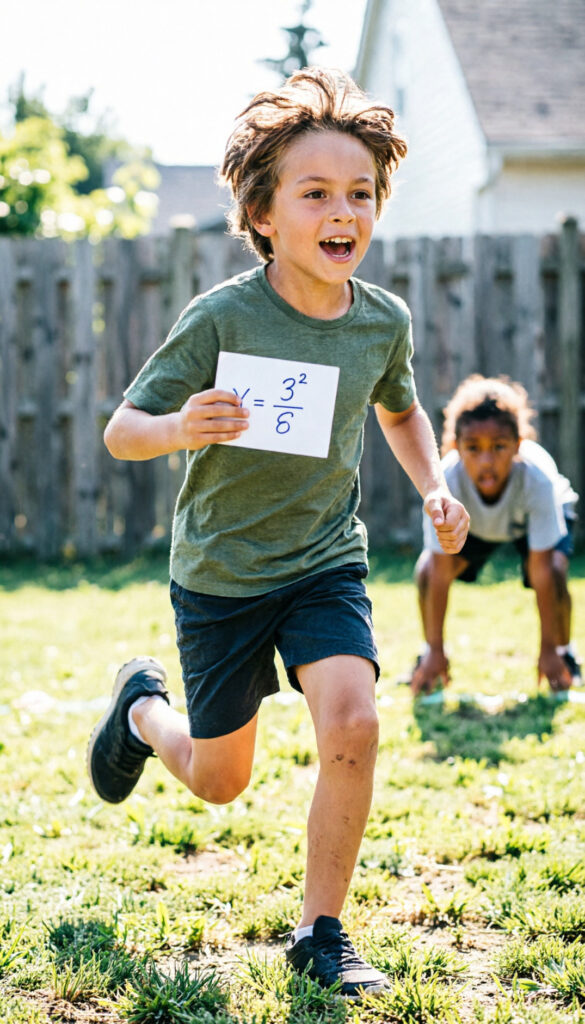
When a kid has too much energy in their legs, flashcards at a table are a losing battle. This one gives the energy somewhere to go and turns fact practice into a sprint.
- Real ages: 7-11, best at 8-10. Down to 6 with addition to 10 or number recognition. Up to 11-12 with two-step problems.
- Time: 10 minutes prep (writing cards), 15-20 minutes play, 2 minutes cleanup.
- Mess: None.
- Supervision: You are there the whole time, because you are the one checking answers.
- You’ll need: 20 index cards, one chunky marker, a rock or a shoe to hold the stack down.
- Free swap: Cereal box rectangles, or skip cards entirely and chalk the problems in a row on the driveway.
- What goes wrong the first time: You use their worksheet problems. A kid who has just sprinted 60 feet and is breathing hard cannot do their hardest math, and the first wrong answer ends the game. Go one notch easier than their homework. Also write big and dark, because thin pen in bright sun is unreadable to a kid squinting and out of breath, and put a rock on the card stack or the first gust redistributes it across the lawn.
- Skip it if: Your kid melts down when timed, has asthma or a mobility limit (walk-and-solve works just as well), or is deep in math anxiety, in which case start with game 4 instead.
Setup and Materials
Twenty index cards, one thick dark marker, and an open stretch of grass or driveway about 40 to 60 feet long. Write one problem per card, matched to whatever unit they are in right now. Twenty cards is roughly 12 to 15 minutes of real play once you include the arguing about whether they touched the line. Do not write fifty.
How to Play
- Put the stack of cards face down at the far end, weighted with a rock.
- Your kid stands at the near end. That is home base.
- Say go. They sprint down, grab one card, and sprint back.
- They read the problem out loud and answer it before they are allowed to go again.
- If the answer is wrong, you do not say “wrong”. You say the problem back to them slowly and let them fix it, then they run.
- Keep the finished cards in a pile so they can see it growing. The pile is the reward.
Tip: let them beat their own time on the second round rather than racing you. Beating a parent is either too easy or impossible, and both kill it.
Educational Value
This is fact fluency practice, plain and simple. The value is in the number of times they retrieve a fact from memory out loud, and a 15 minute relay gets you 30 to 45 retrievals with no complaints, which is more than most kids will do on a worksheet before they stall. It also uses up a real chunk of the 60 minutes of daily activity that CDC and WHO recommend for school-age kids, so you are not choosing between homework and getting outside.
I will not pretend the sprinting itself makes them better at math. What it does is make them willing to do the repetition.
Modifications for Advanced Learners
Write missing-number problems (4 x ? = 24) instead of straight facts. Most 8 to 10 year olds have never seen a letter used as a variable, so write it as a blank or a box rather than “4x = 24”, and read it out loud as “four times what makes 24”. Same skill, none of the panic. For a confident 10 or 11 year old, put two problems on one card so they have to hold the first answer in their head while solving the second.
2. Sidewalk Chalk Math Grid
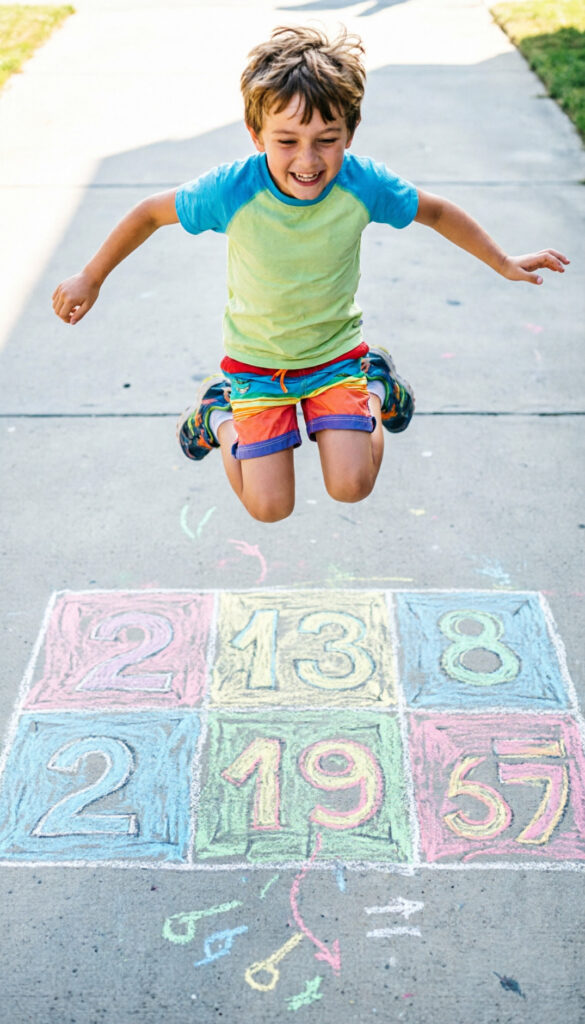
Your driveway becomes a giant board game and your kid becomes the playing piece. This is the one my kids ask for again, and it is also the one that costs you the most knee pain.
- Real ages: 7-10. Down to 5-6 with numbers 1 to 20. Up to 11 with coordinates or square numbers.
- Time: 15-20 minutes of adult prep (that is you, kneeling), 15 minutes play, cleanup is a hose or nothing.
- Mess: Low, but chalk dust travels. It is on their hands, their knees, and the soles of their shoes, and shoe soles are how it gets on your hallway floor. Shoes off at the door.
- Supervision: You stand at the edge calling prompts for the whole game. Driveway car rule applies.
- You’ll need: Sidewalk chalk in dark colours, and something to kneel on.
- Free swap: Blue painter’s tape on a patio or garage floor, numbered paper plates weighted with rocks (works on grass and you can rearrange them), or a spray bottle of water on hot pavement.
- What goes wrong the first time: Three things. Yellow and light blue chalk are close to invisible on light grey concrete in bright sun, so use dark blue, purple, red, or black. Twelve inch squares are too small for a 10 year old’s feet, so make them 15 to 18 inches. And your knees will hurt more than you expect after 25 squares, so kneel on a folded towel or a foam garden pad.
- Skip it if: You have no driveway, patio, or paved path, or your only paved surface meets the street.
Setup and Materials
Draw a five-by-five grid, squares 15 to 18 inches across, and write one number in each. For an 8 to 10 year old, use products from the times tables they are learning, multiples of a single number, or a mix of two-digit numbers, decimals, and fractions if they are further along.
Dip the chalk stick in water before you draw. It roughly doubles the colour intensity and the lines survive being walked on much longer. That single trick is the difference between a grid you can see and a grid you are squinting at by round three.
How to Play
- Stand at the edge of the grid where you can see every square.
- Call a prompt that requires a calculation, not a number. “Jump to the product of 6 and 4.” “Jump to a multiple of 10.”
- They work it out and jump onto the square.
- Add both feet once they are warmed up: “left foot on a prime number, right foot on a multiple of 5.”
- Chalk an X through squares they have already solved so the grid gets harder as it empties.
Tip: when they land on the wrong square, do not say no. Ask “what is 6 times 4?” and let them move themselves. They almost always self-correct, and it stays a game.
Practical note: the grid does not survive rain. Take one photo of it before you go inside, and next time you can redraw the exact same grid in six minutes instead of twenty.
Educational Value
The useful part is that they have to do the calculation and then find the answer in a field of 25 numbers. Answering “24” is one step. Spotting 24 among two dozen competing numbers while your body is committed to jumping is harder, and it is the closest thing to how math actually gets used.
It also drills vocabulary that trips kids up on tests: product, multiple, factor, prime, even, sum. Hearing those words in a game rather than on a test is how they stop being scary.
Modifications for Advanced Learners
Turn it into a coordinate grid: letters along the bottom, numbers up the side, and call out coordinates to stand on. Worth knowing that fifth graders work in the first quadrant only, so positive coordinates are on-target and all four quadrants with negative values is grade 6 material. Save that until they have met negative numbers, or run game 13 first.
3. Fraction Scavenger Hunt

Fractions are where a lot of kids decide math is not for them. Finding them in the real world helps, but only if you set this up properly, and the usual version of this activity is set up badly.
- Real ages: 8-11. Down to 6-7 with halves and quarters only. Up to 12 with equivalent fractions and percentages.
- Time: 5 minutes prep, 25-40 minutes walking, no cleanup.
- Mess: Low. Dirty hands, grass-stained knees.
- Supervision: Full, you are walking with them. Poison ivy, ticks, and a firm nothing goes in your mouth rule.
- You’ll need: A clipboard, paper, a pencil, and a phone camera if you want a record.
- Free swap: A cereal box panel and a binder clip is a clipboard. Pencil beats pen because paper outside is often slightly damp and pens skip.
- What goes wrong the first time: “Go find fractions in nature” is too abstract. My kid wandered for four minutes, found nothing, and asked to go in. The fix is to hand them specific targets instead of an open prompt: find something split into four equal parts, find a group of five things where two are a different colour, find something that is exactly half gone.
- Skip it if: Your kid needs fast feedback and hates open-ended tasks. Give them the target list version or pick game 6 instead.
Setup and Materials
A clipboard, paper, a pencil, and a list of five to eight specific targets you write in advance. That list is the whole activity. Without it this is just a walk.
Here is the thing nobody tells you: a suburb is a far better fraction hunting ground than a forest. A brick wall, a paving stone path, a six-pane window, a chain link fence, and a set of porch steps are all cleanly divided into equal parts. Nature is mostly unequal parts, which is exactly what makes it confusing.
How to Play
- Hand them the clipboard and read the first target out loud.
- Walk. Let them find it, not you.
- When they find something, they sketch it roughly and write the fraction next to it.
- Ask them to say the fraction out loud with the words: “three out of eight”, then “three eighths”.
- Move to the next target. Five finds is a full session.
Tip: the best question you can ask at each find is “what is the whole?” Kids get fractions wrong far more often because they lost track of the whole than because they cannot count the parts.
Educational Value
There are actually two different kinds of fraction hiding in this game and mixing them up is where kids get muddled. Part of a whole is one object split into equal pieces, like a leaf torn in half. Part of a set is a group where some members differ, like three yellow flowers out of eight. Both are legitimate fractions, and both appear in their schoolwork, but they feel completely different to a kid. Naming which one you are looking at each time is the single most useful thing you can do here.
The other real gain is that a fraction stops being two numbers with a line between them and becomes a description of something they can see.
Modifications for Advanced Learners
Ask for equivalent fractions. If they find eight pebbles and four are white, they write four eighths and then reduce it to one half. For a fifth grader, add a conversion column: four eighths, one half, 0.5, 50 percent, all describing the same pile of pebbles. Watch out that percentages are grade 6 in most standards, so treat it as a bonus rather than an expectation.
4. Target Toss Math
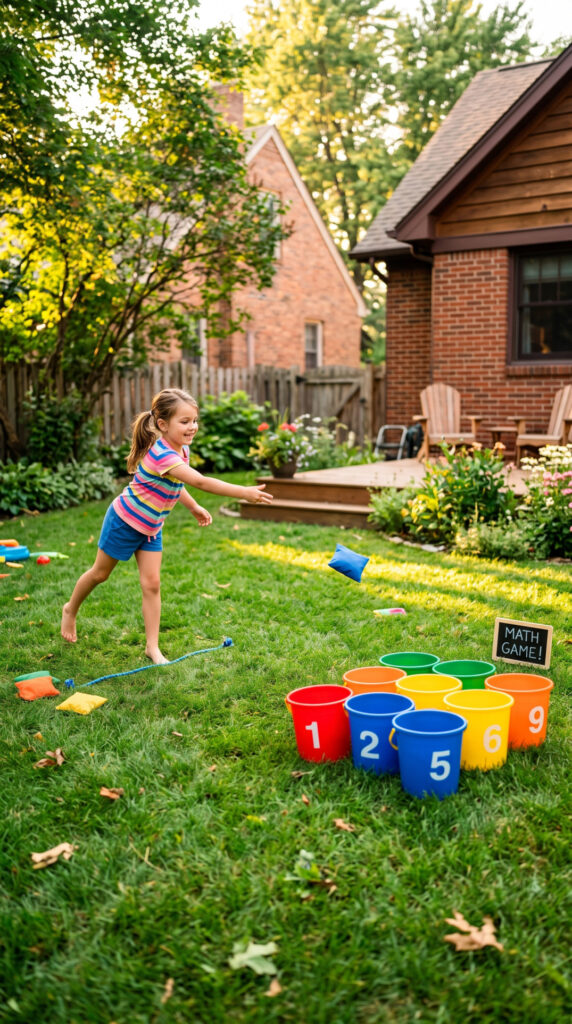
If I could only keep one game from this list, it would be this one. It works for almost every kid, it takes five minutes to set up, and it scales from a six year old to a twelve year old with no changes to the equipment.
- Real ages: 6-11 and beyond. The most adaptable game here.
- Time: 5-10 minutes setup, 20 minutes play.
- Mess: None.
- Supervision: Right there, keeping score and holding the throwing line.
- You’ll need: Three to five buckets, bowls, or hula hoops, and three to five beanbags.
- Free swap: Rolled socks and cardboard boxes. Or chalk circles on the driveway with point values written inside, which costs nothing and never blows over.
- What goes wrong the first time: Two practical problems. Empty buckets tip and roll the moment a bag hits the rim, so drop a rock in the bottom of each or half fill them with water. And beanbags bounce straight out of hard plastic buckets, which is why rolled socks work better. Put a folded cloth in the bottom of each bowl if you are using beanbags. Also, every kid on earth immediately creeps closer, so chalk the throwing line and mean it.
- Skip it if: Nothing much. If your kid has poor coordination, let them stand closer rather than dropping the game. Landing nothing for ten throws is the only thing that ruins this.
Safety: do not use small stones as throwing objects, which is the version of this game floating around online. Rocks cause eye injuries and it teaches a habit you will regret at the next family barbecue. Rolled socks, beanbags, or a tennis ball only. Set the targets so nobody is throwing toward a window, a car, or a sibling.
Setup and Materials
Buckets, plastic bowls, or hula hoops at different distances from a chalk throwing line. Write a point value or an operation on each with chalk or a taped label. Beanbags, rolled socks, or tennis balls to throw.
Put the highest number on the furthest, smallest target. Kids work out the risk and reward on their own within about three throws, and that is a real piece of math thinking you did not have to teach.
How to Play
- Chalk a throwing line and set out the targets.
- They throw all three or five bags in one turn.
- Read the numbers where the bags landed out loud together.
- They combine those numbers using whatever operation you set. Two bags in a 7 and an 8 means 7 times 8 for the round score.
- Write each round score on the driveway in chalk and total it at the end. Seeing the running total is half the appeal.
Tip: let them choose the operation for one round out of every four. They will pick multiplication because the numbers get bigger, which means they choose the harder math on their own.
Educational Value
This one gets you volume of practice without it feeling like practice, and it adds a decision on top of the calculation. Aim for the safe target and get a small guaranteed score, or the far target and risk zero. That is early probability thinking, and kids do it here without being taught it.
Holding two or three numbers in their head while working out how to combine them is also exactly the working memory load that timed tests demand, minus the test.
Modifications for Advanced Learners
Label the buckets with operations instead of numbers: “multiply your score by 3”, “subtract 15”, “double it”. They start with a base score and apply the operations in the order the bags landed, which is a natural way into order of operations (grade 5 in most standards). Add a rule that anything in brackets happens first and you have a real PEMDAS lesson disguised as a throwing game.
5. Geometry Scavenger Hunt
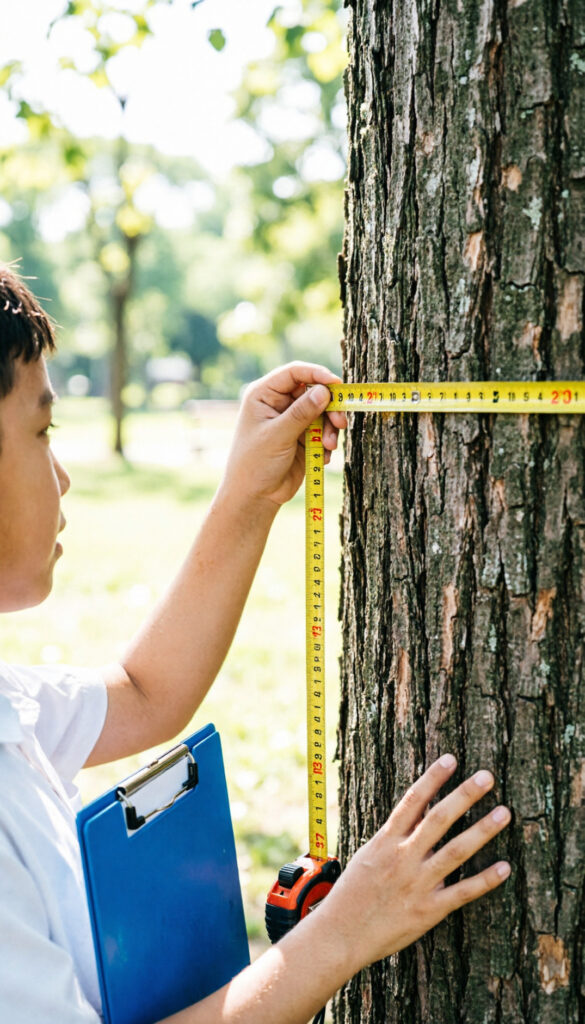
This is the most independent game on the list, which makes it the one to reach for when you need twenty minutes to make dinner.
- Real ages: 8-11. Down to 6 with circles, squares, triangles, and rectangles only.
- Time: 10 minutes prep writing the list, 25-30 minutes hunting.
- Mess: None.
- Supervision: Check in every few minutes if it is your own yard and they are 9 or 10. Full supervision if you are going further than that.
- You’ll need: A checklist, a pencil, a measuring tape, and something to check right angles with.
- Free swap: The corner of an index card is exactly 90 degrees, and it is a better right-angle checker than a protractor. Fold a piece of paper twice and you have the same tool.
- What goes wrong the first time: They find a cylinder and a sphere in ninety seconds, then stall completely on rhombus and trapezoid, because those are genuinely rare outdoors. A plastic protractor is also awkward on a real-world angle, since you cannot line the vertex up against a fence post. Give them the hunting list below and the index card trick and this goes from frustrating to fast.
- Skip it if: Your kid hates anything that looks like a worksheet. This is the most worksheet-like game here.
Setup and Materials
A checklist of shapes and angle types at their grade level, a pencil, a 25 foot tape measure, and an index card. Angle measurement with a protractor is a grade 4 skill, so a third grader is better off sorting angles into bigger than, smaller than, or the same as the corner of the card.
Where the hard shapes actually live, because this is what saves the activity:
- Rhombus: a chain link fence, a lattice fence panel, or a diamond-pattern garden trellis. This is the only reliable rhombus in a suburb.
- Trapezoid: a bucket seen from the side, a lampshade, a flower pot, or the side view of a wheelbarrow.
- Octagon: a stop sign.
- Triangle: a bike frame, a roof gable, a step ladder from the side.
- Parallel lines: bench slats, siding, road markings, fence rails.
- Right angle: a curb corner, a window frame, a brick, a gate post.
- Cylinder: a tree trunk, a drain pipe, a fence post.
- Rectangular prism: a brick, an air conditioner unit, a mailbox.
How to Play
- Hand them the list, the pencil, the tape, and the index card.
- Set a boundary out loud. The yard, the block, the park fence, whatever it is.
- They find each item, write what it was, and tick it off.
- For every shape they find, they measure one dimension and write it down.
- Come back and pick two objects to calculate the perimeter of together.
Tip: Ask them to find one thing that is almost a shape but not quite, like a nearly-square window or a slightly wonky brick. Working out why something fails the definition teaches the definition better than finding a perfect example.
Educational Value
Shape vocabulary is mostly memorisation on paper, and memorised vocabulary evaporates. Attaching “rhombus” to the specific chain link fence at the end of your street makes it stick, and it makes the defining property (four equal sides, angles that are not 90 degrees) something they can see rather than recite.
Measuring real objects also does something a ruler on a worksheet cannot: it forces them to deal with numbers that are not tidy. A real brick is not 8 inches. It is a bit under, and deciding what to do about that is genuine mathematical judgment.
Modifications for Advanced Learners
Have them measure actual angle degrees on fences, playground frames, and branch junctions and log the numbers. Then move from perimeter to area, and for a fifth grader, to volume: the mailbox, a planter, a cooler. Volume of a rectangular prism is a grade 5 standard, so this is right on target rather than a stretch.
6. Skip Counting Hopscotch
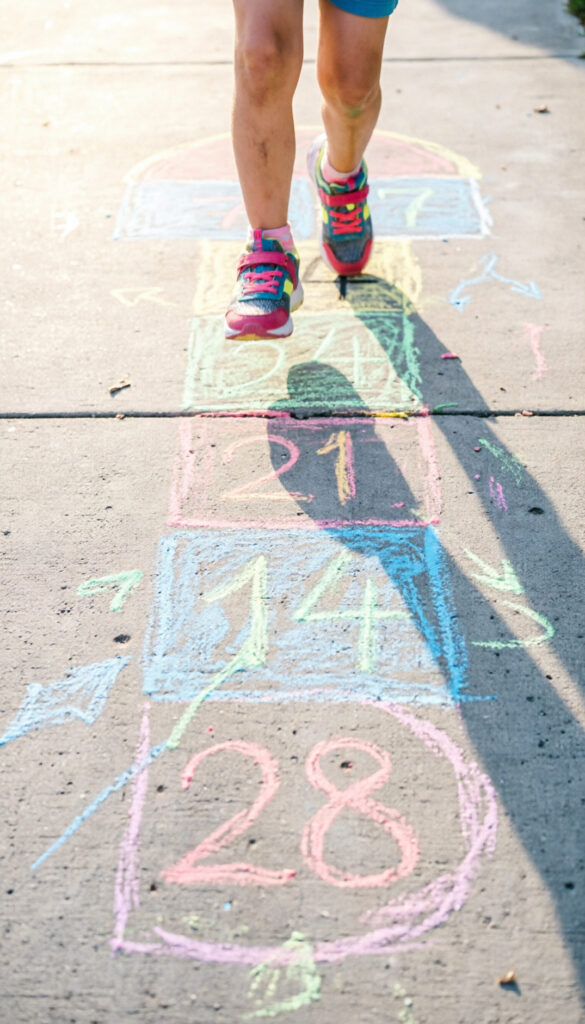
Times tables set to a rhythm. This is the cheapest game here and the one with the best return per minute of prep, with one social catch you should know about.
- Real ages: 6-10. Counting by 2s, 5s, and 10s is grade 2, so an 8 to 10 year old should be on 3s, 4s, 6s, 7s, and 8s.
- Time: 10 minutes drawing, 15 minutes play.
- Mess: Low, chalk dust on hands and shoes.
- Supervision: Nearby, counting along. Driveway car rule applies.
- You’ll need: Chalk and a beanbag or bottlecap as the marker.
- Free swap: Painter’s tape indoors, a bottlecap or a wood chip for the marker.
- What goes wrong the first time: A 10 year old will tell you hopscotch is for little kids, and they are not entirely wrong. The fix is to make it physically hard rather than childish: draw it twice as long as normal, make it one-footed the whole way, or time it. Squares also need to be 15 to 18 inches for a kid with size 4 feet. And the stone-tossing half of traditional hopscotch slows the counting right down, so if your kid just wants to hop and chant, let them drop the toss.
- Skip it if: Your kid has balance or coordination difficulties, since sustained one-foot hopping is genuinely hard. Two-footed jumping works fine and keeps the counting.
Safety: Use a beanbag or bottlecap as the marker, not a rock. Markers get thrown when a round goes badly.
Setup and Materials
Chalk a standard hopscotch grid, but fill the squares with a skip counting sequence instead of 1 to 10. For the seven times table: 7, 14, 21, 28, 35, 42, 49, 56, 63, 70.
Write the sequence in one colour and leave two or three squares blank for them to fill in themselves. The blanks are where the actual thinking happens.
How to Play
- Draw the grid and read the sequence out loud together once, slowly.
- Rub out two numbers in the middle and have them work out what goes there before they start hopping.
- They hop the grid, calling each number out loud as their foot lands.
- At the far end they turn around and count backward on the way home.
- Second run, they go without the numbers written in the last three squares. Third run, cover more.
Tip: counting backward is the part that matters. Forward skip counting can be done from memory as a chant without any thinking. Backward forces actual retrieval, and it is where division fluency comes from.
Educational Value
Pairing a number sequence with a physical rhythm helps it stick, which is the same reason kids remember song lyrics they never tried to learn. Rote practice is boring on paper, and boredom is what makes kids stop before the facts are automatic.
The real target here is automaticity. A kid who has to work out 7 times 6 from scratch has no attention left for the long division problem it is buried inside. Getting these to instant recall makes everything downstream easier, and hopping is a much better delivery mechanism than a timed test.
Modifications for Advanced Learners
Number the squares in quarters or tenths (0.25, 0.5, 0.75, 1.0, 1.25) so they see fractions and decimals increasing in equal steps, which is a grade 4 to 5 skill and much harder than it looks. Or run two sequences side by side, 4s in one column and 6s in the other, and have them hop only on numbers that appear in both. That is common multiples, and it is a genuinely tough grade 4 concept made visible.
7. Math Obstacle Course
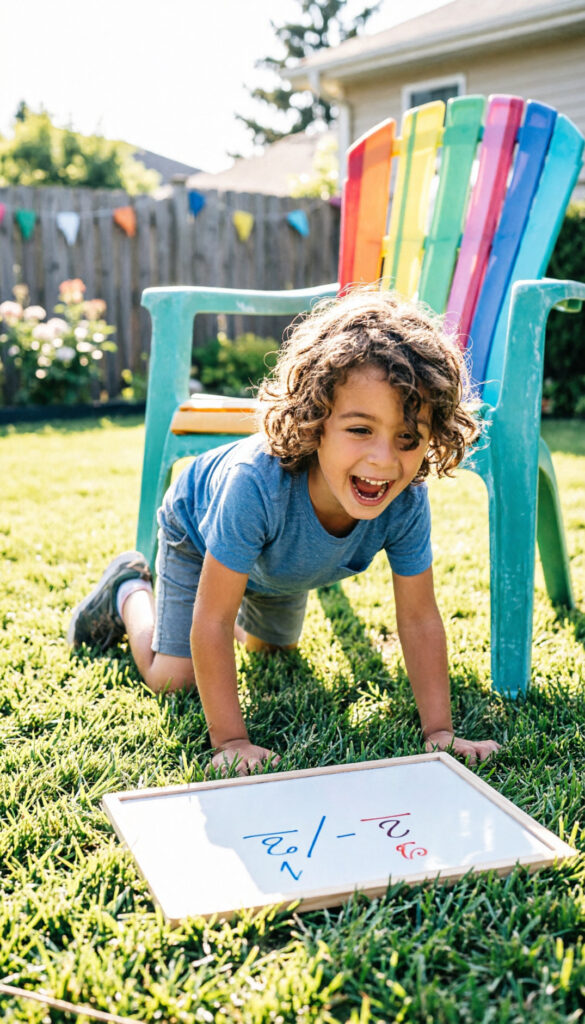
The highest energy game here, and the one with the biggest gap between how it sounds and how it goes the first time.
- Real ages: 7-11.
- Time: 15-20 minutes setup, 20 minutes play, and they will want to run it five more times, which is exactly what you want.
- Mess: Low. Grass stains, wet knees if the lawn is damp.
- Supervision: Arm’s reach at anything they climb, balance on, or crawl under.
- You’ll need: Jump ropes, cones, a garden hose, pool noodles, buckets, and station cards.
- Free swap: Everything here is already in your yard. A Dollar Tree pool noodle is the single most useful obstacle course item for a dollar and change.
- What goes wrong the first time: Your kid spends forty minutes building the course and four minutes running it, and no math happens at all. Either you build it, or you set a ten minute build timer. The other failure is that they sprint through and guess wildly at the problems because stopping to think ruins their time, so do not time the first run.
- Skip it if: It is a hot day, or your kid has a mobility limit or asthma. Also skip on wet grass in anything but proper shoes.
Safety: do not have them crawl under a patio chair. Metal and heavy resin chairs tip, and a chair tipping onto a kid’s back or head is a real injury. Use a pool noodle or a broom laid across two buckets so the thing that falls is light. No stations on a slope, and nothing that involves jumping down from higher than a single step.
Setup and Materials
Four to six stations using what is in the yard: a jump rope laid out as a balance beam, a hose as a tightrope, cones to weave through, a pool noodle limbo bar on two buckets, a set of five jumping jacks. One index card with a math problem at each station, weighted with a rock or slipped inside a sandwich bag if the grass is wet.
Damp index cards go soft and unreadable in about ten minutes on wet grass. The sandwich bag is not fussiness, it is the difference between six stations and four.
How to Play
- Walk the course with them once, no running, so they know the order.
- They complete the physical task at station one.
- They solve the card at that station out loud before moving on.
- Repeat through the course.
- Second run, they can try to beat their first time. That is when they start doing the math faster on purpose.
Tip: put the hardest problem at station one, while they are fresh, and the easiest at the last station, when they are gasping. The natural instinct is the opposite and it does not work.
Educational Value
Switching between physical effort and mental work is a real skill, and doing it repeatedly in one session is where the value is. Practically, the repeat runs are the point: a kid who runs the course four times does every problem four times, and by run three they are answering without calculating because the fact has moved into recall.
I am not going to claim this rewires anything. It is repetition your kid volunteers for, which beats repetition you have to enforce.
Modifications for Advanced Learners
Add a second problem at each station that depends on the first answer, so they carry a number through the course. Multi-step word problems read out loud at each station also work well for a strong 10 or 11 year old.
8. Measurement Challenge
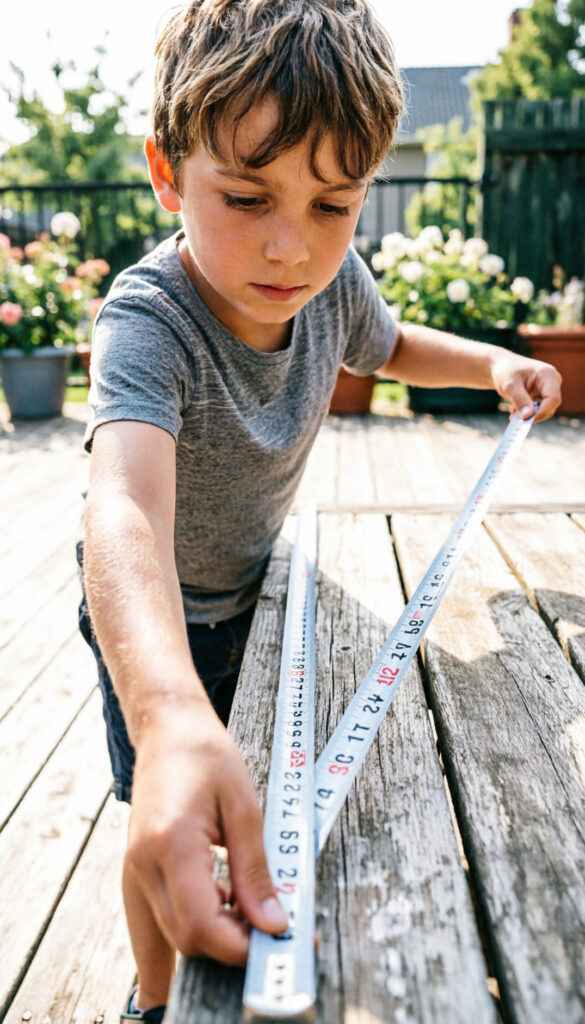
A 12 inch ruler teaches kids that measuring is a school activity. A 25 foot tape teaches them it is how adults get things done.
- Real ages: 7-11. Grade 3 through 5 measurement work.
- Time: 5 minutes prep, 25 minutes play.
- Mess: None.
- Supervision: Check in every few minutes, but you will need to hold one end of the tape.
- You’ll need: A 25 foot retractable tape, a yardstick, a 12 inch ruler, and a notebook.
- Free swap: A ball of string and a ruler. Measure with the string, then measure the string. Or start with heel-to-toe kid feet, which is genuinely the best entry point and teaches why standard units exist in the first place.
- What goes wrong the first time: One kid cannot hold both ends of a 25 foot tape across a driveway. It collapses, they get frustrated, and they quit. Put a rock on the end or be the second pair of hands. The other failure is boredom after three measurements, because measuring for its own sake is pointless. Give them an actual job (how much rope for a swing, how many pavers fit along the bed, will the paddling pool fit in the shade) and it changes completely.
- Skip it if: Nothing really. This is the most useful life skill on the list.
Safety: A retractable tape has two hazards adults forget. The blade edge is thin metal and it can slice a finger, and the retract snaps back hard enough to hurt a hand and to whip the metal hook into a face. Teach them to walk it back with a thumb on the brake rather than letting it go.
Setup and Materials
A 25 foot tape, a yardstick, a 12 inch ruler, a notebook, and a pencil. Three tools rather than one is deliberate, because choosing the right tool for the job is half of measurement.
How to Play
- Give them three specific challenges written down, not shouted across the yard.
- Start with something they can reach alone: the height of the mailbox, the width of a step.
- Move to something needing two people: the length of the driveway, the perimeter of the garden bed.
- They write every measurement down as they go, in a unit they choose.
- Sit down at the end and calculate the perimeter or area of one thing together.
Tip: Ask them to guess before every single measurement and write the guess next to the real number. Their guesses get dramatically better within about six measurements, and watching that happen is more motivating than the measuring.
Educational Value
Perimeter and area are abstract on a worksheet and obvious with a tape measure in your hand. A kid who has measured the garden bed and worked out how many edging stones it needs understands why the formula exists, which is a different thing from knowing the formula.
Choosing between a ruler, a yardstick, and a tape is also real mathematical decision-making, and it is the sort of thing that never comes up in a workbook where the tool is already chosen for you.
Modifications for Advanced Learners
Convert everything. The patio in inches, then feet, then yards, then metres. Unit conversion within a system is a grade 4 skill and across systems is grade 5, so this is on-target rather than a stretch. For a strong 10 or 11 year old, have them scale a plan: measure the yard, then draw it to scale on grid paper where one square equals one foot. That is where measurement meets geometry and it is genuinely satisfying to finish.
9. Estimation Station
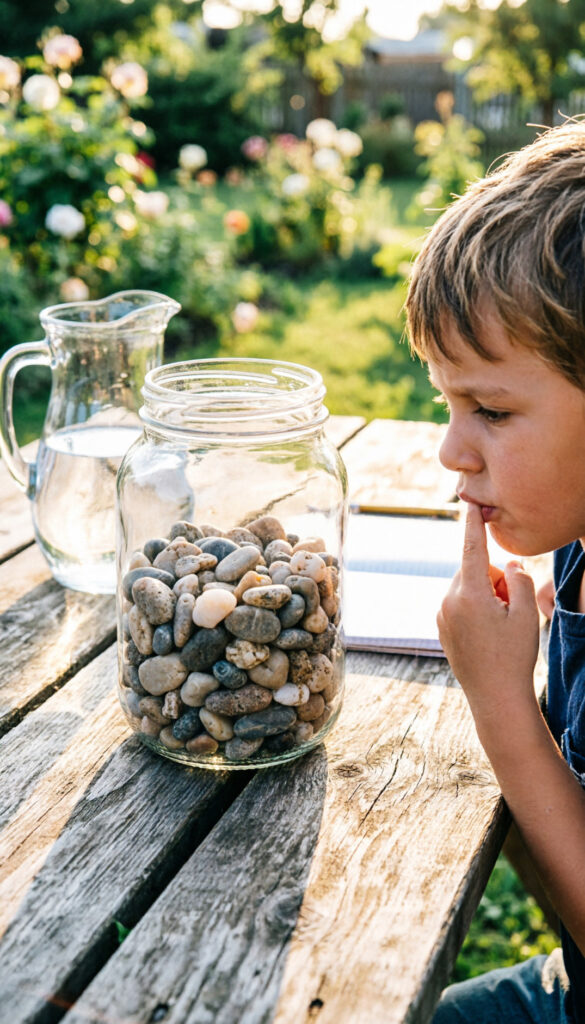
Estimation is the skill that lets a kid notice their answer is nonsense before they hand the test in. It is also the game most likely to upset a kid who hates being wrong, unless you set it up the way described below.
- Real ages: 8-11.
- Time: 15 minutes setup, 20-25 minutes play.
- Mess: Medium if water is involved. Pebbles scatter.
- Supervision: Hands-on the whole time.
- You’ll need: A clear jar, a pitcher, a measuring cup, a kitchen scale, and things to count and weigh.
- Free swap: An empty pasta jar, dry beans or cereal, and the bathroom scale for anything heavy. An egg carton is the best free counting tool you own.
- What goes wrong the first time: You fill the jar with 200 pebbles, and then counting them to check the estimate takes fifteen minutes and the whole thing dies at pebble 90. Keep quantities under about 60, and count into an egg carton so every full carton is a tidy twelve. Also, do not use anything you actually need for dinner, because it will end up on the lawn.
- Skip it if: Your kid cannot tolerate being wrong. Read the reframe below first, because it fixes this for most kids.
Safety: Pebbles, dry beans, and beads all pass through a toilet paper tube, so they are a choking hazard if a toddler comes into the yard. A heavy landscaping rock on a table edge is a foot injury waiting to happen, so put it on the ground. And a kitchen scale left in the wet grass is a dead kitchen scale.
Setup and Materials
Set three or four stations on an outdoor table. A clear jar with a countable number of pebbles or beans, a pitcher of water with a measuring cup, something to weigh on the kitchen scale, and something long to estimate the length of.
Keep the counting jar under 60 items. This is the single change that makes this game work.
How to Play
- They visit each station and write down an estimate.
- Ask for a range, not a number. “Between 40 and 60”, not “48”.
- After all the guesses, you check them together by counting, measuring, or weighing.
- Score a hit if the real answer falls inside their range.
- Second round, they narrow the range. That is where the skill actually develops.
Tip: Ask “how did you decide?” before you check the answer. The strategy is the lesson. The number is just the scoreboard.
Practical note: asking for a range instead of a single number is the whole game for a kid who hates being wrong. A single guess is either right or wrong, and wrong stings. A range is a judgment you either got inside of or missed slightly, which feels completely different, and it happens to be how estimation actually works in real life.
Educational Value
Number sense is the quiet skill behind everything else in math. A kid with good number sense looks at 6 x 48 = 2,880 and knows something went wrong without redoing the calculation. That instinct comes from having estimated a lot of real quantities and then checked.
Estimation also builds a genuinely useful habit: making a rough judgment on purpose rather than either guessing blindly or freezing until you can be exact.
Modifications for Advanced Learners
Teach sampling properly. Count how many pebbles fill one inch of the jar, work out roughly how many of those layers make up the whole jar, and multiply. That is a real technique, it is how actual estimates get made, and it feels like a magic trick to a 10 year old. Then compare their sampled estimate to their gut estimate and ask which was closer, and why.
10. Water Balloon Math
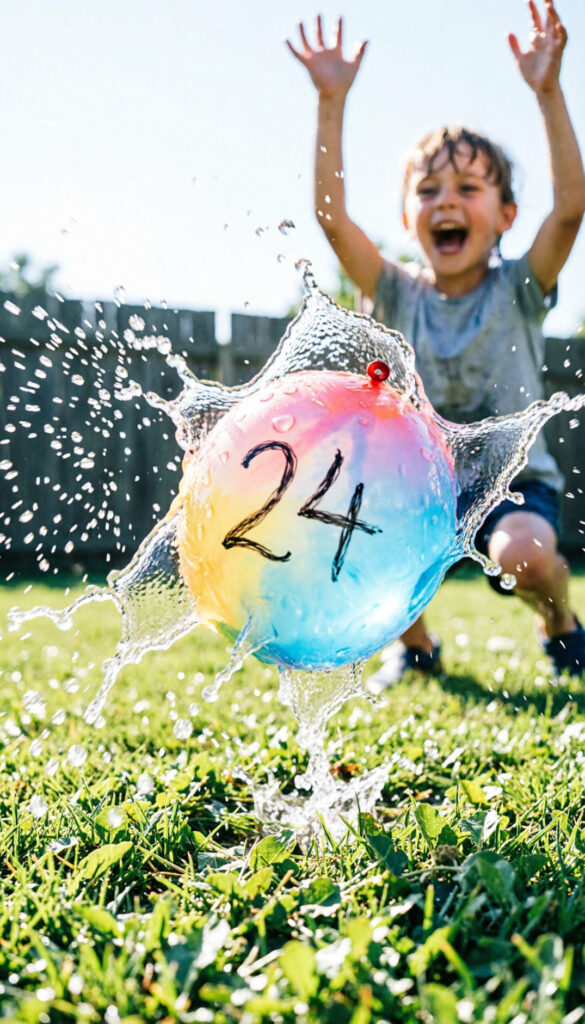
The most motivating game here and the one with the worst ratio of setup to play. Read the safety notes properly on this one, because balloons are the one material on this list that regulators warn about specifically.
- Real ages: 6-11, and only if there is no child under three anywhere in the yard.
- Time: 20-25 minutes prep (filling and labelling), 10-15 minutes play, 10 minutes of adult-led cleanup.
- Mess: High. Soaked clothes and shredded latex across the lawn.
- Supervision: Hands-on, and you do the fragment sweep yourself.
- You’ll need: Water balloons, a filler, and chalk.
- Free swap: Wet sponges, and this is not a downgrade. Cut three kitchen sponges into strips, band them together with an elastic, write numbers on them while dry with a Sharpie, and soak them in a bucket. They are reusable, they do not shred, there is nothing to choke on, and you can play ten rounds instead of one. If I were writing this list from scratch, the sponge version would be the main version.
- What goes wrong the first time: A Sharpie will not write on a wet, filled balloon. The ink beads up, smears, and the balloon squirms out of your hand. I lost fifteen minutes learning this. The fix is to skip writing on balloons entirely: chalk numbered circles on the driveway and set one balloon in each. Second problem, water balloons often do not pop on grass, they bounce, and a kid who has done the math correctly and gets no splash is furious. Play on pavement or let them stomp. Third problem, you will spend 25 minutes filling and the game will be over in eight.
- Skip it if: Anyone has a latex allergy, there is a toddler or a dog in the yard, your kid is sensory-sensitive about wet clothes or cold water, or it is below about 70 degrees. Also skip if you are reading this in autumn or winter, and come back to it in May.
Safety, and this one is not negotiable. Uninflated balloons and burst balloon fragments are a documented choking and suffocation hazard for young children, and US federal law requires latex balloon packaging to carry a warning naming children under eight. Wet latex conforms to the airway and is very difficult to clear. So: no toddlers in the yard, no dogs (they eat the pieces), nobody stretches a balloon with their teeth, and every single fragment gets picked up before anyone goes inside. Do the sweep yourself and do it in daylight. Latex allergy is also real and more common in kids who have had multiple surgeries, so use non-latex or the sponge version if that applies to anyone in your family.
Setup and Materials
Water balloons and a way to fill them fast. Bunch O Balloons fills around forty at once and takes the prep from twenty minutes down to about five, which is the difference between doing this and not doing it. Dollar store bags of plain balloons are cheaper but you are filling and tying them one at a time.
Chalk to draw numbered circles on the driveway, so you never have to write on a balloon.
How to Play
- Chalk ten to fifteen numbered circles on the driveway, spread out.
- Put one filled balloon in each circle.
- Call out an equation whose answer is one of the numbers.
- They work it out, run to that circle, and stomp the balloon.
- Wrong circle means the balloon stays and they try again. No penalty, just another go.
- When the balloons are gone, everyone helps pick up pieces, and you check the lawn again afterwards.
Tip: Call the equations in a random order rather than working down the numbers. Kids figure out a sequence within three rounds and stop doing math.
Educational Value
The value here is speed under a bit of pressure, and the immediate reward. A correct answer produces a splash within four seconds, and that tight loop between doing the math and getting the payoff is why kids will do twenty problems in ten minutes without noticing.
Be realistic that this is a fluency game, not a thinking game. Nobody does careful multi-step reasoning while holding a water balloon.
Modifications for Advanced Learners
Read multi-step word problems instead of equations. They have to hold the problem in their head, pull out the numbers, and work out which operation to use, which is far harder than it sounds when they are already keyed up. Give them ten seconds of think time before you say go, otherwise they will guess.
11. Money Math Market
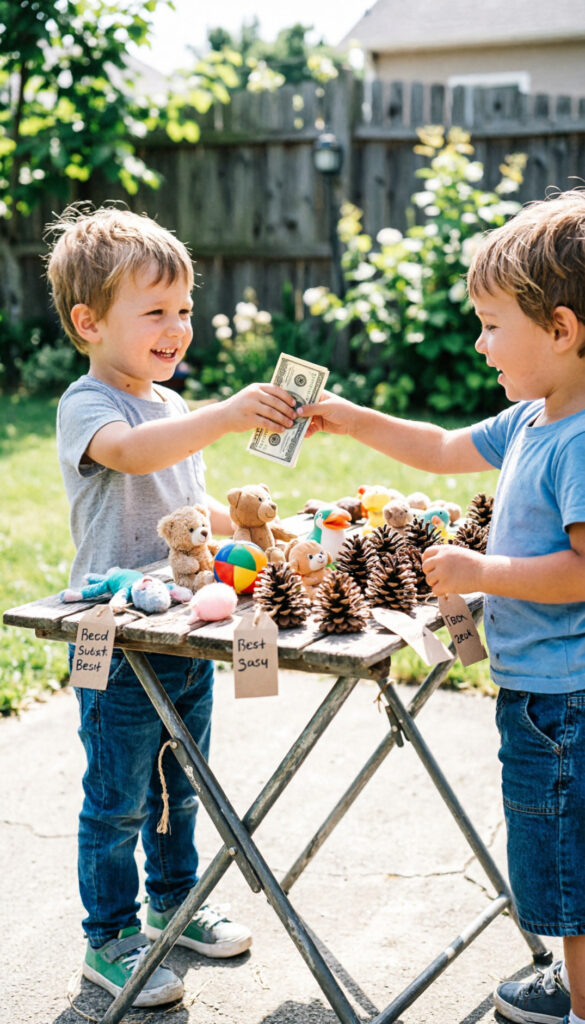
The longest-lasting game on the list, and the only one where the math is something they will still be using at 40.
- Real ages: 7-11. Counting coins starts in grade 2, decimals and making change land in grades 4 and 5.
- Time: 15-20 minutes setup, 25-30 minutes play.
- Mess: None, but your house gets raided for merchandise.
- Supervision: You are in the game as the customer or the shopkeeper, so you are there throughout.
- You’ll need: A folding table, items to sell, price tags, and play money.
- Free swap: Print play money, or cut paper rectangles and write amounts on them. Even better and completely free: hand them last week’s grocery receipt and a highlighter and ask them to work out what the five most expensive items cost together.
- What goes wrong the first time: They want to actually keep what they buy, and the game collapses the moment you say it is pretend. Agree upfront, or make one real prize (they get to choose one snack for real at the end). The other failure is pricing everything at $1.45 and $3.75 straight away. A kid still learning decimals shuts down. Round one is whole dollars. Round two adds 50 and 25 cents. Round three gets ugly.
- Skip it if: Your kid cannot settle at a table for twenty minutes. This is the least physical game here, which is worth knowing given the point of the list.
Safety: If you use real coins, remember that a dime, a penny, and a nickel all pass through a toilet paper tube, so play money is the safer choice with a toddler in the house. If you use real snacks as stock and a friend joins, ask about allergies and keep the wrappers so you can check labels.
Setup and Materials
A folding table as the shopfront, ten to fifteen items from around the house (small toys, sealed snacks, interesting rocks, books), a price tag on each, and play money.
Give them a written budget on a slip of paper. A budget they can see beats a number you said out loud, because they will check it four times.
How to Play
- Set out the stock with prices and hand over the budget.
- They browse and pick what they want.
- They add up the total before they come to the register. No calculator.
- They hand over the money and work out the change they are owed before you tell them.
- Swap roles. They run the shop and you are the awkward customer who pays for a $2.40 item with a five dollar bill.
Tip: Let them be the shopkeeper for at least one round. Making change is harder than paying, and being the one in charge of the money is the part kids actually fight over.
Educational Value
Adding and subtracting decimals in a context where the decimal point genuinely matters is worth a stack of worksheets. Kids who write 4.5 + 0.75 = 5.25 on paper without blinking suddenly get careful when it is money.
There is also a budgeting lesson that happens on its own. Once they realise they cannot have all four things, they start comparing value, and that conversation is more useful than the arithmetic.
Modifications for Advanced Learners
Add a discount or a sales tax. “Everything is 20 percent off today” makes them find the discount before they can pay. Percent calculation is a grade 6 skill in most standards, so for an 8 or 9 year old start with half off, which they can do, and work up. For a strong fifth grader, add both a 20 percent discount and a tax and make them apply them in the right order, which is a real-world problem plenty of adults get wrong.
12. Backyard Graphing
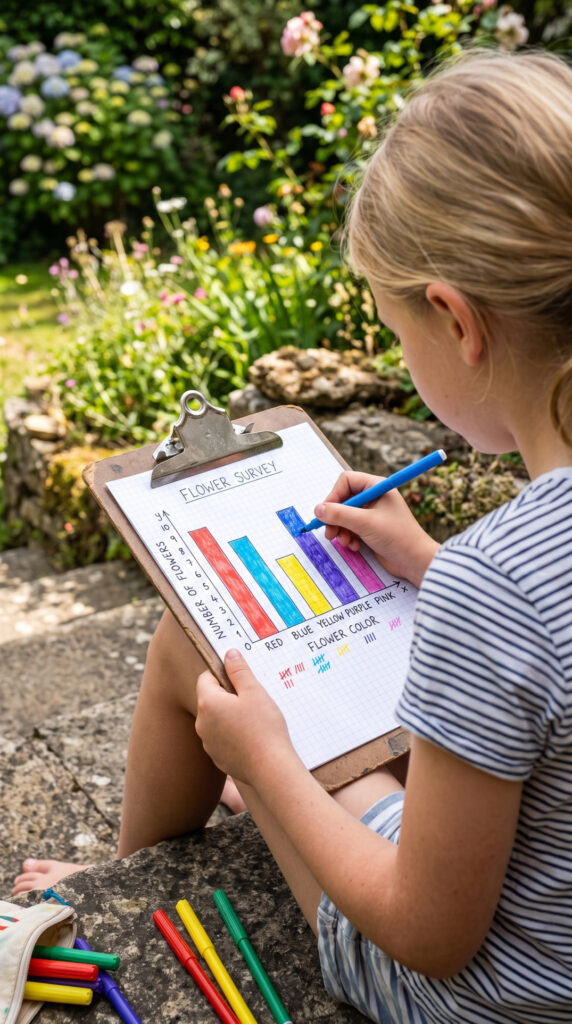
Data collection is genuinely fun for this age group. The graphing part is where it usually falls apart, and there is an easy fix for that.
- Real ages: 8-11. Scaled bar graphs are a grade 3 skill, so this sits comfortably in range.
- Time: 10 minutes prep, 20 minutes collecting, 15 minutes graphing.
- Mess: Low.
- Supervision: Check in during collection, sit with them for the graph.
- You’ll need: A clipboard, grid paper, a pencil, a ruler, and coloured markers.
- Free swap: Print grid paper free, or draw the grid. A cereal box panel and a binder clip is your clipboard.
- What goes wrong the first time: The categories are too vague. “Types of insects” produces a tally that reads bug, bug, another bug. Pick four or five named categories before you go out (ant, beetle, spider, worm, bee) plus one “other” column. The second failure is that collecting is twenty minutes of fun followed by fifteen minutes of “do I have to do the graph”. Fix: do the graph outside on the driveway in chalk, giant, standing up.
- Skip it if: Your kid is bug-averse. Count flower colours, leaf types, or car colours from the porch instead. The math is identical.
Safety: Flipping rocks and logs is where spiders, centipedes, and wasps live. Flip with a stick, from the opposite side, never with bare hands, and put it back the way it was. Do not go near a nest. Check for ticks after any time in long grass, and know whether your kid has ever reacted to a sting before you start turning over rocks.
Setup and Materials
A clipboard, paper ruled into named columns, a pencil, and a boundary you agree out loud. Grid paper, a ruler, and markers for the graph, or chalk if you take my advice and do it on the driveway.
How to Play
- Agree the categories and write them as column headings before anyone goes outside.
- Set the boundary and a time limit. Fifteen to twenty minutes.
- They tally with marks, one per sighting, grouped in fives.
- Come back and total each column.
- Chalk a giant bar graph on the driveway, one chalk square per tally, and label both axes properly.
Tip: Make them decide the scale themselves. If the biggest column is 23, one square per item makes an absurdly tall bar, and working out that each square should be worth 5 is the actual grade 3 to 4 skill hiding in this game.
Educational Value
Turning a messy pile of observations into something readable is what data work is, and doing it with data they collected themselves means they care whether the graph is right. Labelling axes stops being a rule the teacher nags about and becomes the thing that makes their graph make sense to you.
The chalk version adds something paper cannot: the graph is body-sized, so a bar that is twice as tall is something they walked the length of.
Modifications for Advanced Learners
Track one variable over a week (daily high temperature, rainfall in a jar with a ruler taped inside, how many cars pass in ten minutes) and plot it as a line graph to look for a trend. That is a genuine multi-day project and the waiting is part of it.
13. Number Line Races
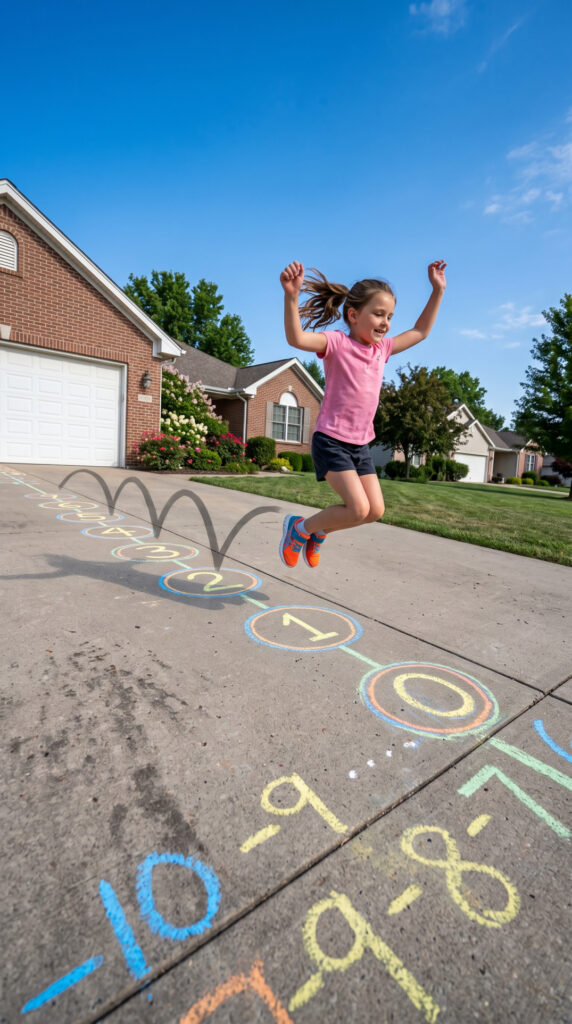
Standing on a number line and walking the arithmetic is the clearest way I have found to explain what subtraction actually does.
- Real ages: 8-11 for the positive side. Negative numbers are formally grade 6 in Common Core, so for an 8 or 9 year old this is a first introduction, not a lesson they should already know.
- Time: 10-15 minutes drawing, 15 minutes play.
- Mess: Low, chalk dust.
- Supervision: You are at the line calling prompts. Driveway car rule applies, and this game is long, so it can drift toward the street. Chalk the line running across the driveway, not down it.
- You’ll need: Chalk. A lot of chalk.
- Free swap: Numbered paper plates spaced out on the grass, which you can rearrange and reuse. Or chalk only 0, 5, 10, 15 and have them count the steps in between.
- What goes wrong the first time: Drawing 31 marks from -15 to +15 at a stride apart eats about 30 feet of driveway and most of your patience. Start at -5 to +10. Sixteen marks is plenty, and you can extend it later with three minutes of chalk. Also expect them to walk the wrong way for subtraction over and over. Do not correct it fast. Ask “which way makes the number smaller?” and let them work it out.
- Skip it if: They are in grade 2 or 3 and have never seen a negative number. Run 0 to 20 and it is still a good game.
Setup and Materials
Chalk a long line across the driveway with evenly spaced marks and numbers. Start with -5 to +10 for a first go, or 0 to 20 for a younger kid.
Mark zero in a different colour and make it wider than the others. A kid who loses track of zero loses the whole line, and it happens constantly.
How to Play
- They stand on zero.
- Call an instruction. “Start at 5 and subtract 8.”
- They walk or jump along the line to the answer and stand on it.
- Ask them to say the answer out loud before you confirm.
- Chain instructions together once they are confident. “From there, add 6. Now subtract 4.”
Tip: Temperature is the best way into negative numbers, better than abstract subtraction. “It is 3 degrees tonight and it drops another 8 degrees by morning.” Every kid understands cold, and suddenly minus 5 is a real thing rather than a rule.
Educational Value
Moving right to add and left to subtract makes the direction of arithmetic physical, and it turns “what is 5 minus 8” from an impossible question into an obvious walk. Kids who have been told you cannot take 8 from 5 get a genuine moment here.
The other benefit is that the number line is the mental model they will use for the rest of school, including on a coordinate plane and eventually in algebra. Building it at body scale first means it is a place rather than a diagram.
Modifications for Advanced Learners
Introduce absolute value: ask for a number that is 7 away from zero and let them work out that both +7 and -7 qualify. This is a grade 6 concept, so treat it as a puzzle for a curious 10 or 11 year old rather than something a fourth grader is behind on. Distance between two points on the line (“how far from -3 to 5?”) is the same idea in a friendlier form and works much earlier.
14. Outdoor Math Pictionary
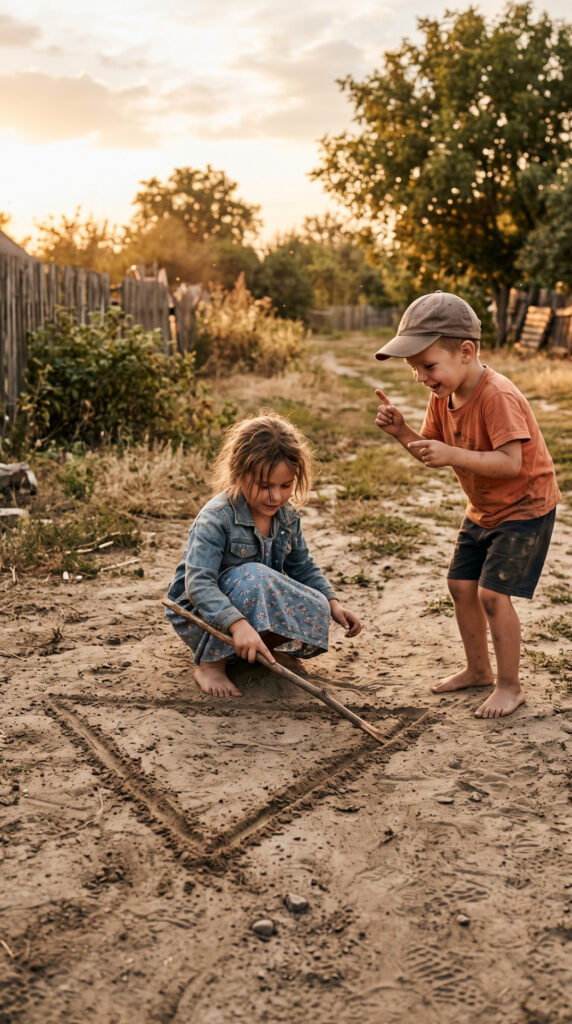
The only game on this list that will not work with one child alone, so read the ages line before you plan your afternoon around it.
- Real ages: 8-11, and it needs at least two players. If you have one kid, you are playing, which is fine but means you are not making dinner.
- Time: 5 minutes prep, 20 minutes play.
- Mess: Low, chalk dust.
- Supervision: You are in the game.
- You’ll need: Chalk, slips of paper with math words, and something to hold the slips.
- Free swap: A stick in dirt or sand costs nothing and works just as well. A sandbox is the ideal surface because wiping it clean takes one sweep of a hand.
- What goes wrong the first time: The word list is too hard and the round dies in silence. A kid who has never internalised “denominator” just draws a shape and waits. Go and get their actual math folder and pull the vocabulary from the unit they are in. That one step is the difference between this working and not. Second thing: put a 60 second limit on each turn, or they will produce a detailed illustrated masterpiece and nobody will guess anything.
- Skip it if: You have one child and you are not up for playing, or your kid freezes when they have to draw in front of people. Some kids find that genuinely stressful and it is not worth pushing.
Setup and Materials
A patch of concrete and chalk, or a stick and a patch of dirt. Ten to fifteen slips of paper with one math word on each, folded in a cup.
Pull the words from their current unit. Good ones for this age: parallel, perpendicular, symmetry, perimeter, area, fraction, angle, right angle, equal, half, double, pattern, array, factor.
How to Play
- One person takes a slip and reads it without showing anyone.
- They have 60 seconds to draw it. No numbers, no letters, no words.
- Everyone else guesses out loud.
- Whoever guesses it takes the next turn.
- Rub it out and go again. Keep a running count of how many the group cracked, not who won.
Tip: Whoever is guessing should stand beside the drawer, not opposite them. A drawing on the ground is upside down from the other side, and that alone has ruined more rounds in my house than hard vocabulary has.
Educational Value
You cannot draw a concept you only half know. Drawing symmetry means deciding what symmetry actually is, and a kid who has been repeating the word for two weeks may discover here that they never quite pinned it down. That gap is worth finding.
It also gets math vocabulary out loud in a low-stakes setting, which matters because a lot of test mistakes at this age are vocabulary mistakes rather than calculation mistakes.
Modifications for Advanced Learners
Add harder words: intersecting, perpendicular, denominator, volume, quotient, equivalent, congruent. Or reverse it, where you draw something and they have to name every mathematical property they can see in it, which is much harder and produces better conversation.
15. Giant Yard Dice Probability
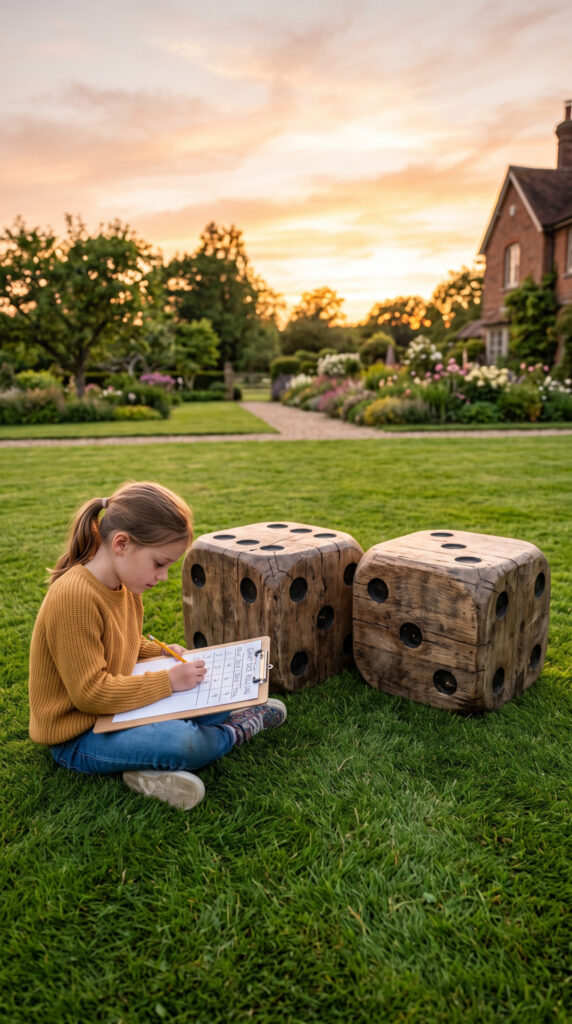
The slowest burn on the list, and the one where the original instructions will let you down if you follow them exactly. Fix the roll count and it becomes the most interesting conversation of the afternoon.
- Real ages: 8-11 for rolling, tallying, and spotting which sum came up most. The theoretical probability and mean, median, and mode extensions are grade 6 and 7 material, so treat those as a bonus for a curious kid, not a benchmark.
- Time: 10 minutes setup, 25 minutes rolling and recording, 10 minutes reviewing the chart.
- Mess: None.
- Supervision: Nearby, and you will need to help record.
- You’ll need: Two large dice and a way to record 60 or more rolls.
- Free swap: Two small cardboard boxes taped shut with the numbers written on the faces. A tissue box works. Or just use two regular dice, which changes nothing about the math.
- What goes wrong the first time: Thirty rolls is not enough. With only thirty rolls the expected pattern (7 coming up most often) frequently does not appear, and then you have told your kid something and the data has contradicted you, which is a bad afternoon. Do at least 60 rolls, and ideally 100. The other failure is that kids stop recording around roll 15, so trade jobs every ten rolls.
- Skip it if: Your kid needs a quick payoff. There is no splash and no sprint here, just rolling and marking.
Safety: Wooden yard dice are heavy hardwood blocks, and a three and a half inch oak cube on a bare foot is genuinely painful. Foam is the safer buy. Rolling underhand along the ground only, never thrown, and never at another person. If you are making your own from lumber offcuts, the sawing is an adult job with eye protection, not a kid activity.
Setup and Materials
Two oversized dice, foam or wooden, and a recording surface. Skip the poster board taped to a fence, because it flaps in any wind and the marker tears through it. Chalk eleven columns on the driveway labelled 2 through 12 instead, and drop a bottlecap or chalk a mark in the right column after each roll.
That version builds a physical bar graph as you go, which is a much better ending than a sheet of tally marks, and it ties straight back to game 12.
How to Play
- Chalk eleven columns labelled 2 to 12 on the driveway.
- Before rolling, ask them which sum they think will win. Write their prediction down.
- They roll both dice underhand along the ground.
- They add the two faces out loud and mark the right column.
- Trade jobs every ten rolls so nobody gets bored of recording.
- Aim for 60 rolls minimum. Stop and look at the shape of the columns.
Tip: Ask why 7 wins before you explain it. Most kids get there on their own if you ask them how many ways they can make 7 with two dice, versus how many ways they can make 12.
Educational Value
This is experimental probability done honestly, and the honest version includes the fact that small samples are unreliable. If your 60 rolls produce a scruffy chart where 6 beats 7, that is not a failed experiment. That is the lesson: more trials means a clearer pattern, and thirty of anything tells you very little. Kids who learn that at nine are ahead of a lot of adults reading headlines.
The counting argument underneath it is the good part. There is exactly one way to roll a 2 and six ways to roll a 7, and once a kid sees that written out, probability stops being mysterious.
Modifications for Advanced Learners
Have them list every combination that makes each sum before rolling (1 and 6, 2 and 5, 3 and 4, and each in reverse), count them, and predict the ranking. Then compare the prediction to the real chart. Calculating the mean, median, and mode of the results is a grade 6 skill, so it is a real stretch for a 10 year old, but “which sum was the most common” is the mode in plain English and they can absolutely do that.
Common Mistakes Parents Make The First Time
These are the specific ways I have watched this go wrong, in my own yard and with other people’s kids.
Announcing it as math. “We’re going to do some math practice outside” ends the game before it starts. Say “come help me with something in the driveway”. The math is a thing that happens, not a thing you declare.
Using their homework problems. Out-of-breath math has to be a notch easier than desk math. If they can only just do it sitting down, they cannot do it after a sprint, and the first stall kills the momentum.
Writing 50 cards. Twenty is a full session. Fifty means you spend longer preparing than they spend playing, and you will resent it, which is how a good idea becomes a once-only idea.
Correcting instantly. The urge to say “no, it’s 42” the second they are wrong is very strong. Say the problem back to them slowly instead. They fix it themselves about eight times out of ten, and the game survives.
Going straight from the school bus into a game. Almost every 4pm meltdown at my house is a blood sugar problem wearing a math costume. Snack and ten minutes of nothing first, then chalk.
Letting them build the obstacle course. Forty minutes of construction, four minutes of running, zero math. Either you build it or you set a ten minute timer on the build.
Setting up at the street end of the driveway. A kid concentrating on where the prime numbers are is not listening for cars. Garage end, with something physical between the game and the road.
Turning wrong answers into exercise. Push-ups or laps as a punishment for a wrong answer makes being wrong shameful and makes exercise a penalty. Both are the opposite of the point.
Playing until it dies. Stop while they still want one more round. A game that ends at the peak gets requested tomorrow. A game that limps to a halt does not.
Using yellow chalk. On light concrete in bright sun, yellow and pale blue are effectively invisible. Dark blue, purple, red, black.
Filling sixty water balloons. Twenty five minutes of filling for eight minutes of play. Use sponges, or accept that this one is short and plan accordingly.
Let’s Make Math Fun Again
Math practice does not have to happen at a table with a pencil, and for a lot of 8 to 10 year olds it works better when it does not. Everything above is the same repetition their worksheet asks for, moved outdoors and attached to something their body wants to do anyway.
I am not going to promise this fixes a kid’s relationship with math. Some kids need real intervention, and a chalk grid is not that. What it does reliably do is get the practice done without a fight, which on a Tuesday afternoon in September is a substantial win on its own.
Start with one. Target Toss Math if you want the safest bet, the chalk grid if you have twenty minutes and decent knees, relay races if your kid has been sitting still since 8am. Write ten problems on ten index cards tonight, put them in a tote with the chalk by the back door, and it will still be there next week when you need it at 4:20 on a Tuesday.
FAQs
How can I adapt these outdoor math games if the weather is bad?Swap chalk for blue painter’s tape and run the grid, hopscotch, or number line on a hard floor or in the garage. Target Toss Math works indoors with rolled socks and laundry baskets, and the relay race becomes a card hunt with problems hidden around the house.
My child gets frustrated easily when they get a math problem wrong. How should I handle this during games?Say the problem back to them slowly instead of giving the answer, and never attach a penalty to being wrong. Keep the problems one notch easier than their homework so the challenge is the game, not the arithmetic, and for the estimation game ask for a range rather than a single number, which takes the sting out of missing.
How long should an outdoor math session last?Twenty to thirty minutes is the realistic window for an 8 to 10 year old, because these games use physical and mental energy at the same time and kids tire faster than they do at a desk. Stop while they still want one more round, since that is what gets you a second session tomorrow.
Are these games suitable for children with learning differences like ADHD?Movement-based practice suits a lot of kids who struggle to sit for worksheets, and there is reasonable evidence that a burst of aerobic activity helps attention in children with ADHD for a while afterwards, though the effect is modest rather than transformative. Be more careful with timed games if your child has math anxiety or dyscalculia, since a stopwatch can make things worse, and pick the untimed games (5, 8, 9, 11, 12) instead.
What are the essential materials I should keep on hand for outdoor math?A tub of dark-coloured sidewalk chalk, 20 index cards, one thick marker, three beanbags or rolled socks, a 25 foot tape measure, and a clipboard covers thirteen of the fifteen games. Keep the lot in one tote by the back door, because hunting for the chalk is what actually stops these sessions happening.
How do I run these games with two kids at different ages?Give them different jobs in the same game rather than different games: the younger one rolls the dice or finds the balloon while the older one records the data or works out the score. On the chalk grid, call an easy prompt and a hard prompt in the same round so both are moving, and avoid anything where the younger kid gets eliminated first, because that ends the game for everyone.
Read next
If the money market game was the one that landed, kids’ money and budgeting games or a first allowance is the natural follow-on, and it uses the same play money you just bought.
For the same age group when you have a whole day rather than twenty minutes, our list of summer camp style activities for kids ages 8 to 10 covers longer projects and group games for exactly this age.