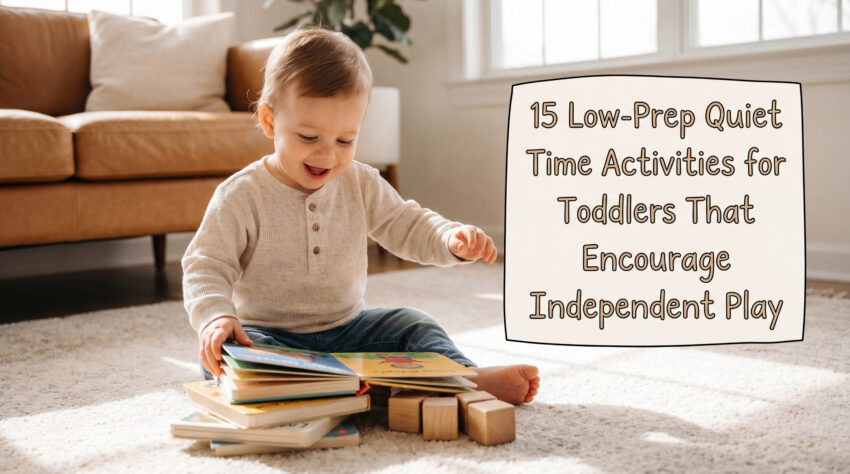
Low-prep quiet time activities for toddlers should use household items, take under 5 minutes to set up, and encourage independent play for 10-25 minutes. The best options focus on fine motor skills (like threading pipe cleaners through a colander) or open-ended exploration (like sorting socks) rather than crafts requiring constant supervision. Always supervise for small parts and match activities to your child’s current frustration tolerance not just their age.
Why Quiet Time Beats Screen Time When Naps Disappear
Remember that Tuesday last month? Rain pouring down, lunch ended in a yogurt-on-the-floor disaster, and by 12:30 PM your toddler was bouncing off the walls demanding “more, more, more!” while you stared at your overflowing inbox. That’s the nap transition reality no one warns you about.
Quiet time isn’t just about stealing back your afternoon it’s when toddlers actually process all that morning stimulation. When my daughter stopped napping at 2.5, I noticed she’d meltdown by 3 PM unless we had this reset period. Independent play builds the executive functioning skills she needed to handle preschool later: initiating tasks, sticking with them when they got hard, and self-soothing when frustrated. Screen time might keep them still, but it doesn’t build those crucial skills.
How to Make Quiet Time Actually Work (Without Losing Your Mind)
Forget elaborate setups. Success comes from three things: a truly safe space, a visual timer they understand, and starting stupidly small. I learned this the hard way when I set the timer for 20 minutes on day one and spent the next hour playing hallway referee.
Start with 5 minutes. Seriously. Set that visual timer (I use the $8 Time Timer Mini from Amazon) for 5 minutes, celebrate like they won the lottery when they make it, then add 5 minutes every 3-4 days. My goal was 45 minutes, but we crept up to there over 6 weeks. Pushing too fast just teaches them quiet time = punishment.
Safety first, always. Even in their bedroom, get down on your hands and knees and look for hazards: loose change under the bed, blind cords, tiny Lego pieces. If you wouldn’t leave them alone with a puppy, it’s not quiet time ready. And yes you still need to monitor. I keep the baby monitor on and check in every 5-7 minutes, not because I don’t trust them, but because toddlers surprise you. (Mine once decided to “decorate” the wall with diaper rash cream during quiet time. Lesson learned: put the cream away.)
Zero-Prep Household Explorations
These need literally zero setup—just open a drawer and go. Perfect for those mornings when you’re running on fumes.
1. The Safe Junk Drawer Exploration
Age range: 18 months-4 years (adjust item size)
Time: 2 minutes prep | 8-15 minutes play | 0 minutes cleanup (if using contained basket)
Supplies: Small basket or bowl + junk drawer raid
Budget alternative: Use an empty yogurt container instead of a basket
What to grab: Big cardboard erasers (the kind from Dollar Tree), thick rubber bands (not the tiny ones), a blunt plastic ruler, soft tape measure, oversized plastic paperclips (jumbo size), clean wine corks. Avoid: anything smaller than a golf button (choking hazard), sharp scissors, staples, or items with small detachable parts.
How it works: Dump the basket on the floor or rug. No instructions needed just let them explore. My son spent 20 minutes one day just wrapping rubber bands around his wrists and ankles, giggling at the “snap.” My daughter preferred lining up the erasers like dominoes.
Real parent tip: If they try to put things in their mouth (inevitable with rubber bands), calmly say “These stay in our hands” and redirect to banging two erasers together. It’s not worth a power struggle just remove the item and try again tomorrow.
Mess level: None (unless they decide to taste-test)
Supervision: Hands-on for first 3-4 minutes until you see they’re not mouthing items, then check-in every 5 minutes
What goes wrong first try: They dump everything immediately and lose interest.
Fix: Use a basket with higher sides or sit beside them modeling gentle exploration.
Developmental win: Builds tactile discrimination and satisfies their intense curiosity about “grown-up stuff” without you saying “don’t touch!” a hundred times.
2. Tupperware Lid Matching
Age range: 2-4 years
Time: 3 minutes prep | 10-20 minutes play | 2 minutes cleanup
Supplies: 6-8 plastic food containers with matching lids
Budget alternative: Use empty whipped cream tubs or sour cream containers
Setup: Wash and dry containers. Separate lids from bases. Scatter both piles on the floor.
Execution: Challenge them to find the matching lid for each base and snap it on. Start with just 3 pairs if they’re younger or easily frustrated.
Real parent tip: Choose containers with very different lid shapes (round vs square) at first. Similar shapes (like all round containers) caused instant frustration for my 2-year-old. Save the similar ones for when they’ve mastered the concept.
Mess level: None
Supervision: Check-in every 5 minutes (mostly to prevent lid-throwing frustration)
What goes wrong first try: They try to force lids on upside-down bases or get upset when it doesn’t snap.
Fix: Demonstrate slowly with one pair first, then hand them the matched set to try.
Developmental win: This is deceptively hard it teaches visual discrimination, spatial reasoning, and bilateral coordination. My daughter’s preschool teacher later told me this activity directly helped her with puzzle skills.
3. The Sock Sorting Station
Age range: 2-4 years
Time: 1 minute prep | 10-18 minutes play | 3 minutes cleanup (matching socks back)
Supplies: Basket of clean, unfolded socks (aim for 8-12 pairs)
Budget alternative: Use mismatched socks from the “lost” bin it actually makes it more interesting!
Execution: Dump socks in a pile. Ask them to find matching pairs and make little sock balls or lines.
Real parent tip: Start with socks that have obvious differences stripes vs solids, big vs small, kids vs adult socks. All-white socks led to 10 minutes of frustrated staring for my son. Add in one or two “trick” pairs (like similar navy socks) only after they’re confident.
Mess level: None
Supervision: Check-in every 5 minutes (to redirect if they start sock-puppet shows instead of sorting)
What goes wrong first try: They make one pair then lose interest. Fix: Join them for 2 minutes to model the fun of finding matches, then step back.
Developmental win: Beyond matching, this builds patience and pre-math skills. Bonus: it actually helps with laundry folding later my 4-year-old now insists on sorting her own socks.
4. Book Stacking and Browsing
Age range: 18 months-4 years
Time: 0 minutes prep | 12-25 minutes play | 0 minutes cleanup
Supplies: 4-6 sturdy board books
Budget alternative: Use catalogs or magazine pages taped to cardboard
Execution: Make a small pile of books. No rules let them stack, line up, flip through, or use as ramps for toy cars.
Real parent tip: Pick books with interesting textures (touch-and-feel) or bold, simple illustrations (like Sandra Boynton). My kids ignored books with busy pages but spent ages rubbing the fuzzy bear in “Pat the Bunny” or giggling at the hippo in “But Not the Hippopotamus.”
Mess level: None
Supervision: Glance over every 5-7 minutes (mostly to ensure books aren’t being used as frisbees toward the TV)
What goes wrong first try: They try to stand on the pile or throw books. Fix: Calmly say “Books stay on the floor for quiet time” and offer a alternative like lining them up.
Developmental win: This builds book handling skills (turning pages right-to-left) and print awareness without the pressure of “reading time.” My daughter’s love for books started here, not during lap reading.
Kitchen Pantry Fine Motor Challenges
The kitchen is an excellent resource for low-prep toddler activities. These tasks require grabbing a few simple tools and offer highly engaging fine motor challenges.
5. Colander and Pipe Cleaner Threading
Age range: 2-4 years
Time: 1 minute prep | 10-22 minutes play | 2 minutes cleanup
Supplies: Metal or plastic colander + 6-8 fuzzy craft pipe cleaners
Budget alternative: Use a clean plastic berry container with holes poked in the bottom + twisted aluminum foil strips
Execution: Show them how to thread one pipe cleaner through a hole and out the other side. Then let them go wild.
Real parent tip: Use fuzzy pipe cleaners they’re easier to grip than smooth ones. Avoid sparkly ones; the glitter flakes off and gets everywhere. I keep a dedicated quiet-time pipe cleaner stash in a snack bag so they don’t get bent out of shape.
Mess level: Low (just stray pipe cleaner bits)
Supervision: Check-in every 5 minutes (to prevent poking eyes or ears yes, my daughter tried this)
What goes wrong first try: They try to shove multiple pipe cleaners through one hole and get frustrated when it jams. Fix: Demonstrate slowly with one hole, then hand them a pre-threaded cleaner to pull through.
Developmental win: This is killer for pincer grasp and hand-eye coordination. My son’s occupational therapist actually recommended similar activities for his fine motor delays.
6. Dry Pasta and Shoelace Stringing
Age range: 2.5-4 years (needs better finger control)
Time: 2 minutes prep | 12-18 minutes play | 3 minutes cleanup
Supplies: 1/2 cup dry penne or rigatoni pasta + one thick shoelace
Budget alternative: Use yarn taped at the end + large cereal like Fruit Loops
Execution: Tie a big knot at one end of the lace. Show them how to thread pasta onto it one by one.
Real parent tip: Do not use tiny pasta like orzo or acini de pepe it’s frustrating and a choking hazard. Penne works best because the holes are big enough for little fingers but small enough to stay on the lace. If pasta keeps slipping off, double-knot the end or wrap tape around it.
Mess level: None (unless they decide to crumble pasta)
Supervision: Hands-on for first demonstration, then check-in every 5 minutes
What goes wrong first try: They get mad when pasta falls off or try to eat it. Fix: Explain “Pasta stays on the lace or in the bowl it’s not for eating” and offer a snack instead.
Developmental win: Builds bilateral coordination (using both hands together) which is crucial for later skills like buttoning coats or using scissors. My daughter mastered shoe tying months after her peers because of activities like this.
7. Muffin Tin Color Sorting
Age range: 2-4 years
Time: 4 minutes prep | 10-20 minutes play | 3 minutes cleanup
Supplies: 12-cup muffin tin + construction paper circles + bowl of mixed items (pom-poms, large buttons, blocks)
Budget alternative: Use egg carton + cereal (Fruit Loops work great for color sorting)
Execution: Cut small circles of colored paper and tape one in each muffin cup. Let them sort items by color into the cups.
Real parent tip: Start with just 2-3 colors (like red, blue, yellow) using items that are only those colors. Mixing in similar shades (like red and orange) caused instant meltdowns for my 2-year-old. Use tongs or chopsticks only after they’ve mastered sorting with fingers.
Mess level: None
Supervision: Check-in every 5 minutes (to prevent item-throwing when frustrated)
What goes wrong first try: They dump all items in one cup then lose interest.
Fix: Play alongside them for 3 minutes, celebrating each correct match with a high-five.
Developmental win: This is early math in action categorization and visual discrimination. My son’s preschool teacher said his sorting skills were notably strong because of pantry activities like this.
8. The Spice Jar Smell Test
Age range: 2-4 years
Time: 3 minutes prep | 8-15 minutes play | 2 minutes cleanup
Supplies: 4-5 mild spices (cinnamon, oregano, garlic powder, vanilla on cotton ball) + small tray
Budget alternative: Use extracts (lemon, almond) on cotton bags or fresh herbs from the garden
Execution: Place open spice jars on tray. Let them sniff each one (no putting nose in jar!) and describe what it smells like.
Real parent tip: Avoid spicy stuff like chili powder or black pepper even a whiff can make their eyes water. Stick to baking spices and herbs. I keep a dedicated quiet-time spice tray in a high cabinet so the jars don’t get contaminated with cooking oils.
Mess level: None (unless they shake the jars)
Supervision: Check-in every 3-4 minutes (closer for younger kids—they might try to taste)
What goes wrong first try: They try to pour spices out or put jars in their mouth. Fix: Say “Smell only with your nose—jars stay on the tray” and immediately redirect if they reach in.
Developmental win: Engages the often-neglected sense of smell, which helps with emotional regulation and memory. My daughter now says “This smells like Grandma’s house” when she smells cinnamon—a direct link to baking sessions we’ve done together.
Mess-Free Sensory and Art Activities
Art and sensory play are incredibly valuable, but parents often avoid them during quiet time to prevent a massive cleanup. These activities provide the benefits of sensory engagement without the mess.
9. Water Painting on Construction Paper
Age range: 18 months-4 years
Time: 1 minute prep | 10-20 minutes play | 0 minutes cleanup
Supplies: Small bowl + 1/2 inch water + paintbrush + construction paper
Budget alternative: Use coffee filters or paper towel squares
Execution: Dip brush in water and “paint” on paper. Watch it darken, then fade as it dries.
Real parent tip: Use heavyweight construction paper the cheap stuff pills and tears when wet. I keep a dedicated quiet-time pad of 9×12 inch paper in the art cabinet. Add a drop of dish soap to the water if it beads up on the paper.
Mess level: None (water only)
Supervision: Glance over every 5 minutes (to ensure they’re not drinking the bathwater)
What goes wrong first try: They try to sop up all the water with the brush or paint off the paper. Fix: Give them a small sponge specifically for quiet time and say “Water stays on the paper.”
Developmental win: Teaches cause-effect (wet paper = dark) and builds brush control without stain anxiety. My son’s preschool art teacher noted his confidence with brushes came from activities like this.
10. Painter’s Tape Rescue Mission
Age range: 2-4 years
Time: 3 minutes prep | 12-25 minutes play | 2 minutes cleanup (peeling tape off toys)
Supplies: Small hard plastic toys + blue painter’s tape
Budget alternative: Use washi tape (less sticky) or masking tape test first for surface safety
Execution: Tape toys firmly to a surface (baking sheet, wall, floor). Challenge them to peel the tape off to “rescue” the toys.
Real parent tip: Test tape on your surface first—some paints peel with painter’s tape. I use the inside of a baking sheet or a piece of cardboard taped to the wall. Use just enough tape to hold the toy too much makes it impossible for little fingers to start peeling.
Mess level: None
Supervision: Check-in every 5 minutes (mostly to cheer them on this is hard work!)
What goes wrong first try: They get frustrated and try to yank the toy off. Fix: Demonstrate slowly peeling one corner, then hand them the toy to try. Celebrate micro-progress: “You got the corner up!”
11. Sensory Bags with Hair Gel
Age range: 18 months-4 years
Time: 4 minutes prep | 10-20 minutes play | 2 minutes cleanup
Supplies: Gallon ziplock bag + bottle of cheap hair gel + large googly eyes/buttons + packing tape
Budget alternative: Use clear hand sanitizer + glitter (though messier if bag breaks)
Execution: Fill bag 1/3 with gel, add items, squeeze out air, seal tightly, and tape all edges shut. Lay flat on floor or tape to window.
Real parent tip: Double-bag it—put the filled bag inside a second ziplock before taping. Use hair gel, not dish soap it’s thicker and provides better resistance. I buy the $1 Suave Professionals gel at Walmart and keep a backup bottle in the quiet-time closet.
Mess level: None (if properly sealed)
Supervision: Check-in every 5 minutes (to ensure seal integrity my son once popped a bag by sitting on it)
What goes wrong first try: They try to open the bag or shake it violently. Fix: Say “This stays flat for quiet time let’s see what we can make inside” and redirect to pushing items around.
Developmental win: Provides deep pressure input which is incredibly calming for overwhelmed nervous systems. I use this during pre-dinner witching hour when my kids are melting down—5 minutes of squishing often prevents a full tantrum.
12. Contact Paper Sticky Wall
Age range: 2-4 years
Time: 5 minutes prep | 15-25 minutes play | 3 minutes cleanup
Supplies: Clear contact paper + painter’s tape + lightweight items (tissue squares, feathers, cotton balls)
Budget alternative: Use masking tape sticky-side-out on cardboard (less sticky but works)
Execution: Cut contact paper square, peel backing, tape to wall sticky-side-out. Let them decorate.
Real parent tip: Put it low—on the fridge or a cabinet door, not high on the wall. My kids lost interest fast when they had to reach up. Place a towel or mat underneath for dropped items. Use very light things feathers work better than pom-poms which weigh down the paper.
Mess level: None
Supervision: Check-in every 5 minutes (to prevent peeling off large sections)
What goes wrong first try: They cover one spot then lose interest. Fix: Join them for 2 minutes to make a simple design (like a smiley face), then step back.
Developmental win: Vertical surface work builds wrist extension and shoulder strength crucial for handwriting. My son’s OT called this “pre-writing work in disguise.”
Concentration and Spatial Building Activities
Activities that require building and spatial manipulation are excellent for sustaining a toddler’s attention over longer periods and encouraging deep concentration.
13. Solo Cup Pyramids
Age range: 2-4 years
Time: 0 minutes prep | 10-20 minutes play | 2 minutes cleanup
Supplies: Stack of standard solo cups
Budget alternative: Use paper cups (less durable) or clean yogurt cups
Execution: Show them how to build a pyramid: side-by-side base, then layer on top.
*Real parent tip: Start with just 6 cups (3-2-1 pyramid). A full stack overwhelmed my 2-year-old. Celebrate when it stands for 5 seconds it’s about the effort, not perfection. If cups keep sliding, try a slightly textured surface like a placemat.
Mess level: None
Supervision: Check-in every 5 minutes (mostly to prevent cup-throwing frustration)
What goes wrong first try: They knock it down immediately and get upset. Fix: Say “Uh oh, gravity won! Let’s try again” and model rebuilding slowly. Keep it playful not a test.
Developmental win: Teaches balance, gravity, and emotional resilience when things fall. My son learned to say “It’s okay, we rebuild!” here before he could say it during block tower meltdowns.
14. Aluminum Foil Sculpting
Age range: 2-4 years
Time: 1 minute prep | 12-22 minutes play | 2 minutes cleanup
Supplies: Standard aluminum foil
Budget alternative: Use the inside wrapper from cereal boxes (less shiny but moldable)
Execution: Tear off sheets and let them crumple, fold, twist.
*Real parent tip: Use standard foil, not heavy-duty it’s easier to crumple. Give them one sheet at a time; a whole roll is overwhelming. Show them how to make a simple ball or snake first, then let them experiment.
Mess level: None (just foil scraps)
Supervision: Glance over every 5 minutes (to ensure they’re not shaping it into sharp points)
What goes wrong first try: They try to make something complex and get frustrated when it won’t hold shape.
Fix: Say “Foil likes to be simple let’s see what shapes we can make with just our hands” and demonstrate basic shapes.
Developmental win: Builds whole-hand strength (crumpling) and fine motor control (shaping). My daughter’s pencil grip improved noticeably after weeks of foil play.
15. The Playing Card Drop
Age range: 2.5-4 years
Time: 2 minutes prep | 10-18 minutes play | 2 minutes cleanup
Supplies: Coffee can or oatmeal container lid + deck of playing cards
Budget alternative: Use cereal box + slot cut in lid + old gift cards or laminated photos
Execution: Cut thin rectangular slit in plastic lid. Show how to align and drop cards through.
Real parent tip: Make the slit just wider than a card—about 1/8 inch. Too wide and they don’t learn precision; too narrow and it’s impossible. Test with one card first. Use new cards the slick surface slides better than worn, sticky ones.
Mess level: None
Supervision: Check-in every 5 minutes (mostly to prevent card-bending or throwing)
What goes wrong first try: They try to force cards through crooked or bend them.
Fix: Demonstrate slowly with one card, saying “Watch how straight it needs to be” then hand them a card to try.
Developmental win: This is the gold standard for hand-eye coordination and concentration. My daughter’s kindergarten teacher said her scissor skills were advanced because of activities like this that taught her to slow down and focus.
Keeping the Novelty Alive: Rotation System That Works
If all 15 activities are out all the time, quiet time fails in 3 days. Here’s what actually works in my house:
Get 4-6 small plastic bins (the 6-quart Sterilite ones from Walmart work perfectly). Put 2-3 activities in each bineverything needed for that activity. Store bins on a high shelf in the closet, completely out of sight during regular play.
Rotate every 2-3 days. Monday: Bin A (junk drawer + Tupperware lids + water painting). Tuesday: Bin B (sock sorting + pasta threading + foil sculpting). Wednesday: Bin C (spice smell + tape rescue + sensory bags). Don’t repeat a bin until the week is over.
Watch what they actually engage with. If they ignore the junk drawer bin for 3 days straight, swap it out for something new even if it’s just different items in the same bin (e.g., swap rubber bands for bracelets and big beads).
Pro tip: Let them “help” choose the next bin by showing two options and letting them point. This buy-in cuts resistance dramatically. My son now asks “Is it junk drawer day?” when he sees me heading to the closet.
Real Parent FAQs
Q: My toddler dumps everything immediately does that mean they’re not ready for quiet time?
A: Not at all. Dumping is exploration too. Stay nearby and narrate: “You’re looking at all the colors!” or “Let’s see what happens if we put one sock here.” Often after 2-3 minutes of dumping, they’ll start engaging. If they’re truly not ready, go back to 3-minute sessions and build up.
Q: How do I keep them from putting small items in their mouth?
A: Supervision and redirection. For mouthers, stick to large items (popsicle sticks, big pom-poms, sponge shapes) and immediately say “This stays in our hands” if they mouth it, then offer a teether or snack. It’s a phase most kids outgrow it by 3.
Q: What if they refuse to stay in the room?
A: Make leaving boring. No talking, no eye contact, no negotiation. Just calmly take their hand and walk them back, saying “Quiet time is in your room.” Repeat as needed it took 17 returns on day one for my daughter, but by day 4 she was staying put for 8 minutes.
Q: Can I use food items like cereal or pasta for these activities?
A: Yes, but only if your toddler isn’t a mouther AND you’re supervising closely. Dry pasta is great for threading but never leave them alone with it choking hazard. For food-based sorts, use large items like cereal or crackers and keep sessions short.
Q: My kid does the activity for 2 minutes then wants me to play how do I handle that?
A: Join them for 90 seconds to launch the activity (“Let’s find the first match together!”), then say “I’m going to fold laundry nearby come show me when you make a match!” Check in every 2-3 minutes with specific praise: “I see you got the blue cup on top!”
Q: How long should quiet time really last for a 2.5-year-old?
A: Start with 5 minutes, add 2-3 minutes every few days when they’re successful. Most 2.5-year-olds max out at 15-20 minutes of truly independent play. Quality over quantity better to have 15 minutes of focused play than 40 minutes of them wandering around bored.
Common Mistakes to Avoid
- Starting too long: Beginning with 20-minute sessions guarantees failure and tears. Seriously—start with 5 minutes.
- Using choking hazards: That junk drawer exploration needs oversized items. I learned this when my son tried to swallow a tiny rubber band now I use a choke tube tester on everything.
- Skipping the safety sweep: Always get on your hands and knees to check for loose change, blind cords, or tiny toys under furniture before quiet time begins.
- Letting them help set up: While tempting, having them gather supplies often turns into play before quiet time even starts. Prep bins yourself when they’re napping or occupied elsewhere.
- Ignoring their signals: If they’re consistently frustrated or mouthing items, the activity is too advanced. Swap it for something simpler quiet time should feel like a break, not a test.
Conclusion
Navigating the end of the toddler napping era is undeniably a challenging phase of parenting, but it also presents a valuable opportunity to foster a new stage of childhood independence. By replacing the midday nap with a structured, consistent quiet time routine, parents reclaim necessary breaks while providing their children with crucial cognitive and emotional benefits.
The key to long-term success does not lie in elaborate, expensive setups. It lies in utilizing simple, low-prep activities that challenge a toddler’s fine motor skills, encourage sensory exploration, and require independent problem-solving. With a strategic rotation of household items, the use of a visual timer, and unwavering boundary enforcement, quiet time can successfully transform from a daily struggle into a peaceful, highly productive hour that benefits the entire family.