
Last Saturday I loaded the kids into the car with the world’s most optimistic plan: fresh air, no screens, some vague notion of “let’s just be outside.” We got to the park. I said, “Let’s do something outside.” Ten minutes later, both kids were sitting on a bench asking for snacks and whether we could go home and watch something.
That’s the gap nobody warns you about. Wanting your kids outside and knowing what to actually do out there are two completely different skills. Forest school activities are the fix, because they’re built around stuff that’s already lying on the ground, not a Pinterest board of supplies you don’t own.
Quick answer: Forest school activities are simple, low-prep outdoor challenges built around natural loose parts like sticks, mud, leaves, and dirt, instead of instructions or plastic toys. Most work for kids from about age 2 through the tween years, need under $15 in extra supplies (often $0), and the biggest requirement isn’t gear, it’s your willingness to let something get muddy. You don’t need an actual forest either; a backyard, a local park, or a vacant lot with some dirt works exactly the same way.
How Can Forest School Activities Encourage Creativity and Imagination?
Hand a kid a toy with a button and it does one thing, every time. Hand a kid a stick and in the same afternoon it’s a sword, a fishing rod, and (according to my son, aged 7 at the time) “a highly classified spy detector.”
That’s the whole mechanism. Nature doesn’t come with instructions. There’s no manual for a pile of leaves, no single correct way to climb a dirt hill. When kids aren’t told what something is for, their brains stop consuming and start building. That’s the shift forest school programs are actually chasing, and it’s the same shift you can get in your own backyard for free.
Practical note: the first ten minutes outside are almost always the worst. Kids used to structured entertainment need a little boredom before the imagination kicks in. Don’t rescue that gap with a suggestion. Let it sit.
Best Forest School Activities For Kids
1. Mud Climbing
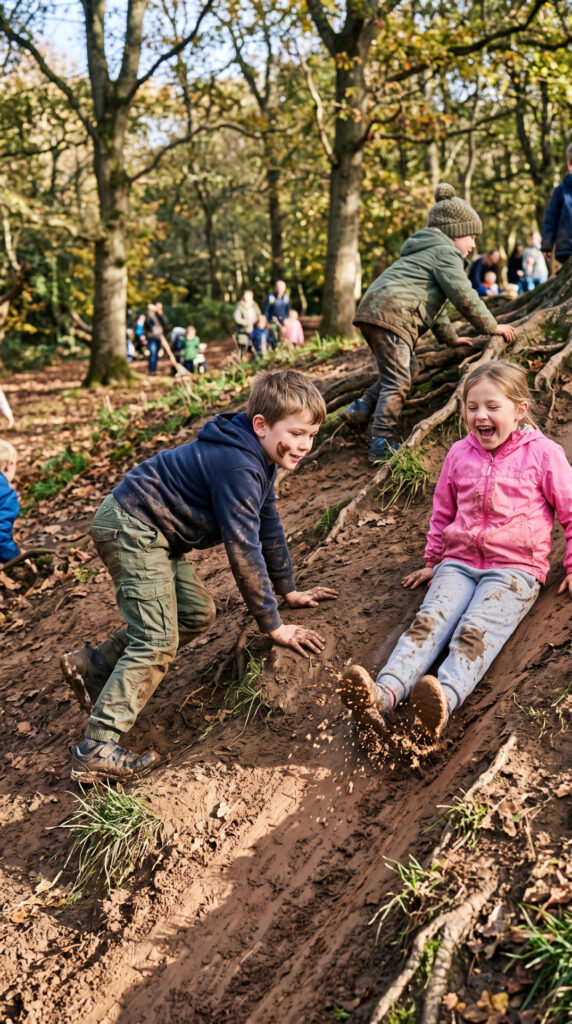
Age range & time: Ages 3 and up (spot young toddlers closely on steeper slopes). 20–40 minutes of play, zero prep, 5 minutes of cleanup if you keep a towel in the car.
The second my kids spot a dirt hill, it’s over, they’re gone. No instructions needed. One kid attacks it head-on, one crawls, one slides back down laughing every single time and treats that as the actual point of the game.
Supplies: Just an incline. A rolling hill at the park, a construction dirt pile (check it’s not an active site), or the sloped edge of a sandy playground all work. Optional: a couple of sturdy sticks or a short step-stool ladder for extra challenge, free if you already have either lying around.
Mess & supervision: Moderate to high mess (shoes, knees, hands), stay within arm’s reach the whole time, don’t sit back with your phone. This is a “watch, don’t direct” activity, not a “watch from a bench” one.
Steps:
- Pick a hill with no rocks, roots, or glass at the base.
- Let kids choose their own route up, resist correcting their technique.
- Offer sticks or a step for extra grip only if they ask.
- Call time before legs get too tired to control a fall.
Tip: A hill that’s “too easy” for a 7-year-old is often perfect for a 3-year-old. Bring siblings of different ages to the same spot and let each pick their own line.
2. Outdoor Classroom

Age range & time: Ages 4–11, easily split by task. 15–30 minutes, minimal prep if you keep a “outdoor school bag” packed.
Sitting on a log instead of a plastic chair changes how kids listen, and I don’t fully understand why, but it does. My daughter will “read for fun” outside for ten minutes when the same book gets two minutes indoors.
Supplies: A small chalkboard or a $5 whiteboard from Dollar Tree, clipboards (or just cardboard and a binder clip), pencils. Free swap: skip the board entirely and write spelling words on flat rocks with sidewalk chalk.
Mess & supervision: Low mess, check-in supervision (every few minutes), not hands-on the whole time.
Steps:
- Pick a shady, quiet spot: a park bench area or backyard corner.
- Keep the “lesson” under 10 minutes, one task at a time.
- Turn it into a scavenger hunt for vocabulary words or shapes.
- Let older kids journal or sketch while younger ones count acorns.
3. Stick Shelter
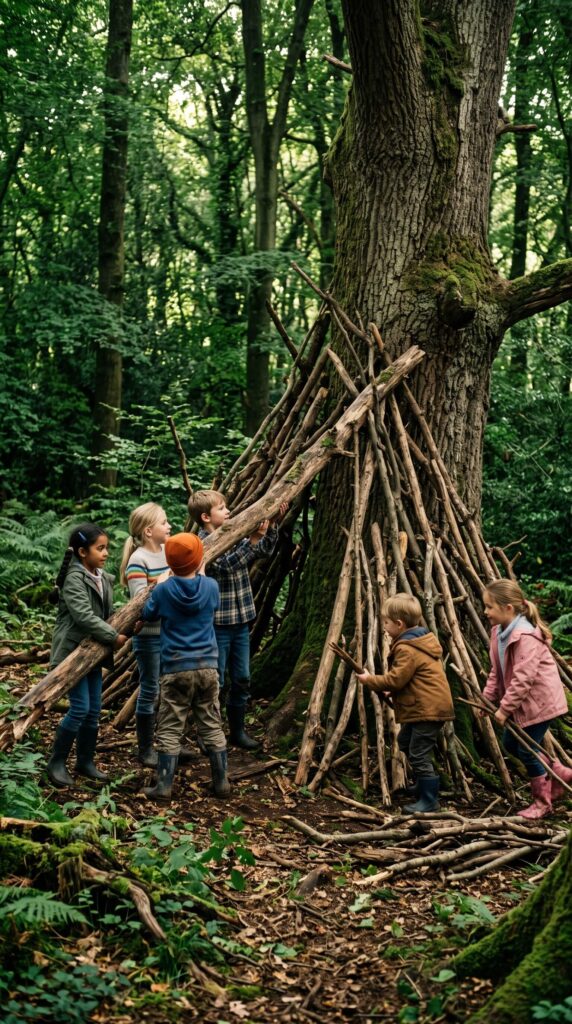
Age range & time: Best for ages 4 and up (needs the coordination to carry heavy branches without dropping them on a sibling’s foot, which has happened in my yard). 30–60 minutes, no prep, no cleanup since you leave it in the woods.
A pile of branches goes from nothing to a “secret café” to a “dragon-proof fort” in about four minutes flat once kids start moving sticks.
Supplies: Fallen branches only, never cut live ones. Free.
Mess & supervision: Low mess, moderate supervision (watch for pinched fingers and branches being swung like swords, which will happen).
Steps:
- Find a clearing with a strong tree trunk to lean the frame against.
- Show them how to lean the largest branches first for a stable frame.
- Let them layer smaller sticks and leaves for “walls.”
- Do not fix their design. The lean is the lesson.
Practical note: Their first shelter will fall down at least once. That’s not a failed activity, that’s the actual activity.
4. Mud Play

Age range & time: Ages 2–10. 30–45 minutes of play, 15 minutes of cleanup (hose and old towels help a lot).
Clean clothes have never built a single good memory in my house. The loudest laughing I’ve heard from my kids all year happened the day I let them make “mud soup” in the backyard with an old saucepan.
Supplies: Topsoil and water, or use a rain-soaked patch of grass. Old kitchen utensils (thrift store, or ones you were about to toss) turn it into a bakery or potion lab. Budget swap: a $1 Dollar Tree spoon set beats sacrificing your real kitchenware.
Mess & supervision: High mess, hands-on nearby (not hovering, but present), define boundaries before hands hit mud.
Steps:
- Mark where mud is and isn’t allowed (patio furniture: no).
- Offer old pots, spoons, and cups.
- Add sticks, leaves, or stones as decoration.
- Let them dig, smear, and build without a goal.
5. Nature Binoculars
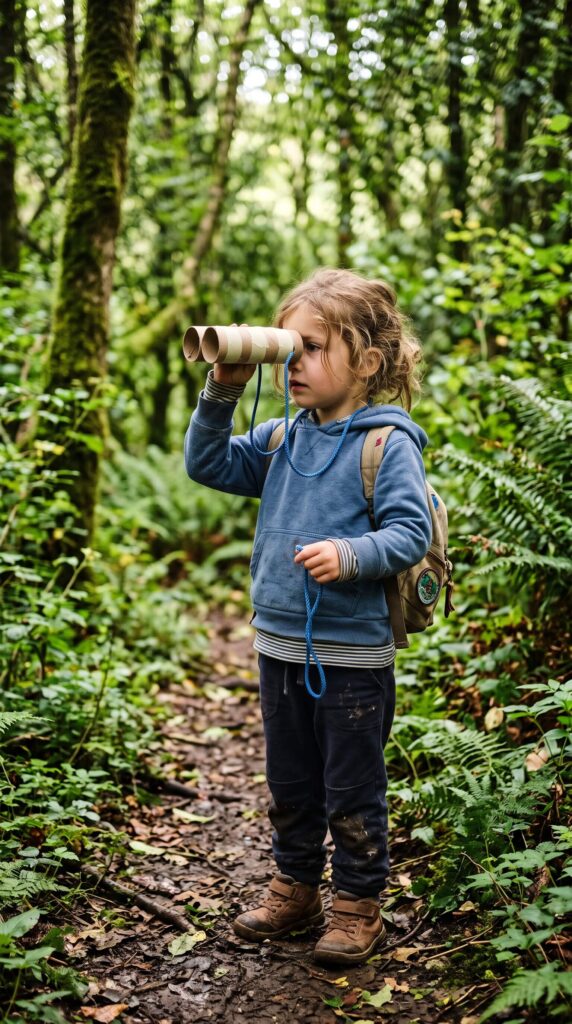
Age range & time: Ages 3–7 (older kids tend to find the cardboard tubes a bit babyish, though a couple of my nephew’s friends at 9 still loved the “spy mission” framing). 10 minutes to make, 20–30 minutes to use.
The moment a toilet paper tube becomes “real” binoculars, kids slow way down. Suddenly every rustle in a bush is a five-alarm event.
Supplies: two empty toilet paper rolls, tape, string. Entirely free if you save your tubes for a week.
Mess & supervision: near-zero mess, check-in supervision on the walk itself.
Steps:
- Tape two tubes together side by side.
- Punch a small hole near the top of each and thread string through for a neck strap.
- Head out and frame it as a “spotting mission.”
- Challenge them to find five leaf shapes or three different bird calls.
6. Forest Mural

Age range & time: Ages 2 and up (younger toddlers need thicker, less runny paint). 15 minutes prep, 30–45 minutes of painting, 20 minutes cleanup for hands and clothes.
Painting outside removes the “stay inside the lines” pressure completely. My kids paint bigger and messier outdoors than they ever would at the kitchen table, and honestly the results are better for it.
Supplies: An old white bedsheet or a roll of butcher paper, rope, washable paint (we’ve had good luck with Crayola Washable Kids Paint specifically, it comes off skin and most fabric without a fight). Free swap: use mud instead of paint, same technique, zero cost.
Mess & supervision: High mess, hands-on supervision (paint travels farther than you expect), old clothes non-negotiable.
Steps:
- Hang the sheet or paper between two trees using rope.
- Set out paint in wide, shallow containers (yogurt tubs work).
- Offer hands, leaves, pinecones, or sticks as brushes.
- Paint in shade if you want it to stay workable longer.
7. Log Building

Age range & time: Ages 3–10. 20–30 minutes, no real prep, minimal cleanup.
One wrong move and the tower comes down, and somehow that’s exactly why my kids keep rebuilding it instead of getting frustrated.
Supplies: Scrap wood pieces, flat cut logs, or wooden blocks. Budget swap: a bundle of same-size sticks from your yard works nearly as well as bought blocks.
Mess & supervision: Low mess, check-in supervision, watch fingers when towers topple.
Steps:
- Find a flat surface, a tree stump works well.
- Let kids stack sideways, crisscrossed, or straight up.
- Don’t correct their method, let gravity teach the lesson.
- Turn it into a height contest for older kids.
8. Bug Hunt
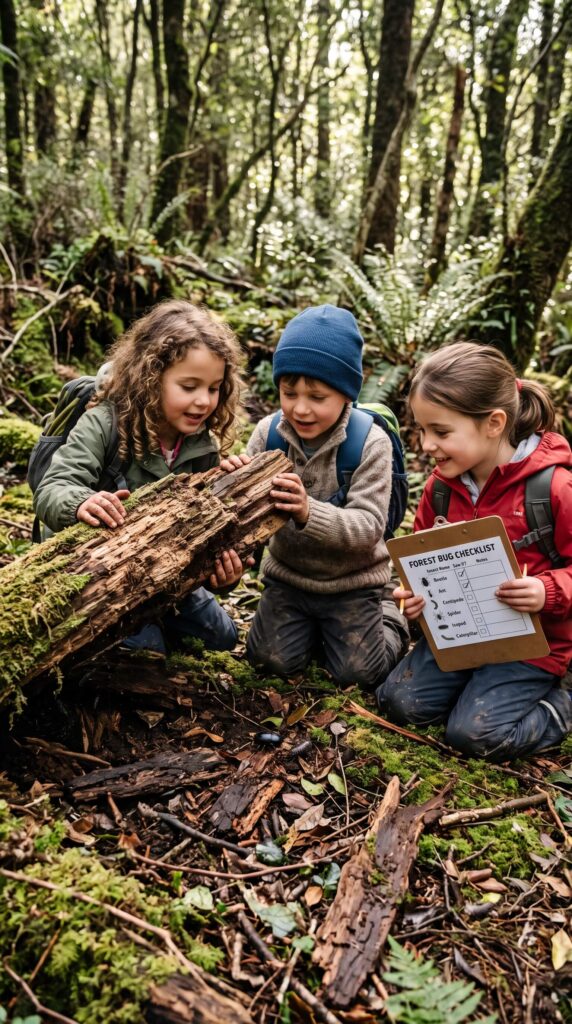
Age range & time: Ages 2–10, easy to split by task (matching for little ones, tallying for older ones). 30–40 minutes, 5 minutes of prep for a printed checklist.
A simple printed chart turns a walk into a treasure hunt. Every rustle in dry leaves becomes a big deal.
Supplies: A free printable insect ID sheet (search “backyard bug identification printable”) or a hand-drawn checklist on a clipboard. Free.
Mess & supervision: Low mess, check-in supervision, watch for allergic reactions to stings (know if your child has a known bee or wasp allergy before this one).
Steps:
- Print or draw a simple checklist of common bugs.
- Head to a shaded path, garden edge, or backyard.
- Lift logs and check bark gently, put everything back.
- No catching required; spotting and naming is the whole goal.
9. Campfire Cooking
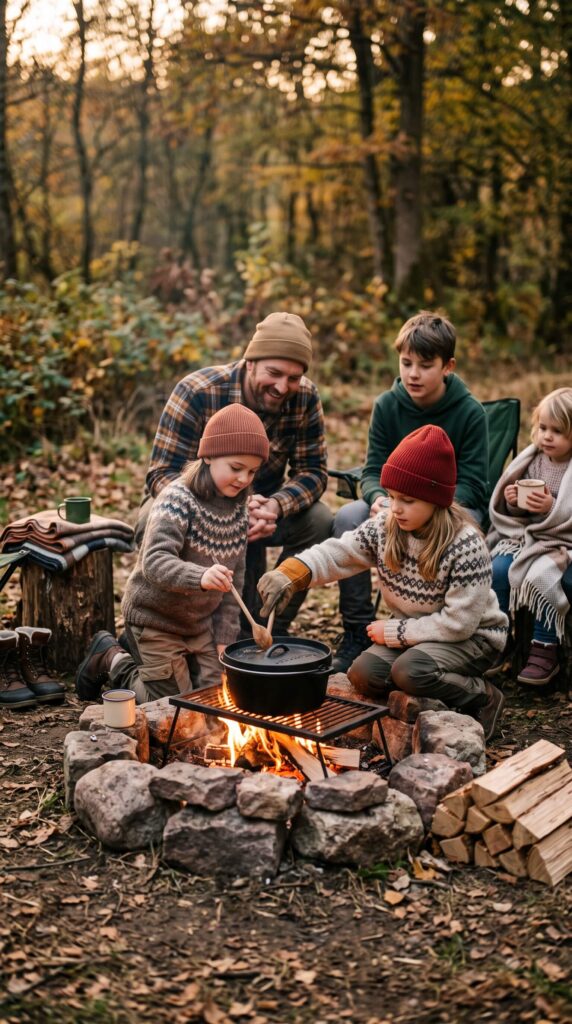
Age range & time: Ages 6 and up for hands-on tasks (younger kids can watch from a designated seat). 15 minutes setup, 30–45 minutes cooking, adult-managed the entire time.
Safety first: This one needs a real, contained fire pit, constant adult supervision, and zero exceptions on the “kids don’t touch the fire” rule. Check for local burn bans before you start.
Handing a kid a roasting stick near a controlled fire changes their whole energy. Loud turns quiet, careless turns careful.
Supplies: A small, ringed fire pit, long roasting sticks, simple food (bread, apple slices, or a pot of soup). Budget swap: skip store-bought roasting sticks and use straight, green (not dry) branches, sanded smooth.
Mess & supervision: Moderate mess, full adult supervision required at all times, no exceptions.
Steps:
- Build the fire circle with a clear rock boundary and keep water or a fire extinguisher within reach.
- Explain the boundary rules before lighting anything.
- Let older kids help with dry kindling under direct hand-over-hand supervision.
- Keep the menu simple: toast, fruit, soup.
10. Fire Lighting

Age range & time: Ages 8 and up, and only in small groups with one adult per one or two kids. This is best treated as a supervised, deliberate lesson, not a casual backyard activity, and it’s genuinely more appropriate run through an actual forest school program with a trained instructor than solo at home.
Safety first: Check local fire regulations and burn bans before doing this at all. Kids should never strike a match or use a lighter without an adult’s hand guiding theirs the first several times. Keep water or an extinguisher within arm’s reach the entire time.
Striking a spark and waiting for it to catch teaches a kind of focus I haven’t seen from any screen. Hands go steady, breathing slows, without a single “calm down” from me.
Supplies: An established, level fire pit clear of debris, dry sticks for kindling. Free if you already have a legal fire pit.
Mess & supervision: Low physical mess, maximum supervision, hands-on the entire time, no exceptions.
Steps:
- Clear the pit of any loose, dry material nearby.
- Show a simple teepee shape using dry sticks.
- Guide the child’s hand for the first light, don’t hand over full control until they’ve watched several times.
- Watch wind direction throughout.
11. Fire Experiment
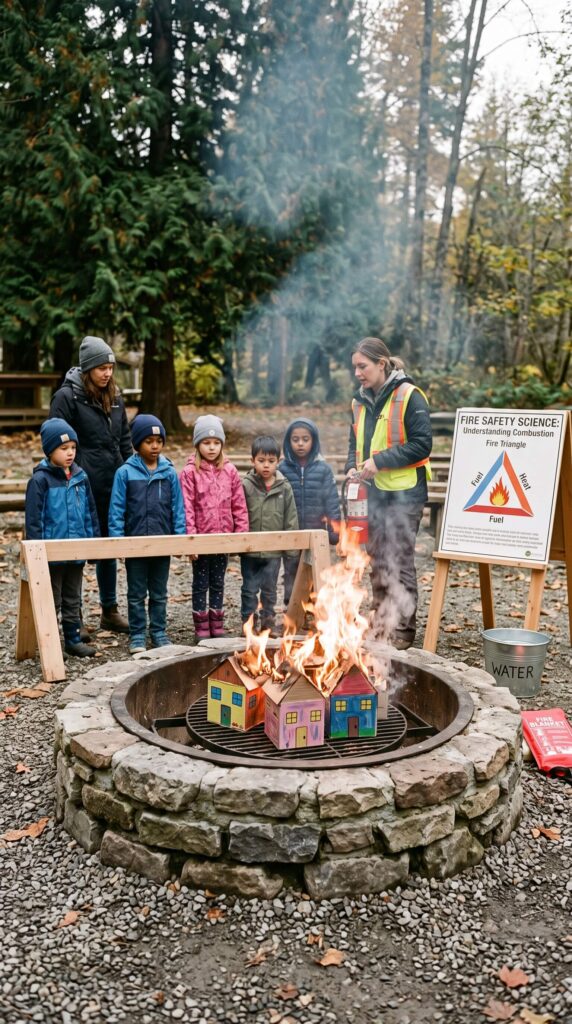
Age range & time: Ages 8 and up. 15 minutes to build cardboard structures, 15–20 minutes for the controlled burn, adult-lit and adult-managed throughout.
Safety first: Do this only in a real fire pit or bare-dirt area with nothing flammable nearby, water on hand, and a strict no-cross line the kids understand before anything is lit.
Watching cardboard catch and burn while you talk through why (wind, dryness, oxygen) makes fire science click in a way no diagram does.
Supplies: Scrap cardboard, a controlled fire pit. Free.
Mess & supervision: Low mess, full adult supervision, kids observe from a fixed safe distance, they do not light anything themselves in this one.
Steps:
- Build small cardboard “houses” together beforehand.
- Set them a safe, defined distance from the fire pit.
- Adult lights the fire, kids observe from the boundary line.
- Talk through what sped it up or slowed it down as it burns.
12. Parachute Games

Age range & time: Ages 3–12, genuinely one of the best mixed-age activities on this list. 5 minutes setup, 20–30 minutes of play.
Everyone grabs a colorful edge, one lift sends it soaring, one drop traps the giggles underneath.
Supplies: A play parachute (roughly $20–30 online) or a large lightweight bedsheet, free if you have one to spare.
Mess & supervision: Zero mess, check-in supervision, needs an open grassy area.
Steps:
- Start with slow, synchronized up-and-down waves.
- Add a soft ball on top and try to keep it bouncing.
- Call names for kids to swap places underneath before it drops.
- Count out loud together to keep everyone in rhythm.
13. Forest Tea
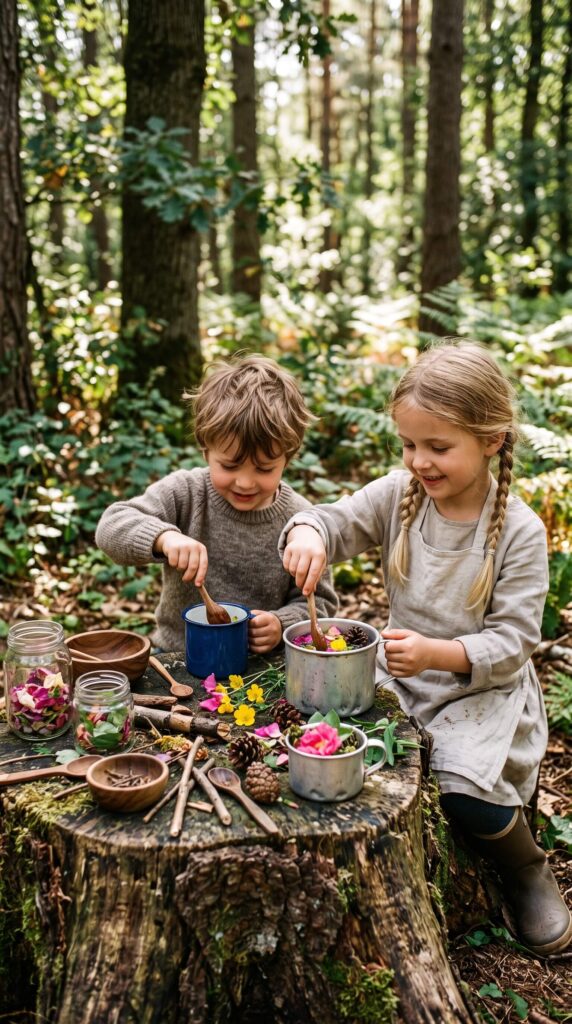
Age range & time: Ages 2–8. 10 minutes setup, 30+ minutes of open-ended play, low cleanup.
A battered kettle, a few metal cups, and some pinecones turn into a “five-star forest café” faster than you’d believe.
Supplies: old pots, wooden spoons, metal camping cups (thrift store finds work great). Ingredients: water, flower petals, safe herbs, grass. Never add anything you can’t positively identify as non-toxic, no random berries or mushrooms.
Mess & supervision: Low mess, check-in supervision, but stay close enough to catch anything going in a mouth.
Steps:
- Set up a low table or a circle of flat stumps.
- Provide pots, spoons, and safe natural “ingredients.”
- Let them cook, pour, and serve without directions.
- Older kids can add menus and pretend “customers.”
14. Marshmallow Toast

Age range & time: Ages 5 and up (younger kids can watch and eat, not hold a stick near flame). 10 minutes setup, 20 minutes toasting, adult-supervised throughout.
Safety first: A defined safe-distance line (draw it in the dirt) before anyone approaches the fire, and a “no running near the pit” rule enforced from the start.
The excitement is instant, but the real lesson is patience, since rushing gets you a charred, flaming marshmallow instead of a golden one.
Supplies: Marshmallows, roasting sticks, a contained fire pit. Budget swap: store-brand marshmallows work exactly the same as name brand.
Mess & supervision: Moderate mess (sticky hands and faces), full supervision near the fire, hands-on the entire time.
Steps:
- Establish the safe-distance boundary before lighting anything.
- Show how to turn the stick slowly for even toasting.
- Take short turns so everyone gets a fair shot.
- Talk afterward about what technique worked best.
15. Mud Digging

Age range & time: Ages 2–9. 20–30 minutes, minimal prep, moderate cleanup (a waterproof mud suit like Oakiwear’s saves your laundry pile).
One push of a spade and suddenly worms, roots, and different soil layers become the main event of the afternoon.
Supplies: Small hand forks or spades ($1–2 at Dollar Tree). Free swap: an old kitchen spoon works for toddlers.
Mess & supervision: High mess, check-in supervision, define the dig zone clearly beforehand.
Steps:
- Pick a permitted digging spot, an unused garden bed works well.
- Set a small goal: find three soil textures, or one intact root.
- Let them dig without rushing or competing.
- Return worms gently to the soil when finished.
16. Clay Imprints


Age range & time: Ages 3–10. 10 minutes setup, 30 minutes of play, plus drying time if using air-dry clay.
Fallen leaves leave fossil-like veins in soft clay, pinecones stamp sharp geometric patterns, every mark feels permanent to a kid.
Supplies: Air-dry clay (Crayola Air-Dry Clay is widely available and genuinely easy to clean up), a basket of sticks, feathers, bark, and stones. Free swap: use mud instead of store-bought clay for the same pressing effect, just skip the “keep it forever” part.
Mess & supervision: Moderate mess, check-in supervision, easy outdoor cleanup.
Steps:
- Set a low table with clay and a basket of textured objects.
- Let kids roll it flat and press objects in.
- Older kids can build repeating “nature tile” patterns.
- Let pieces air-dry fully before moving them.
17. Balance on Fallen Logs

Age range & time: Ages 3–10. 15–20 minutes, no prep, no cleanup.
Safety first: Test any log yourself before kids step on it, check it’s not rolling, rotten, or hollow underneath.
Walking heel-to-toe across a fallen trunk builds core strength and balance faster than any structured exercise I’ve tried with my kids.
Supplies: A safely fallen, tested log. Free.
Mess & supervision: Zero mess, hands-on supervision, spot younger kids at the hips if needed.
Steps:
- Test the log’s stability yourself first.
- Let kids walk across at their own pace.
- Add a challenge (carrying a bean bag, walking backward) for older kids.
- Spot, don’t hold, unless a child asks for help.
18. Photograph Forest Discoveries
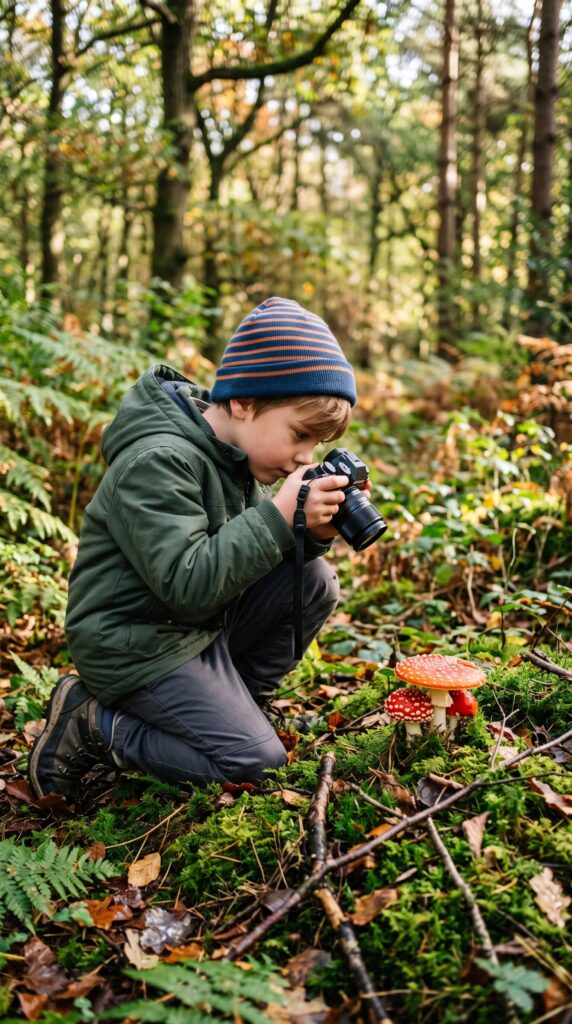
Age range & time: Ages 5 and up. 20–30 minutes, no prep beyond charging a device.
Supervision note: An old smartphone with the SIM removed or a basic kids’ digital camera works, no need to hand over your primary phone.
If your kid is a screen-lover, this bridges the gap. My son turned a walk into a genuine hunt for spiderweb close-ups once he had a camera in hand.
Supplies: An old phone (SIM removed) or a cheap kids’ digital camera (around $25–40). Free swap: a disposable camera works and adds the fun of not seeing results right away.
Mess & supervision: Zero mess, check-in supervision.
Steps:
- Hand over the camera with one simple challenge (“find five textures”).
- Let them choose angles without direction.
- Look through the photos together afterward.
- Print a few favorites for a scrapbook if they enjoyed it.
19. Make a Nature Alphabet

Age range & time: Ages 4–9. 30–45 minutes, no prep.
Finding a natural object for every letter (Acorn, Bark, Caterpillar) blends movement with early literacy without it feeling like homework.
Supplies: None, or a clipboard to track letters found. Free.
Mess & supervision: Low mess, check-in supervision.
Steps:
- List the alphabet on a clipboard or just say letters aloud.
- Walk and search together, letting kids lead.
- Skip tricky letters (Q, X) rather than forcing it.
- Celebrate however many letters get filled, no need to finish.
21. Find Every Color of the Rainbow

Age range & time: Ages 3–8. 20–30 minutes, no prep.
Red berries, orange leaves, a blue sky reflection in a puddle, kids get surprisingly competitive trying to complete the set.
Supplies: None. Free.
Mess & supervision: Zero mess, check-in supervision.
Steps:
- Name the rainbow colors together before starting.
- Search as a family or in teams.
- Point and name rather than picking (leave plants where they are).
- See who spots the trickiest color first (usually blue or purple).
Quick Comparison Table
| Activity | Age Range | Mess Level | Time Needed |
| Mud Climbing | 3+ | High | 20–40 min |
| Outdoor Classroom | 4–11 | Low | 15–30 min |
| Stick Shelter | 4+ | Low | 30–60 min |
| Mud Play | 2–10 | High | 30–45 min |
| Nature Binoculars | 3–7 | Very Low | 30–40 min |
| Forest Mural | 2+ | High | 45–60 min |
| Log Building | 3–10 | Low | 20–30 min |
| Bug Hunt | 2–10 | Low | 30–40 min |
| Campfire Cooking | 6+ | Moderate | 45–60 min |
| Fire Lighting | 8+ | Low | 20–30 min |
| Fire Experiment | 8+ | Low | 20–30 min |
| Parachute Games | 3–12 | None | 25–35 min |
| Forest Tea | 2–8 | Low | 30+ min |
| Marshmallow Toast | 5+ | Moderate | 30 min |
| Mud Digging | 2–9 | High | 20–30 min |
| Clay Imprints | 3–10 | Moderate | 30 min + dry time |
| Balance on Logs | 3–10 | None | 15–20 min |
| Photograph Discoveries | 5+ | None | 20–30 min |
| Nature Alphabet | 4–9 | Low | 30–45 min |
| Rainbow Colors | 3–8 | None | 20–30 min |
Common Mistakes First-Timers Make
- Bringing brand-new clothes. The first ruined outfit teaches you fast; save yourself the lesson and start with clothes you’ve already written off.
- Stepping in to “fix” the stick shelter or the log tower. It undoes the entire point of the activity and kids notice.
- Skipping the boundary conversation before mud or fire activities. Set the line before hands or sticks touch anything, not after mud is already on the porch furniture.
- Overplanning. Bringing five activities for one afternoon usually means none of them get finished. Pick one or two.
- Doing fire activities without checking local burn restrictions first. Many areas have seasonal bans; always check before lighting anything.
Frequently Asked Questions
Is forest school play safe for a 3-year-old?
Yes, for the low-risk activities (mud play, binoculars, rainbow hunts, log stacking). Skip anything involving fire, sharp tools, or unsupervised deep digging until at least age 6–8.
How do I get mud or paint out of clothes and carpet?
Let mud dry completely, then brush it off before washing, wet mud smears instead of lifting. For washable paint like Crayola, cold water and a stain pretreater before a normal wash cycle usually does it.
What exactly is a “forest school” approach?
It’s an educational approach centered on child-led, outdoor learning where adults act as facilitators rather than instructors, letting kids take supported risks and build confidence through hands-on nature play.
Do I need an actual forest to do these activities?
No. A backyard, local park, or community garden works fine. The philosophy is about loose natural materials, not the location.
What’s the best way to dress kids for these activities?
Layers you don’t mind ruining. In cold weather: base layer, insulating layer, waterproof shell. In heat: breathable cotton and a sun hat. A mud suit or rain suit saves serious laundry time.
How do I handle safety when letting kids take the lead?
Do a hazard check before play starts (remove real dangers like glass or unknown plants), then allow supported risks like climbing or balancing. Stay close enough to intervene, far enough that kids feel in control.