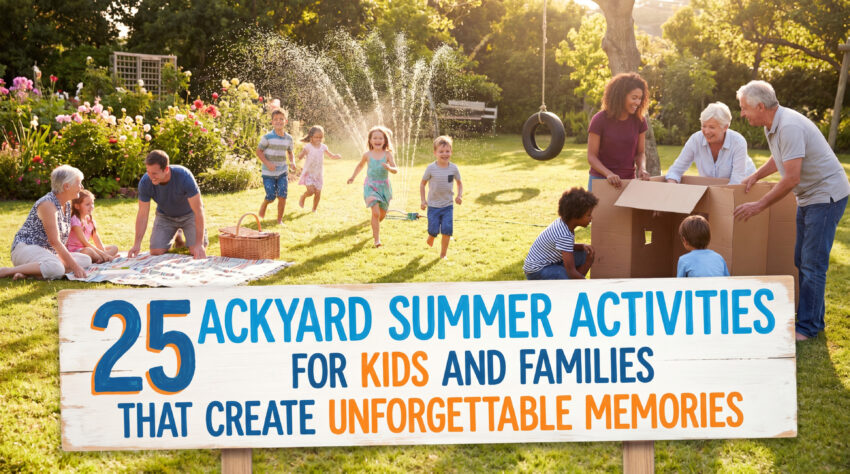
The best backyard summer activities for kids mix physical play (obstacle courses, water games, relay races) with creative and sensory options (ice painting, mud kitchens, nature hunts) so energy levels and attention spans are both covered. Most can be set up with items already in your house or from a dollar store, and the activities that work best are the ones you start with them for the first five to ten minutes, then step back. For ages 3 to 10, rotating what’s available every few days beats putting everything out at once.
The Real Problem with Summer BoredomIt was day four of summer break. My nine-year-old had already announced he was bored three times before 9am. The five-year-old was following him around the house like a shadow, which was making everything worse. The iPad was technically an option, but I’d promised myself we weren’t doing that by default anymore.
I walked them both out to the backyard and, for about thirty seconds, nobody knew what to do.
That’s the real problem. It’s not that kids don’t want to play outside. It’s that the blank yard feels like a blank page, and they need a starting point. Once you hand them that starting point, most of them run with it for hours.
This list is that starting point. Twenty-five activities I’ve either done myself with my own kids or watched work reliably for other families, organized by energy level and time of day so you can pick what fits the moment, not just the season.
Activity Quick-Pick Table
| Activity | Best Ages | Mess Level | Approx. Time | Supervision Needed | Cost |
| Obstacle Course | 4 to 12 | Low | 1 to 2 hrs | Check in every 15 min | $0 to $15 |
| Sponge Relay | 3 to 10 | Medium (wet) | 30 to 45 min | Minimal (5+) | $0 to $2 |
| Water Balloon Dodgeball | 5 to 12 | Medium (wet) | 30 to 60 min | Nearby for under 6 | $15 to $20 |
| Backyard Olympics | 4 to 12 | Low | 2 to 3 hrs | Active | $0 to $10 |
| Lawn Bowling | 3 to 9 | Very low | 20 to 40 min | Minimal | Free |
| Giant Bubbles | 2 to 10 | Low | Open-ended | Active (under 3) | $5 to $10 |
| Animal Walk Races | 2 to 8 | Very low | 15 to 30 min | Minimal | Free |
| Cup Races | 4 to 10 | Medium | 30 min | Minimal | $0 to $5 |
| Scavenger Hunt | 3 to 11 | Low | 30 to 60 min | Nearby | Free |
| Ice Painting | 2 to 8 | Medium | 30 to 45 min | Light | $5 to $8 |
| Mud Kitchen | 2 to 7 | High | 1 to 2 hrs | Check in | $0 to $5 |
| Sensory Bin | 18 mo to 6 | Medium | 30 to 60 min | Close (toddlers) | $0 to $8 |
| Fizzing Potions | 3 to 9 | Low | 30 to 45 min | Light | Free |
| Nature Weaving | 5 to 12 | Low | 45 to 60 min | Setup only | Free |
| Shadow Tracing | 4 to 10 | Zero | Spans the day | Minimal | Free |
| Tape Resist Art | 4 to 10 | Low | 1 hr + drying | Light | $2 to $5 |
| Bird Feeders | 3 to 10 | Low (sticky) | 15 min | Active (under 5) | $5 to $8 |
| Seed Planting | 3+ | Low | 15 min + daily | Minimal | $2 to $5 |
| Rain Gauge | 5 to 10 | Zero | 15 min | Setup only | Free |
| Bug Safari | 3 to 10 | Zero | 30 to 60 min | Nearby | $0 to $8 |
| Story Stones | 3 to 10 | Low to med | 45 min + dry | Active (paint) | $5 to $8 |
| Flashlight Tag | 4 to 12 | Zero | 30 to 60 min | Present | Free |
| Stargazing | 3+ | Zero | 30 to 60 min | Relaxed | Free |
| Ring Toss | 4 to 12 | Zero | 20 to 30 min | Nearby | $1 to $2 |
| Movie Night | All ages | Low | 2 to 3 hrs | Relaxed | $0 to $60 |
High-Energy Backyard Summer Activities to Burn Energy
When the primary goal is cardiovascular exercise and burning off excess energy, structured physical challenges are highly effective. These activities are designed to keep children moving continuously while remaining highly engaging.
1. DIY Backyard Obstacle Courses
Ages: 4 to 12 (with adjustments).
Time: 20 min setup, 45 min to 2 hrs of play, 10 min cleanup.
This is the most repeatable activity on the list. Set it up once, let them beat it, then have them redesign it themselves. The redesign phase is where they stay busy longest.
What you need:
- Pool noodles (Dollar Tree carries these in summer, usually $1.25 each)
- Hula hoops (dollar store or Amazon, around $8 for a set)
- Cardboard boxes from any recent delivery
- Jump ropes, patio cushions, chalk for marking
- Optional: a $5 digital stopwatch or just your phone
Budget swap: Skip buying anything new. Use cardboard boxes as tunnels, line up garden chairs as a slalom, and draw the lanes with chalk.
Steps:
- Lay out a circuit with a clear start and finish. Draw both in chalk.
- Create a balance section (a plank or a line of chalk to walk), a crawl section (under pool noodles propped on chairs), and a jump section (hula hoops flat on the ground, hop from one to the other).
- Add a “laser maze” by weaving string between two fence posts at different heights.
- Time their first run. Write the score in chalk. Let them try to beat it.
- After a few rounds, hand it over: “Your turn to change one thing.”
Tip: The moment you make it competitive with a stopwatch, most kids immediately want to run it again. That’s your hour sorted.
Mess level: Low. Chalk washes off, pool noodles go back in the shed.
Supervision: Set it up with them, then check every 10 to 15 minutes. The main hazard is the balance plank (keep it low) and string at neck height (keep it at waist or lower).
What goes wrong first time: Parents make the course too long and kids lose interest halfway through. Start with five elements max. You can always add more.
Who it won’t work for: Kids under 3 (tripping hazard on every element). Kids who get very dysregulated by competition may melt down on the timing part, so skip the stopwatch for them.
2. The Sponge Relay Race
Ages: 3 to 10.
Time: 5 min setup, 30 to 45 min play, 2 min cleanup.
Two buckets, two sponges, a lot of screaming. That’s genuinely all this is.
What you need:
- 4 buckets (you probably already have these)
- 2 large car-washing sponges (dollar store, about $1 each)
- Water access
Budget swap: Old kitchen sponges cut in half work fine.
Steps:
- Fill two buckets with water at one end of the yard. Place two empty buckets at the other end.
- Split kids into two teams (even solo kids can race against a timer).
- Soak the sponge, run, squeeze it out into the far bucket, run back, pass the sponge.
- First team to empty their starting bucket wins.
Mess level: They will be soaked. Plan accordingly. Either tell them to wear bathing suits or accept that their clothes are done.
Supervision: Minimal for kids 5+. Watch for slipping on wet grass, especially with younger kids. Barefoot on grass is safer than shoes here.
What goes wrong first time: Kids squeeze the sponge before they get to the far bucket. Make the “squeeze only over the bucket” rule explicit before you start.
Who it won’t work for: Kids who hate getting wet (and some genuinely do). Sensory-sensitive kids may find the cold water unpleasant rather than fun.
Practical note: This works with as few as two kids. For a solo child, time them and let them try to beat their own record. Works just as well.
3. Reusable Water Balloon Dodgeball
Ages: 5 to 12.
Time: 5 min setup, 30 to 60 min play, 5 min cleanup.
Regular water balloons are a mess of limp plastic shreds in the grass that you’re still finding in August. Reusable silicone magnetic water balloons (brands like Bunch O Balloons make a reusable version, and generic sets are on Amazon for around $15 to $20) fill in seconds and seal themselves. Worth every penny if you’re doing this more than once.
What you need:
- Reusable magnetic water balloons (or a set of soft water-soakable balls as a free alternative)
- Bucket of water for refills
- Jump ropes to mark boundary lines
Budget swap: Water-soaked soft sponge balls do the same job and cost nothing if you already have sponges.
Steps:
- Mark safe zones with jump ropes laid on the ground.
- Fill balloons and place the refill bucket at center.
- Set a five-minute timer. Players tag each other with the balloons.
- Anyone hit sits out until the next round.
Mess level: Moderate. The yard will be wet. The magnetic closure means no little balloon scraps in the grass, which is the main advantage.
Supervision: Stay nearby for kids under 6. The throwing force on older kids is enough to sting, so set an “underarm throws only” rule if ages are mixed.
What goes wrong first time: Older kids throw too hard with younger kids in the game. Mixed-age groups need the underarm rule, full stop.
4. Classic Backyard Olympics
Ages: 4 to 12.
Time: 30 min setup, 2 to 3 hrs for a full event.
This is a full-afternoon commitment, not a quick activity. Best for a playdate or a family day when you want one big structured event instead of five small ones.
What you need:
- Soft bandana or old fabric strip (three-legged race)
- Chalk for marking lanes
- Cardboard scoreboard
- Optional: small medals (Amazon $8 for a set of 12, or just draw them on cardboard)
Suggested events:
- Standing broad jump (mark landing spots with chalk)
- Wheelbarrow race (pairs)
- Three-legged race (pairs)
- Hula hoop endurance
- Sponge relay (see above)
Mess level: Low, unless you add water events.
Supervision: Active during the wheelbarrow race. Kids face-plant when they’re tired and their partner gives out. Have a soft landing zone or just keep a close eye.
What goes wrong first time: You try to do too many events and the kids lose energy by event four. Pick five maximum and end on a high.
5. Lawn Bowling with Recycled Bottles
Ages: 3 to 9.
Time: 10 min setup, 20 to 40 min play.
What you need:
- 10 empty 2-liter plastic bottles
- Sand, water, or dried beans to weight them (about 1 inch in the bottom)
- A heavy rubber playground ball
Budget swap: Completely free if you’ve been saving bottles. Skip the filler if your yard is level and not too windy.
Steps:
- Fill bottles with an inch of sand.
- Arrange in a triangle (4-3-2-1 formation).
- Mark a throw line with chalk. Roll to knock them down.
- Count the pins knocked down and keep a tally.
Mess level: Very low.
Supervision: Minimal. Watch that younger kids don’t try to throw the ball overhand at a sibling.
What goes wrong first time: Bottles on uneven grass fall over on their own. Either use the driveway or add more filler weight.
6. Giant Bubble Making Station
Ages: 2 to 10.
Time: 15 min setup, open-ended play.
This is one of the few activities that genuinely works for toddlers and school-age kids at the same time. The toddler chases the bubbles. The older kid tries to make the biggest one. Both are occupied.
What you need:
- 6 cups water
- 1 cup dish soap (Dawn works best, the original blue formula)
- 1/4 cup glycerin (available at most pharmacies, around $5, or Amazon)
- Two wooden dowels or garden stakes
- Cotton string or a shoelace (loop between the two sticks)
- A shallow tray or container to dip into
Budget swap: Skip the glycerin. The bubbles will be smaller and pop faster, but it still works. Corn syrup is a close substitute.
Steps:
- Mix solution gently (don’t agitate it, foam ruins it). Let it sit 30 minutes if you can.
- Tie the cotton string in a loop between two sticks, leaving enough slack that it sags slightly.
- Dip the loop into the tray of solution.
- Pull it through the air slowly, or just stand still and let the breeze do it.
Tip: Humid days make much better bubbles than dry ones. If it’s too windy, the bubbles pop before they form.
Mess level: Grass gets slippery. Shoes off or non-slip sandals.
Supervision: Active for kids under 3 (they will drink the solution if you look away for a second). The dish soap is non-toxic but tastes terrible and will cause an upset stomach.
SAFETY NOTE: Keep the bubble solution away from toddlers’ mouths. Not dangerous, but definitely unpleasant.
What goes wrong first time: Parents make the solution too soapy. The ratio matters. Too much soap and it just foams.
7. Animal Walk Races
Ages: 2 to 8.
Time: Zero setup, 15 to 30 min.
Free, instant, no supplies needed. This is your “I need something in 30 seconds” activity.
Steps:
- Mark start and finish with chalk or shoes.
- Call out an animal: crab walk (hands and feet on the ground, belly up), bear crawl (hands and feet on the ground, belly down, hips high), frog jump (squat, jump forward, land in squat).
- Race to the finish line.
Mess level: Hands get grassy. That’s it.
Supervision: Watch for head collisions on the crab walk when kids reverse into each other.
8. Water Squirter Cup Races
Ages: 4 to 10.
Time: 15 min setup, 30 min play.
What you need:
- 2 plastic cups
- String or thin rope (about 20 feet per lane)
- Water squirt guns or spray bottles
- Two fixed anchor points (trees, fence posts)
Steps:
- Thread a long piece of string through each cup (pierce the bottom of the cup first).
- Tie one end of each string to a tree or post, and the other end further away, creating a horizontal track.
- Slide the cups to the starting end.
- Squirt water into the open cup to push it down the string toward the finish.
Mess level: Moderate wetness.
Supervision: Minimal for kids 5+. They’ll figure out aiming quickly.
What goes wrong first time: The string isn’t tight enough and the cups just hang. Pull it taut before you start.
Creative and Sensory Backyard Activities
Not all backyard summer activities need to be highly physical. Integrating art, science, and sensory exploration engages different areas of the brain and provides a calming counterbalance to high-energy games.
9. Nature Scavenger Hunts
Ages: 3 to 11 (adjust the list complexity).
Time: 10 min setup, 30 to 60 min play.
What you need:
- Printed or handwritten scavenger list
- Clipboard or cardboard backing
- Small bucket or bag
- Optional: magnifying glass (dollar store, $1 to $1.25)
Sample list for ages 5 to 8:
- Something smooth and flat
- An insect with six legs
- Three different leaf shapes
- Something that makes a sound
- A seed
- Something yellow
Mess level: Low.
Supervision: Stay close for kids under 4 (small objects are choking hazards). For older kids, do a quick sweep of your yard first to remove any hazards like rusty nails or broken glass from the search zone.
SAFETY NOTE: Tell kids before they start: look but don’t taste. Some berries and plants look interesting but aren’t safe. Make “just look” the rule from the beginning.
10. Ice Painting
Ages: 2 to 8.
Time: Overnight freeze + 5 min setup, 30 to 45 min activity.
This is the activity that consistently surprises parents. Kids stay at it longer than you’d expect because the medium keeps changing as the ice melts.
What you need:
- Ice cube tray
- Washable liquid watercolors (Colorations brand, available on Amazon, is excellent and genuinely washable on most surfaces)
- Popsicle sticks
- Large sheet of butcher paper or old cardboard
Steps:
- The night before: fill the tray with water, add a few drops of watercolor to each section, insert a popsicle stick, freeze.
- Roll out the butcher paper on the lawn or driveway.
- Hand them the frozen paint cubes and let them go.
Mess level: Moderate on clothes (use washable watercolors), low on the lawn. The color washes off driveways within a day or two.
Supervision: Light touch for ages 3+. Watch that toddlers don’t put the ice sticks in their mouths for extended periods (cold burn risk).
What goes wrong first time: Using regular food coloring instead of watercolors. It doesn’t spread well and can stain concrete.
Practical note: Do this in the shade if possible. In direct sun, the ice melts in under five minutes and you lose the slow-reveal effect that makes it interesting.
11. Mud Kitchen Masterpieces
Ages: 2 to 7.
Time: 10 min setup, 1 to 2 hrs play.
If you only do one thing from the sensory section, do this one. It is the highest-return activity in the entire list for kids under 6. They will play at a mud kitchen longer than almost anything else.
What you need:
- Old pots and pans (thrift store, $2 to $5 total)
- Wooden spoons, measuring cups, muffin tins
- A watering can or cup to add water
- A designated dirt patch or a bin filled with soil
Budget swap: Everything here can be sourced from a thrift store for under $5, or just grab whatever old cookware you were about to donate anyway.
Steps:
- Set up the “kitchen” in a shaded corner with a dirt patch nearby.
- Add the tools.
- Let them add water and mix.
- That’s it. They take it from there.
Mess level: High. This is the point. Old clothes or clothes you’re happy to wash. Do not do this in anything you care about.
Supervision: Check in every 10 to 15 minutes. Main concern is toddlers putting mud in their mouths (they will). Not harmful, genuinely gross.
SAFETY NOTE: If your soil has been recently treated with pesticides, fertilizer, or weed killer, don’t do this. Use a bin of purchased potting soil instead.
What goes wrong first time: Parents get anxious about the mess and shut it down too soon. Let the mess happen. That’s where the sensory benefit lives.
12. Sensory Bins and Digging Zones
Ages: 18 months to 6 years.
Time: 10 min setup, 30 to 60 min play.
What you need:
- Large shallow under-bed storage bin (about $5 at Walmart or Target)
- Filling: kinetic sand, dried beans, rice, or water beads
- Small plastic toys, coins, or dinosaur figures to hide inside
- Scoops, tongs, spoons
Budget swap: Dried rice or dried beans from the pantry work perfectly and cost almost nothing.
SAFETY/CHOKING NOTE: Water beads are a serious choking and ingestion hazard for children under 3. They expand dramatically when swallowed and require emergency medical attention. Use only with children who are past the mouthing stage, and supervise closely. Dried beans are a safer alternative for younger kids.
Mess level: Medium. Set the bin on a tarp or old shower curtain for easy cleanup.
Supervision: Close watch for toddlers regardless of filling material.
13. Fizzing Potion Station
Ages: 3 to 9.
Time: 5 min setup, 30 to 45 min play.
What you need:
- Baking soda
- White vinegar
- Food coloring
- Small plastic bowls or cups
- Squirt bottles or droppers
Budget swap: Everything here is a pantry staple. This is genuinely free.
Steps:
- Put a scoop of baking soda into each small bowl.
- Fill squirt bottles with vinegar and add a few drops of different food coloring to each.
- Let them squirt and watch it fizz.
- Let them mix colors.
Mess level: Low. The reaction is contained to the bowls. Do it on a tray for easy cleanup.
Supervision: Light. Make sure no one squirts vinegar in another kid’s eyes (it stings but isn’t dangerous). Keep it pointed down.
What goes wrong first time: Adults try to turn it into a lesson too early. Just let them play. The curiosity comes naturally.
14. Nature Weaving Loom
Ages: 5 to 12.
Time: 15 min to make the loom, 30 to 45 min to weave.
What you need:
- A piece of sturdy cardboard (cereal box thickness or thicker)
- Scissors (adult)
- Yarn or string
- Nature materials: grass blades, leaves, flower stems, twigs
Steps:
- Adult: cut small slits along the top and bottom edges of the cardboard, about 1 cm apart.
- Thread yarn tightly across the board, looping through the slits, creating the vertical warp.
- Kids: collect nature materials from the yard.
- Weave the collected items horizontally through the yarn.
SAFETY NOTE: Adults cut the notches. The scissors required for this are too sharp for most kids under 7 to use on thick cardboard safely.
Mess level: Low.
Supervision: Active during the cardboard-cutting setup, then light once the loom is made.
Who it won’t work for: Kids with low frustration tolerance may find the weaving fiddly. Start with wider gaps between warp threads to make it easier.
15. Shadow Tracing
Ages: 4 to 10.
Time: 5 min setup, activity spans 3 times throughout the day.
What you need:
- Sunny day with a driveway or patio
- Plastic toys or small objects
- Large paper or just the chalk-able surface itself
- Chalk or marker
Steps:
- Mid-morning: place toy animals or building blocks on paper or pavement. Trace the shadows with chalk. Write the time next to each.
- Midday: repeat with the same objects in the same spots.
- Late afternoon: repeat again.
- Compare. Talk about why they changed.
Mess level: Zero.
Supervision: Minimal.
16. Outdoor Watercolor Tape Resist
Ages: 4 to 10.
Time: 20 min to set up and tape, 30 min to paint, drying time before reveal.
What you need:
- Painter’s tape (blue masking tape, any hardware or dollar store)
- Heavy cardboard or watercolor paper
- Watercolors
- Brushes
Steps:
- Apply painter’s tape in geometric patterns, lines, letters, or shapes.
- Paint over the whole surface.
- Let it dry completely (this is the hard part for kids; give them something else to do while they wait).
- Peel the tape to reveal the design.
Tip: The thicker the cardboard, the better it holds up to wet paint without buckling.
Mess level: Low outdoors. Watercolor cleans easily from skin and most surfaces.
Educational and Nature-Based Activities
The backyard is an ecosystem ripe for exploration. These activities disguise scientific observation and critical thinking as play.
17. DIY Bird Feeders
Ages: 3 to 10.
Time: 15 min to make, then ongoing observation.
What you need:
- Large pinecones (from the yard or dollar store in craft section)
- Peanut butter (or sunflower seed butter for nut-free households)
- Mixed birdseed (any hardware or grocery store, about $5 for a bag)
- String
ALLERGEN NOTE: If anyone in the household has a peanut allergy, use sunflower seed butter. Birds cannot tell the difference.
Steps:
- Tie a 12-inch piece of string around the top of the pinecone.
- Spread peanut butter all over the pinecone with a knife (adult task for kids under 5).
- Roll it in birdseed on a plate until coated.
- Hang from a low branch.
Mess level: Sticky hands. Have wet wipes ready.
Supervision: Active during the peanut butter spreading for younger kids.
18. Seed Planting and Germination Station
Ages: 3 and up.
Time: 15 min to plant, then 5 min daily for watering.
What you need:
- Fast-growing seeds: radishes sprout in 3 to 5 days, sunflowers in 7 to 10, green beans in 5 to 8
- Small terracotta pots ($1 each at Dollar Tree) or a patch of ground
- Potting soil
Why radishes are the right first seed: They germinate so fast that kids don’t lose interest before anything happens. That’s the whole trick with young kids and gardening.
Steps:
- Fill pot with soil, leaving 1 inch from the top.
- Press 2 to 3 seeds about half an inch into the soil.
- Water gently.
- Mark the pot with their name.
- Assign them daily watering duty.
Mess level: Low. Soil cleanup is quick.
Supervision: Minimal once set up.
19. DIY Rain Gauge Observation
Ages: 5 to 10.
Time: 15 min to make.
What you need:
- Clear plastic water bottle
- Scissors (adult)
- Permanent marker
- Ruler
Steps:
- Adult: cut the top third of the bottle off. Invert the top and nestle it into the base as a funnel.
- Use the marker and ruler to draw measurement lines up the side (start from above the funnel’s base).
- Place outside in an open area before a storm.
- Read it after the rain. Keep a chart over the summer.
Mess level: Zero.
Supervision: Minimal. Adult needed only for the cutting step.
20. Backyard Bug Safari
Ages: 3 to 10.
Time: 0 setup, 30 to 60 min.
What you need:
- Bug-catching container with air holes (Melissa and Doug makes a good one around $8, or just use any jar with a punched lid)
- Magnifying glass
- Optional: regional insect field guide or a free ID app like iNaturalist
Steps:
- Gently catch bugs and examine them.
- Use the guide or app to identify.
- Release everything when you’re done.
SAFETY NOTE: Teach kids to check for bees and wasps before reaching under rocks or into long grass. Disturbing a nest by accident is the main hazard here. Brief them before you start.
Mess level: Zero.
Supervision: Close watch for kids who don’t yet handle creatures gently.
21. Story Stones Painting
Ages: 3 to 10.
Time: 30 to 45 min to paint, drying time, then story activity.
What you need:
- Smooth, flat river rocks (collect from a park, buy a bag at craft stores for about $5)
- Acrylic paint or paint markers
- Mod Podge or clear sealant (optional, to weatherproof them)
Steps:
- Paint different simple images on each rock: animal, house, tree, person, vehicle, weather symbol.
- Let dry completely.
- Put all stones in a bag.
- Take turns pulling one out and adding a sentence to the group story.
Mess level: Low if using paint markers, moderate with acrylic paint.
Supervision: Active for younger kids during the painting phase.
Evening and Nighttime Backyard Activities
The backyard remains a valuable resource even after the sun goes down. Evening activities take advantage of cooler temperatures and introduce children to a completely different atmospheric environment.
22. Musical Flashlight Tag
Ages: 4 to 12.
Time: 5 min setup, 30 to 60 min play.
What you need:
- Flashlight (one per “it” player)
- Bluetooth speaker
- Music playlist
Steps:
- “It” carries a flashlight.
- Music plays; runners move around the yard.
- When music pauses, everyone freezes.
- Anyone caught moving by the flashlight beam is out.
Mess level: Zero.
Supervision: Active. Night play in the yard needs a parent either present or watching from close range. Check the yard during the day for anything that could cause a trip at night.
SAFETY NOTE: Do a daytime walkthrough before nighttime play. Hoses, toys, and sprinkler heads become tripping hazards in the dark.
23. Backyard Stargazing and Astronomy
Ages: 3 and up.
Time: Minimal setup, 30 to 60 min.
What you need:
- Waterproof blanket or sleeping bag
- Free app: Sky Map (Android) or Sky View Lite (iOS)
Steps:
- Lay out blankets after sunset.
- Point the app at the sky to identify constellations and planets.
- Find the moon, find one constellation, find one planet.
Tip: This winds kids down naturally. The stillness and quiet after a day of activity is good for everyone.
Mess level: Zero.
Supervision: Active but relaxed.
24. Glow-in-the-Dark Ring Toss
Ages: 4 to 12.
Time: 5 min setup, 20 to 30 min play.
What you need:
- Glow stick bracelets and necklaces (dollar store, usually $1 to $2 for a pack)
- A wooden stake or sturdy stick pushed into the lawn
Steps:
- Activate the glow sticks.
- Mark a throw line in chalk (or just agree on a distance).
- Take turns tossing rings onto the stake.
- Keep score.
SAFETY NOTE: Glow stick liquid is non-toxic but tastes very bitter and can irritate eyes. If one cracks open, rinse eyes with water immediately. Don’t let young kids chew on them.
Mess level: Zero.
25. Outdoor Movie Nights
Ages: All ages.
Time: 20 to 30 min setup.
What you need:
- Portable projector (Amazon has budget options around $50 to $60, or borrow from a friend)
- White bedsheet suspended between two trees or fence posts, or project onto the side of the house
- Extension cord
- Sleeping bags, floor cushions, popcorn
Steps:
- Hang the sheet or identify the projection wall.
- Position the projector.
- Set out the sleeping bags before the kids see it so the setup is part of the surprise.
- Start the movie after dark for best picture quality.
Mess level: Popcorn. You know how that goes.
Supervision: Relaxed. This is the wind-down activity at the end of a full day.
Tip: The movie almost doesn’t matter. The event of being outside at night in sleeping bags is what they remember.
Common First-Timer Mistakes to Avoid
These are the things that actually trip parents up the first time, not the obvious stuff.
- Putting everything out at once. The fastest way to guarantee boredom by noon is to make everything available on day one. Rotate. Keep things back. Novelty is the actual engine.
- Setting up without a five-minute “play with them” start. Kids rarely launch into independent play cold. If you start the obstacle course with them, then gradually step back, they’ll keep going. Drop them into it alone and they’re done in ten minutes.
- Overthinking the mess before it happens. The activities with the most hands-on mess are almost always the ones they stay with longest. Mud kitchen, ice painting, fizzing potions: parents who lean into these get the most play time per minute of cleanup.
- Stopping an activity at its peak. If they’re still engaged, let it run. The instinct to call it and clean up when it’s going well is real, but if you let it exhaust itself naturally, they’re more likely to ask for it again.
- Forgetting the sunscreen timing. Thirty minutes before going out. Not right before. The application-to-protection delay is real and easy to skip when you’re trying to get outside quickly.
- Not briefing kids on safety rules before the activity starts. Once the water balloons are in hand, nobody’s listening. Give the “throw underarm only” or “look but don’t taste” rule before you hand out the supplies.
Safety Notes for Summer Backyard Play
Hydration. Kids don’t self-regulate thirst well when they’re excited. Set a reminder to offer water every 30 minutes during active play. A jug and cups outside removes the back-and-forth inside.
Sunscreen. SPF 30 or above, broad spectrum. Apply 30 minutes before going out. Reapply every two hours and immediately after water activities. This is the step most parents skip when they’re moving fast.
Standing water. Empty all buckets, kiddie pools, and water tables immediately after use. Even a few inches of standing water is a drowning hazard for toddlers and creates a mosquito breeding site within 24 to 48 hours.
Play structure checks. Before the summer starts, walk your play structures and check for splinters, loose bolts, and any sharp edges. Hoses coiled on the ground become tripping hazards when kids are running.
Evening insect protection. For outside time after dusk, use a child-safe repellent with DEET or Picaridin. Eliminate any standing water from earlier in the day. Oscillating fans create airflow that mosquitoes struggle to fly through.
Practical note: The activities with the highest actual risk on this list are the nighttime ones (tripping hazards in the dark) and the sensory bin ones for toddlers (choking and ingestion hazards). Everything else is manageable with normal attentiveness.
FAQs
Is a mud kitchen safe for a 2-year-old?
Yes, with close supervision. The main concern is them eating the mud, which is unpleasant but not dangerous in a yard that hasn’t been recently treated with pesticides or chemicals. Use purchased potting soil if you’re not certain about your yard’s soil. Keep wet wipes nearby and check in frequently.
How do I get watercolor paint off the driveway?
Washable watercolors (like Colorations) rinse off concrete with a garden hose within a day or two. If it’s soaked in, a scrub brush and soapy water handles it. Regular craft store watercolors can stain, which is why the brand matters here.
Are water beads safe for kids?
Not for children under 3, and only with close supervision for kids 3 to 5. Water beads are a serious ingestion hazard because they expand dramatically inside the body and require medical attention. Use dried rice or dried beans as a safer sensory bin filling for younger kids.
How do I keep the lawn from dying under heavy summer use?
Rotate where you set things up. Don’t leave the kiddie pool or anything that smothers the grass in one spot for more than two days. Water the lawn deeply in the early morning to help it recover. Move the play zone around the yard rather than concentrating everything in one corner.
What do I do if my kid loses interest in an activity after five minutes?
Play alongside them for the first few minutes rather than setting them up and walking away. Most kids need an adult to model the activity briefly before they engage independently. If they still leave after five minutes, the activity isn’t the right fit right now. Come back to it in a week or two.
How do I handle bugs and mosquitoes during evening activities?
Eliminate any standing water in the yard before the evening starts (buckets, kiddie pools, water tables). Use child-safe repellent with DEET or Picaridin on exposed skin. An outdoor oscillating fan pointed at the play area creates enough airflow that mosquitoes generally give up.