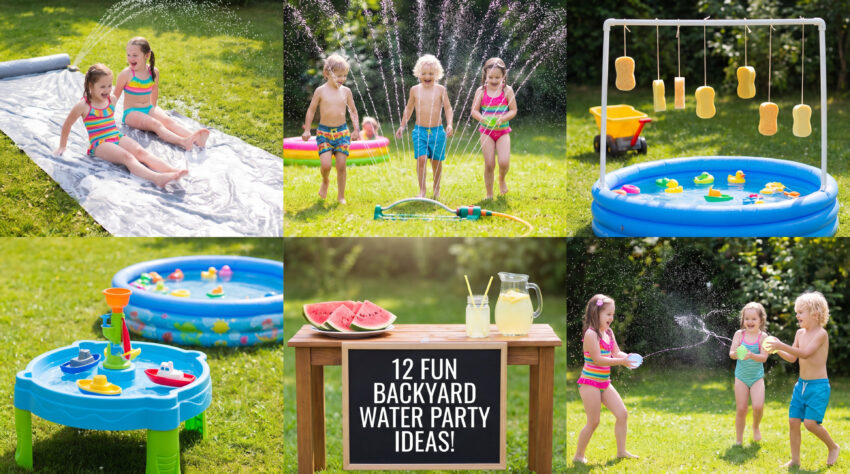
A backyard water party works best with three activities, not twelve: one splash station (a sprinkler or a hose-fed splash mat), one game with a target (sponge toss or a bucket relay), and one quiet water table for the kids who need a break from being soaked. Plan on about 90 minutes, and name one adult whose only job is watching the water, with toddlers kept within arm’s reach of anything holding more than a couple of inches. You do not need a pool or a big yard, and a party for eight kids costs around $15 to $20 if you already own towels and a hose.
The Birthday Party That Fell Apart in Eleven MinutesNine kids showed up at 11am for my daughter’s sixth birthday. My entire plan was one oscillating sprinkler and a bag of water balloons.
The balloons were gone in about six minutes. By 11:20 four kids were fighting over the hose, one was crying because the concrete was too hot to stand on, and the birthday girl had gone inside to ask for the iPad.
What fixed it the next year was not spending more money. It was starting at 9:30 instead of 11, setting up three separate things in three separate corners, and accepting that kids stay at any one water station for about eight to twelve minutes before they need something new.
That is the whole trick. Small yard, weird sloped yard, townhouse patio, gravel side strip, none of it matters much. What matters is having more than one thing to do, a shady spot to retreat to, and a plan for the water when the party ends.
Everything below is sorted so you can pick by your yard, your kid’s age, and how much mess you can tolerate today. Late-season note: if you are reading this in September, this is the cheapest week of the year to buy splash mats and pool floats, because the clearance racks go out right after Labor Day and the stock does not come back until spring.
Essential Planning Tips for an Outdoor Splash Party
Six things decide whether this goes well, and none of them are decorations.
Start early or start late. A water party between 11am and 3pm in July is a party where somebody burns their feet and somebody else gets a headache. I run mine 9:30 to 11am, or after 4pm when the yard is in shade. The water is more fun when the kids are not already overheated.
Pick three activities and stop. Not twelve. Three, spread across three corners so kids move between them on their own. Twelve stations means twelve half-set-up things and no adult standing anywhere useful.
Make the dry zone a real place. A picnic blanket in shade on the far side of the yard, with towels, a cooler, and the snack table. It only works if it has a physical edge (the blanket, a cooler as a marker) and if you put the food out last. Put snacks out at the start and you spend the party fighting wasps instead of watching water.
One towel per kid plus two spares, in a laundry basket by the back door. Nine identical blue beach towels on wet grass is a problem you only make once. I write names on painter’s tape and stick it to the towel, and it stays on all party.
Sun and heat come before the fun list. Shade first (a canopy, a tree, or a bedsheet clipped to a fence with binder clips), then sunscreen 15 minutes before anyone gets wet, then a cooler of water with actual cups. Kids in cold water do not feel thirsty and will not ask.
Have the rain plan and the ending plan written down. Idea 9 is the rain plan. The ending plan is a popsicle: announce a last round, then hand out something frozen, because nobody gets out of the water for an announcement alone.
Here is the shape of a 90 minute party that works, and 90 minutes is the right length for ages 4 and up. For toddlers, cut it to 45.
| Time | What is happening |
| Minus 30 min | Fill tubs, lay out towels, hose down hot concrete, check the yard barefoot yourself |
| 0 to 10 min | Arrivals, sunscreen check, shoes off, ground rules said out loud to the kids |
| 10 to 35 min | Station 1, the big splash activity, while everyone is fresh |
| 35 to 55 min | Station 2, the game with a target and a scoreboard |
| 55 to 70 min | Snack and shade break in the dry zone, all containers emptied first |
| 70 to 85 min | Station 3, the quiet water table, or one last round of the favorite |
| 85 to 90 min | Popsicles, dry clothes, wet clothes into grocery bags to go home |
Practical note: the most dangerous 20 minutes of a water party is the snack break, because the adults sit down and the water is still sitting there full. Tip the buckets and pools before anyone gets a plate, not after.
What You Actually Need (With a Cheap Swap for Everything)
The best thing in this entire article costs $1.25. A six pack of car wash sponges from Dollar Tree, cut into strips, outperforms every water blaster I have ever bought.
| Item | What it does | Rough cost | Cheap or free swap |
| Car wash sponges | Sponge bombs, sponge toss, the car wash station | $1.25 for 6 at Dollar Tree | Any old bath sponge with no green abrasive backing |
| Water balloons | Ten minutes of pure joy, then a scrap hunt | $3 to $8 | Cut sponges (no scraps, no choking risk, reusable) |
| Self-tying balloons (Bunch O Balloons) | Fills about 35 at once in 20 seconds | $6 to $10 for 100 | Standard balloons and a hose nozzle, plus 20 more minutes |
| Deep tubs and buckets | Filling, relays, targets, sponge storage | $1.25 each at Dollar Tree | Kitchen mixing bowls, a recycling bin, storage tubs from the garage |
| Kiddie pool | Toddler splash, floating toys | $12 to $30 | A clear under-bed storage box (Sterilite), no inflating and it tips to drain |
| Hose-fed splash mat | Toddler splash pad | $15 to $25 | Pushpin holes in an empty 2 liter bottle, duct-taped to the hose end |
| Sprinkler | The main splash zone for a group | $8 to $15 | Lay the hose over a chair back so it arcs, or thread it through a pool noodle |
| Heavy plastic sheeting | The tarp slide | $25 to $40 for 6 mil | No good free swap. A cheap thin tarp tears within an hour, and a torn tarp is a hazard |
| Pool noodles | Slide edges, limbo bar, human car wash | $1 to $3 each | Rolled up towels along the slide edges |
| Turkey baster and funnels | The water lab, and the single most fought-over tool | $1.25 each | Free oral medicine syringes from any pharmacy counter, and a soda bottle cut in half with the rim taped |
| Muffin tin or ice cube tray | Color mixing, pouring targets | Already in your kitchen | Egg carton, yogurt cups |
| Food coloring (McCormick) | Turns pouring into a science lab | $4 | Skip it. Nothing free replaces it, and clear water still works fine |
| Tear-free baby wash | Slide lubricant, car wash suds | $4 | Any tear-free shampoo you already own. Not dish soap in eye range |
| Prizes | The scoreboard payoff | $2 to $5 | Bubble wands or sticker sheets from the dollar store. Skip candy, it melts and it is a choking risk for the little ones |
| Shade | Keeps the whole party viable | $30+ for a canopy | A flat bedsheet clipped to a fence and two chairs with binder clips |
My whole supply list for eight kids, if I already have towels and a hose, comes to about $15 to $20. The tarp slide is the only thing on this page that meaningfully changes that math.
Water Safety Rules That Actually Matter at a Backyard Water Party
Read this part before you buy anything. Water play with a group of kids has three real hazards (drowning, balloon fragments, and slipping) plus heat, and none of them announce themselves.
Name a water watcher out loud, and hand the job off out loud. One adult, one job, phone in a pocket, not grilling and not hosting. Fifteen minute shifts work because attention genuinely fades. “We are all watching” means nobody is, and that is the most common setup at a party. If the grown-ups are drinking, the water watcher is the one who is not.
Drowning is fast, silent, and shallow. CDC data puts drowning as the leading cause of death for children ages 1 to 4. It does not look like splashing and shouting, and a couple of inches in a storage tub is enough. Toddlers stay within arm’s reach of any water, every single time, with no exception for “I am right here.”
Count your containers, then empty them. Buckets, tubs, coolers with melted ice, kiddie pools, the wheelbarrow. CPSC has warned specifically about 5 gallon buckets, which are tall enough and heavy enough that a toddler who tips in headfirst cannot get back out. Empty each one the moment its activity ends and turn it upside down, and dump everything before the last family leaves rather than at dusk.
Latex balloon pieces are the choking hazard nobody plans for. Latex balloon packaging carries a federal warning for children under 8 for a reason: a burst fragment is exactly the shape that seals a small airway, and a kid can inhale one while trying to blow it up or chew it. Run a scrap patrol before anyone sits down to eat, use pale colors because dark green and navy vanish into grass, and pay a nickel a piece if you want the lawn genuinely clear in five minutes.
Use the toilet paper tube test on everything you put in a bin. If it fits through a toilet roll tube, it can choke a child under 3. That rules out the river rocks, plastic shells, small sea creatures, and the little rubber o-rings from self-tying balloon kits, all of which end up on the ground at these parties.
Some jobs are yours, not theirs. Cutting sponges with kitchen shears, cutting bottles (then folding duct tape over the cut rim), laying and anchoring the tarp, and carrying any bucket a kid cannot lift alone.
Test everything hot with the back of your hand. Water sitting in a dark hose in the sun comes out hot enough to scald, so run it onto the lawn for 30 to 60 seconds before handing it to a child. Same test for dark tarps, rubber mats, pavers, and asphalt, all of which run far hotter than the air temperature. Hose down concrete ten minutes before the party starts.
Most garden hoses are not rated for drinking water, so put out a cooler and cups. Kids will drink from the hose otherwise, because they always do.
Sun and heat need a plan, not a reminder. AAP guidance is shade and clothing for babies under 6 months, with sunscreen on small exposed areas only if shade is not available. For everyone else, broad spectrum SPF 30, applied 15 minutes before water, reapplied every two hours and after swimming. A “water resistant” label means 40 or 80 minutes, not all day, and it goes on dry skin or it just slides off.
Know what heat exhaustion looks like, because kids in cold water hide it. Heavy sweating, cool clammy skin, dizziness, cramps, nausea, or a kid who suddenly goes quiet and sits down means shade, water, cool cloths, and no more running. Hot dry skin, confusion, or vomiting is heat stroke, which is a 911 call, not a rest in the shade.
Wet concrete and decks behave like ice. No running in the splash zone, soap only in the sliding lane of a tarp slide and nowhere else, and cheap aqua socks with rubber dots grip a wet deck better than Crocs do, which are slick when wet.
Shared water gets contaminated fast. CDC advice for kiddie pools is to empty them after use rather than trying to treat the water, and any kid with diarrhea in the past two weeks stays out of shared water entirely. Say “no drinking the pool water” out loud, because at least one kid will try.
Separate the ages physically. A 2 year old and an 8 year old cannot share a splash zone, and a toddler gets flattened by a kid who is not even looking. Gentle zone on one side, running games on the far side, and say the boundary out loud to the older kids.
If any child at the party wanders, including autistic kids, for whom wandering toward water is a documented drowning risk, assign one adult to that one child by name for the whole party and check that gates are latched before anyone arrives.
Ask about allergies on the invite, since the food at a water party is usually the afterthought. Popsicles, fruit, and anything with nuts on a shared table needs checking, and sunscreen itself can cause reactions on kids with eczema.
Thunder ends the party. The National Weather Service rule is simple: if you hear thunder, go inside, and wait 30 minutes after the last rumble before going back out. Hoses, metal poles, and open lawns are not where you negotiate with a kid about one more slide.
Pick a Water Party Idea in 30 Seconds
Scan the mess column first. That is the one that decides your afternoon.
| # | Idea | Real ages | Space it needs | Mess | Total time | Supervision |
| 1 | Water balloon station | 4 to 12 | A side strip, 10 ft | Low mess, high wet | 55 min (25 of it filling) | Eyes on, arm’s reach under 5 |
| 2 | Toddler splash pad corner | 1 to 5 | Flat 6 x 6 ft | Low, soggy lawn | 40 min | Arm’s reach, always |
| 3 | Bring-your-own-pool bash | 2 to 10 | Whole yard, one sightline | Medium | 2 hours | One watcher per pool |
| 4 | Games without a pool | 4 to 12 | 20 ft of lawn | Low | 55 min | Check in every few minutes |
| 5 | Kids luau | 3 to 10 | Any, patio works | Low | 90 min | Eyes on |
| 6 | Toddler birthday splash | 1 to 3 | Small, shaded | Medium | 90 min (45 of party) | Arm’s reach, no exceptions |
| 7 | Tarp water slide | 5 to 12 | A slope plus 15 ft runout | High | 1 hr 45 min | Hands-on the whole time |
| 8 | DIY water park stations | 4 to 11 | Big lawn | Medium | 2 hours 20 min | One adult per station |
| 9 | Indoor backup games | 1 to 10 | Kitchen or bathroom | Contained if planned | 40 min | Arm’s reach near tubs |
| 10 | Deck or driveway sprinkler | 3 to 10 | Paved area away from the street | Low | 70 min | Eyes on, plus a street watcher |
| 11 | Water obstacle course | 7 to 12 | 30 ft of lawn | Medium | 2 hours | Eyes on at the wet legs |
| 12 | Backyard water lab | 2 to 9 | A table in shade | Low, or staining with dye | 60 min | Check in, arm’s reach under 3 |
Two honest notes about that list. Idea 9 is not a backyard activity at all, it is the rain plan, and idea 10 is for families with no lawn. And while most of these need no pool, ideas 3 and 6 do involve standing water, which changes the supervision level from “keep an eye out” to “stay within arm’s reach.”
Save this for later, because the table is the part you will want on your phone while you are standing in the dollar store aisle deciding how many sponges to buy.
12 Fun and Easy Backyard Water Party Ideas
Twelve ideas, and eleven of them are genuinely easy. Number 7, the tarp slide, is the one that needs an hour, a slope, real anchoring, and an adult standing at the top the entire time, so treat it as the project of the day rather than one station among many.
1. Ocean-Themed Water Balloon Station in a Side Yard
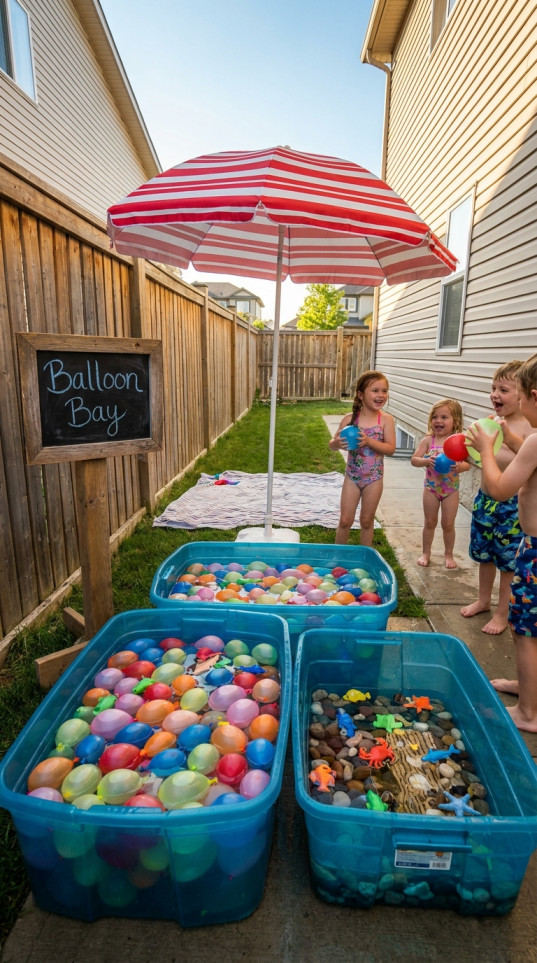
- Real ages: 4 to 12 for throwing. The calm tide pool version works from about 18 months, but with no balloons and no small parts in it.
- Time: 25 minutes filling, 10 minutes of actual throwing, 20 minutes picking up scraps.
- Mess level: low mess, completely soaked kids. Nothing stains, nothing to scrub.
- Supervision: eyes on the whole time, arm’s reach for under 5s because of the fragments.
- You’ll need: two deep tubs, 100 balloons, a hose nozzle, one bucket labelled for scraps.
- Cheap swap: cut sponges. Three strips of a car wash sponge banded with a zip tie makes a sponge bomb that holds more water than a balloon, stings less, needs no picking up, and costs about a fifth as much.
- Adult-only step: trimming the zip tie tails flush, and cutting sponges with kitchen shears.
Set it up:
- Pick the shady side strip. A narrow yard is right for this, because balloons need a target zone rather than a running field.
- Fill in a tub of water, not over your hand, so the drops that burst early land somewhere useful.
- Split the filled balloons into two tubs at opposite ends so there are two supply points and no scrum.
- Say the rules before you hand any out: chest and below, no head shots, and nobody in the dry zone is a target.
- Put the scrap bucket in the middle of the action before the first throw.
Tip: Fill them the morning of, not the night before. Balloons left overnight soften, sweat, and start bursting in the tub on their own.
What goes wrong the first time: A hundred balloons last about six minutes. Then you have a 20 minute scrap hunt for a six minute activity, which is the whole reason I now run sponges as the main event and balloons as the opening ten minutes. Self-tying kits are quick (about 35 in 20 seconds) but you need decent water pressure, roughly one in five pops while filling, and the little rubber o-rings end up scattered in the grass at exactly choke-tube size.
The tide pool styling from the original idea is worth keeping for the toddler version, with one change: leave out the river rocks, plastic shells, and small sea creatures. Every one of those fits through a toilet paper tube.
Skip it if: There are kids under 3 at the party, or you have a kid who hates being hit. Give that kid the scorekeeper job or a sponge target instead, because “it is just water” does not help a child who is already overwhelmed.
2. Splash Pad Corner for Toddlers in a Small Garden
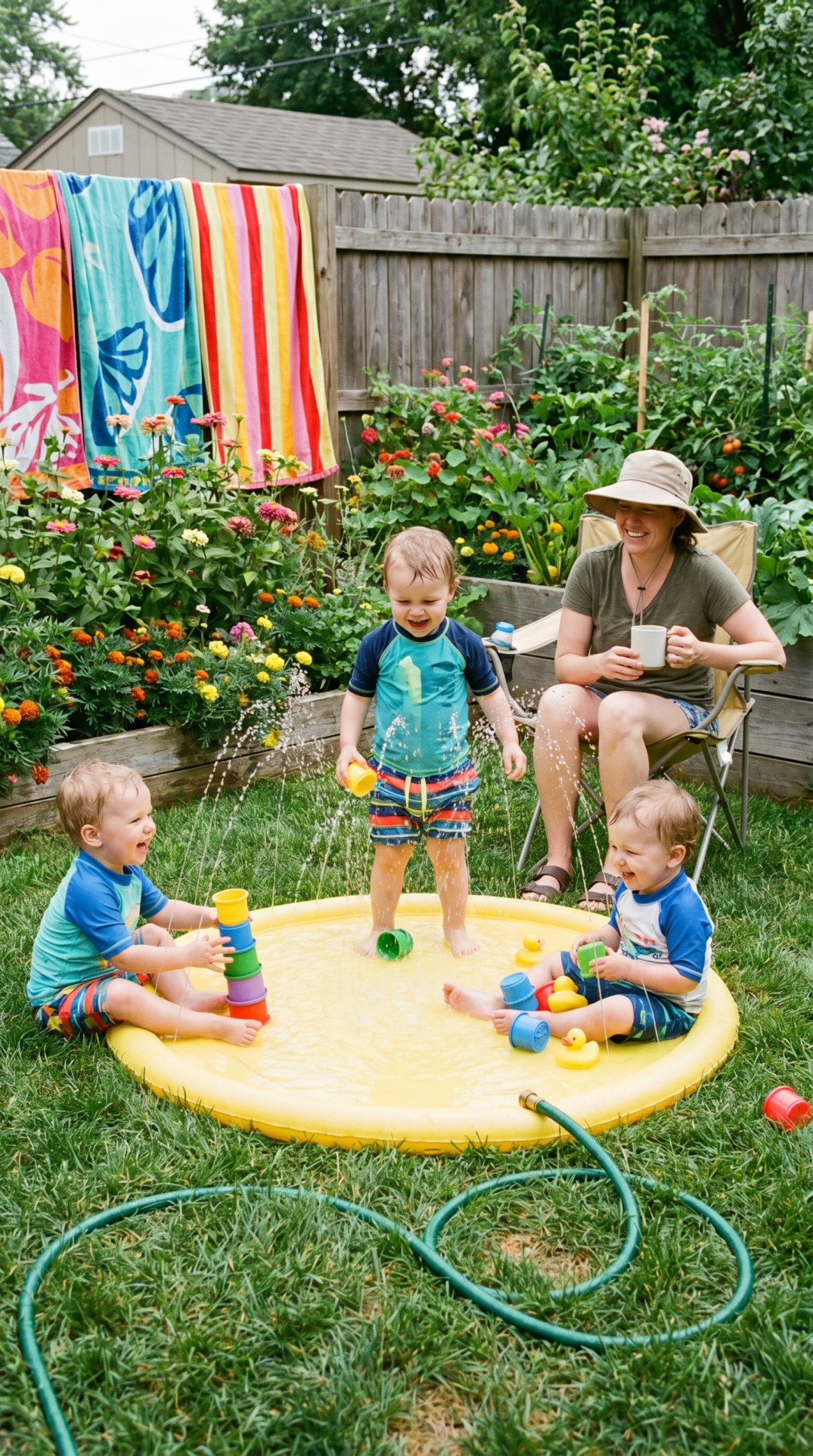
- Real ages: 12 months to 5. Past 5 they run through it twice and want the sprinkler instead.
- Time: 5 minutes setup, 20 to 30 minutes of play, 5 minutes cleanup.
- Mess level: low, though you will have a soggy patch of lawn for a day.
- Supervision: arm’s reach, always, even at one inch of water.
- You’ll need: a hose-fed splash mat, the flattest spot you have, stacking cups and a couple of floating bath toys.
- Cheap swap: an empty 2 liter bottle with pushpin holes, duct-taped to the hose end and laid on the grass. Or thread the hose through a pool noodle and let it arc.
- Adult-only step: the pushpin holes, and checking the water temperature at the hose before they touch it.
Set it up:
- Run the hose onto the lawn for 30 to 60 seconds first. Water that has been sitting in a sun-baked hose comes out hot.
- Find the flattest patch, then walk it barefoot to feel for stones and sprinkler heads.
- Attach the mat, turn the pressure up slowly, and let a toddler watch the spray start rather than getting sprayed by surprise.
- Add a bin of warm water beside it with cups and a couple of bath toys. Warm water roughly doubles how long a toddler stays.
- Put your chair in the shade on the same side as the gate.
Practical note: Toddlers get cold at 85 degrees. Watch for blue-ish lips, hunched shoulders, or a kid who starts standing in one spot, and call it at 20 to 25 minutes with a hooded towel ready. They will not tell you they are cold, they will just get miserable and you will think it is the party.
What goes wrong the first time: Low water pressure turns a splash mat into a sad dribble, so test yours before you buy one. The mat surface is also slick under wet feet, and a toddler who runs onto it goes down hard, so keep it to walking. If your yard slopes even slightly, water pools at the low corner and the mat lifts and folds.
Skip it if: Your only flat ground is concrete. A splash mat on concrete is a bruise waiting to happen, so use idea 10 instead.
3. Bring-Your-Own-Pool Backyard Bash
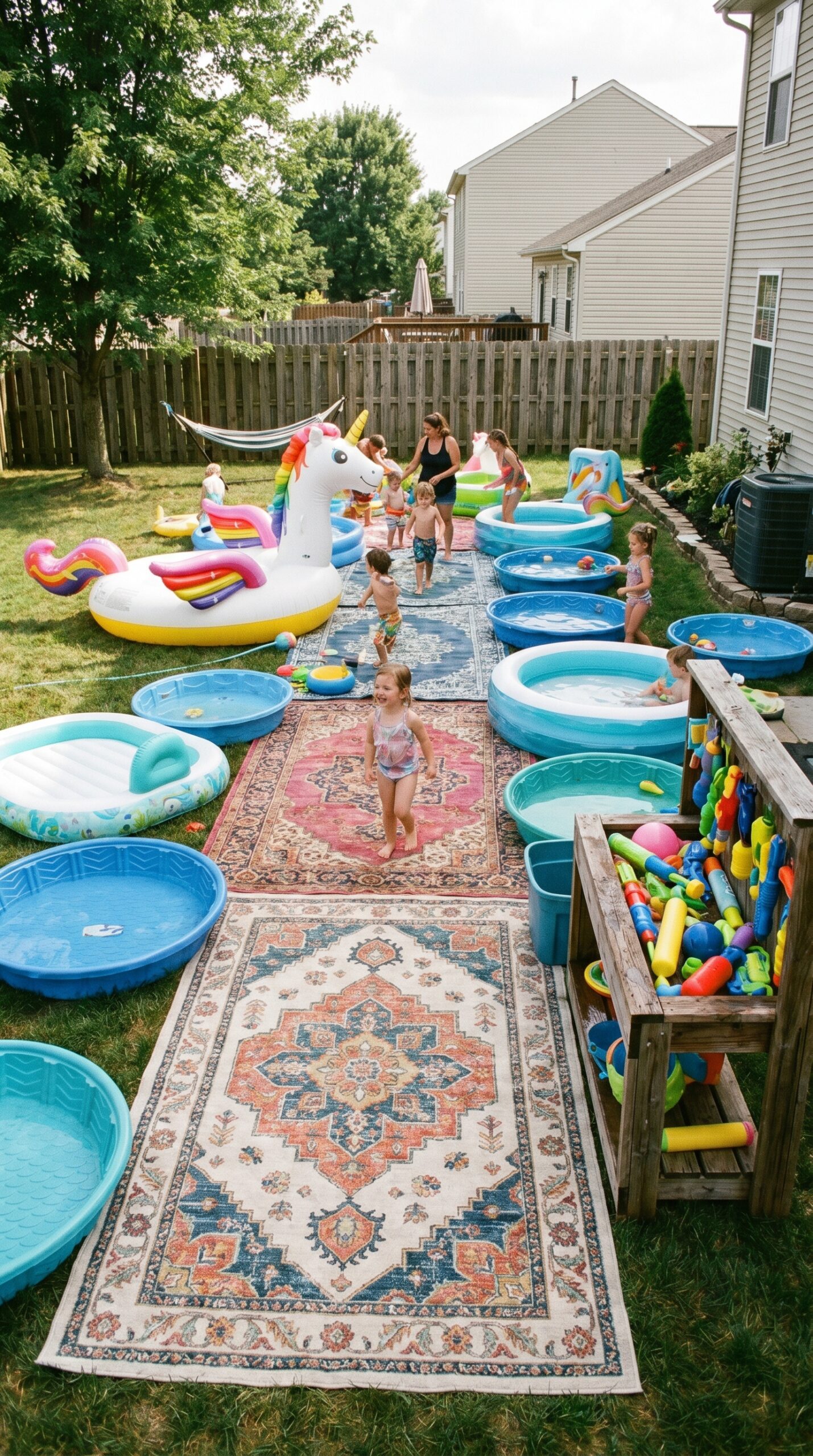
Read this before you send the invite. Scattering five kiddie pools around a yard is the single riskiest idea on this page, because standing water plus split sightlines is exactly how a quiet drowning happens. It works, but only with a cap on the number of pools and one adult per pool.
- Real ages: 2 to 10, with strict zones. Under 2, hold them or skip it.
- Time: 20 minutes of arrival chaos, 60 to 90 minutes of party, 20 minutes draining and stacking.
- Mess level: medium, plus flattened yellow grass wherever a pool sat.
- Supervision: one adult per pool, or fewer pools. This is not negotiable and it is the reason to cap the number.
- You’ll need: three pools maximum, a sprinkler, floating toys, picnic rugs for the middle.
- Cheap swap: ask families to bring storage tubs or under-bed boxes instead of buying pools. They stack, they drain by tipping, and nobody has to inflate anything.
- Adult-only step: siting the pools and draining them. A full 10 inch pool is far too heavy for a kid to tip safely.
Set it up:
- Decide the number of pools by the number of adults who will actually be watching, then say that number in the group chat.
- Line them up along one fence in a single row so every pool is visible from one chair. No pool behind a shed, around a corner, or on the far side of the house.
- Set the sprinkler over the middle pool and leave the center of the yard open for foot traffic.
- Put a doormat or an old towel at each pool edge, because grass clippings on wet feet turn the water cloudy within an hour.
- Assign the pools out loud: this adult has these two, that adult has that one, swap in 15 minutes.
- Drain everything before the last family leaves, and tip the empties upside down.
What goes wrong the first time: The pools end up spread around the yard because each family sets theirs down wherever they walked in, and you lose your sightline in the first two minutes. Every kid also wants the giant unicorn one, so put a five minute timer on it. Sunscreen makes inflatable floors greasy and slippery, which surprises people.
CDC advice for kiddie pools is to empty them after use rather than trying to treat the water, and any child who has had diarrhea in the past two weeks stays out of shared water. Say the no-drinking rule out loud, then dump the water on the lawn (not on vegetable beds if there is soap or sunscreen in it).
Skip it if: You cannot see every pool from one spot, or you are hosting alone with toddlers present.
4. Pool Party Games Without a Pool
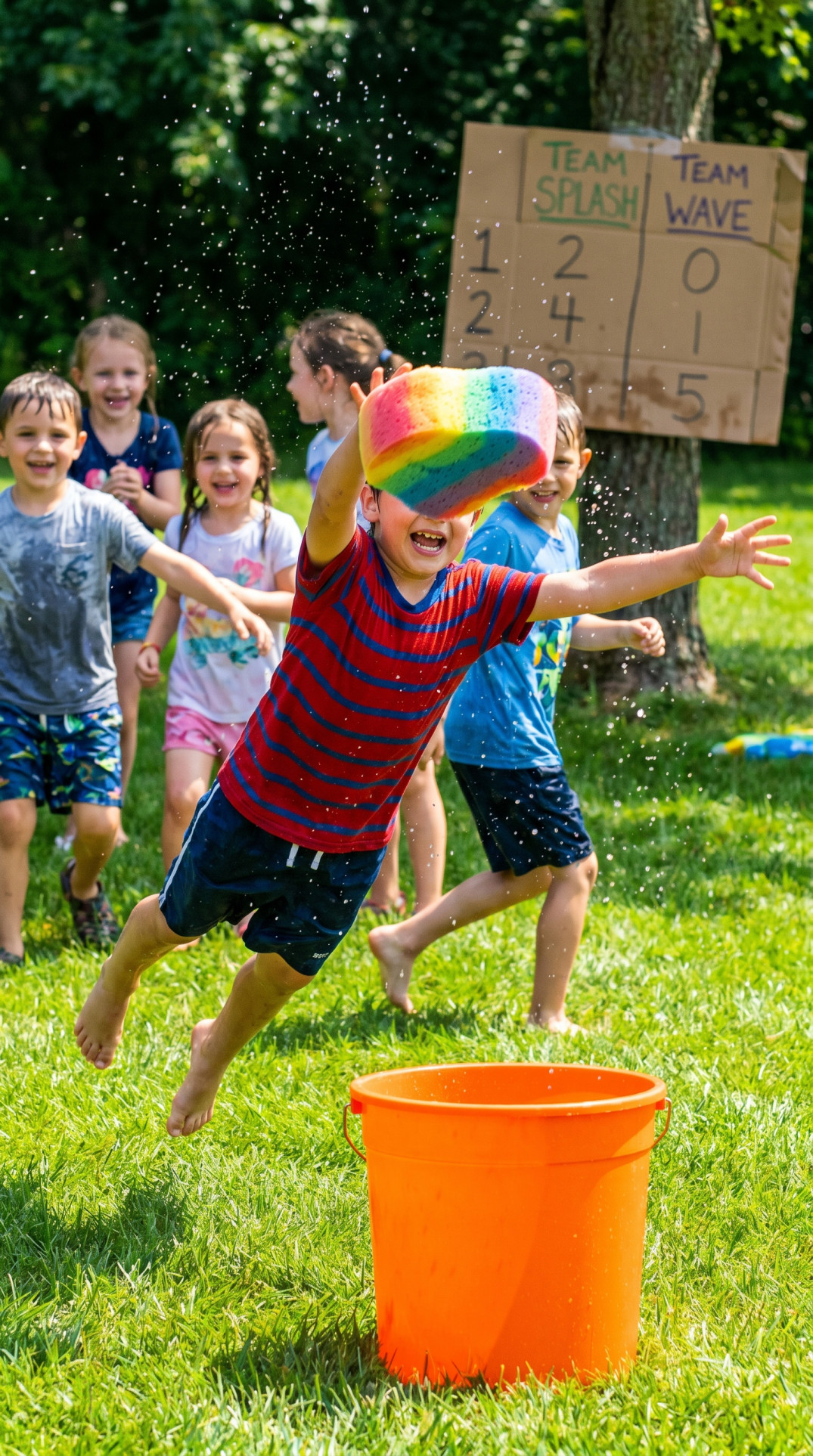
This is the highest value section on the page. No standing water, no drowning risk, and the sponge games get more laughs than anything I have bought.
- Real ages: 4 to 12. A 3 year old can join the sponge toss with a helper, but will not care about points.
- Time: 15 minutes prep, 30 minutes of games, 10 minutes cleanup.
- Mess level: low. This is the one to pick if you are hosting on someone else’s lawn.
- Supervision: check in every few minutes once the rules are set.
- You’ll need: six car wash sponges, four buckets, plastic cups, a cardboard scoreboard, a marker.
- Cheap swap: the whole thing is already the cheap version. Mixing bowls work as buckets and a flattened cereal box works as a scoreboard.
- Adult-only step: cutting the sponges into cubes or strips with kitchen shears. Never use sponges with the green abrasive backing, it takes skin off wet legs.
Set it up:
- Cut each sponge into three strips. Six sponges gives you eighteen sponge bombs, which is plenty for eight kids.
- Fill two soaking buckets halfway. Halfway is deliberate, see below.
- Draw a Sharpie fill line inside the target bucket for the relay, so kids can see progress instead of arguing about it.
- Mark throwing lines with chalk or two towels laid on the grass.
- Run the sponge toss first (partners, one step back after each catch), then the cup relay, then repeat the favorite.
- Score points instead of eliminating players.
Tip: Halfway-full buckets are the difference between a relay that lasts eight minutes and one that ends in four seconds because two kids dumped the whole thing at once.
What goes wrong the first time: A 6 year old cannot run with a full cup, so use half cups and expect most of it to be gone by the finish line, which is the funny part. Elimination formats also knock the youngest kid out first and leave them standing there for the rest of the round, so keep it point based.
For prizes, skip the foil-wrapped candy from the original plan. It melts into a puddle in the sun and it is a choking risk for the little ones. Dollar store bubble wands or sticker sheets do the same job.
Skip it if: Your whole group is under 4. They do not want to score points, they want to sit in the water, which is idea 6.
5. Kids Luau Party with Backyard Water Fun
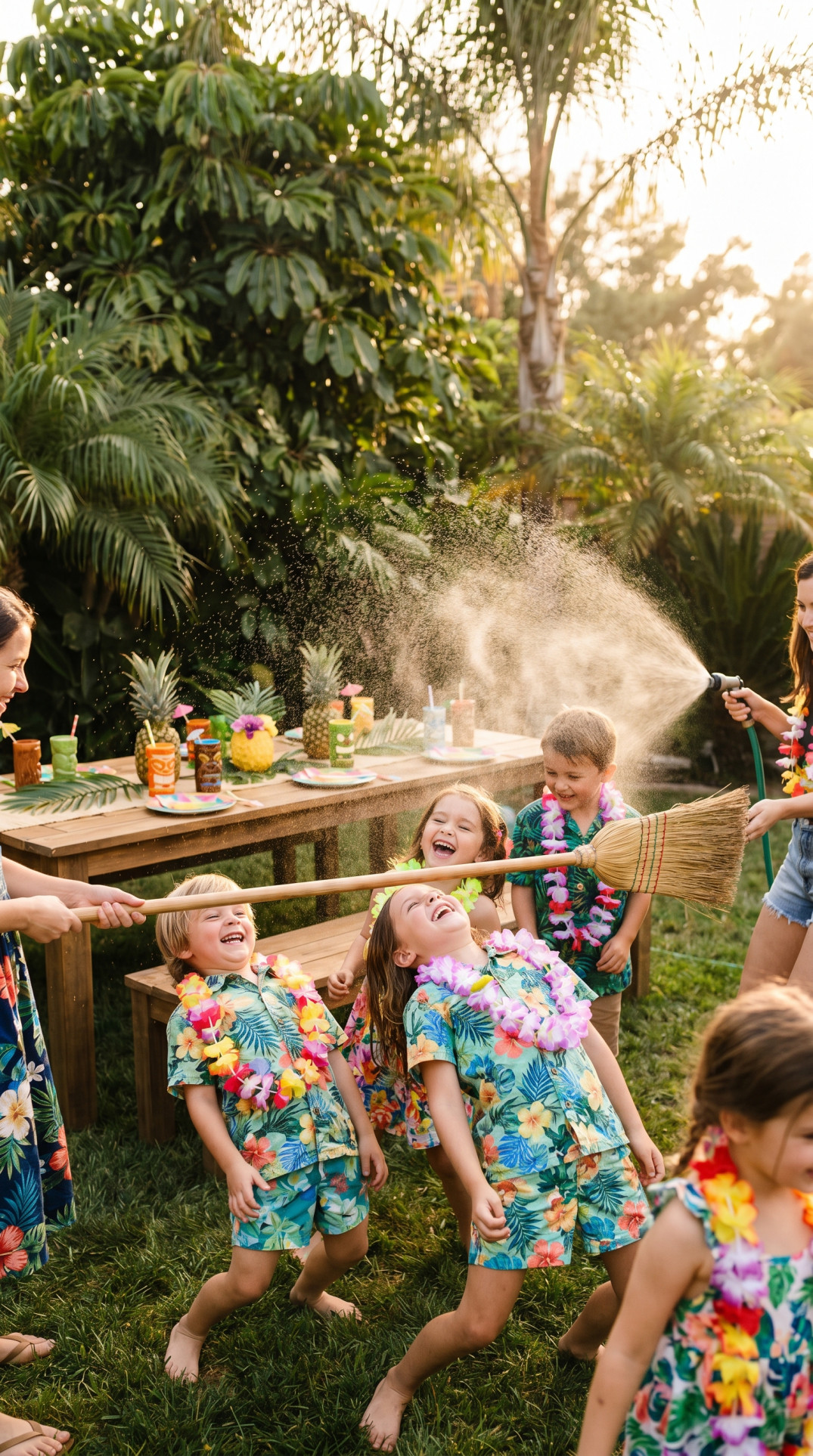
- Real ages: 3 to 10. This is the theme that works when you have a wide age spread, because the decorations do the entertaining while kids drift in and out of the sprinkler.
- Time: 30 minutes prep, 90 minutes of party, 15 minutes cleanup.
- Mess level: low, apart from soggy leis shedding dye.
- Supervision: eyes on. Leis come off any child under 3, since anything that loops around a neck is a strangulation risk and the beads come apart.
- You’ll need: dollar store leis, an oscillating sprinkler, a pool noodle, tropical playlist, a couple of whole pineapples as centerpieces.
- Cheap swap: paper flowers taped to a length of yarn, cut short, or skip the leis and use face paint dots. Fruit you already have works as well as pineapple.
- Adult-only step: cutting fruit, and holding the limbo bar.
Set it up:
- Sprinkler in the open middle of the yard, dry zone in shade with the food.
- Hand out leis at the gate, straight onto older kids and into the toddlers’ hands rather than over their heads.
- Make the limbo bar a pool noodle held loosely by two adults, one at each end, at chest height and dropping.
- Run limbo with a wet sponge balanced on their head, or a cup of water in each hand.
- Play the music at a volume where you can still hear a kid across the yard.
I would change one thing from the original version of this idea. Do not have kids hold a water balloon under their chin. That puts a latex balloon directly at a child’s mouth, and latex fragments are a genuine choking and suffocation hazard, which is why the packaging carries a warning for under 8s. A sponge on the head is funnier anyway, because it drips down their face.
Same for the limbo bar: a broomstick resting on two chairs looks fine until a kid clips it, the chair tips, and the stick goes somewhere near an eye. Two adults holding a noodle costs nothing and cannot fall.
What goes wrong the first time: Cheap leis bleed dye onto white shirts the moment they get wet, so warn parents on the invite or hand them out at the end. Loud music is the other one, and it matters more than it sounds: if you cannot hear a cough or a call for help from the far side of the yard, the music is too loud.
Skip it if: You have a sensory-sensitive kid at the party. Loud music, a surprise sprinkler, sticky leis, and a crowd is a lot at once. Give them the water lab in idea 12 and let them join the sprinkler on their own terms.
6. Outdoor Toddler Birthday Splash Party
- Real ages: 12 months to 3.
- Time: 30 minutes prep, 45 minutes of party, 15 minutes cleanup. Forty five minutes is the real ceiling for this age, and a 90 minute toddler party ends in tears every time.
- Mess level: medium. Wet grass, wet everything, soapy toy trucks.
- Supervision: arm’s reach, no exceptions, for every container.
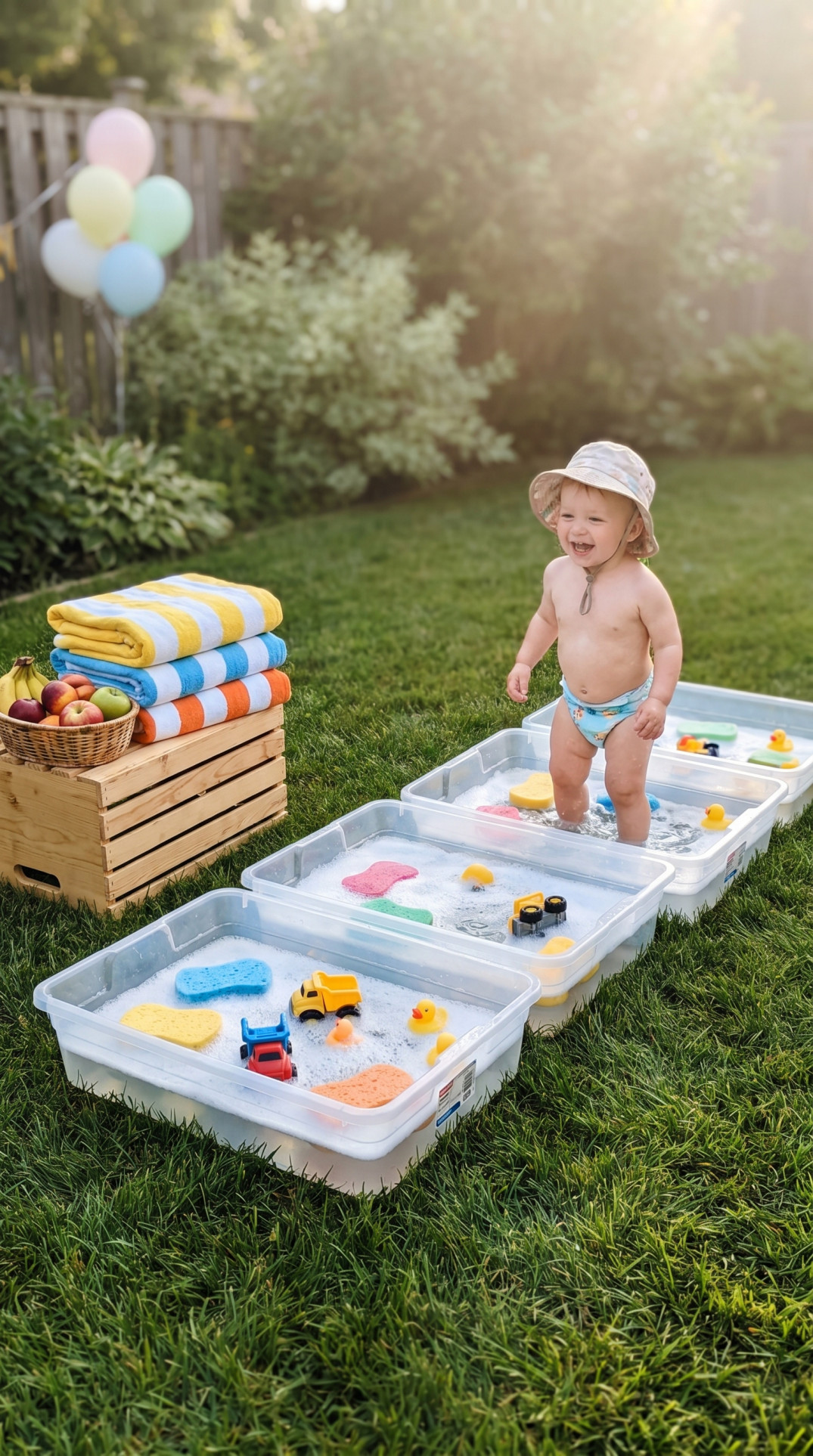
- You’ll need: two shallow trays or an under-bed storage box, warm water, toy trucks, soft sponges, tear-free baby wash (Johnson’s Head-to-Toe works), a hooded towel per child.
- Cheap swap: a clear Sterilite under-bed box beats an inflatable pool. Nothing to inflate, it tips to drain, and it stores flat. Roasting pans and dish tubs work for the car wash.
- Adult-only step: testing the water temperature on your own wrist, and freezing the ice block the night before.
Set it up:
- Fill trays with two inches of water, warm from the tap and tested on your wrist. Never hot tap water, a toddler’s skin burns at temperatures an adult finds merely warm.
- Set the trays at shin to hip height on a low table or upturned crates. A bin on the ground gets sat in, which turns a two inch tray into a toddler-sized bath.
- Build the car wash: trucks in one tray, a squirt of tear-free wash in the other, soft sponges between them.
- Add one big ice block, frozen in a loaf pan, not ice cubes. Cubes are a choking size and toddlers will absolutely try to eat them.
- If your garden slopes, put the activities at the top so runoff drains away from the play area instead of turning it to mud.
- Empty every tray the moment you move on to cake, and turn them over.
Practical note: Skip paper decorations entirely, they are pulp within ten minutes. Bright towels over the fence and colored buckets do the whole decorating job, and none of it needs saving from the sprinkler.
What goes wrong the first time: The birthday child melts down during the singing, because a wet, cold, over-stimulated toddler has nothing left for a group performance. Do cake first, water after, and keep the guest list to about four kids. Toddlers also chill fast even in real heat, so a hooded towel on standby matters more than any activity here.
Skip it if: It is over 90 degrees. Move to 9am, use full shade, or do it another day. Little kids overheat much faster than we do and they cannot tell you it is happening.
7. Backyard Water Slide Party (with a bit of hill helps a lot)
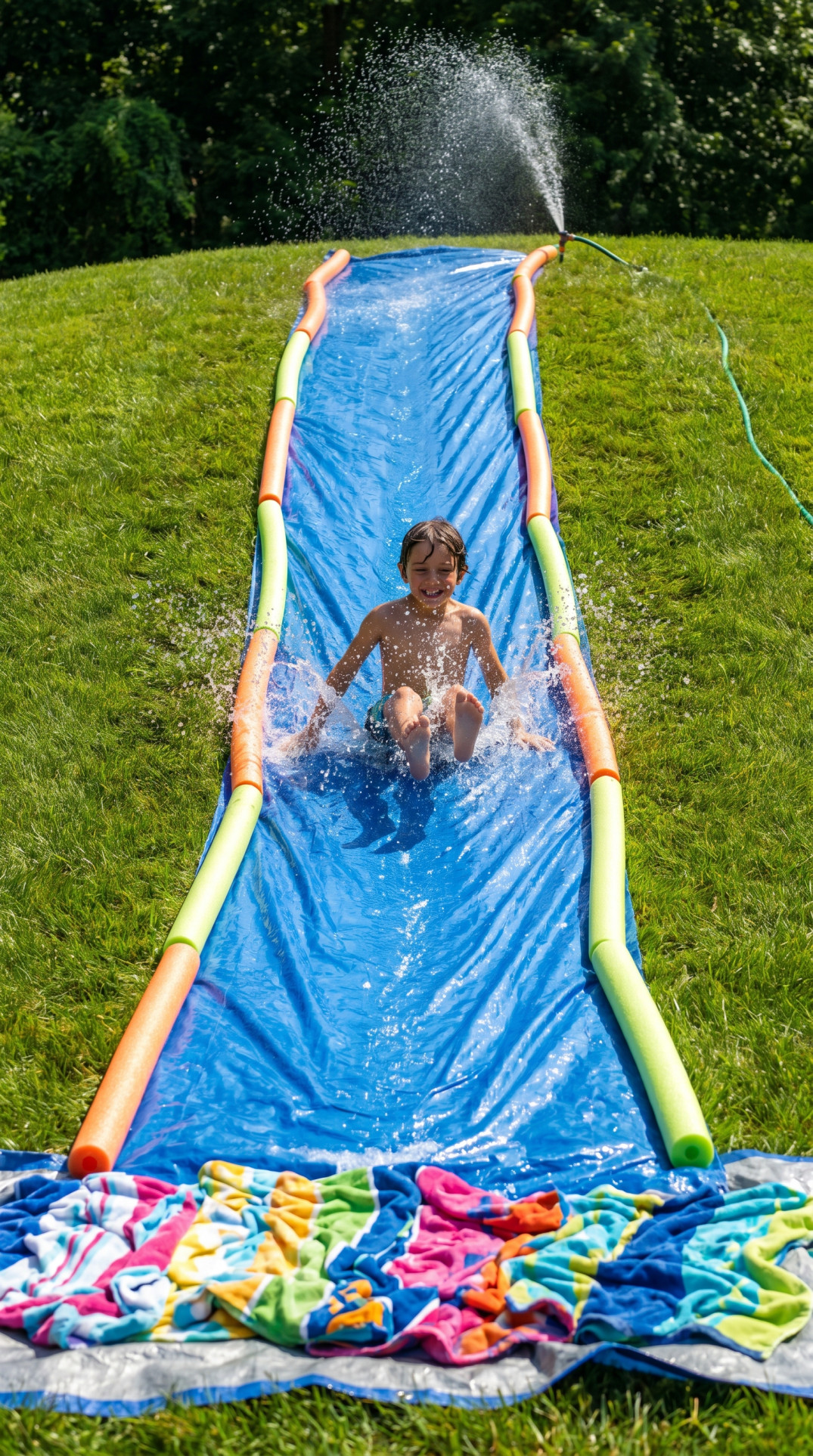
Read this first. Backyard water slides carry a real injury history, and CPSC’s 1993 warning about them was aimed squarely at teenagers and adults, roughly anyone over about 110 pounds, because a heavier body stops abruptly at the bottom and the neck keeps going. Kids only, one at a time, feet first, on their belly or their bottom. No adults, no teenagers, no doubles, no head first, no exceptions when someone’s dad decides to have a go.
- Real ages: 5 to 12.
- Time: 30 minutes setup, 45 minutes of sliding, 30 minutes cleanup, plus a yellow strip of lawn for about two weeks.
- Mess level: high. Soap, mud at the bottom, grass stains on everything.
- Supervision: hands-on the entire time. One adult at the top releasing one kid at a time, one adult at the bottom.
- You’ll need: 6 mil plastic sheeting about 10 ft by 25 ft, four pool noodles, tear-free baby wash, a hose that reaches the top.
- Cheap swap: there is not a good one, and I would rather say that than pretend. A thin dollar-store tarp tears within an hour and a torn tarp with a curled edge is worse than no slide.
- Adult-only step: all of the setup. Laying the sheeting, weighting the edges, and walking the lane barefoot to clear it.
Set it up:
- Walk the whole lane barefoot yourself before the tarp goes down. You are feeling for sprinkler heads, stones, dog bones, and roots. This is the step that prevents the injury.
- Check where the slope ends. If it ends at a fence, a driveway, a tree, or the street, do not build the slide there.
- Lay the sheeting down the slope and weight the edges with sandbags, rocks, or buried lips of plastic, outside the sliding lane. Never drive stakes or landscape pins anywhere near where a body travels.
- Line both edges with pool noodles to keep kids centered.
- Leave 10 to 15 feet of flat, wet, soap-free grass at the bottom as a runout. Do not put a kiddie pool, a splash mat, or a stack of towels there. A hard rim or an abrupt stop at the end of a fast slide is exactly what causes neck injuries.
- Set the hose running from the top, then add a small squirt of tear-free wash every few slides. Not a bottle, a squirt.
- Keep the walk-back path completely soap-free, and route it up the side rather than up the slide.
Tip: A rash guard or an old t-shirt prevents the friction burn kids get across the ribs on a tarp, and it is the difference between eight slides and two.
What goes wrong the first time: Too much soap. It stings eyes, foams across the whole lawn, and turns your walk-back lane into a slip zone. By slide three someone will try to go standing up, so the rule needs restating out loud every few minutes. The tarp also bunches into ridges under the middle, so smooth it every ten minutes. And the soapy strip where the tarp sat will go yellow for a couple of weeks, which is worth knowing before you build it on the front lawn.
Skip it if: You have no slope and no room for a runout, if the only slope ends at concrete, or if the group includes teens who will not accept a no.
8. DIY Water Park Stations in a Big Garden
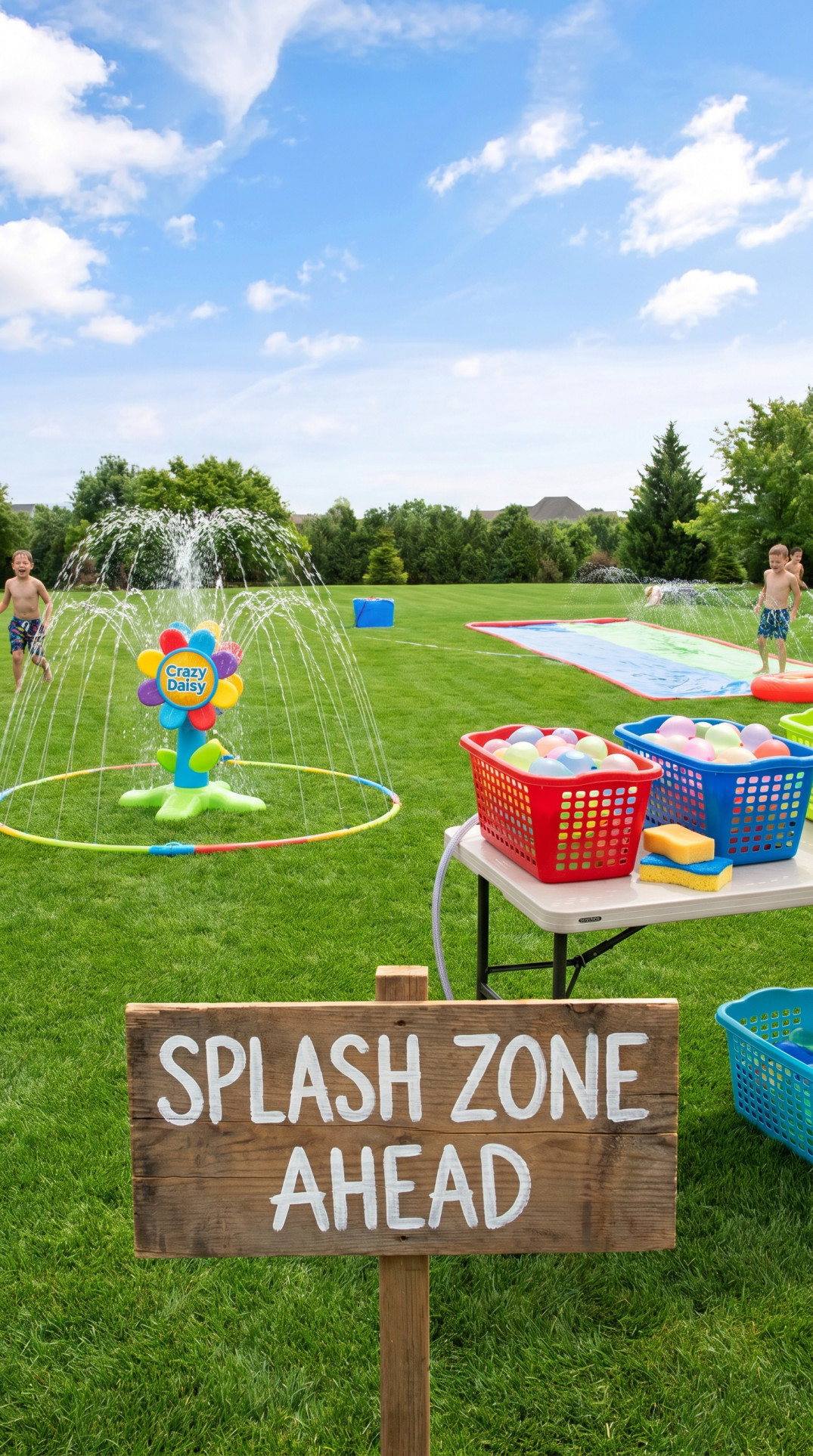
- Real ages: 4 to 11, and this is the best format for a mixed-age group because kids self-select.
- Time: 45 minutes prep, 60 to 75 minutes of play, 30 minutes cleanup.
- Mess level: medium, spread thinly across the whole yard.
- Supervision: one adult per station. If you only have two adults, run two stations, not four.
- You’ll need: four plastic baskets to hold supplies, chalk or cardboard signs, sponges, balloons, a sprinkler, pool noodles, string, a whistle.
- Cheap swap: cereal box signs, laundry baskets instead of bought bins, and the human car wash built from noodles you already have plus streamers cut from a plastic tablecloth.
- Adult-only step: hanging anything overhead, and keeping the string for the car wash short enough that it cannot loop around a neck.
Set it up:
- Count your adults first, then set that many stations. This is the only decision that matters here.
- Put the loud, fast station (balloons or the human car wash) furthest from the dry zone and the quiet one nearest the shade.
- Load each station’s supplies into its own basket so nothing walks off.
- Give each station a sign, then walk the kids around the loop once before anyone starts.
- Rotate on a whistle every 8 to 12 minutes, which is roughly how long a station holds attention.
- Empty the water containers at each station as you close it, not at the end.
What goes wrong the first time: Everyone swarms one station and ignores the other three, which is why the walk-around and the whistle matter. Supplies also migrate, so the sponges end up at the balloon station and the last twenty minutes turn into a hunt. And four stations with two adults means two of them are unsupervised, which defeats the point of splitting up at all.
Skip it if: You are the only adult. Run idea 4 instead, all in one spot where you can see everything.
9. Indoor Backup Plan with Water Games (for rainy surprises)
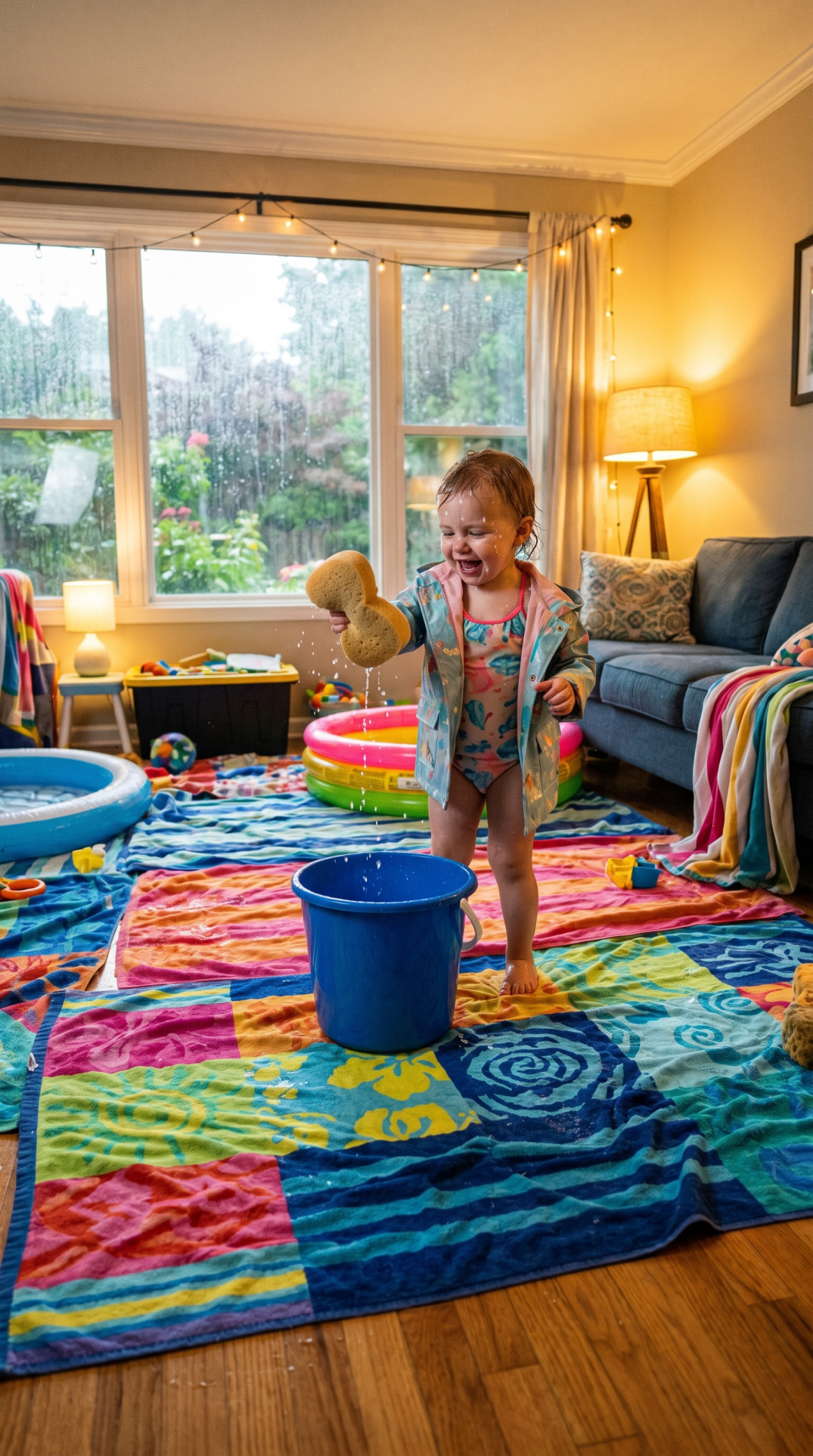
- Real ages: all ages, with different versions. The bathtub games are 1 to 4, the target games are 4 and up.
- Time: 10 minutes to pivot if the supplies are already in the house, 30 minutes of play.
- Mess level: contained if you plan it, ugly if you improvise.
- Supervision: arm’s reach for anything involving a tub, and eyes on hard floors.
- You’ll need: a $1.25 plastic tablecloth, old towels, a muffin tin, a turkey baster, a baking sheet, ice cubes, small boats or plastic cups.
- Cheap swap: all of it is already in your kitchen. A trash bag split open replaces the tablecloth.
- Adult-only step: laying the towel path, and draining the tub the second a bath game ends.
Set it up:
- Pick the room with hard, water-resistant flooring, then lay the plastic tablecloth down and towels around the edges. A cheap tablecloth catches most of the splash.
- Set a towel path from the back door to that room, because the injuries indoors come from wet feet on hard floor, not from the water itself.
- Run turkey baster target practice: a muffin tin on a towel, a cup of water, one point per cup filled.
- Ice hockey on a baking sheet with two spoons as sticks buys another ten minutes.
- For little ones, boat races in two inches of bathwater, with you sitting on the floor beside the tub the entire time, and the tub drained the moment it ends.
I would drop the shaving cream from the original version of this idea. It is not a young-kid material (it stings eyes badly, it is not food, and toddlers taste everything), and “shaving cream bowling using water balloons” is two different games mashed together. If you want foam, use whipped cream for under 3s, or whisk a drop of dish soap into warm water for a bowlful of bubbles that rinses away.
What goes wrong the first time: You pivot indoors with eight soaked kids and no towel path, and then somebody runs. Set the boundary before you open the door. If the reason you moved inside is thunder, stay in for 30 minutes after the last rumble.
Skip it if: You have carpet everywhere. Move the whole thing to the bathroom or the kitchen and run one game, not three.
10. Beach Vibe Sprinkler Setup on a Deck or Driveway
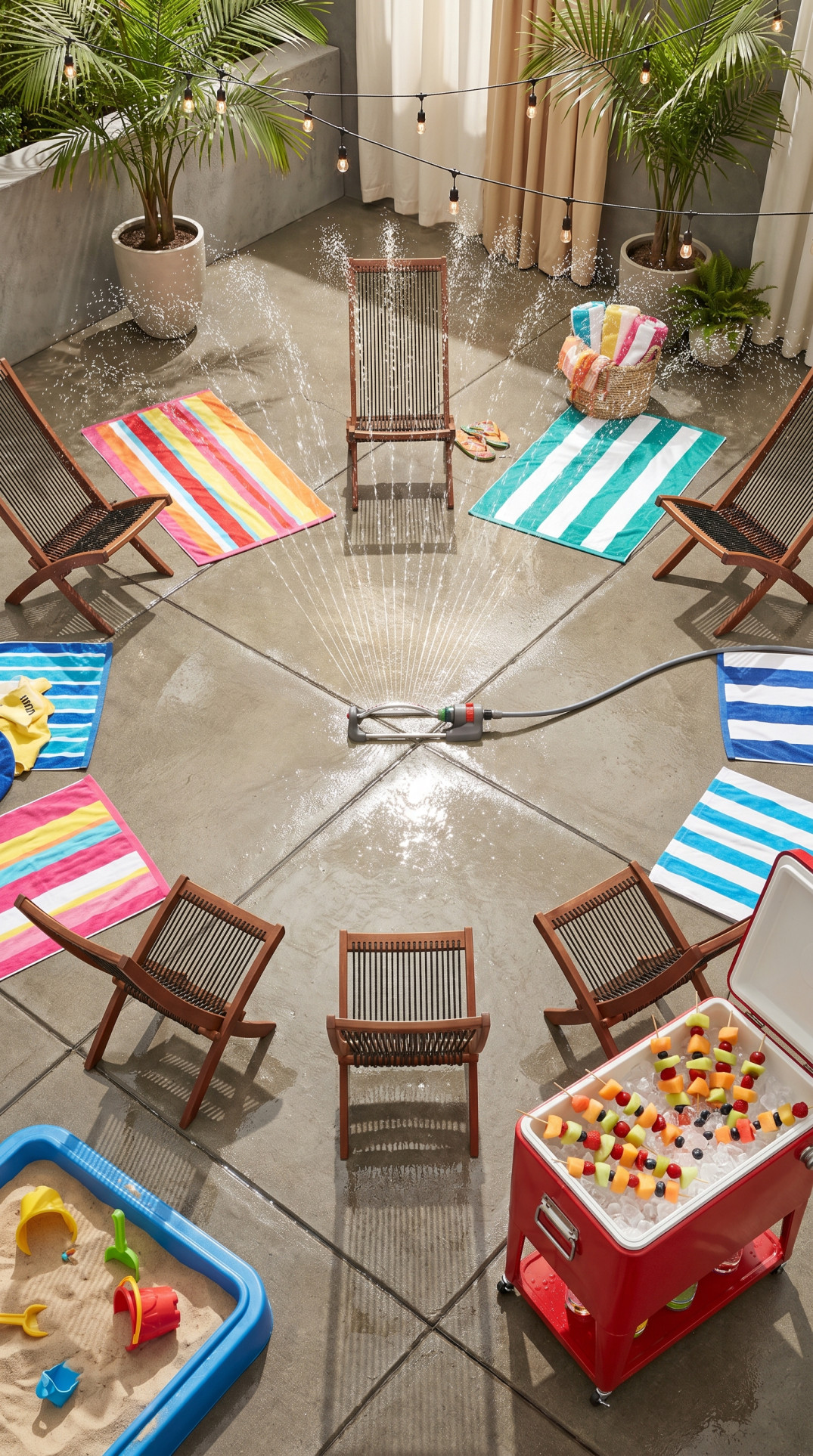
The original version of this idea skipped the two things that actually matter on a driveway: cars and surface heat. A driveway ends at a street, and wet kids chasing a sponge do not look before they run.
- Real ages: 3 to 10.
- Time: 20 minutes prep, 45 minutes of play, 5 minutes cleanup (the fastest cleanup on this page).
- Mess level: low. Everything dries in twenty minutes and nothing stains if you keep dye and soap out of it.
- Supervision: eyes on, plus one adult whose job is the bottom of the driveway.
- You’ll need: an oscillating sprinkler, thick beach towels, low chairs, a cooler, cones or a parked car, a contained sand bin, plastic shovels and buckets.
- Cheap swap: the bottle sprinkler from idea 2, towels you already own, and a storage tub of sand instead of a sandbox.
- Adult-only step: parking the car across the driveway end, and hosing the concrete down before anyone comes out.
Set it up:
- Block the street end. Park a car across it, or set cones with an adult stationed there, and say the “nobody past the cones” rule to every kid as they arrive.
- Hose the concrete for a few minutes about ten minutes before the party. Bare feet on sun-baked concrete or asphalt is the first thing that goes wrong, and wet dark pavers can still be too hot. Test with the back of your hand.
- Set the sprinkler in the middle of the paved area, and arrange towels and low chairs in a ring at the edge of its reach.
- No soap out here at all. Soapy concrete behaves like ice.
- Put the sand bin and the cooler in shade, and keep the foot-soak tub warm rather than hot.
- Check who is reversing. If your driveway is shared, tell your neighbors what time you are out there.
What goes wrong the first time: The water runs downhill to the street and takes the sponges with it, which sends kids after them. Set the splash zone at the top of the slope. Kids also fall on wet concrete far more than on wet grass, so this is the setup where the no-running rule needs enforcing rather than announcing.
One thing to avoid on a wooden deck: a hard-sided or large inflatable pool. Water weighs about 8.3 pounds per gallon, so a hundred gallon pool is more than 800 pounds sitting on one spot of decking. Shallow tubs on a deck are fine, a filled pool is not.
Skip it if: Your driveway opens onto a busy road or a shared alley. Move to the back patio, even if it is smaller.
11. Water-Themed Obstacle Course for Bigger Kids
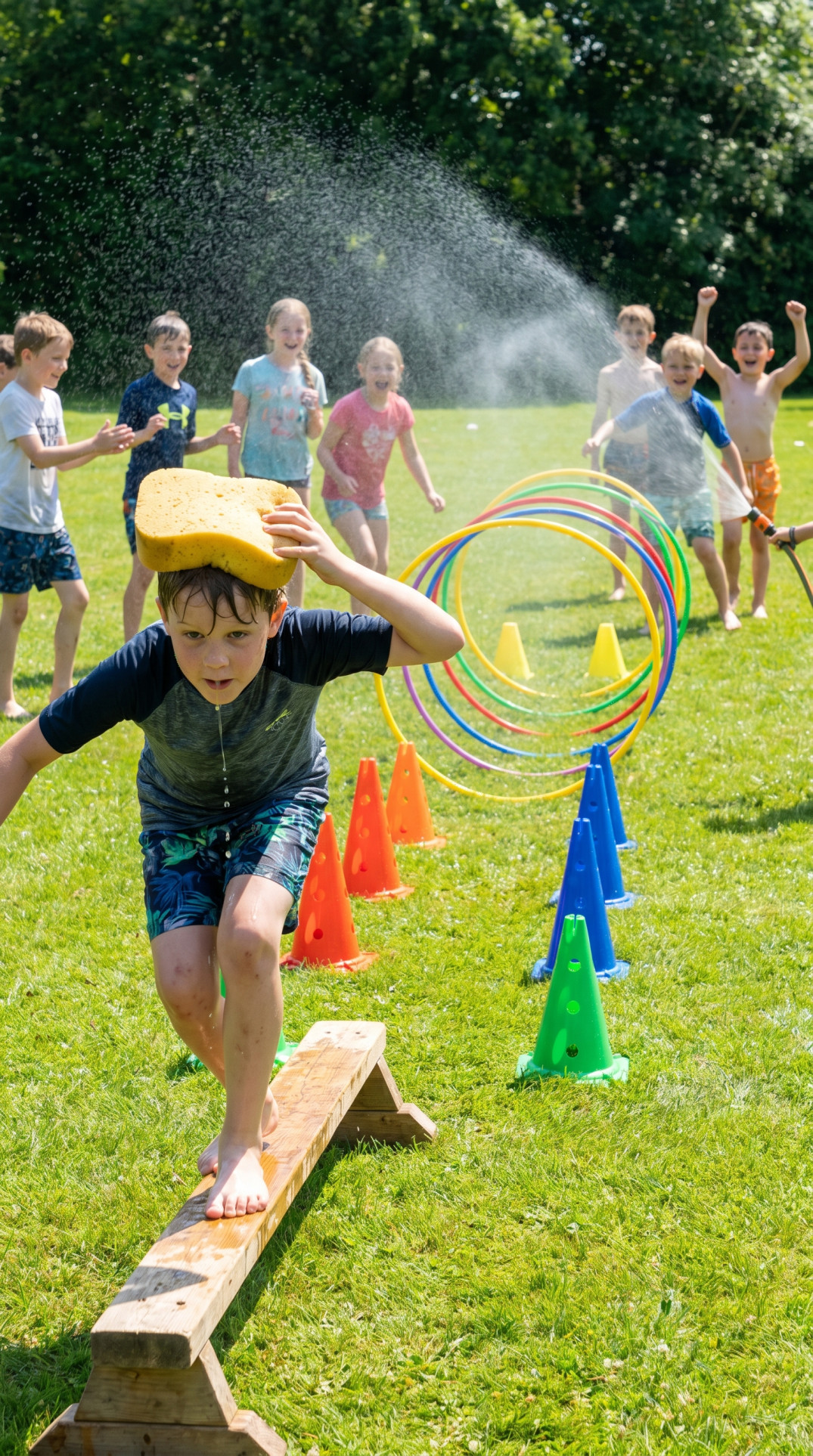
- Real ages: 7 to 12. Below 7 the sequence is too long to remember and the competition stops being fun.
- Time: 45 minutes to build, 45 minutes to run, 30 minutes to pack up.
- Mess level: medium.
- Supervision: eyes on at every wet leg, and an adult at the start line controlling one runner at a time.
- You’ll need: sports cones or upturned flower pots, two hula hoops, a small bucket with a hole drilled in it, sponges, chalk, a phone timer, a whiteboard or cardboard leaderboard.
- Cheap swap: flower pots and rolled towels as markers, a yogurt tub with a nail hole as the leaking bucket, chalk instead of a balance beam.
- Adult-only step: drilling or punching the bucket hole, and holding the hoops.
Set it up:
- Map four or five stations in a loop, alternating wet and dry legs so nobody is sprinting on a soaked patch.
- Use a chalk line or a 2×4 laid flat on the grass as the balance leg. Not wet lumber propped up, and not barefoot on splintery wood.
- Have an adult hold each hula hoop at knee height for the crawl-through rather than propping it against furniture.
- Fill the leaking bucket about a third full. A full 5 gallon bucket weighs around 40 pounds and no 8 year old should be running with it.
- Time kids one at a time against the clock, not head to head, and post times on the leaderboard so there is a reason to run it again.
- Keep the finish line on flat, dry ground.
The one change I would make to the original layout: do not put the slip-and-slide at the end of a timed course. Kids arrive at speed, already running, and hit the tarp standing up, which is the exact position the water slide warnings are about. Run the slide as its own station with its own line and its own adult, and make the course finale something slow, like carrying a soaked sponge on your head.
What goes wrong the first time: They run it once, and unless there is a leaderboard it is over. The fastest kid also finds the shortcut within two attempts, so walk the route with them and agree what counts. And the younger sibling will insist on running it, so build a three station short version for them off to one side rather than saying no.
Skip it if: Your group is mostly under 7, or you cannot spare an adult to run the start line.
12. Easy Backyard Water Lab with Buckets & Tools
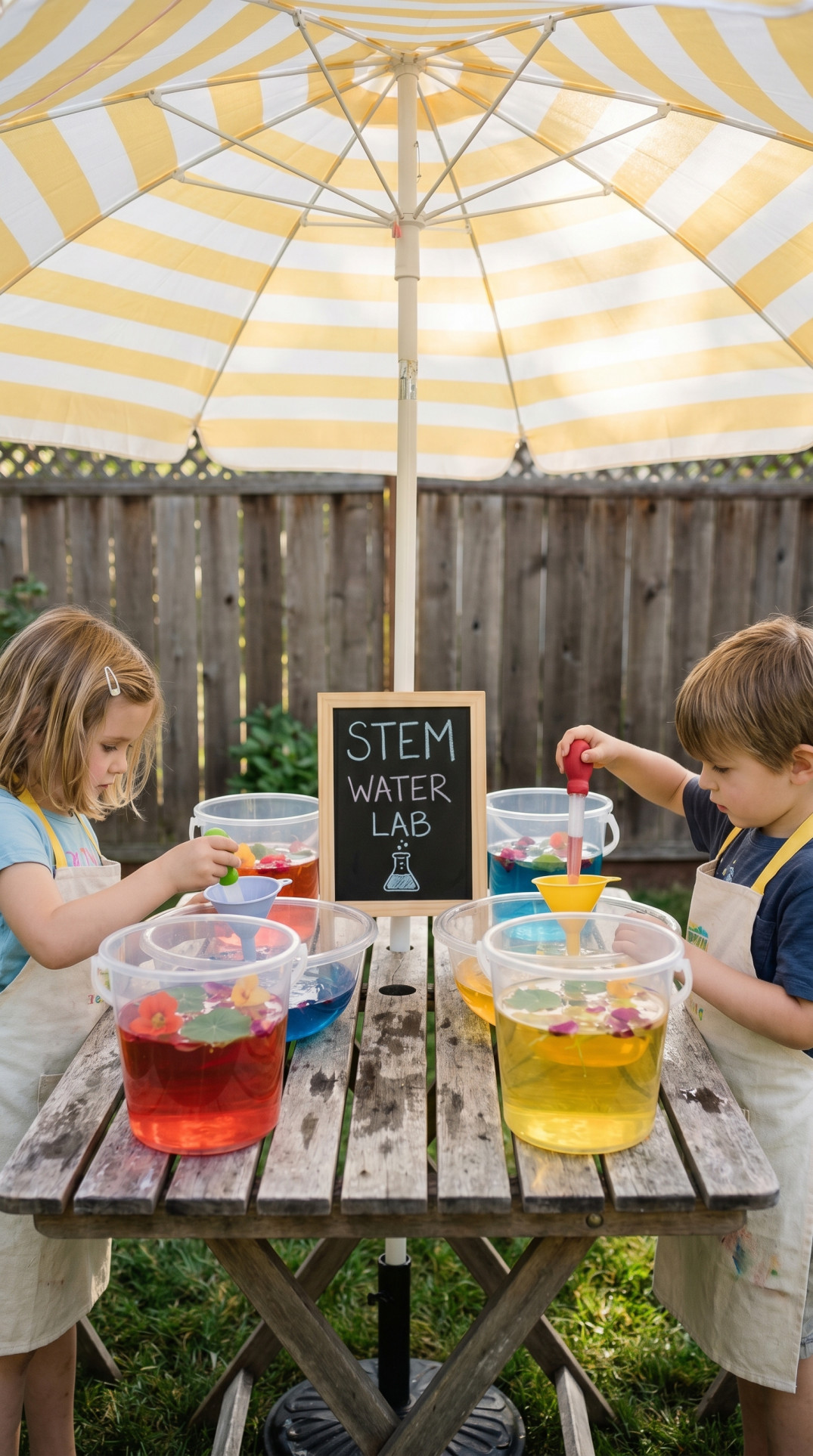
This is the one that lasts longest. At every party I have hosted, the water lab outlives the games by twenty minutes, and it is where the overwhelmed kids go to reset.
- Real ages: 2 to 9, with the sweet spot at 3 to 6.
- Time: 10 minutes setup, 30 to 45 minutes of play, 10 minutes cleanup.
- Mess level: low with plain water. Medium and staining the moment you add food coloring.
- Supervision: check in every few minutes for over 4s, arm’s reach under 3.
- You’ll need: a folding table in shade, funnels, measuring cups, two turkey basters, a muffin tin, an ice cube tray, a couple of buckets, McCormick food coloring.
- Cheap swap: free oral medicine syringes from any pharmacy counter are better droppers than anything sold as a toy, and a soda bottle cut in half (with duct tape folded over the rim) is a perfect funnel.
- Adult-only step: cutting bottles and taping the rims, and carrying the buckets.
Set it up:
- Table in the shade, set at their chest height so nobody is reaching up and tipping things toward their face.
- Buckets on the ground beside it, filled two thirds, with a bin at shin to hip height for the little ones.
- Buy two turkey basters. One baster with three kids is the single most reliable fight at any water party, and two identical tools prevents most of it.
- Use an ice cube tray as the color palette, and three primaries at most. Add a fourth and everything on the table is brown within two minutes.
- Let them measure, pour, and mix on their own. This is not an activity you run, it is one you set up and step away from.
Food coloring is worth understanding before you use it. It dyes hands for a day, it dyes cotton permanently, and it stains porous concrete, pavers, and grout, so keep the whole table on grass and skip red near a light patio. It is also the reason I use food coloring rather than paint here: somebody always tastes the water.
If you are doing the “potions” version, set the foraging rule out loud: fallen leaves and grass only, nothing picked off a plant, no berries, no seed pods, and no mushrooms ever. Kids under 3 do not forage at all, because everything goes in the mouth. Wash hands afterward.
What goes wrong the first time: The table floods, the bin gets climbed into, and a kid drinks the blue water. All three are survivable, but they are the reason the dye is food grade and the bin is shallow.
Skip it if: Your kid needs to run. This is the calm corner, not the main event, and forcing a wound-up 5 year old to sit and pour goes nowhere.
Common Mistakes First-Time Water Party Hosts Make
- Planning ten activities. Three is the number. The rest of your energy goes into watching kids, not running stations.
- Starting at noon. Hot concrete, hot hose water, cranky kids, and sunscreen sweating off in fifteen minutes.
- Filling balloons the night before. They soften, sweat, and burst in the tub before anyone arrives.
- Filling relay buckets to the top. The round ends in four seconds and the kids feel cheated. Halfway.
- Saying “we are all watching the water.” Nobody is. Name one person, hand the job over out loud, swap every fifteen minutes.
- Leaving tubs and pools full during the snack break. This is the moment adults sit down and stop looking. Empty first, eat second.
- One towel each, all identical. Names on painter’s tape, plus two spares, in a basket by the door.
- Announcing the end with no transition. Nobody gets out of water for an announcement. They get out for a popsicle.
- Soap anywhere except the sliding lane. Soapy concrete and soapy walk-back paths are where the falls happen.
- Letting them drink from the hose. Most hoses are not rated for drinking water. Put out a cooler and cups.
- No plan for wet kids in the house. Decide which door and lay a towel path, or you will be mopping at 6pm.
- Putting the snack table out first. Wasps find it before the kids do. Food comes out at the break.
- Buying a splash mat without checking your water pressure. Low pressure turns a $20 mat into a dribble.
- Assuming a 2 year old and an 8 year old can share a zone. They cannot, and the toddler is the one who gets hurt.
FAQs
What is the safest way to host a water party on a concrete patio?Hose the concrete down about ten minutes before you start so it is not too hot for bare feet, keep soap off it entirely, and enforce no running rather than just announcing it. Cheap aqua socks with rubber dots grip wet concrete much better than Crocs or bare feet, and a couple of thick towels laid at the wettest spots gives kids somewhere to stop.
How can I make a water party more eco-friendly and conserve water?Contained activities use a fraction of what a running hose does, so lean on sponge games, bucket relays, and the water lab, and put the sprinkler on 15 minute bursts instead of leaving it on. When you drain the tubs, tip the clean water onto the lawn or flower beds, but keep soapy or sunscreen-heavy water off vegetable beds.
What are the best food options for a kids’ outdoor splash party?Frozen grapes (halved for under 4s), chilled watermelon slices, popsicles, pretzels, and simple sandwiches all survive wet hands and heat. Skip anything dairy-heavy that sits in the sun, keep the food in the shaded dry zone rather than beside the water, and check the invite replies for allergies before you plan a shared table.
How do I handle varying age groups at the same water party?Separate them physically: a gentle zone with shallow trays and a splash mat at one end, the running games at the far end, and the boundary said out loud to the older kids. Give the big kids something that needs skill (the obstacle course or a scoreboard game) so they are not looking for entertainment in the toddler zone.
Is a backyard water party safe for a 3 year old?Yes, with two rules that do not bend: an adult within arm’s reach of any water, and no latex balloons anywhere the 3 year old can reach, since a burst fragment is a serious choking hazard for under 8s. Keep their water to about two inches, keep them out of the running games, and empty every container the moment the activity ends, because drowning at this age is silent and needs very little water.
How do I get food coloring stains off concrete and out of clothes?On clothes, rinse in cold water immediately and soak in an oxygen bleach solution (OxiClean or similar) before it dries, since heat sets it. On concrete and grout, a paste of baking soda and a little dish soap left for ten minutes then scrubbed lifts most of it, and sunlight fades the rest over a week or two. Never mix cleaning products, and never expect it to come off skin faster than a day.
Read Next
If you are building the games list rather than the whole party, 25 water games to make a party fun without a pool has the versions for older kids and the ones that need almost no setup.
And if the guest list is mostly toddlers and preschoolers, start with DIY outdoor water play ideas for kids under 6 instead, since the whole list is built around two inches of water and arm’s reach supervision.
Conclusion
Pick three activities, not twelve. One splash station, one game with a target, one quiet table in the shade, and you have a party that runs itself for ninety minutes.
Start earlier than you think you should, put the towels in a basket by the door, and name the person watching the water before the first kid arrives. Those three decisions do more for the afternoon than anything you can buy.
Then when it winds down, walk the yard once and tip every single container upside down. That is the last job, and it is the one that matters most.
Next step: open your calendar, pick a 9:30am Saturday, and buy a $1.25 bag of sponges. Everything else on this page is optional.