
Disclosure: As an Amazon Associate I earn from qualifying purchases. Some links on this page may earn us a commission at no extra cost to you.
Quick Verdict
For the youngest toddlers, buy the Melissa & Doug K’s Kids My First Activity Book. It is the rare busy book with a manufacturer age rating that starts at 1 month, its fasteners are toddler-scaled, it adds puppets most rivals skip, and it goes in the washing machine. For travel, buy My Quiet Book — it zips shut, has a carry handle, and every removable piece is ribbon-tethered to its page, so nothing migrates under a car seat. For the most activities, buy the Project Montessori Busy Board (Upgraded Edition) — eight felt pages running from zippers to a clock, calendar, and alphabet board — but read its own small-parts warning below first. On a budget, buy the Lamaze Peek-a-Boo Forest at $14.99: fewer activities than everything above, honestly, but the flaps and crinkles are exactly what a 6-to-18-month-old actually uses.
Limitation: ages, prices, activity lists, and safety notes are based on manufacturer pages and published specifications, not hands-on testing. Prices move; check the live price before buying.
How we judged them
Three definitions shaped every verdict below.
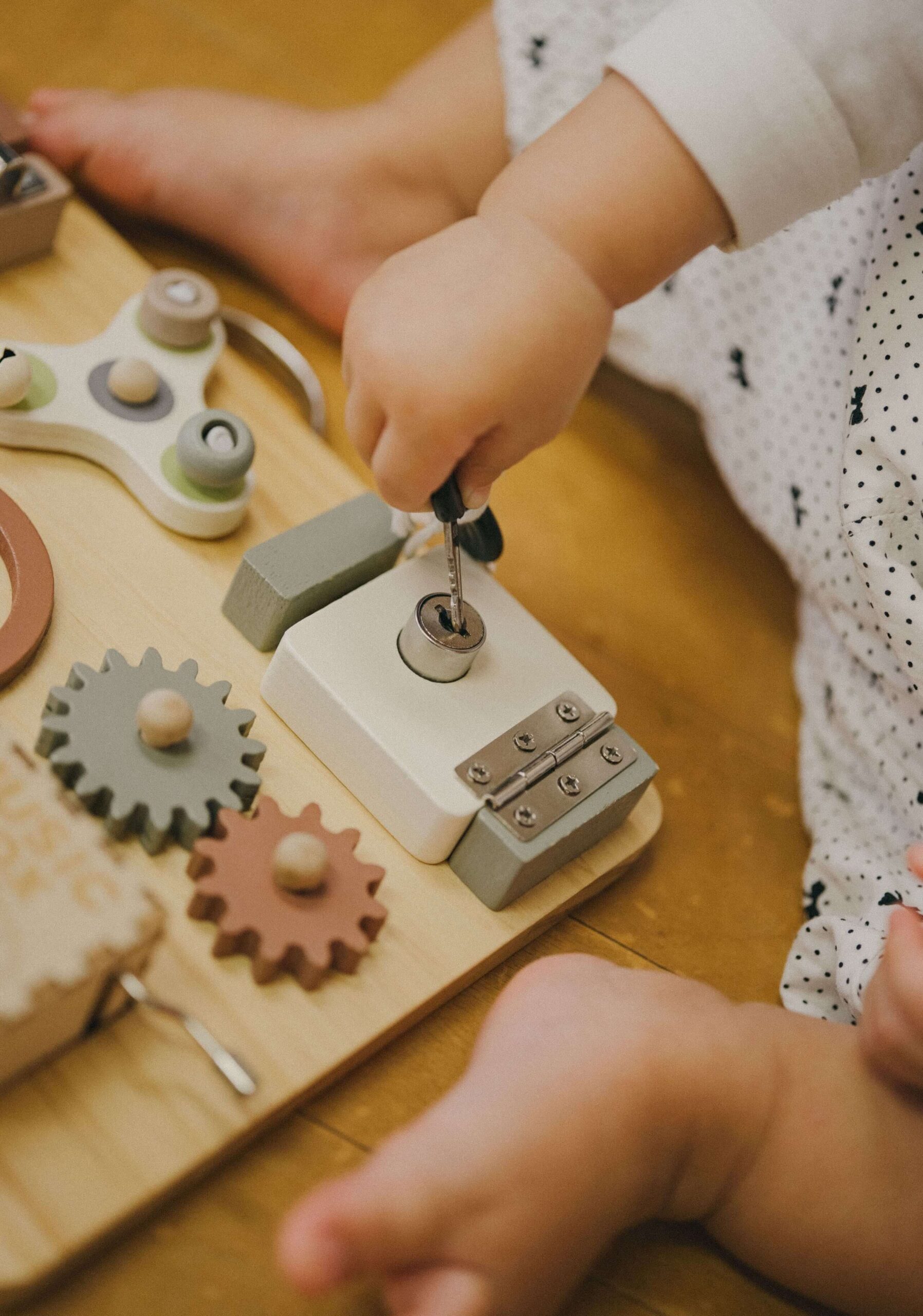
“Builds a real skill” means the activity is the actual task from the child’s own life — a buckle like the one on their shoe, a zipper like the one on their jacket — or a clear stepping stone to one, like threading, matching, or telling time. A page that only makes a noise or flashes a texture is stimulation, not a skill. Both have their place, and this guide labels which is which instead of pretending every crinkle is education.
“Quiet” is graded honestly, because this category lies about it. Several books below contain crinkle paper, and one contains an actual squeaker. Crinkle is a soft rustle. A squeaker is a noise on purpose. Where a book makes sound, we say so.
“Pieces stay put” separates the books that survive travel from the ones that shed. Fixed hardware and ribbon-tethered pieces cannot be lost. Loose hook-and-loop pieces and removable puppets can — sometimes worth it, but it should be a choice, not a surprise.
The picks at a glance
| Product | Type | Age (manufacturer) | Headline activities | Price |
|---|---|---|---|---|
| Wee Gallery Friendly Faces in the Garden | Cloth book | Marketed from birth* | High-contrast faces, padded pages | — |
| Jellycat Fluffy Tails Activity Book | Cloth book | 0+ | Textured fabric tails, crinkly cover | $18.50 |
| Lamaze Peek-a-Boo Forest | Cloth book | 6 months+ | Peek-a-boo flaps, textures, crinkles | $14.99 |
| Mary Meyer Taggies Soft Book | Cloth book | Not printed* | Squeaker, crinkle, 8 ribbon tags | — |
| Manhattan Toy Where’s The Bone? | Cloth book | Not printed* | Tethered toy, tactile pages, simple words | $35.00 |
| Melissa & Doug K’s Kids My First Activity Book | Cloth book | 1 month–2 years | Buttons, buckles, clock, counting, puppets | $18.99 list |
| My Quiet Book (Soft Skills Learning) | Fabric quiet book | Pre-K band* | Shoe-tying, snaps, zippers, shape matching | $34.95 list |
| deMoca Montessori Busy Board | Wooden board | 1–3 years | 10 fixed hardware activities | — |
| Project Montessori Busy Board, Upgraded | Felt busy book | 1–6 years† | 8 pages: fasteners, clock, calendar, alphabet | $39.95 |
* No exact manufacturer age rating appears in the sources we could open — see each section. † The brand’s own spec sheet adds a small-parts warning; see its section.
1. Wee Gallery Friendly Faces in the Garden — the newborn book
Most busy books on this page are useless to a 2-month-old, and this is the one that is not. There are no fasteners to fail at — just high-contrast black-and-white animal faces (cat, dog, bunny, raccoon, owl, bee) on soft, padded pages, designed by the publisher to stimulate visual development in young infants. It is something for a baby to look at during tummy time and in the stroller, long before “activities” mean anything.
The skill: visual tracking and focus — the only developmental job of the first months, done properly.
Honest limits: that is also all it does. There is nothing here for a 14-month-old who wants to do things, and the publisher copy prints no exact age rating, so “from birth” is the book’s marketing position rather than a certified range. Buy it as a newborn gift, not as a toddler toy.
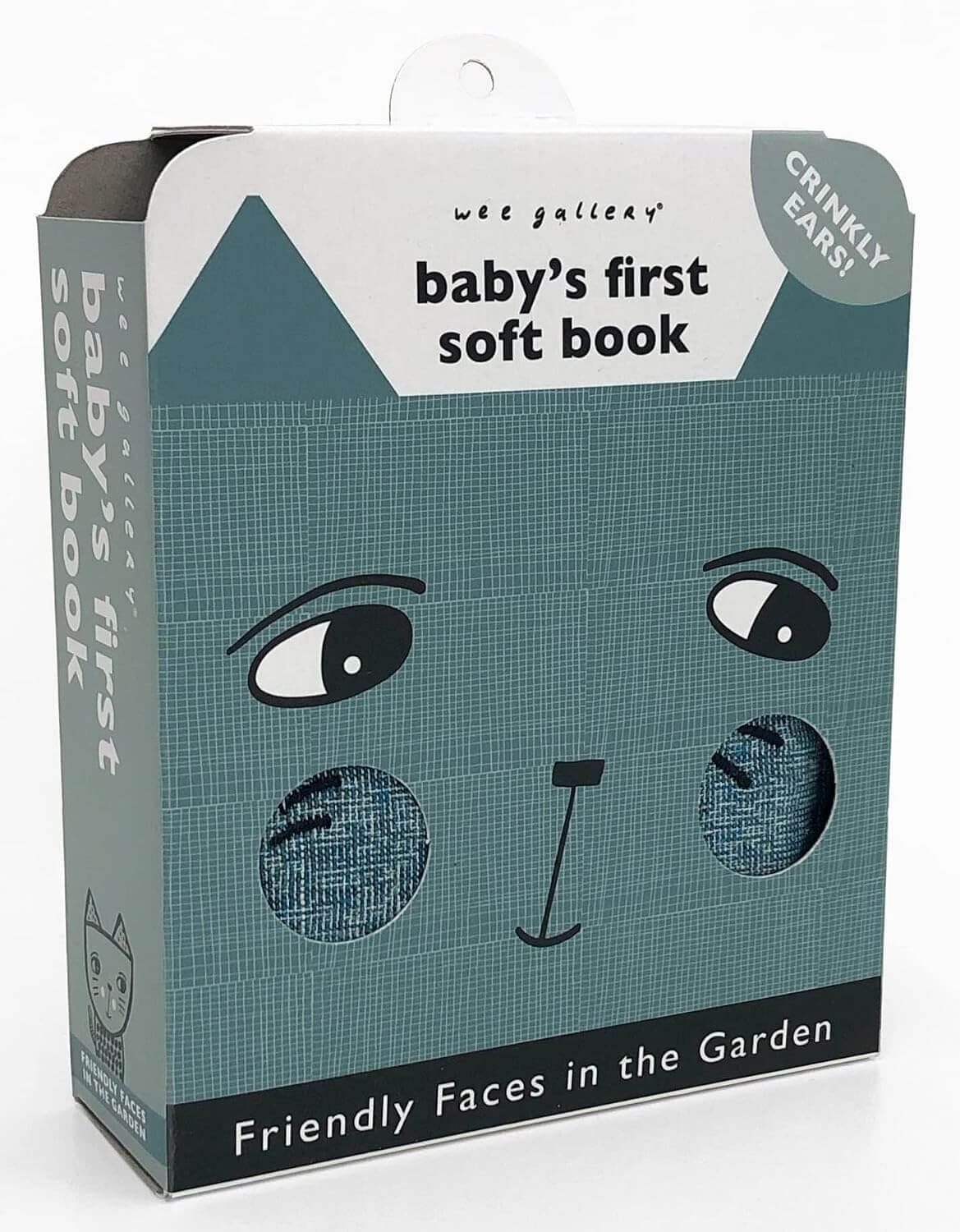
- The newborn pick — high-contrast faces match what young infants can actually see
- Soft, padded pages — nothing to break, tear or lose
- The publisher prints no exact age rating — “from birth” is marketing positioning, not a certified range
- Nothing here for an older toddler who wants to do things
2. Jellycat Fluffy Tails Activity Book — texture before tasks
Jellycat’s Tails books give each animal a fabric tail in a different texture, and the play is running small fingers over all of them. The cover crinkles. It is rated 0+ and priced at $18.50 in the listing we checked — sensory play first, like the Wee Gallery book, with more to touch.
The skill: tactile discrimination and grasping — a baby learning that the world has textures, and reaching for the one they like.
Honest limits — read this one carefully: some titles in Jellycat’s Tails line are not this book. The sibling Sea Tails carries a printed warning that it contains a sound chip with non-replaceable cell batteries — a swallowing hazard if the casing is ever breached. Fluffy Tails’ own listing shows a crinkly cover and no sound chip, but check the specific title in your cart: the line mixes quiet and battery-powered books under near-identical covers.
$18.50 · Ages 0+
- A different textured fabric tail on every page
- Bright illustrations and a crinkly cover
- Rated 0+ in the listing we checked
- Check the title in your cart: the sibling Sea Tails book carries a sound-chip battery warning — Fluffy Tails itself is crinkle-only
- Texture variety a baby can work through page by page
- Rated from birth — usable from the first months
- The Tails line mixes quiet and battery-powered books under near-identical covers — check the specific title
- Sensory only: no fasteners or dressing skills to grow into
3. Lamaze Peek-a-Boo Forest — the budget pick that earns it
TOMY rates this soft book 6 months+, and its whole design is one good idea repeated well: durable pages, soft peek-a-boo flaps a baby can open and close, multiple textures, and surprise crinkles, with a clip for strollers and diaper bags. At $14.99 it is the cheapest book in this guide, and under 18 months it is not a compromise — flaps and crinkles are the correct difficulty.
The skill: peek-a-boo flaps are object-permanence practice (things exist when hidden) plus the hand-eye coordination of opening and closing them — Lamaze’s own description says exactly this.
Honest limits: there are no real fasteners, no dressing skills, nothing to grow into past about age 2. You are buying the best version of the baby stage, not a book that lasts to preschool — at this price, that trade is fair.
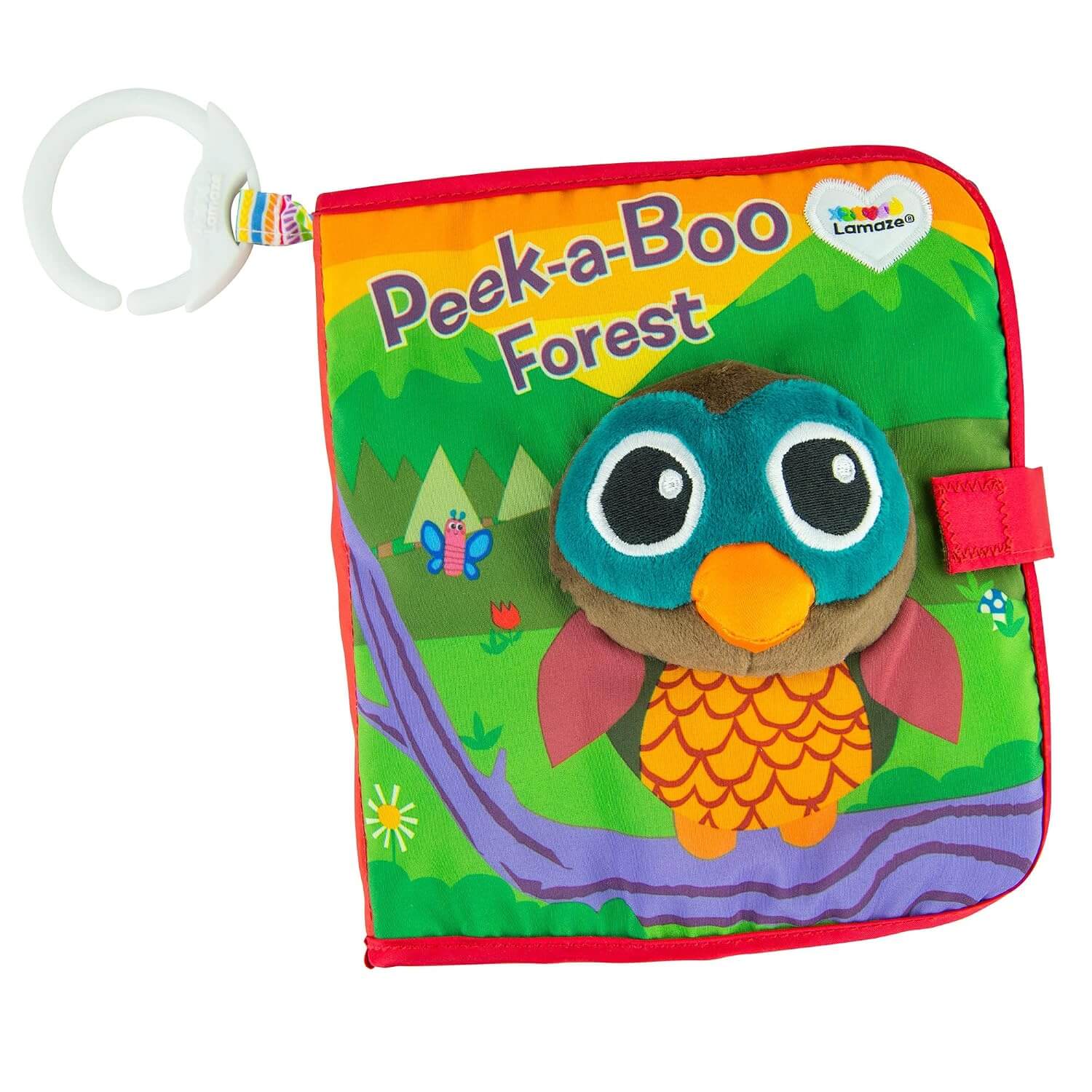
- The budget pick at $14.99 — and under 18 months it is not a compromise
- Flaps are object-permanence practice plus hand-eye coordination
- No real fasteners and no dressing skills
- Nothing to grow into past about age 2
4. Mary Meyer Taggies Soft Book — the soother, with a confession
Mary Meyer’s own catalog describes the formula precisely: eight pages, a short story, a Velcro closure, textured fabric covers, and eight of the satin Taggies ribbons babies rub between their fingers to self-soothe — a genuinely observed baby behavior this line is built around. It is machine washable. For a fussy baby in a car seat, the ribbons are the point.
The skill: self-soothing and page-turning; the story gives it a lap-reading life the pure sensory books lack.
The confession: the same catalog lists a squeaker and crinkle paper inside. A Taggies book is a lovely book, but it is not a silent one, and it has no business on a “quiet books” list that does not disclose that. Mary Meyer prints no age rating or retail price in the material we could open, so we state neither — expect baby positioning and mid-range pricing, and verify both at the listing.
- Eight satin Taggies ribbons babies rub between their fingers to self-soothe
- Eight pages with a short story, textured fabric covers and a Velcro closure
- Machine washable, per the manufacturer’s catalog
- Contains a squeaker and crinkle paper inside — it is not a silent book
- Built around a real self-soothing behavior — the ribbons are the point
- The short story gives it a lap-reading life the pure sensory books lack
- It squeaks — not a quiet book, whatever the category promises
- Mary Meyer prints no age rating or retail price in the catalog material we could open
5. Manhattan Toy Where’s The Bone? — the story-led one
Where most busy books are activity samplers, this one is a story with a job: find the bone, with a tethered toy that travels through the pages and simple words alongside tactile exploration, per Manhattan Toy’s description. The tethered-piece design means the star of the book cannot be lost. It is $35 at Target.
The skill: early language and search-and-find attention — following a simple narrative and hunting for a hidden object, the closest thing here to reading readiness.
Honest limits: $35 is a premium price for a book whose activity count is modest next to the fastener-heavy books below, and Manhattan Toy’s listings print no exact age rating or page count in the sources we could open — the brand positions it for babies and toddlers generally. You are paying for story, build, and the un-losable toy, not for skill density.
$35.00
- A story with a job: find the bone, page by page
- Tethered toy travels through the pages — the star of the book cannot be lost
- Simple words alongside tactile exploration
- Priced at $35.00 in the Target listing we checked
- The story-led pick — early language and search-and-find attention
- Tethered design: nothing to lose
- A premium price for a modest activity count
- Manhattan Toy prints no exact age rating or page count in the sources we could open
6. Melissa & Doug K’s Kids My First Activity Book — best for the youngest toddlers
This is the only book here whose manufacturer age rating starts at 1 month and whose activities are genuine dressing skills: buttoning, buckling, and a shoe with self-stick tab buckles, scaled for small hands. Around them sit the baby-appropriate extras — peek-a-boo, counting, matching, a clock with movable hands, a crinkling surprise, a removable hand puppet and two finger puppets. Eight pages, built-in handles, fabric construction, and — the detail parents will appreciate most — machine washable, per the publisher’s description. List price is $18.99; some retailers sell it nearer $15.
The skills: buttons and buckles are dressing independence in miniature; the clock and counting pages are early numeracy; the puppets turn the book into language play with a parent.
Honest limits: the manufacturer tops the rating at 2 years, and that is honest — a 3-year-old who can already button will finish its challenges quickly. The removable puppets are also the losable kind, by design. Buy it for the 6-to-24-month window it was made for, where it is the strongest all-rounder here.
$18.99 · Ages 1 month–2 years
- Buttoning, buckling, and a shoe with self-stick tab buckles, scaled for small hands
- Clock with movable hands, counting, matching and peek-a-boo pages
- Removable hand puppet and two finger puppets included
- Eight fabric pages with built-in handles — and machine washable
- Best for the youngest toddlers — real fasteners at baby scale, rated from 1 month
- Machine washable, and the puppets turn it into language play
- The manufacturer tops the rating at 2 years — older toddlers finish its challenges quickly
- The removable puppets are the losable kind, by design
7. My Quiet Book (Soft Skills Learning) — the travel pick
The classic quiet book, done the traditional way: eight soft pages of dressing practice — tying a shoe, matching shapes to their outlines, snaps, zippers, buttons, belts, color matching. Two design decisions make it the travel pick. Every removable piece is fastened to its page with a short length of ribbon, so pieces cannot get lost — the failure mode of half this category, engineered away. And the book itself zips shut with a carry handle, at roughly 8.5 × 9 inches closed. List price $34.95; we found it at $29.95.
The skills: the fullest pure dressing-skills set in a fabric book — laces, snaps, and zips are the exact fasteners on a preschooler’s own clothes and shoes.
Honest limits: the publisher material we could open lists a pre-K grade band rather than an exact age rating, and there are no baby-stage sensory pages — this is a book for a child ready to practice tasks, roughly the 2-to-4 set, not a first book for an infant.
$34.95
- Eight soft pages: tying a shoe, shape matching, snaps, zippers, buttons, belts, color matching
- Every removable piece is ribbon-tethered to its page — pieces cannot get lost
- Zips shut with a carry handle, roughly 8.5 × 9 inches closed
- The publisher lists a pre-K grade band rather than an exact age rating
- The travel pick — zips shut with a handle, and nothing can migrate under a car seat
- The fullest pure dressing-skills set in a fabric book
- No baby-stage sensory pages — it is for a child ready to practice tasks
- No exact manufacturer age rating in the publisher material we could open
8. deMoca Montessori Busy Board — real hardware, fixed forever
The deMoca board takes the opposite approach to fabric: a wooden board carrying 10 fixed activities from the manufacturer’s manual — zipper, buckle, gears, latch, shoelace, and a maze among them. Nothing detaches, because nothing can: every mechanism is mounted. The manual rates it 1–3 years and lists no sound elements (what you hear is the soft click of real hardware); retailer-measured specs put it at roughly 15 × 11 inches and 1.7 lb. We rated this same board in our quiet toys guide, where its lose-nothing design made it the flight heavyweight.
The skills: the real versions of the fabric books’ imitations — an actual latch, actual gears, an actual shoelace — with real resistance and feedback.
Honest limits: wood and hardware make it the heaviest pick here; it earns its space on a flight but crowds a small restaurant table. Small hardware also means what it means — supervise a mouthing toddler around latches and laces. We could not verify a current manufacturer price from an opened source, so we print none.
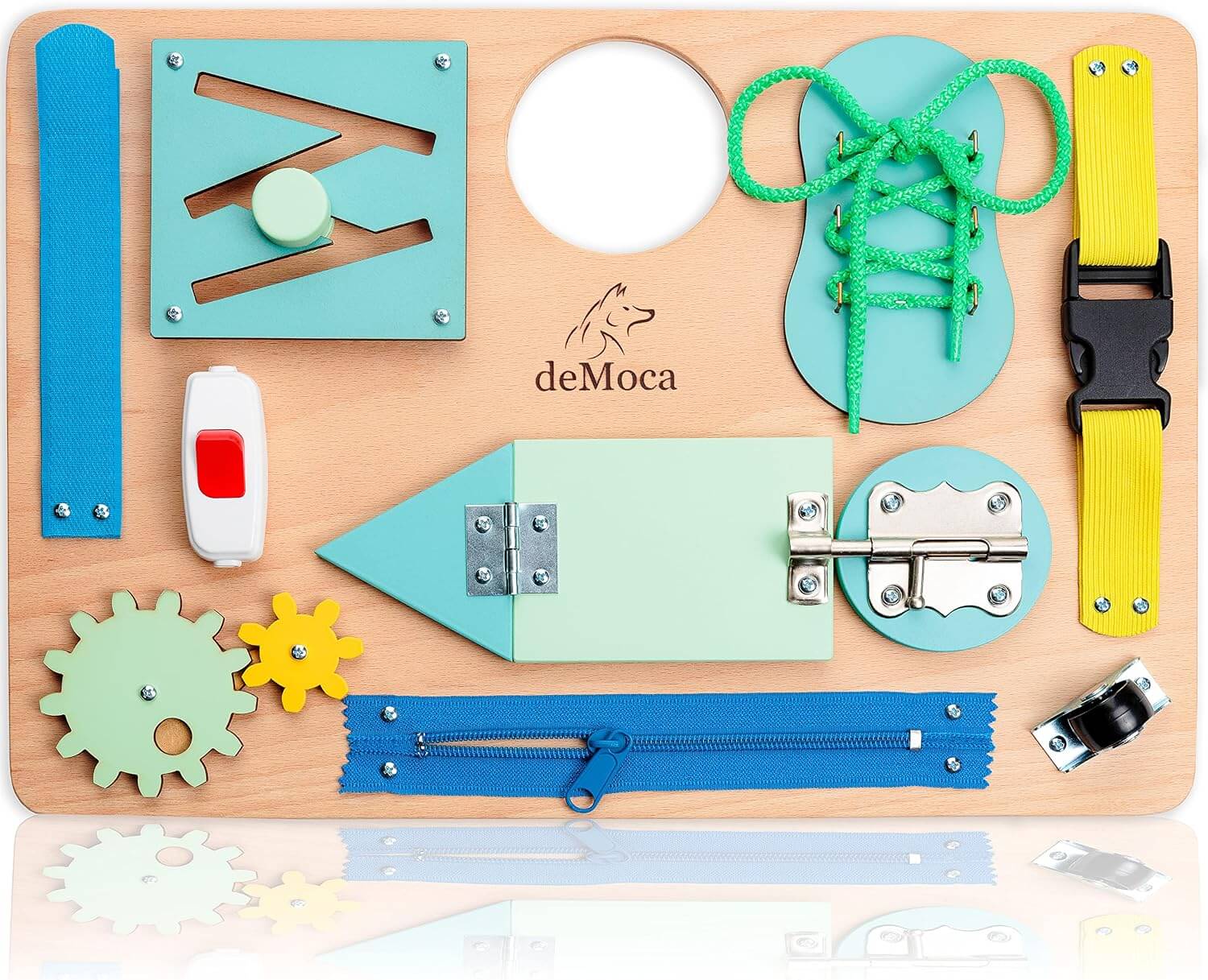
- Real hardware with real resistance — the actual latch, gears and shoelace
- Lose-nothing design: it cannot shed a piece in a car or on a plane
- The heaviest pick here — it crowds a small restaurant table
- Small hardware means supervising a mouthing toddler; no manufacturer price could be verified, so none is printed
9. Project Montessori Busy Board, Upgraded Edition — the most activities, with an asterisk
On content, nothing else here is close. The brand’s own store lists eight felt pages of progressive difficulty: zippers, buckles, and laces first, then shape sorting, puzzle pieces, number threading, and a top end of clock, calendar, alphabet board, and shoelace tying aimed at 4-to-6-year-olds. It folds from about 17.5 × 11 inches open down to travel size and costs $39.95 direct from the brand.
The skills: the widest ladder here — fasteners at the bottom, time and letters at the top, with hand-eye work (sorting, threading, placing pieces) through the middle.
The asterisk — from the brand’s own pages: the store labels it “Ages 1-6” and sells it as a board “for 1yr,” while its own specification block reads “Small parts — not for children under 12 Months · Adult supervision recommended,” and its FAQ warns that the alphabet letters, puzzle pieces, and shapes “are small and present a choking hazard.” Those pieces are hook-and-loop attachments — loose by design, with some assembly required at setup — and the felt is spot-clean only, no machine washing. None of this makes it a bad buy for a supervised 3-to-5-year-old. It just makes the headline age a bad reason to hand it to a 1-year-old. Buy it for the top of its range, not the bottom.
$39.95 · Brand-labeled ages 1–6 — read the warning below
- Eight felt pages of progressive difficulty: zippers, buckles, laces, shape sorting, puzzle pieces, number threading
- Top end aimed at 4-to-6-year-olds: clock, calendar, alphabet board and shoelace tying
- Folds from about 17.5 × 11 inches open down to travel size
- Warning from the brand’s own spec block: “Small parts — not for children under 12 Months”; its FAQ calls the loose letters, puzzle pieces and shapes a choking hazard
- Loose hook-and-loop pieces, some assembly at setup; felt is spot-clean only
- The most activities here by a distance — fasteners at the bottom, time and letters at the top
- One purchase that stretches for years at the top of its range
- The headline “Ages 1-6” conflicts with the brand’s own small-parts warning — buy it for a supervised 3-to-5-year-old, not a 1-year-old
- Loose pieces to store like puzzle pieces; spot-clean only, no machine washing
The safety section most busy-book guides skip
This category looks harmless — fabric, felt, and wooden boards — and its recall history says otherwise. The CPSC has recalled products in this exact category: a wooden busy board sold on Amazon was recalled because its zipper pull contained more lead than federal law allows, and in 2018 a Manhattan Toy soft book was recalled because a metal grommet attaching a fabric flap could detach and become a choking hazard. Different brands, different years, same lesson: the risk in a busy book is never the concept, it is the small attached hardware.
So the working rules, applied to every pick above:
- Match the rating on the box, not the marketing headline. The Project Montessori board is the standing example — its spec sheet warns of small parts under 12 months while its headline age starts at 1.
- Inspect the attachments. Buttons, snaps, buckles, and grommets should resist a firm adult tug. Check again after washes; stitching loosens before fabric fails.
- Loose-piece books are supervised books. Hook-and-loop letters and removable puppets are fine for a watched toddler, wrong for a mouthing baby left alone.
- Check the specific product, not the brand family. Jellycat’s Tails line mixes crinkle-only books with a sound-chip title carrying a battery warning under near-identical covers.
- Buy from brands that publish safety information. Every pick above comes from a maker whose specifications, warnings, or catalog data we could actually read — the no-name marketplace boards are precisely the ones with recall notices and no spec sheet.
Who should buy which — and who should buy none
Buy the Melissa & Doug My First Activity Book if: the child is roughly 6–24 months; you want real fasteners at baby scale; machine-washable matters (it will).
Buy My Quiet Book or the deMoca board if: travel is the use case. The fabric book zips shut with everything ribbon-tethered; the wooden board cannot lose a piece because nothing comes off. Choose fabric for a diaper bag, wood for a flight bag.
Buy the Project Montessori board if: the child is 3–5 (whatever the headline age says), you want one purchase to stretch for years, and you will store the loose pieces like puzzle pieces.
Buy the Lamaze, Jellycat, Wee Gallery, or Taggies book if: the child is under 18 months and the honest job is sensory play, soothing, and first flaps — not dressing skills yet. Among them: Lamaze for budget, Wee Gallery for a newborn, Taggies for a ribbon-rubbing soother (squeaker disclosed), Jellycat for texture variety, title checked first.
Buy none of them if: the child already dresses independently — they have graduated, and the money belongs in construction toys or a first art kit instead. Also buy none if what you actually want is a story book to read aloud nightly: with the partial exception of Where’s The Bone? and the Taggies books, these are activity objects with little narrative. And buy none as a silence guarantee for a cabin or library — crinkles rustle, one pick squeaks, and “quiet book” is a category name, not a promise.
Frequently asked questions
What age do busy books actually work for?
Match the manufacturer’s rating, then the child’s hands. Sensory cloth books (Wee Gallery, Jellycat, Lamaze) work from the first months. Fasteners become realistic practice from roughly 18 months — buttons and zips are genuinely hard before that — and the deep felt boards earn their price at 3–5.
Are busy books really quiet?
Quieter than almost any electronic toy, but not silent. Crinkle paper rustles — Lamaze, Jellycat, and the Melissa & Doug book all include some — hardware clicks softly, and the Taggies book contains an actual squeaker. The genuinely no-sound picks here are My Quiet Book and the Project Montessori board, per their descriptions.
Fabric book or wooden busy board?
Fabric folds into a bag and survives drops; its fasteners are imitations at toddler scale. Wood gives real hardware with real resistance, and activities that cannot be lost — at the cost of weight and size. Under age 2, fabric. For depth at 2–4, wood — or a felt book if it must fold.
How do you clean them?
Only where the sources say: the Melissa & Doug book and the Taggies book are machine washable per their manufacturer material. The Project Montessori felt board is explicitly spot-clean only. For the rest, no care claim was verified — follow the tag on the book.
Are the small pieces dangerous?
They are the category’s one real hazard, and the brands say so themselves — Project Montessori’s own FAQ calls its loose letters and shapes a choking hazard, and this category has CPSC recalls for detachable parts and lead in hardware. Respect age ratings, tug-test attachments, supervise mouthing toddlers, and retire any book whose stitching starts to let go.
Is a $35–40 busy book worth it over a $15 one?
Only if the child is old enough to use what the extra money buys. The premium buys activity depth (the felt board’s clock and alphabet pages) or construction (the classic quiet book’s sewn, tethered pages) — worth it at 3–4, wasted at 12 months, where the $14.99 Lamaze is not the cheap option but the correct one.
How this guide was researched
We compared manufacturer pages, catalogs, and published specifications on 2026-10-23: Melissa & Doug publisher descriptions (K’s Kids My First Activity Book, model 30267), the Mary Meyer 2025 Baby Catalog, Project Montessori’s own store specifications and FAQ, TOMY’s published age data for the Lamaze line, and retailer listings (Target, Rainbow Resource) only where they reproduce manufacturer product data. Where a source conflicted with a brand’s own marketing — most sharply, a busy board labeled for age 1 whose spec sheet warns of small parts — the conflict is printed rather than smoothed over, and facts we could not verify (four exact age ratings, three prices) are stated as missing instead of guessed. No hands-on testing was performed. Prices change constantly; check the live price before buying.