
Disclosure: As an Amazon Associate I earn from qualifying purchases. Some links on this page may earn us a commission at no extra cost to you.
Quick Verdict
Build the kit in stages, not in one shopping trip. From 12 months: egg-shaped washable crayons (Crayola Palm Grasp) or natural beeswax crayons (Honeysticks Originals), plus the one paint designed from 12 months — Honeysticks Finger Paint. From age 2: tripod-grip washable markers (Crayola Tripod Grip) and Play-Doh (note the wheat warning). From age 3: real paint — spill-proof and mess-free formats first, liquid paint after.
The short answer
Build the kit in stages, not in one shopping trip. From 12 months: egg-shaped washable crayons (Crayola Palm Grasp) or natural beeswax crayons (Honeysticks Originals), plus the one paint actually designed from 12 months — Honeysticks Finger Paint. From age 2: tripod-grip washable markers and Play-Doh, with a wheat warning printed in full below. Real paint waits for the manufacturer’s 3+ rating, and when it arrives, spill-proof and mess-free formats beat open pots. Every pick carries its manufacturer’s own age rating and cleanup reality — including one classic box that is not washable, and one popular marker line we left out entirely.
Limitation: safety, age, and cleanup ratings are based on manufacturer descriptions and published specifications, not hands-on testing.
How we rated “safe” and “low-mess”
Most toddler art lists never define either word. We do — the definitions shaped this whole kit. Safe, for this guide, means three checkable things: the manufacturer’s own age rating fits a toddler (we print it; it wins over any retailer’s looser listing); the maker states the product is non-toxic — look for the AP (Approved Product) seal or a printed “Conforms to ASTM D-4236” statement, the conformance line US art materials are labeled under; and nothing in the design works against a mouthing toddler.
Low-mess is graded on the manufacturer’s own cleanup wording, because “washable” is not one promise: Crayola’s washable lines state what they wash from — skin, most washable clothing, sometimes carpet. A non-toxic product with no washable claim at all is graded as exactly that (see pick #10). And one design fails our test outright: art supplies scented like food. A toddler’s job is learning that crayons are not snacks; a marker that smells of strawberry teaches the opposite lesson (see the left-out note below).
Full comparison table
| Product | Mess level | Official age | Buy stage |
|---|---|---|---|
| Crayola Palm Grasp Crayons, 3 ct | Low — washable formula | 12 months+ | Buy first |
| Honeysticks Originals Beeswax Crayons, 12 pk | Low — not washable; marks wipe with a warm damp cloth | 1–3 years (brand: safe 1+) | Buy first |
| Honeysticks Finger Paint | Moderate — water-based, skin-safe; hands and tray get painted | 12 months+ | Buy first |
| Crayola Tripod Grip Markers, 8 ct | Low — fully washable per Crayola | 2+ | Buy next |
| Play-Doh Modeling Compound, 5 pack ⚠️ | Dry mess — crumbs; dry, scrape, vacuum | 2+ | Buy next — contains wheat ⚠️ |
| Crayola Color Wonder Fingerpaint Activity Book | Zero — color appears only on its special paper | 3+ | Buy at 3 |
| Crayola Washable Fingerpaint, 3 ct | Moderate — washes from skin and most fabrics | 3+ | Buy at 3 |
| Crayola Spill Proof Washable Paint Set | Low — semi-solid paint prevents spills and drips | 3+ | Buy at 3 |
| Honeysticks Watercolour Paints | Low — solid discs, water-activated; no open liquid pots | 3+ | Buy at 3 |
| Crayola Jumbo Crayons, 8 ct ⚠️ | ⚠️ Standard formula — Crayola does not call these washable | 3+ | Buy at 3, with the flag |
| Crayola Silly Scents markers ❌ | Washable — but scented like food, and rated 5+ by Crayola | 5+ (retailers often say 3+) | EXCLUDED — see below |
The picks, honestly rated
1. Crayola Palm Grasp Crayons — the very first mark
Egg-shaped crayons a 12-month-old can hold in a fist and press in any direction — there is no wrong way up. The Stage 1 set has three colors (red, blue, yellow), and Crayola’s description notes each egg equals 14 regular crayons. They are washable and — the words to look for — AP Certified nontoxic.
Best scenario: a first-birthday kit, and any 12–18-month-old still drawing with their whole arm — the crayon that matches a fist grip, before any finger grip exists.
Honest limits: three colors is a starter palette, not a rainbow — replaced on purpose by picks #2 and #10 later. The washable claim is the manufacturer’s; supervision still applies, as with every crayon.
- Egg-shaped — hold in a fist, no wrong way up
- 3 colors: red, blue, yellow
- Each egg equals 14 regular crayons
- Washable formula
- AP Certified nontoxic
- Age 12 months+
- First-birthday kit pick for a 12–18-month-old still drawing with the whole arm
- Matches a fist grip, before any finger grip exists
- No wrong way up
- Only three colors — a starter palette, not a rainbow
- The washable claim is the manufacturer’s; supervision still applies
2. Honeysticks Originals — the natural first crayon
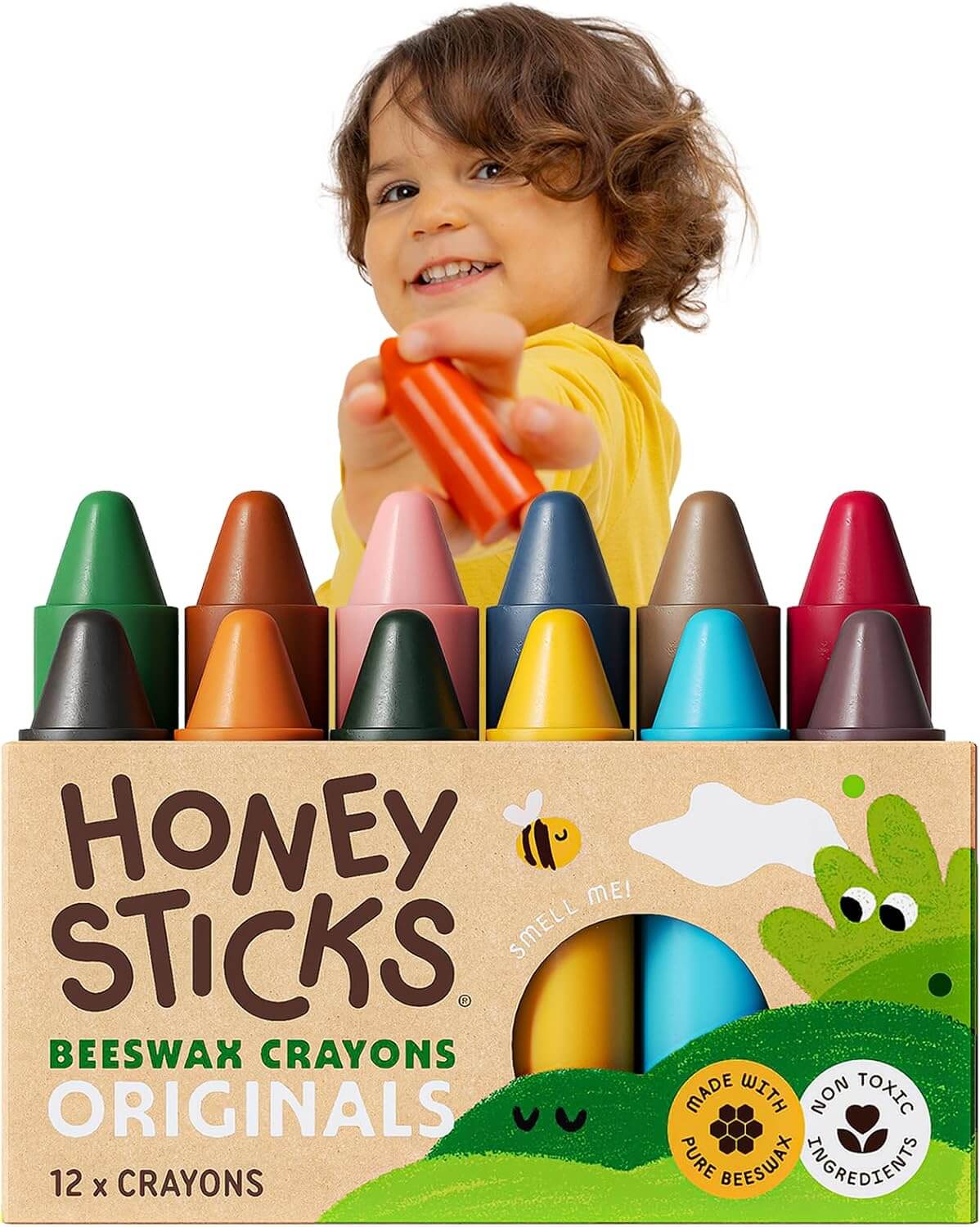
Short, stubby crayons handcrafted in New Zealand from 100% pure beeswax, colored with food-grade pigments — no paraffin wax, the base of most conventional crayons. Honeysticks rates them for toddlers aged 1–3 — its Stage 1 scribble crayon: easy to grip, tough to break. At $24.95 on Honeysticks’ own store, this is the premium pick — the one price we print, because it is the manufacturer’s own.
Best scenario: families who want the simplest possible ingredient list for a child who will definitely mouth a crayon. The brand is blunt that crayons are not food — but if one gets chewed, the ingredients are beeswax and food-grade pigment.
Honest limits: these are not a washable formula. Honeysticks’ own FAQ says the crayons are designed for paper, and that marks on clothes or surfaces come off with a cloth dampened with warm water — a wipe, not a laundry-cycle promise. You are paying for ingredients and durability: 12 colors, one box, nothing to refill.
- Simplest possible ingredient list for a child who will mouth a crayon
- If one gets chewed, the ingredients are beeswax and food-grade pigment
- Easy to grip, tough to break
- Not a washable formula — no washable claim
- Marks come off with a cloth dampened with warm water: a wipe, not a laundry-cycle promise
- 12 colors, one box, nothing to refill
3. Honeysticks Finger Paint — first paint, a full year early
Most fingerpaint is rated 3+. This one is the exception we could verify: Honeysticks’ own guidance describes its finger paint as designed for children aged 12 months and up — non-toxic, water-based, and skin-safe, free from heavy metals and harsh odours, in small pots. That makes it the only paint in this kit a young toddler can start with.
Best scenario: a 12–24-month-old’s first painting sessions — short, supervised, on paper or card (the surfaces the brand names).
Honest limits: water-based and skin-safe is not the same as tidy. Fingerpaint’s mess is the point of it — budget a smock or an old shirt, and keep expectations at sensory play, not artwork. Adult help is built in: the brand’s own instructions have a grown-up open the pot and portion the paint out.
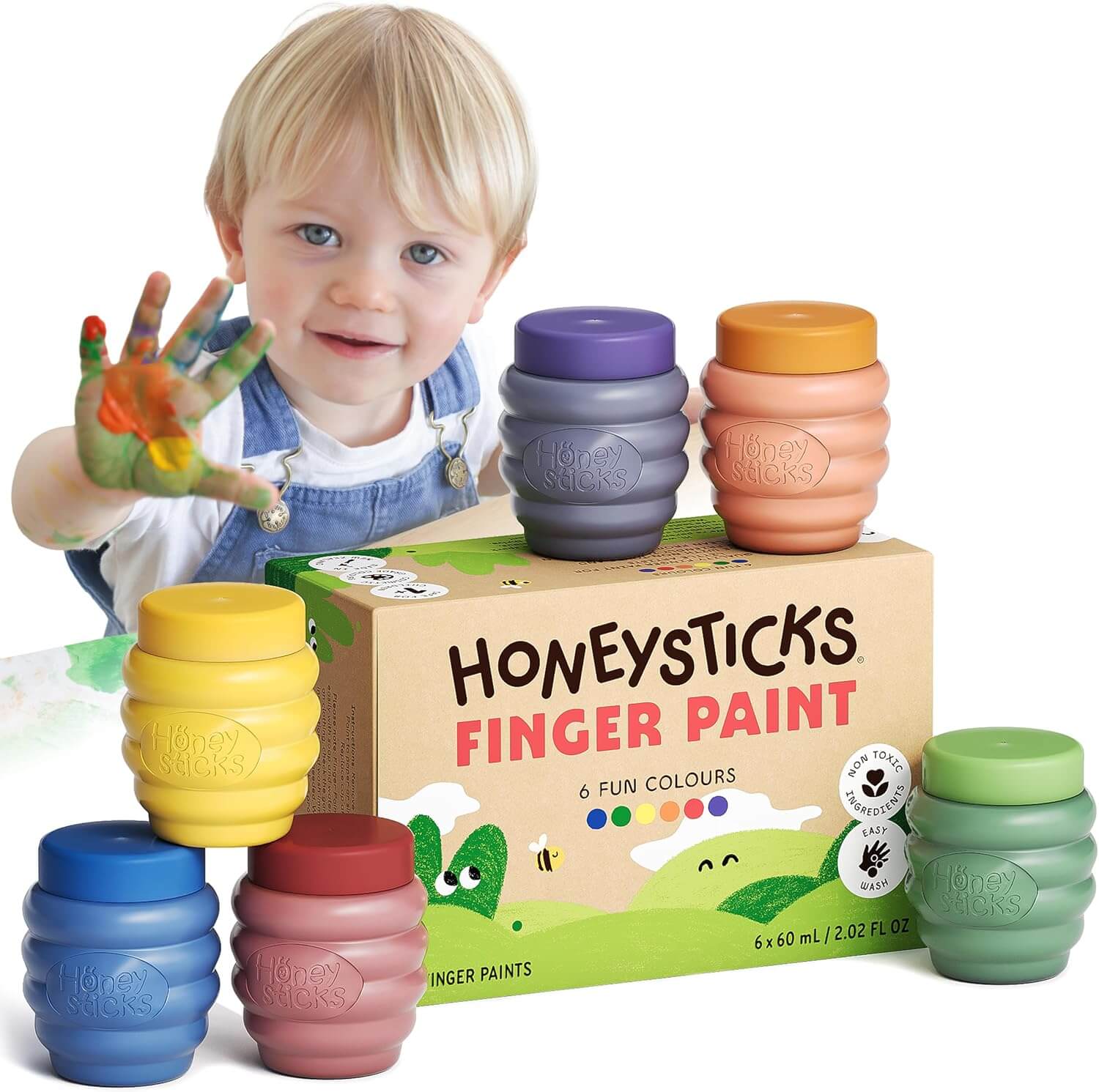
- The only paint here designed from 12 months — for first painting sessions at 12–24 months
- Short, supervised sessions on paper or card
- Water-based and skin-safe is not the same as tidy — fingerpaint’s mess is the point
- Budget a smock or an old shirt; expect sensory play, not artwork
- A grown-up must open the pot and portion the paint
4. Crayola Tripod Grip Markers — first markers, from age 2
Crayola’s first-marker design: a triangular barrel that sits in a toddler’s fingers and, in the brand’s words, promotes the proper writing grip — and won’t roll off the table. Eight colors, rated 24 months and up. The cleanup claim is Crayola’s strongest: fully washable and, per Crayola, no staining of clothes, carpet, or skin.
Best scenario: the step up from crayons at age 2, when a child wants the bold line only a marker makes — and the household wants it on paper, not upholstery.
Honest limits: caps are the weak point of any marker at this age — a cap left off is a dried-out marker, so cap checks become a parent job. And fully washable is the manufacturer’s claim for its own formula; the first session stays supervised, as with every pick here.
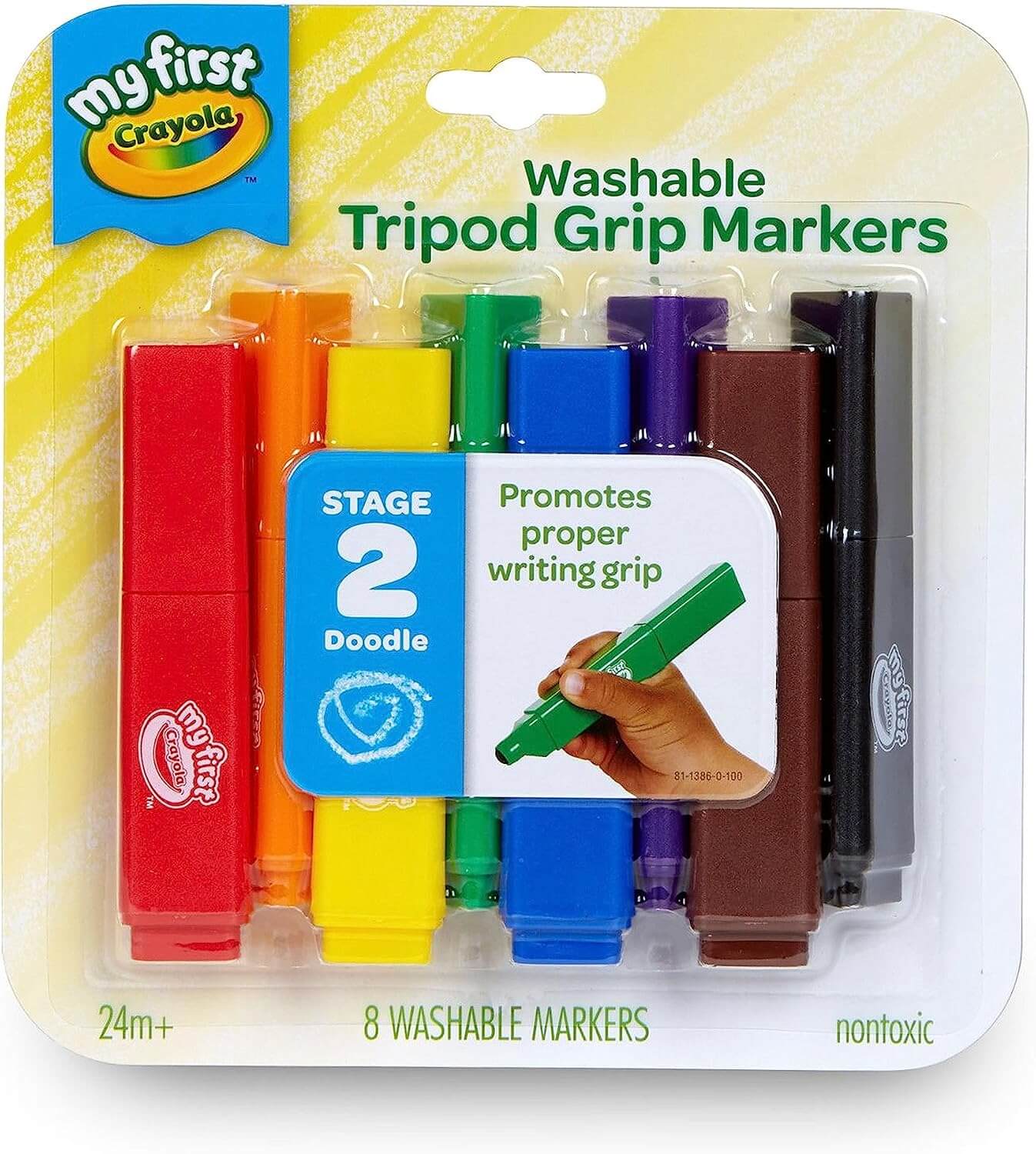
- The step up from crayons at age 2, when a child wants the bold line only a marker makes
- Triangular barrel promotes the proper writing grip
- Won’t roll off the table
- Caps are the weak point — a cap left off is a dried-out marker, so cap checks become a parent job
- Fully washable is the manufacturer’s claim; the first session stays supervised
5. Play-Doh Modeling Compound — the dough, with its warning in full
Five 3-ounce cans (red, blue, light blue, yellow, white), rated 2 years and up. Squeezing, rolling, and flattening is sculpture for a 2-year-old — and Hasbro states the compound is made primarily with water, salt, and flour, is non-toxic, and conforms to ASTM D-4236. Cleanup is the driest on this list: let scraps dry, then scrape or vacuum.
Best scenario: rainy-day table play from age 2 — open-ended, reusable while the cans stay sealed, and the best hand-strength builder in the kit.
Honest limits — and the flag stays on: Hasbro prints “Notice to Parents: Contains Wheat” on its own product pages, and “Compound not intended to be eaten.” For a child with a wheat allergy or celiac disease, this is the wrong product, full stop. Dried crumbs also travel in socks and carpets until vacuuming day.
- Five 3-oz cans: red, blue, light blue, yellow, white
- Made primarily with water, salt, flour
- Non-toxic, conforms to ASTM D-4236
- ⚠️ Notice to Parents: Contains Wheat
- Age 2+
- Rainy-day table play from age 2 — open-ended, reusable while the cans stay sealed
- The best hand-strength builder in the kit
- Hasbro prints Notice to Parents: Contains Wheat — wrong product for wheat allergy or celiac disease, full stop
- Compound not intended to be eaten
- Dried crumbs travel in socks and carpets until vacuuming day
6. Crayola Color Wonder Fingerpaint Activity Book — painting with zero mess
A 30-page activity book with mess-free fingerpaint: the gel shows its color only on the book’s special paper, so fingers, clothes, and the table stay clean — the same Color Wonder system as the markers in our quiet-toys guide. Rated 3+. Fingerpainting as an activity book, not open-ended art: guided pages, nothing to spill, nothing to set up.
Best scenario: a newly 3-year-old who wants real paint in a setting where real paint is not welcome — a grandparent’s white sofa or a tidy kitchen table.
Honest limits: the pages are single-use, like all Color Wonder paper — when the book is done, it is done, so this is a consumable, not a kit staple. And because the paint works only in this book, it teaches none of the open-ended mixing of real fingerpaint (pick #7).
- 30-page activity book with mess-free fingerpaint
- Gel shows color only on the special paper
- Fingers, clothes, and table stay clean
- Age 3+
- The feel of real paint where real paint is not welcome — a grandparent’s white sofa or a tidy kitchen table
- Fingers, clothes, and table stay clean
- Nothing to spill, nothing to set up
- Pages are single-use — a consumable, not a kit staple
- Teaches none of the open-ended mixing of real fingerpaint
7. Crayola Washable Fingerpaint — the real thing, at 3+
Three bottles (red, yellow, blue) of Crayola’s washable fingerpaint — 8-ounce EZ Squeeze bottles on the Bold set — thick and creamy, as fingerpaint needs to be. Crayola states it washes from skin and most fabrics. Rated 3+: this is the paint toddlers graduate to, not the one they start with.
Best scenario: the first big painting sessions at 3 — handprints, mixing primaries into new colors, artwork worth keeping.
Honest limits: washes from skin and most fabrics is the real claim — most fabrics, not every surface. Crayola’s own care directions for its washable paints say to keep them away from wallpaper, painted walls, finished wood, and carpeting, and to wash clothes promptly.
- 3 bottles: red, yellow, blue
- 8-oz EZ Squeeze bottles on the Bold set
- Thick and creamy
- Washes from skin and most fabrics
- Age 3+
- First big painting sessions at 3 — handprints, mixing primaries into new colors, artwork worth keeping
- Thick and creamy, washes from skin and most fabrics
- Most fabrics, not every surface
- Keep away from wallpaper, painted walls, finished wood, and carpeting; wash clothes promptly
8. Crayola Spill Proof Washable Paint Set — brush painting without the spill
Five jars of semi-solid paint, a brush, and 20 sheets of paper. The semi-solid format is the whole idea: in Crayola’s words, it prevents spills, drips, and messes — tip the jar and the paint stays put. The paint is washable from skin and most washable clothing, dries quickly, and the set is rated 3+.
Best scenario: a 3-year-old’s first brush — painting with a tool, without the cup of colored water and open pot that end first sessions early.
Honest limits: five colors and a starter supply of paper make this an introduction, not a studio — a keen painter will outgrow both, which is what pick #9 is for. Semi-solid also means a lighter color payoff than liquid paint — the price of the no-spill design.
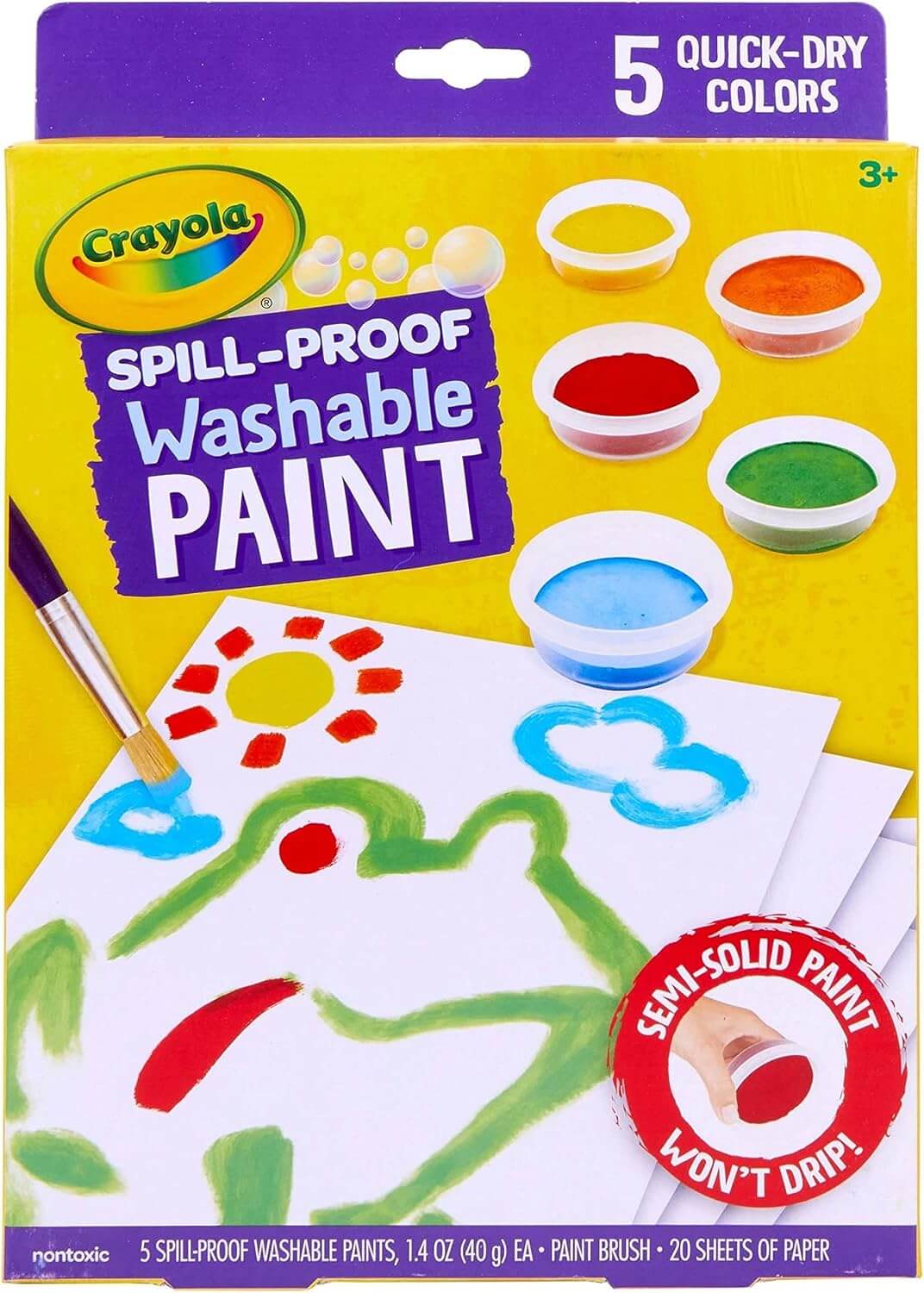
- A 3-year-old’s first brush — no cup of colored water or open pot to end the session early
- Semi-solid paint prevents spills, drips, and messes
- Five colors and a starter supply of paper — an introduction, not a studio
- Semi-solid means lighter color payoff than liquid paint
9. Honeysticks Watercolour Paints — the low-liquid paint
Solid watercolor discs, activated with a wet brush — no pots of liquid paint to knock over. Honeysticks states its watercolour paints are 100% non-toxic, made with food-grade ingredients, and suitable for ages 3+. Retailer specifications list a wooden brush in the set; the brand’s brushes are birchwood with vegan bristles.
Best scenario: painting at the kitchen table where a spilled water cup is the usual session-ender.
Honest limits: watercolor color is translucent by nature — a child expecting the bold payoff of poster paint gets a gentler result, and the discs need the brush kept wet to work well. Set sizes vary by market, so check the disc count on the box rather than assuming.
- Solid discs, water-activated
- 100% non-toxic, food-grade ingredients
- Birchwood brush with vegan bristles (retailer specs)
- Age 3+
- Painting at the kitchen table where a spilled water cup is the usual session-ender
- No liquid pots to knock over — solid, water-activated discs
- Translucent by nature — a gentler result than poster paint
- Discs need the brush kept wet to work well
- Set sizes vary by market; check the disc count on the box
10. Crayola Jumbo Crayons — the classic box, flag attached
Eight chunky crayons in the classic colors (red, yellow, green, blue, brown, black, orange, purple), sized for small hands, in a reusable storage box. Crayola describes them as safe and nontoxic for ages 3 and up. It is here because a first art kit eventually needs a standard crayon, and this is the standard.
Best scenario: the everyday drawing box from age 3, once the palm-grasp and beeswax stages (picks #1–2) have done their work.
Honest limits — and the flag stays on: Crayola’s page for this set does not call it washable, and we will not either. Crayola says so plainly on its washable lines’ pages; this classic formula carries no such claim, so a wall decorated with pick #10 is a scrubbing job, not a wipe. It is the one buy at 3 pick where the cleanup grade, not the safety grade, is the compromise.
- 8 chunky crayons: red, yellow, green, blue, brown, black, orange, purple
- Reusable storage box
- Safe and nontoxic
- Age 3+
- ⚠️ Not washable — no washable claim on the classic formula
- The everyday drawing box from age 3, once the palm-grasp and beeswax stages have done their work
- The standard crayon in classic colors, with a reusable storage box
- Crayola does not call these washable — the classic formula carries no washable claim
- A decorated wall is a scrubbing job, not a wipe
The popular pick we left out — and why
Crayola Silly Scents markers appear in toddler gift guides and retailer listings marked ages 3+. Crayola’s own product pages rate the Silly Scents sets 5+ — and the scents are the deeper problem at this age anyway. The inks smell like foods — coconut, grape, strawberry, banana — and one set adds deliberately stinky smells. They are washable and non-toxic. The problem is the lesson: a first art kit is where a toddler learns that art supplies are not snacks, and a marker designed to smell like dessert teaches the opposite, at exactly the age when everything still goes in the mouth. When listing and manufacturer ages disagree, the manufacturer’s wins here — Silly Scents can wait for the 5-year-olds they were made for.
Building the kit, age by age
12 to 18 months — first marks only
Three purchases cover the whole stage: one fist-grip crayon (Palm Grasp, #1, or Honeysticks Originals, #2), one paint (Honeysticks Finger Paint, #3 — the only manufacturer-rated paint at this age), and the biggest plain paper you can find. Everything else is waiting for an older child.
Around age 2 — the grip grows up
Add the first markers (Tripod Grip, #4) and the dough (Play-Doh, #5 — after the wheat check). Honeysticks’ own grasp ladder makes the same point as this guide: scribble tools first, control tools as the fist opens into fingers. The washable rule does not relax yet — nothing non-washable enters the kit.
Age 3 — the paint chapter opens
The manufacturer’s 3+ wall falls, and the order matters: start contained (Spill Proof, #8, or Color Wonder, #6), then go real (Washable Fingerpaint, #7), then add watercolor (#9) and the classic crayon box (#10, flag and all). A child given open liquid paint first tends to teach the household why the contained formats exist.
On a tight budget
One price is printed in this guide — Honeysticks Originals at $24.95 on the brand’s own store — the only manufacturer-stated price we could verify; the rest move too often for print, and the check-price links show the live figure. The cost structure is steadier than the prices: crayons, markers, dough and watercolor discs are buy-once tools; the true consumables are Color Wonder paper (single-use pages), fingerpaint, and paper itself. Spend first on the stage your child is actually in — a perfect 3-year-old paint set bought at 14 months is storage, not savings.
Buying as a gift
Match the manufacturer’s age on the box, not the retailer’s listing — this guide found a two-year gap on a popular marker line (5+ from Crayola, 3+ in shops). By age: Palm Grasp crayons or Honeysticks Originals for a first birthday; Tripod Grip markers or Play-Doh for a second (wheat check first); the Spill Proof set for a third. Gifting Silly Scents to a toddler because a listing said 3+ is the mistake this guide exists to prevent.
Storage, care, and cleanup notes
Only what manufacturers document. Play-Doh scraps: let them dry, then scrape or vacuum (Hasbro’s own instruction); seal cans between sessions or it dries in the can. Honeysticks crayons: store out of direct sunlight in a dry place, and wipe stray marks with a warm, damp cloth (the brand’s FAQ). Crayola washable paints: wash skin and clothing promptly, and keep paint sessions away from wallpaper, painted walls, finished wood, and carpeting (Crayola’s care directions). Markers live or die by their caps: caps on before the box closes.
Frequently asked questions
What are the safest first art supplies for a 1-year-old?
Three picks here are rated from 12 months by their own manufacturers: Crayola Palm Grasp crayons (AP Certified nontoxic), Honeysticks Originals beeswax crayons (100% beeswax, food-grade pigments), and Honeysticks Finger Paint (12 months+, per the brand’s FAQ). Everything else starts at 2+ or 3+.
What should I look for on the box — non-toxic, AP seal, or ASTM D-4236?
All three belong to the same system: ASTM D-4236 is the US labeling standard art materials are evaluated under, the AP seal marks a product as certified non-toxic under that evaluation, and a printed Conforms to ASTM D-4236 (as on Play-Doh) states it directly. Non-toxic never means edible — Hasbro states Play-Doh is not intended to be eaten, and that holds for every pick here.
Are washable crayons and markers really washable?
Within the manufacturer’s own wording. Crayola’s washable lines state what they wash from — skin, most washable clothing, and for the Tripod Grip markers, clothes, carpet and skin without staining. Grades differ by product, which is why pick #10 is flagged: Crayola does not call the classic Jumbo Crayons washable at all.
Is Play-Doh safe for toddlers?
Hasbro rates it 2 years and up, non-toxic, conforming to ASTM D-4236, made primarily with water, salt, and flour — and prints Notice to Parents: Contains Wheat on its own pages. For most toddlers it is a kit staple; for a child with a wheat allergy or celiac disease it is a hard no — flagged at the pick, not in a footnote.
Why aren’t scented markers in the kit?
Two manufacturer-level reasons: Crayola rates its Silly Scents sets 5+, however retailers label them; and food fragrances teach a mouthing toddler the wrong lesson. See the left-out note above.
Beeswax crayons or regular crayons first?
Either fist-stage crayon works — Palm Grasp for the egg shape and the washable formula, Honeysticks Originals for the pure-beeswax ingredients and durability. What matters is the stage (chunky, unbreakable, whole-hand), not the brand; standard crayons like pick #10 belong to age 3.
Can I just buy one thing from this list?
Yes — the stage decides. Twelve months: Palm Grasp crayons or Honeysticks Originals. Two years: Play-Doh (wheat permitting) or Tripod Grip markers. Three years: the Spill Proof Paint Set — paint, brush, and paper in one box.
How this guide was researched
We compared manufacturer pages and published specifications (age ratings, washability claims, ingredients and safety notices) on 2026-10-22. No hands-on testing was performed. Where a fact came from a retailer listing reproducing manufacturer product data rather than the manufacturer’s own page, the pick notes it and the underlying fact-log marks it retailer-quoted. Prices change constantly; check the live price before buying.