

Disclosure: As an Amazon Associate I earn from qualifying purchases. Some links on this page may earn us a commission at no extra cost to you.
Quick Verdict
Both are genuinely good, both are rated 3+, and neither is a mistake — but they suit different families. Pick Magna-Tiles if you want the most published safety detail (food-grade MABS, ceramic magnets, CPSIA compliance, all on the brand’s own site) and a big first set: the Classic 100-piece is $119.99 on the official store, a verified $1.20 per piece. Pick Connetix if you want the bevelled, light-refracting tiles, more large squares in the starter set, and the dedicated ball-run range. One warning before anything else: neither brand officially guarantees the two brands work together — buy one brand per household.
The short answer
Both are genuinely good, both are rated 3+, and neither is a mistake — but they suit different families. Pick Magna-Tiles if you want the most published safety detail (food-grade MABS, ceramic magnets, CPSIA compliance, all on the brand’s own site) and a big first set: the Classic 100-piece is $119.99 on the official store, a verified $1.20 per piece. Pick Connetix if you want the bevelled, light-refracting tiles, more large squares in the starter set, and the dedicated ball-run range. One warning before anything else: neither brand officially guarantees the two brands work together — buy one brand per household.
Limitation: this guide compares published specifications, age ratings, and safety guidance from the manufacturers. We did not physically test these products, and neither brand publishes magnet-strength figures we could compare.
Quick comparison
| Connetix | Magna-Tiles | |
|---|---|---|
| Official age rating | 3+ (safety tested for 3+) | 3+ (“3–99 years”) |
| Material | Non-toxic ABS, BPA/lead/phthalate-free | Food-grade MABS, BPA/phthalate/latex-free |
| Construction | Ultrasonic welding + metal rivets; bevelled tile design | Internal lattice + fastening rivets |
| Magnet type | Not published by the brand | Ceramic (ferrite) |
| Safety documentation | “Rigorous international testing” (official site); STEAM + MESH accredited; specific standard codes not named | CPSIA + US/EU/international compliance stated on official site |
| Main starter set | 62-pc Rainbow Starter Pack | Classic 100-pc set (also a smaller Classic 32-pc) |
| Larger creative sets | 102-pc Rainbow Creative; 120-pc Pastel Creative (retailer-quoted) | Classic 100-pc is the large core set; wide themed range |
| Flagship extras | Ball Run packs (92-pc Rainbow / 106-pc Pastel), Pastel range, base plates | Wide themed range, microMAGS small-scale line |
| Official set price seen | Not verified (US storefront pricing not confirmed) | $119.99 for 100-pc (≈$1.20/piece, magnatiles.com) |
| Price per piece | Not calculable from an official US price — see break-even method below | $1.20/piece (verified) |
| Compatibility within own brand | Yes — packs “designed to work together as one connected system” | Yes — “Always Compatible” across its own sets |
| Cross-brand compatibility | Not officially guaranteed | Not officially guaranteed |
| Published care guidance | Follow the box instructions (no official care page verified) | Wipe damp cloth, never submerge; store dry, off floor, away from heat |
| Warranty terms | Not published on official pages reviewed | Check the official site before buying |
Build quality: what the official specs actually say
The two brands make different, specific engineering claims — all checkable on their own sites.
Materials, in the brands’ own words
Connetix states its tiles are non-toxic ABS, BPA, lead and phthalate-free — the complete material claim on its official site. Magna-Tiles states food-grade, non-toxic MABS, free from BPA, phthalates and latex: MABS is a modified ABS variant, and Magna-Tiles adds two things Connetix does not publish — the “food-grade” designation, and latex in its exclusions.
Both brands publish a BPA-free, phthalate-free claim in writing — the baseline to demand here. Neither publishes comparative test data, so anyone claiming one plastic is “safer” goes past what the manufacturers state. The honest difference is how much each puts in writing.
Construction: two different answers to the same problem
Every magnetic tile has the same failure risk: if the shell opens, a small magnet becomes accessible. Both brands engineer against that, differently.
Connetix joins two ABS shells by ultrasonic welding, reinforced with metal rivets, so the magnets stay sealed inside. Its signature is the bevelled tile face, which the brand says adds durability and produces the gem-like light refractions Connetix photos are known for. The brand also calls its magnets “exceptionally strong” — but publishes no figure, so treat that as a claim, not a measurement.
Magna-Tiles uses a lattice inside the tile that the brand says prevents cracking, plus fastening rivets to keep magnets secure. Where Connetix leads with design, Magna-Tiles leads with documentation: it names its plastic, its magnet type (ceramic/ferrite), and its compliance (CPSIA, US/EU/international) on its own pages, and states a 25+ year no-recall history.
One more documented difference: Connetix states its products are STEAM and MESH accredited, designed by educators and parents around STEAM principles. Accreditations are not safety certifications — they speak to educational design.
Honest verdict: both brands weld and/or rivet their tiles shut and publish sensible safety engineering. The real difference is transparency — Magna-Tiles puts more verifiable specifics in writing; Connetix emphasises design and educational accreditation.
Shapes and sets: what’s actually in the box
The starter sets diverge in a way parents feel on day one, because shape mix — not raw piece count — decides what a child can actually build.
Connetix Rainbow Starter Pack (62 pieces, retailer-quoted contents): 6 large squares, 24 small squares, 6 each of equilateral, right-angle and isosceles triangles, 6 window pieces, 6 door pieces, and an idea booklet. Six large squares is generous — large squares are the workhorse shape for houses and cubes.
Magna-Tiles Classic 100-Piece Set (verified contents): 50 small squares, 4 large squares, 20 equilateral, 11 right and 15 isosceles triangles. Fewer large squares (4), but 38 more pieces overall — better for two children building at once. The triangle count is the quiet strength: 46 triangles against the Connetix starter’s 18, so more roofs, ramps, and angled builds before a child runs out.
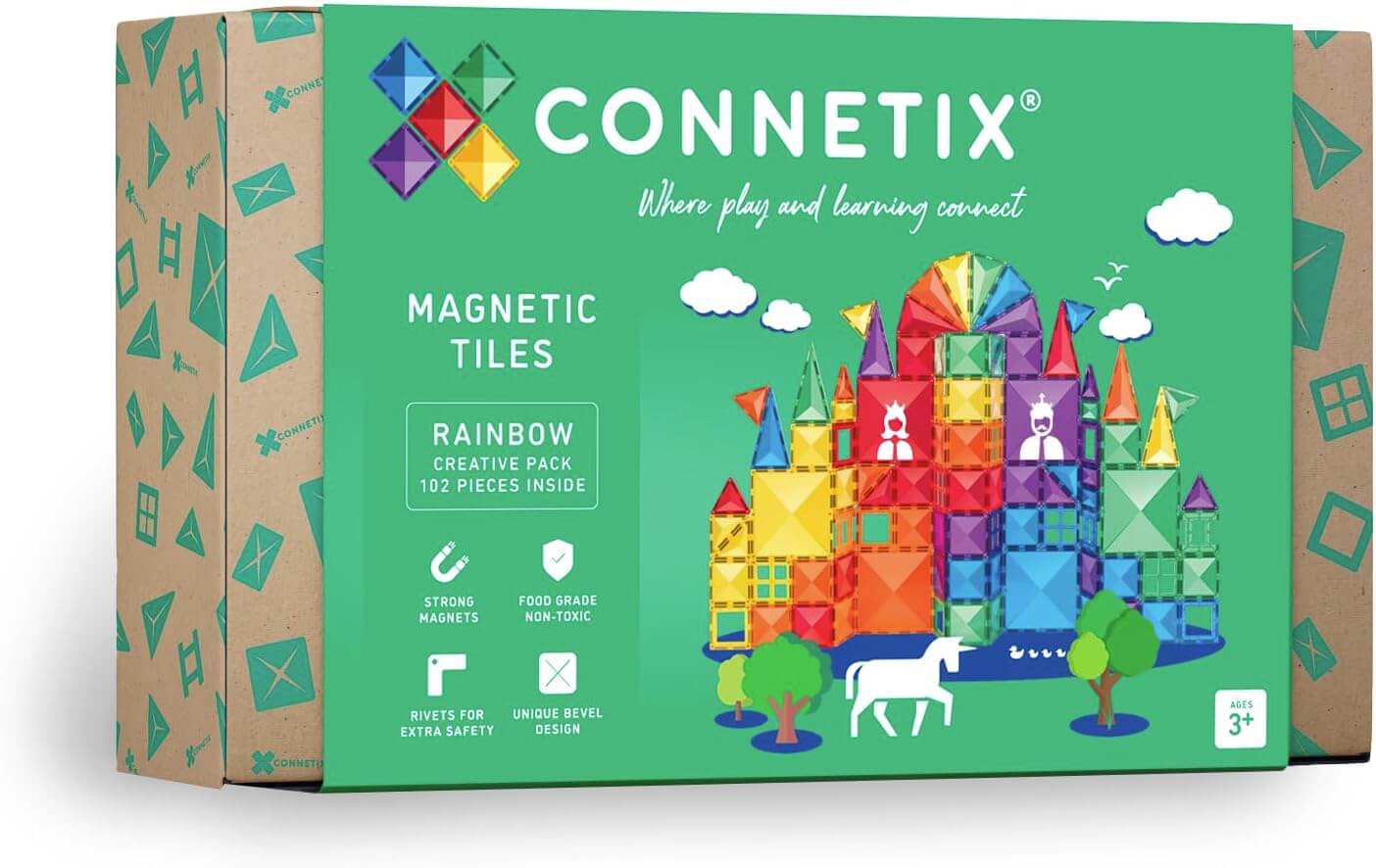
Stepping up within Connetix (retailer-quoted contents): the 102-piece Rainbow Creative Pack lists 36 small and 6 large squares, 12 each of the three triangle types, plus window, door, rectangle and fence pieces. The 120-piece Pastel Creative Pack lists 8 large and 48 small squares, 16 each of the triangle types, 8 each of window and door pieces, and an idea booklet. The pattern: special pieces turn plain boxes into houses and scenes, and large squares rise with set size.
Beyond the starters, the ranges lean different ways. Connetix’s flagship extras are its Ball Run packs (92-pc Rainbow, 106-pc Pastel — retailer-quoted), Pastel range and base plates. Magna-Tiles counters with a wide themed catalogue and the microMAGS small-scale line. Ball-run play: Connetix is the direct route. Broadest add-on catalogue: Magna-Tiles.
How each brand plays, by age and stage
Both brands carry the same official rating — 3+ — and play value changes with the child, not the logo. Read this as stage logic from the published set contents, not test results.
Age 3–4: stacking, matching, first walls. Large squares earn their keep: fewer pieces to align, sturdier first houses. The Connetix starter’s 6 large squares plus window/door pieces give more “house-shaped” results per piece; the Magna-Tiles 100-piece gives more pieces to spread out and rebuild.
Age 5–6: roofs, ramps, multi-room builds. Triangles become the limiting shape — every roof and ramp spends them. The Magna-Tiles 100-piece’s 46 triangles go further; a Connetix household reaches this stage ready for the 102-piece Creative Pack, which triples the starter’s triangle count. This is also where Connetix’s ball-run packs enter as a different kind of play — a structure the ball then tests — rather than just “more tiles.”
Age 7+: bigger engineering, longer projects. Older builders care about total inventory and special pieces, so what matters is that the collection could grow. Both brands guarantee their packs work as one system, so the set bought at 3 is still useful at 8 — if you stayed in one brand.
Price and price-per-piece
The only official price we could verify for this comparison: Magna-Tiles Classic 100-piece at $119.99 on magnatiles.com = $1.20 per piece. Simple, checkable math.
For Connetix, the brand’s storefront served us its Australian region at research time, so we will not state a US list price we couldn’t verify. Do the division yourself: live price ÷ piece count. A 62-piece starter must cost under roughly $74 to beat $1.20 per piece — and per-piece math ignores shape mix (large squares and special pieces are worth more than the raw count suggests).
Budget breakdown: the verified benchmark as your ruler
- Magna-Tiles Classic 100-pc: $119.99 official = $1.20/piece (verified) — the benchmark itself.
- Connetix 62-pc Starter: break-even ≈ $74. Below that live price it beats the benchmark per piece; above it, you are paying a premium — possibly fair, given its 6 large squares and window/door pieces, but pay it knowingly.
- Connetix 102-pc Creative: break-even ≈ $122 (102 × $1.20).
- Connetix 120-pc Pastel Creative: break-even ≈ $144 (120 × $1.20).
Two budget rules: compare sets at the size you intend to end up with, and never compare one brand’s sale price against the other’s list price — run the division on the two live prices in front of you, on the day you buy.
- 62 pieces (retailer-quoted): 6 large squares, 24 small squares
- 6 each of equilateral, right-angle and isosceles triangles
- 6 window pieces, 6 door pieces and an idea booklet
- Non-toxic ABS, BPA/lead/phthalate-free
- Ultrasonic welding + metal rivets; bevelled design
- Official age: 3+
- More large squares in the starter set
- Bevelled, light-refracting tiles
- Windows and doors from the start
- Price not verified from an official US source in this guide
- Magnet type not published by the brand
- No published certification codes — the brand states rigorous international testing
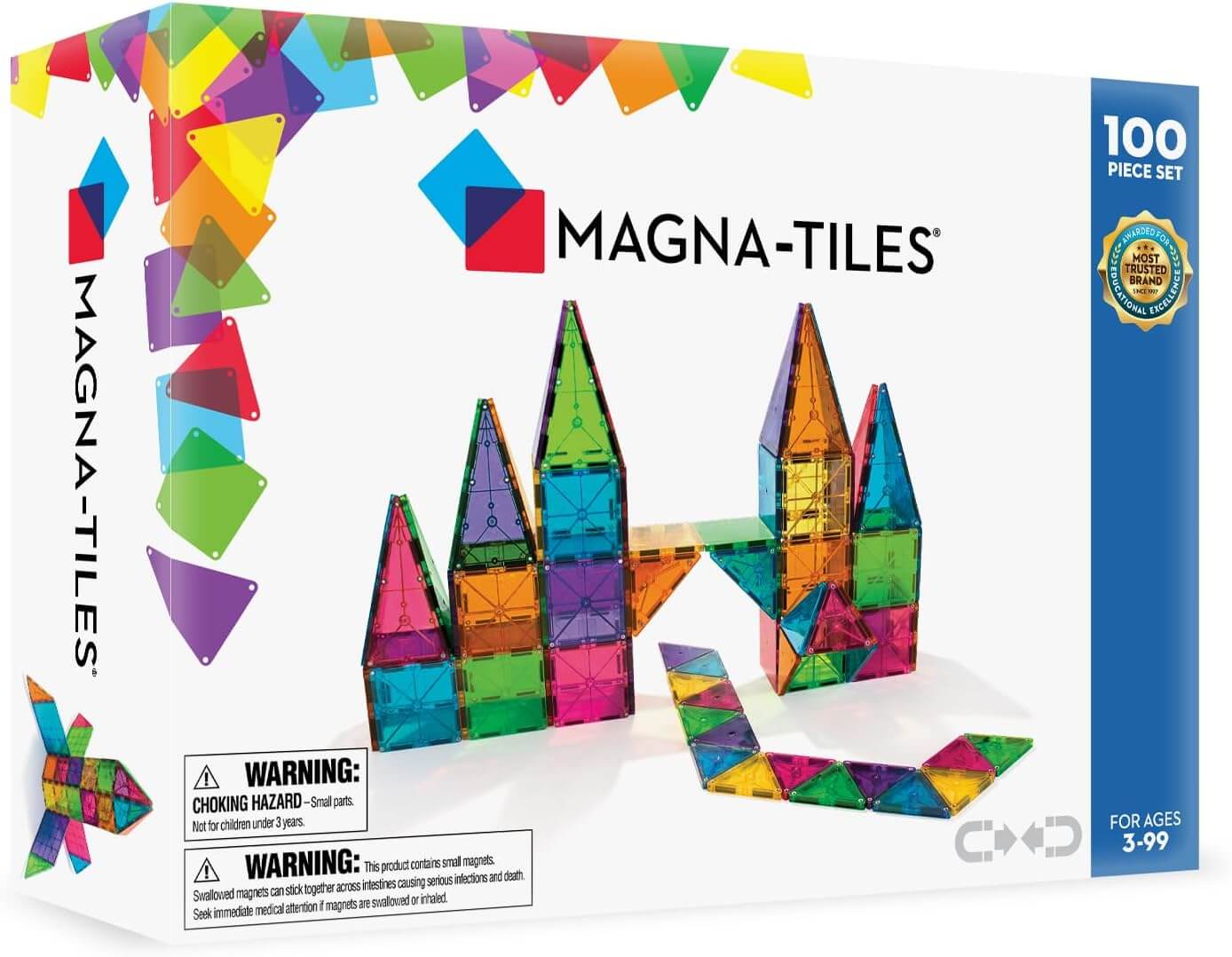
- Most published safety detail — CPSIA compliance stated on the official site
- Big first set — better for two children building at once
- 46 triangles for roofs, ramps and angled builds
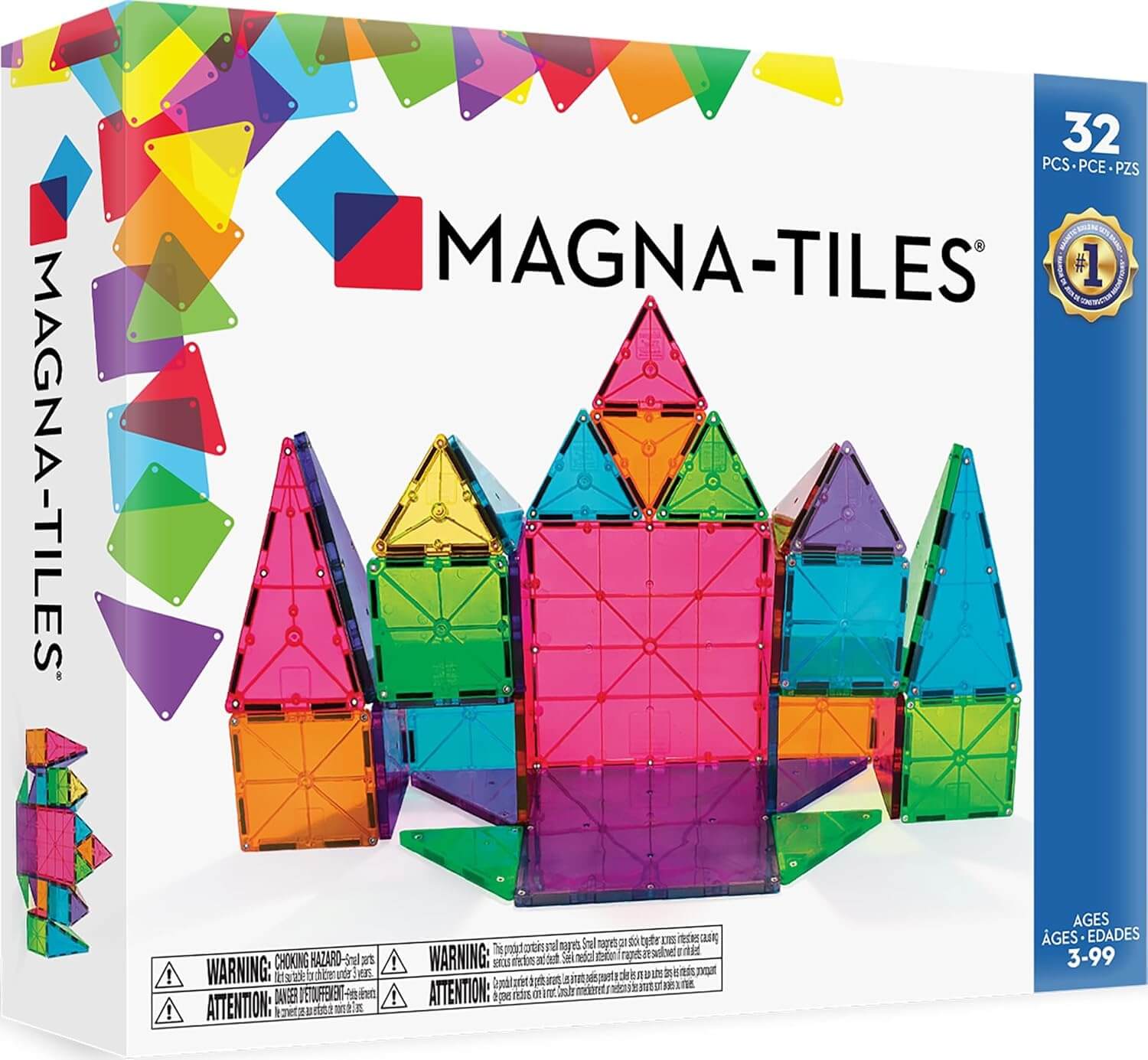
- The 100-piece set is genuinely large — the brand’s compact answer is the 32-piece
- Cross-brand compatibility not officially guaranteed
Compatibility: the question everyone asks
Neither brand officially guarantees that Connetix and Magna-Tiles work together. Magna-Tiles guarantees compatibility only within its own sets. Connetix’s own website makes no claim about Magna-Tiles by name (its retail product copy says “compatible with other leading brands,” which is a marketing line, not a guarantee about a specific rival). Parent reports online conflict — some say the brands connect fine, others say they hold poorly. Because both brands promise full compatibility within their own ranges, the safe advice is simple: pick one brand and grow within it.
The within-brand promises, precisely: Magna-Tiles’ “Always Compatible” covers its own sets as one family; Connetix states every pack “is designed to work together as one connected system,” covering its Rainbow, Pastel, and Ball Run ranges. The cross-brand gap is equally real — plan grandparent gifts around it, because relatives buying the “wrong” brand in good faith is how most mixed collections happen.
Safety (read this whichever brand you choose)
Both brands rate their tiles 3 years and up, and both involve small magnets sealed inside plastic. Swallowed magnets can attract across intestinal walls and are a medical emergency — the one serious risk of this category, for both brands equally. Magna-Tiles’ FAQ directs parents to seek immediate medical attention if a magnet is swallowed; treat that as the rule for any brand.
- Under 3? Buy neither. For toddlers under 3, large non-magnetic bricks such as LEGO DUPLO are the age-appropriate choice (see our magnetic tiles vs LEGO guide).
- Inspect tiles regularly. Cracks are how sealed magnets become accessible. Connetix’s own support replies acknowledge tiles can break if dropped on hard floors or stepped on — retire any damaged tile immediately, from either brand.
- Supervise young builders, and store tiles off the floor in mixed-age homes — Magna-Tiles’ own guidance.
- Documentation differs. Magna-Tiles names CPSIA compliance on its official site; Connetix states “rigorous international testing” without naming standard codes on the pages reviewed. If a specific code matters to you — for a school or daycare — Magna-Tiles is the brand that publishes one.
Care, storage, and small spaces
Magna-Tiles (officially documented): wipe with a damp cloth; never submerge; store dry, off the floor, away from heat; supervision recommended. Off-floor storage does double duty — away from younger siblings, and no stepped-on-tile cracks, this category’s main wear problem.
Connetix: no equivalent official care page found at research time — follow the instructions in your set’s box.
Small spaces: tiles stack flat against themselves, so the difference is set size, not brand — a 100-piece collection needs a bigger box than a 62-piece one. If storage is tight, a smaller starter (Connetix 62-pc, or Magna-Tiles’ Classic 32-pc) plus one planned expansion beats a large set with nowhere to live.
Parent scenarios: which brand, which set
Buying a first set. Magna-Tiles’ own product page calls the Classic 100-piece one of its best first sets — enough for independent builds and sibling play — and points compact-start shoppers to the Classic 32-piece. Connetix’s 62-piece Starter is its launch set, with the idea booklet and house pieces a first builder uses immediately. Verdict: one child, tight space or budget — start at 62 pieces or below. Two children — the 100-piece earns its price on day one.
Buying a gift. A gift has to work inside someone else’s collection, and mixing is not officially guaranteed — first question: “which brand do they already own?” If neither, either starter is a complete gift. If they own one brand, buy only within it: a Ball Run pack for a Connetix household, a themed set for a Magna-Tiles one. When in doubt, ask the parent.
Two-kid households. Piece count is peacekeeping: two builders sharing 62 pieces will run out of squares mid-build. The Magna-Tiles 100-piece is the single-box answer; a Connetix household gets there with the starter plus the 102-piece Creative Pack.
Tight budget. Run the break-even math first: $1.20 per piece is the verified benchmark, and any set priced well above it per piece needs a shape-mix reason. The cheapest legitimate route into either brand is its smaller starter, expanded within the brand.
The ball-run expansion path. Connetix’s clearest structural advantage: dedicated Ball Run packs (92-pc Rainbow, 106-pc Pastel, retailer-quoted) connecting to the same tile system — build-and-test play, not just building. Magna-Tiles’ path is breadth: themed sets and microMAGS. Pick the brand whose second and third purchase you can picture.
You already own one brand. Stay. The guarantees run only within each brand, and both ranges are deep enough to grow a full collection. Sole exception: a separate set in a different space (one brand at home, one at a grandparent’s), where collections never need to merge.
Who should buy which — and who should not
Buy Connetix if: the look matters (bevelled tiles, rainbow and pastel colours); you want more large squares in the starter; ball runs are on your wishlist; you’re starting fresh and can commit to one brand.
Do not buy Connetix if: you need published certification codes before buying (the brand states “rigorous international testing” but names no codes); you need an official US list price or manufacturer warranty terms verifiable on the brand’s own site (neither was, at research time); or you already own Magna-Tiles and planned to mix them.
Buy Magna-Tiles if: published safety documentation matters (named materials, named magnet type, CPSIA stated); you want the biggest first set for siblings; you want a verified $1.20-per-piece benchmark and the widest add-on catalogue.
Do not buy Magna-Tiles if: ball-run play is the main event for your child (Connetix publishes the dedicated range); the bevelled, light-refracting look is a big part of the appeal; or you need a compact first box — the 100-piece is genuinely large, and the brand’s own compact answer is the 32-piece.
Buy neither brand if: your child is under 3 (both are 3+, no exceptions); you already own the other brand and counted on mixing them (not officially guaranteed — sell, swap, or gift the odd set); or your child mainly mouths toys — wait until they’re past that stage.
Frequently asked questions
Which is stronger, Connetix or Magna-Tiles?
Neither brand publishes magnet-strength measurements, so any site claiming a tested winner measured it themselves (or didn’t). Both use sealed, riveted construction and claim strong magnets. We won’t invent a winner.
Can I mix Connetix and Magna-Tiles in one collection?
Not with any official backing. Magna-Tiles guarantees fit only within its own sets; Connetix doesn’t officially confirm Magna-Tiles compatibility either, and parent reports conflict. One brand per household.
Which starter set is better for a 3-year-old?
Both are rated 3+. The Connetix starter’s extra large squares and shaped pieces (windows, doors) make early houses easier; the Magna-Tiles 100-piece gives more total pieces to grow into. Budget decides more than quality — both are legitimate first sets.
Are Connetix tiles BPA-free?
Yes, per the brand: non-toxic ABS, BPA, lead and phthalate-free, ultrasonically welded and riveted. Magna-Tiles states its food-grade MABS is BPA, phthalate and latex-free.
What is the actual difference in plastic — ABS vs MABS?
They’re cousins: MABS is a modified, food-grade variant of ABS. Magna-Tiles publishes the food-grade claim; Connetix publishes “non-toxic ABS, BPA/lead/phthalate-free.” Beyond the labels, neither brand publishes test data we could compare.
Do magnetic tiles break?
They’re built for durability (Magna-Tiles’ lattice; Connetix’s welded, riveted shells), but hard drops and being stepped on can crack them — as Connetix’s support team itself acknowledges. Check tiles regularly and remove damaged ones: a cracked tile is the one real hazard in this category.
What magnets does Connetix use?
The brand does not publish its magnet type — a genuine gap in its documentation, and any review stating one as fact goes beyond the brand’s own pages. Magna-Tiles, by contrast, publishes that its magnets are ceramic (ferrite).
What certifications does each brand have?
Magna-Tiles states CPSIA compliance and US/EU/international regulations on its official site. Connetix states “rigorous international testing” and publishes STEAM and MESH accreditations — educational accreditations, not safety codes; specific standard codes are not named on the Connetix pages reviewed.
Can my 2-year-old play with these if I supervise?
No — for both brands equally. The 3+ rating exists because the tiles contain small magnets; supervision does not change the rating, and Magna-Tiles’ FAQ treats swallowed magnets as an immediate medical emergency. Under 3, choose large non-magnetic bricks instead.
Which set should I buy as a gift if I don’t know what they own?
If the child owns no magnetic tiles yet, either starter is a complete, safe gift. If they already own a set, match that brand — cross-brand compatibility is not officially guaranteed, so a set in the wrong brand may never join their collection properly.
How should I clean and store the tiles?
Magna-Tiles’ official guidance: wipe with a damp cloth (never submerge), store dry, off the floor, away from heat. For Connetix, follow the instructions in the box — we found no official Connetix care page to quote.
Is the bigger set always better value?
Not automatically — run the division. The verified benchmark is $1.20 per piece (Magna-Tiles Classic 100-pc, $119.99 official). A larger set priced far above that is not better value just for being larger. Shape mix is the tiebreaker: large squares and special pieces are worth more than plain small squares in the count.
How this guide was researched
We compared official manufacturer pages (magnatiles.com, connetixtiles.com) and retailer-quoted brand claims for set contents — materials, construction, age ratings, and safety guidance as published on 2026-10-20. No hands-on testing was performed and no specifications invented: where a fact could not be verified (Connetix’s magnet type, official US prices, warranty terms), we say so instead of guessing. Prices change; always check the live price before buying.
Still deciding between tiles and bricks? Our age-by-age guide to Magnetic Tiles vs LEGO for toddlers can help you choose a first buy. Once you have a set at home, try these Magna Tiles build ideas for new things to make. And for older children, see our screen-free STEM toys for 5 year olds.