


Disclosure: As an Amazon Associate I earn from qualifying purchases. Some links on this page may earn us a commission at no extra cost to you.
Quick Verdict
Under 3 years old: buy LEGO DUPLO — it is the only one of the three rated safe for toddlers under 3. For age 3 and up, either system works: DUPLO is simpler and sturdier for beginners, while magnetic tiles (Magna-Tiles, Connetix) build taller, more impressive structures faster. There is no single “best” — it depends on your child’s age.
The short answer
Under 3 years old: buy LEGO DUPLO — it is the only one of the three rated safe for toddlers under 3. For age 3 and up, either system works: DUPLO is simpler and sturdier for beginners, while magnetic tiles (Magna-Tiles, Connetix) build taller, more impressive structures faster. There is no single “best” — it depends on your child’s age.
Limitation: this guide compares manufacturers’ published specifications, age ratings, and safety guidance. We did not physically test these products.
Quick comparison
| LEGO DUPLO | Magna-Tiles | Connetix | |
|---|---|---|---|
| Official age rating | 18 months+ | 3 years+ | 3 years+ |
| Under-3 safe? | Yes — large anti-choke bricks | No — choking hazard warning | No — magnets and small parts warning |
| Material | Not stated on official pages | Food-grade MABS, BPA/phthalate/latex-free | Non-toxic ABS, BPA/lead/phthalate-free (official site) |
| Magnet type | N/A (no magnets) | Ceramic (ferrite) magnets | Not officially confirmed |
| Build style | Stacking bricks | Flat magnetic tiles, fast 3D builds | Flat magnetic tiles, fast 3D builds |
| Starter set size | 80-pc Creative Box (set 10479) | 100-pc Classic set | 60-pc Rainbow starter (retailer-quoted) |
| Official set price seen | $19.99 / 80 pcs (≈$0.25/piece, lego.com US) | $119.99 / 100 pcs (≈$1.20/piece, magnatiles.com) | Not verified |
How each system works in play
LEGO DUPLO: press-together bricks sized for toddler hands
DUPLO is a stacking system: large bricks press together and pull apart — no magnets, no small parts, nothing depending on balance or precision. LEGO states the bricks are made big so there is no swallow risk for teething toddlers, and no harmful-substance exposure if a brick is mouthed.
The starter set used in this guide, the Colorful Creative Box (10479, 80 pieces), shows the play pattern: LEGO’s product page lists easy-to-follow ideas for a flower, whale, duck, plane, rocket, and ice cream, plus “1, 2, 3” number bricks, eye decorations, a propeller, and curved elements. Scale is modest — the largest suggested model, the duck, stands over 3.5 in. (9 cm) tall. LEGO positions the learning value as fine motor skills, focus, counting and colour recognition, and turn-taking in group play.
Honest limits. The age window: LEGO says children typically transition to smaller standard LEGO bricks from age 4. DUPLO is an 18-months-to-4-years system — excellent inside that window, but a purchase to expect graduation from, and its safe chunky format caps build complexity.
- 80 pieces — Colorful Creative Box (set 10479)
- Ages 18 months+
- Large anti-choke bricks — no magnets, no small parts
- ≈ $0.25 per piece (lego.com US)
- Only one of the three rated safe for toddlers under 3
- Simpler and sturdier for beginners
- Large bricks — no swallow risk for teething toddlers
- Children typically transition to standard LEGO from age 4
- Chunky format caps build complexity
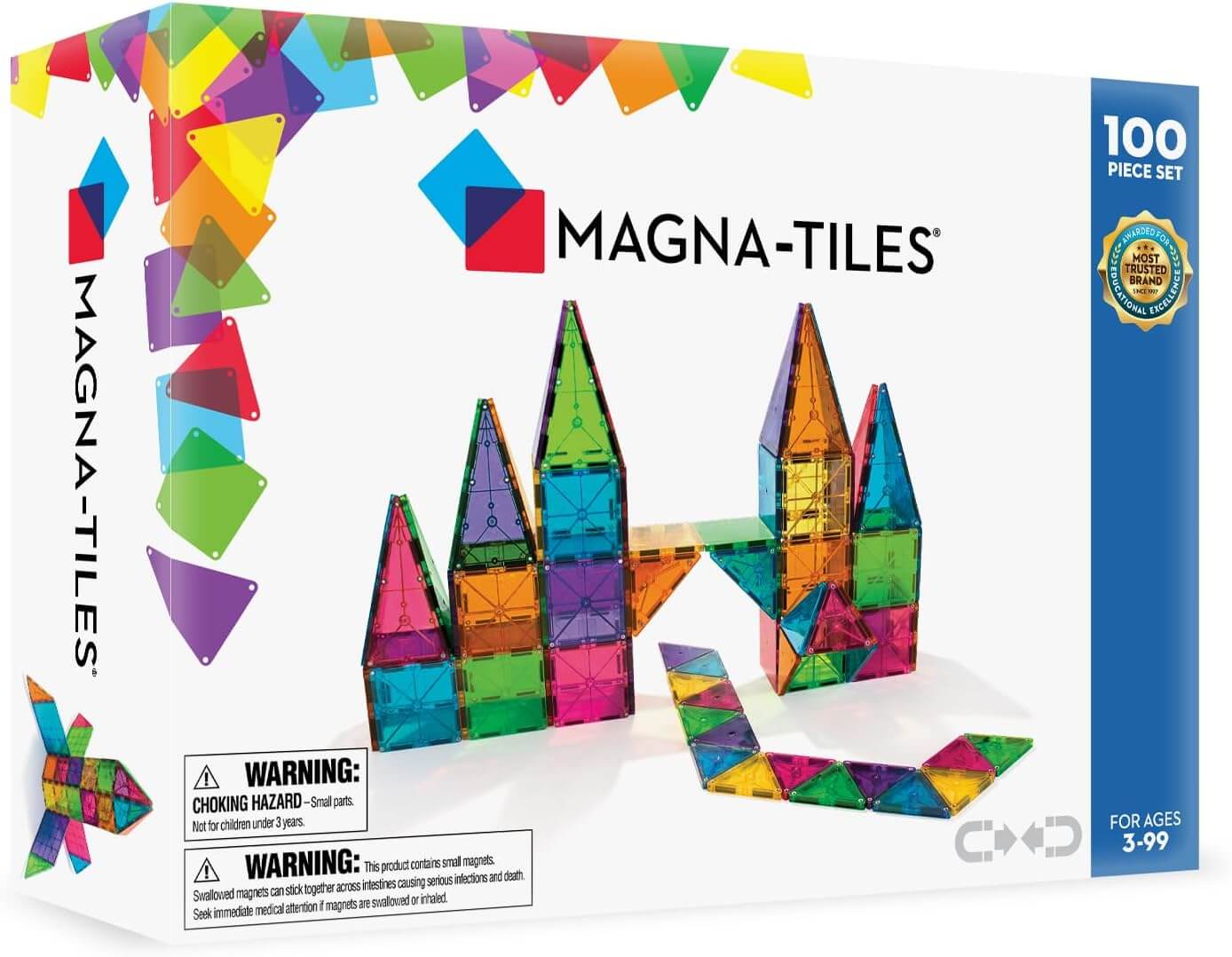
Magna-Tiles: flat magnetic tiles on a 3-inch base
Tiles work the opposite way: flat geometric pieces with edge magnets snap together, so a flat pattern folds up into a 3D structure. Every piece has a 3-inch base. There is deliberately no instruction manual — the brand designs for open-ended play — and its beginner advice is: stacking, then a cube, then a small house or garage. Expect a new 3-year-old to mostly stack and snap pieces flat at first.
The Classic 100-piece contents explain the range: 50 small and 4 large squares do the structural work (walls, floors, cubes); 20 equilateral, 11 right, and 15 isosceles triangles make roofs, ramps, and towers possible. On construction, the brand states: food-grade MABS plastic used since 1997, ceramic (ferrite) magnets, signature rivets, and a crisscross lattice for internal support. Sets carry a 1-year limited warranty (proof of purchase required).
Honest limits. The highest verified price per piece in this guide (budget section below). Tiles are not waterproof and must never be submerged or used in water play. Magnets can lose strength above 480°F, per the brand FAQ — store tiles away from heat. And the safety section below is not optional: a 3+ product with a choking-hazard warning and a real magnet-ingestion risk if a tile is damaged.
- Build taller, more impressive structures faster
- Food-grade MABS, ceramic (ferrite) magnets
- 1-year limited warranty
- Not for under 3s — choking hazard warning
- Highest verified price per piece in this guide (≈$1.20)
- Not waterproof — never submerge
Connetix: magnetic tiles with a bevelled, riveted design
Same style of play — flat tiles combining into 2D patterns and 3D structures — with its own construction. The brand’s official site states: non-toxic ABS plastic, BPA, lead, and phthalate-free; magnets enclosed by ultrasonic welding plus metal rivets; and a signature bevelled design that enhances durability and creates light refractions. The brand describes its magnets as exceptionally strong, supporting tall, large-scale builds — a manufacturer’s claim we have not tested.
The 60-piece Rainbow starter contents (retailer-quoted; the official product page could not be fetched for this set): 6 large and 24 small squares, 6 equilateral, 6 right-angle, and 6 isosceles triangles, 6 window and 6 door pieces, plus an idea booklet. Versus Magna-Tiles: fewer pieces, but windows and doors from the start — aimed at houses, not pure geometry.
Honest limits. Connetix’s official information was thinner in our research: material and construction verified from the brand’s site, but no verifiable consumer price, magnet type, or official care instructions. Where this guide is silent on a Connetix detail, that is why — we do not guess.
- Non-toxic ABS, BPA/lead/phthalate-free (official site)
- Ultrasonic welding + metal rivets; bevelled design
- Ages 3+
- Price not verified in this guide
- Bevelled design creates light refractions
- Windows and doors from the start (retailer-quoted contents)
- Magnets enclosed by ultrasonic welding plus metal rivets
- Not for under 3s — magnets and small parts
- Price not verified; magnet type not officially confirmed
- No official care instructions could be verified
Age-by-age: the decision that matters most
Under 18 months: none of these yet
Even DUPLO’s rating starts at 18 months. Below that, none of the three is rated for your child — soft blocks and stacking cups until then.
18 months to 3 years: DUPLO, no contest
The firmest line in this guide. LEGO rates DUPLO 18 months+, bricks made large against swallowing. Both tile brands say the opposite: Magna-Tiles packaging states “WARNING: CHOKING HAZARD – Small parts. Not for children under 3 years,” its FAQ recommends active supervision and off-floor storage “especially around children under 3,” and Connetix sets are 3+ because they contain magnets and small parts. Swallowed magnets can attract across intestinal walls — a medical emergency. If your child is under 3, the comparison ends here: DUPLO.
Ages 3–4: tiles become age-appropriate; DUPLO still wins for many
Age-appropriate is not the same as best-matched. DUPLO’s chunky bricks forgive imprecise hands — a fallen tower is funny, not frustrating — and LEGO notes DUPLO stays relevant through these years. Tiles at 3 work best with a parent or older sibling building alongside (brand sequence: stacking, cube, small house). Pattern: DUPLO for independent play, tiles for together-play — or wait a year.
Ages 4+: tiles pull ahead; DUPLO phases out
Flat magnetic pieces click into tall towers, castles, and geometric shapes far faster than stacking bricks, and both tile sets’ shape mixes are built for that. Meanwhile LEGO places the typical DUPLO-to-standard-LEGO transition at age 4. Existing DUPLO still works at 4 — and passes down to siblings — but as a new purchase at 4 or 5, DUPLO buys the end of a system’s window while tiles are at the start of theirs: Magna-Tiles rates its sets “3–99 years,” and the open-ended format gives tiles the longer runway.
Full comparison table
| LEGO DUPLO (10479) | Magna-Tiles (Classic 100-pc) | Connetix (Rainbow 60-pc) | |
|---|---|---|---|
| Age rating / reason | 18 months+ — large anti-choke bricks, no swallow risk | 3 years+ — choking-hazard warning; magnets and small parts | 3 years+ — magnets and small parts |
| Material | Not stated on official pages reviewed | Food-grade MABS, BPA/phthalate/latex-free, non-toxic | Non-toxic ABS, BPA/lead/phthalate-free (official site) |
| Magnets | None | Ceramic (ferrite) | Type not officially confirmed |
| Piece size | Chunky bricks; largest suggested model (duck) over 3.5 in. (9 cm) | 3-inch base on every piece | Not officially confirmed |
| Set contents | 80 pcs incl. “1/2/3” number bricks, eye decorations, propeller, curved elements; build ideas included | 100 pcs: 50 small + 4 large squares, 20 equilateral + 11 right + 15 isosceles triangles; no manual (open-ended) | 60 pcs (retailer-quoted): 6 large + 24 small squares, 6+6+6 triangles, 6 windows, 6 doors, idea booklet |
| Safety compliance (as stated) | Fully tested to fulfil child safety standards; drop/heat tests | US/EU/international regulations; CPSIA compliant; brand states 25+ years, no recall | “Safety tested for 3+” (official site); cert codes not confirmed |
| Construction | Solid press-together bricks | Rivets + crisscross lattice internal support | Ultrasonic welding + metal rivets; bevelled design |
| Cleaning | Not officially documented; LEGO advises checking for broken parts before use | Wipe with damp cloth or mild non-abrasive cleaner; never submerge/soak; not waterproof | Not officially documented |
| Storage | Bin or bag | Dry, away from heat, off the floor — especially around under-3s | Not officially documented |
| Longevity | ~18 months–4 years; transition to standard LEGO at ~4 (LEGO) | Rated 3–99 years; 1-year warranty; same MABS since 1997 (brand) | Brand pitches tiles as made to last, growing with the child; warranty not verified |
| Verified official price | $19.99 (lego.com US) | $119.99 (magnatiles.com) | Not verified |
| Price per piece (verified prices only) | ≈$0.25 | ≈$1.20 | Cannot be calculated — price unverified |
| Cross-brand compatibility | N/A | Guaranteed only within MAGNA-TILES sets | Retailers claim “other leading brands”; neither brand officially confirms Connetix↔Magna-Tiles fit |
Safety, in full
DUPLO’s safety is structural: no magnets, no small parts, bricks sized against swallowing, and no harmful-substance exposure if a brick is mouthed (LEGO). LEGO also advises checking pieces before use — broken parts can present a choking hazard or sharp edges.
Magnetic tiles carry two different risks. First, the firm under-3 choking cutoff on the packaging — why this guide never recommends tiles for toddlers. Second, magnet ingestion at any age: if a tile cracks and a magnet is swallowed — especially more than one, or a magnet plus metal — magnets can attract across intestinal walls. Magna-Tiles’ FAQ is unambiguous: seek medical treatment immediately and call 9-1-1 if a child inhales or swallows any magnet. Health Canada has issued its own small-magnet warning. In practice: supervise tile play actively, inspect tiles regularly, remove damaged ones, and store tiles off the floor in any home with an under-3. A third-party testing site has also reported trace readings in tile rivets — a third-party claim, not a recall or regulator finding; Magna-Tiles states CPSIA compliance including lead regulations.
Parent scenarios
Buying a gift. Age is the whole decision, and guessing wrong has a safety dimension. Under 3: DUPLO — a tile set for a 2-year-old is a hazard in a box. Ages 3–4: DUPLO is the lower-risk gift (independent play); tiles if a parent or older sibling will join in. Age 4+: tiles. If you don’t know the child’s exact age, ask.
Two children of different ages. If the younger child is under 3 and mouthing, the older child’s tiles become a household rule: Magna-Tiles’ guidance — off the floor, especially around under-3s — must happen every session, meaning table or separated-space play, packed away afterwards, while DUPLO safely lives in the shared play area. Many families end up with both for this reason. DUPLO passes down to a baby sibling safely; tiles never pass down early.
Small spaces. Judge by storage behaviour, not box size. DUPLO’s 80 chunky bricks tip into a bin in seconds but occupy more room piece-for-piece. Flat tiles stack densely in one bin, but carry storage rules (dry, off the floor, away from heat) and a damage-inspection habit. Small home with an under-3: DUPLO wins outright. Small home, older children only: tiles’ flat packing is efficient.
Tight budget. For an under-3 there is no budget case for tiles, because there is no safety case — and DUPLO is also the cheapest verified entry here. For a 3+ child, ask which purchase is still used in two years: tiles cost more per piece and stay in use longer; DUPLO costs less, with a shorter remaining window the older the child. Nearing 4, tile money is better aimed at tiles — unless a younger sibling will inherit the DUPLO, restoring its value.
Budget breakdown — verified prices only, maths shown
DUPLO Creative Box 10479: $19.99 ÷ 80 pieces = ≈$0.25 per piece (lego.com US).
Magna-Tiles Classic 100-pc: $119.99 ÷ 100 pieces = ≈$1.20 per piece (magnatiles.com).
Connetix Rainbow 60-pc starter: price not verified from an official or reliable source, so no per-piece figure is given; compare its live price against its 60-piece count when you shop.
Per piece, Magna-Tiles costs 4.8× DUPLO — flipped around, $119.99 equals about six DUPLO Creative Boxes (6 × $19.99 = $119.94; 480 pieces) at list prices. But pieces are not interchangeable units of value: a tile’s price buys a ceramic magnet in a riveted, lattice-reinforced housing with a 1-year warranty; a brick is solid plastic. Use per-piece cost to grasp the scale of the commitment, not as a league table.
Care, storage, and cleaning — only where brands document it
Magna-Tiles (official FAQ). Wipe gently with a damp cloth or mild, non-abrasive cleaner; avoid harsh chemicals; never submerge or soak. Not waterproof — never use in pools or baths; if water gets inside, stand the tile upright to drain and dry (trapped water can lead to mould, mildew, or rust). Store dry, away from heat, off the floor — especially around under-3s. Inspect regularly; never let children play with damaged tiles.
LEGO DUPLO. LEGO’s guidance advises checking toys before use and watching for broken parts. No official DUPLO cleaning instructions were found in the sources reviewed, so none are offered here.
Connetix. No official care or storage instructions could be verified from the manufacturer’s site. Retailer listings describe sealed, riveted construction — a construction claim, not a care routine. Follow the instructions in the box.
Cross-brand compatibility (repeated because it decides purchases). Magna-Tiles guarantees compatibility only within its own sets. Connetix retailers claim compatibility with “other leading brands,” but neither brand officially confirms the two connect reliably. Pick one tile system per household and expand within it.
Who should buy which
Buy LEGO DUPLO if: your child is under 3 (the only safe choice of the three); you want the simplest, most forgiving first building toy; younger siblings mouth everything; or your budget is tight and your child is in the 18-months-to-3 window, where its verified per-piece price is a fraction of the tiles’.
Buy magnetic tiles (Magna-Tiles or Connetix) if: your child is 3+ and ready for taller, more creative builds; an adult or older sibling will build alongside a 3-year-old; you want a toy still interesting past age 5, not one with a graduation date around 4; and you can commit to the storage and inspection routine safety requires.
Buy neither yet if: your child is under 18 months — even DUPLO’s rating starts there; soft blocks and stacking cups are the right call. Also buy neither if an under-3 could reach the tiles: waiting is a legitimate answer.
Frequently asked questions
Are magnetic tiles safe for toddlers?
Only for age 3 and up, with supervision. They carry a formal choking-hazard warning for under-3s, and swallowed magnets are a medical emergency. For under-3s, DUPLO is the safe pick.
What should I buy for a 2-year-old?
DUPLO — the only system here rated below 3 (18 months+), with bricks made large to remove the swallow risk. The 80-piece Creative Box is a complete starter.
My child just turned 3 — tiles or DUPLO?
Both are age-appropriate; the decider is play style. Solo play favours DUPLO’s forgiving bricks. If an adult or older sibling builds alongside, tiles work now — Magna-Tiles’ beginner path is stacking, then a cube, then a small house. Waiting until 4 is also reasonable.
Magna-Tiles vs Connetix — which is better?
Verified differences: Magna-Tiles publishes its material (food-grade MABS), ceramic magnet type, 3-inch base, full contents, 1-year warranty, and official $119.99 price. Connetix’s official site confirms non-toxic ABS (BPA/lead/phthalate-free), ultrasonic welding with rivets, and a bevelled design; its contents are retailer-quoted and price unverified here. Neither brand officially confirms cross-brand compatibility.
Can I mix magnetic tile brands?
Not reliably. Magna-Tiles guarantees fit only within its own sets; retailers say Connetix works with “other leading brands,” but no official source confirms the two brands connect. Stick to one brand per household.
How many pieces does a child need to start?
Judge against the manufacturers’ own starter sets: 80 (DUPLO), 100 (Magna-Tiles), 60 (Connetix, retailer-quoted), each balanced for first builds. Far fewer tiles leaves too few squares to close a 3D structure.
Do magnetic tiles break? What if one does?
Inspect tiles regularly for cracks — a damaged tile is how magnets become accessible. Magna-Tiles advises: never let children play with damaged tiles, contact the brand, and note the 1-year warranty (proof of purchase required). LEGO’s equivalent: check toys before use.
Can magnetic tiles go in the bath or under a tap?
Magna-Tiles says no: not waterproof; never submerge, hold under running water, or use in pools or baths. Wipe with a damp cloth; if water gets inside, stand the tile upright to drain and air-dry. Connetix water guidance could not be officially verified — apply the same caution.
What if my child swallows a magnet?
An emergency. Magna-Tiles’ FAQ: seek medical treatment immediately and call 9-1-1 if a child inhales or swallows any magnet. Separately swallowed magnets can attract across intestinal walls — not a wait-and-see situation.
I have a baby and a 4-year-old. Can the older child still have tiles?
Yes, with the brand’s rules enforced: active supervision, tiles stored off the floor around under-3s, packed away after play — tile play where the baby cannot crawl, while DUPLO stays out in shared areas.
Will my child outgrow DUPLO quickly?
LEGO designs DUPLO for 1½ years+ and states children typically transition to standard LEGO bricks from age 4 — roughly a two-to-two-and-a-half-year window from 18 months. A younger sibling inheriting the bricks extends the value.
Why do tiles cost so much more per piece than DUPLO?
The verified gap is ≈$0.25 per DUPLO brick vs ≈$1.20 per Magna-Tiles tile at official list prices. In specification terms, the tile’s price corresponds to a ceramic magnet in a riveted, lattice-reinforced housing with a 1-year warranty, versus a solid plastic brick. Whether it is worth it turns on the age-window maths above — and for under-3s it is moot: tiles are not an option at any price.
How this guide was researched
We compared official manufacturer pages (lego.com, magnatiles.com, connetixtiles.com) and retailer-quoted claims for Connetix set contents — age ratings, materials, safety guidance, contents, and prices, re-verified on 2026-10-20. No hands-on testing was performed and no specifications invented: where a fact could not be verified (Connetix pricing, DUPLO material, cross-brand compatibility), we say so instead of guessing. Prices change; check the live price before buying.
For a head-to-head look at the two tile brands, read our Connetix vs Magna-Tiles comparison. Once your tiles are home, try these Magna Tiles build ideas for fresh ways to play. And if you are shopping for a younger toddler, see our guide to Montessori toys for 2 year olds.